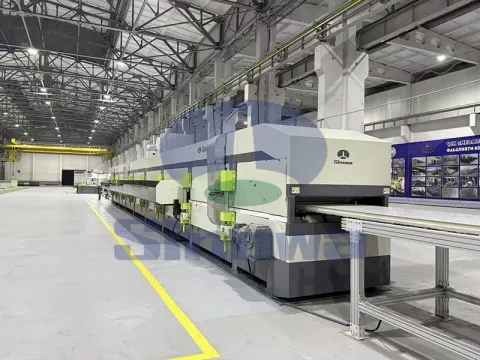
Continuous PU Sandwich Panel Line
Publication Date: Sep 28, 2026
Continuous PU sandwich panel line, fully automatic turnkey machine for continuous PU/PIR insulated roof & wall panels. Stable foaming, precise cutting, ideal for cold storage, factory buildings, clean room insulation panels. High speed, energy saving, reliable sandwich panel production equipment.
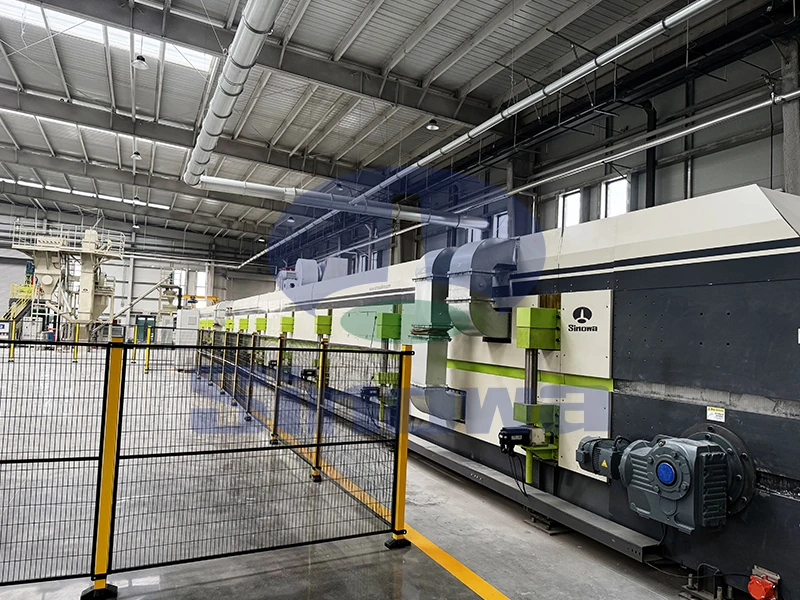
The continuous PU sandwich panel line is a fully automated integrated production system for composite insulation panels. It completes unwinding, foaming, lamination, curing and cutting in one continuous flow, delivering high-consistency, high-performance panels for diverse construction and industrial applications.
Basic Operational Principle of the Production Line
The continuous PU sandwich panel line operates based on integrated chemical foaming and mechanical composite molding principles, realizing uninterrupted mass production of polyurethane sandwich panels. The core working logic lies in the precise coordination of mechanical transmission, chemical reaction control and constant temperature molding technology. Different from intermittent batch production equipment, this continuous line adopts a linear assembly structure, where each production link is closely connected and synchronously operated. The whole process starts with the feeding of upper and lower surface materials, followed by quantitative mixing and high-pressure injection of polyurethane raw materials. The liquid PU materials undergo rapid chemical foaming between two layers of surface materials, then form a tight composite structure through mechanical pressing and constant temperature curing. All operational parameters including transmission speed, material mixing ratio, foaming pressure and curing temperature are dynamically matched. This systematic coordination ensures that the foaming reaction is fully completed and the composite bonding is firm, avoiding uneven foaming, incomplete curing or inconsistent panel thickness that often occur in traditional production modes. The overall principle focuses on synchronous linkage of multiple processes to achieve stable, efficient and standardized panel molding.
Overall Structural Composition of the Production Line
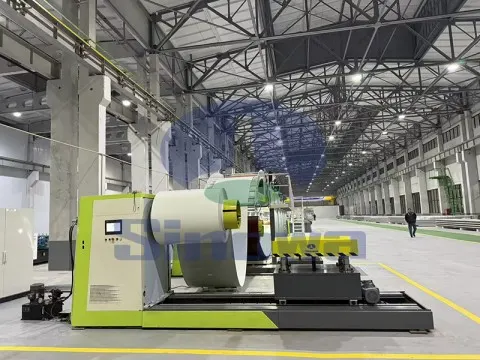
A complete continuous PU sandwich panel production line consists of multiple independent and interlocking functional modules, each undertaking exclusive production tasks to form a closed-loop automated production system. The main structural units include surface material unwinding module, surface pretreatment module, roll forming module, PU raw material metering and mixing module, high-pressure foaming and pouring module, double-belt lamination module, constant temperature curing module, fixed-length cutting module and automatic stacking module. Each module is equipped with independent precision control components and transmission devices, realizing modularized and standardized operation. The unwinding module steadily releases coiled surface materials to ensure continuous material supply without interruption. The pretreatment module handles surface impurities and improves material adhesion. The roll forming module shapes flat surface materials into specified profiles to meet panel structural requirements. The core foaming module controls raw material proportioning and injection accuracy, while the lamination and curing modules determine the final structural stability of panels. All modules are connected by synchronous transmission systems, ensuring consistent operating speed and coordinated production rhythm, which lays a solid foundation for continuous and stable production.
Surface Material Pretreatment and Forming Process
Surface material pretreatment and forming are the preliminary key processes that directly affect the flatness, bonding performance and appearance quality of finished PU sandwich panels. Before formal composite molding, the coiled surface materials are continuously sent to the pretreatment unit, where professional cleaning and surface activation treatments are carried out. The cleaning system removes surface dust, oil stains and residual impurities generated during material storage and transportation, eliminating barrier factors that may weaken subsequent bonding effects. After cleaning, the surface activation process appropriately adjusts the surface roughness of materials, effectively enhancing the adhesion between surface materials and PU foam core layers. Following pretreatment, materials enter the roll forming unit composed of multiple groups of precision roller sets. Through gradual rolling and shaping by rollers with different groove specifications, flat sheet materials are processed into standardized profiles with fixed edge structures and flat surfaces. The roller gap and pressing force can be finely adjusted according to different panel specifications, ensuring uniform forming size and smooth surface without wrinkles or deformation. This integrated pretreatment and forming process provides high-quality surface substrates for subsequent foaming and composite molding, avoiding defective problems such as degumming and uneven panel surfaces in finished products.
PU Raw Material Metering and Mixing Technology
Precise metering and uniform mixing of PU raw materials are the core links determining the thermal insulation performance, structural density and mechanical stability of sandwich panel core layers. Polyurethane foam is formed by the chemical cross-linking reaction of multiple raw material components, and the proportion of each component directly affects the foaming effect and core layer quality. The continuous production line is equipped with high-precision automatic metering equipment, which can accurately control the feeding flow rate and proportion of each raw material in real time. Compared with traditional manual proportioning or semi-automatic equipment, this system features higher metering accuracy and stronger stability, effectively avoiding performance differences caused by raw material ratio deviation. After precise metering, all raw materials are sent to a high-speed mixing chamber for full stirring and homogenization. The professional mixing structure ensures that various components are evenly fused at the molecular level, laying a foundation for uniform foaming. The mixed liquid materials are immediately transported to the injection unit for continuous pouring, preventing material stratification or premature reaction caused by long-term standing. This closed-loop metering and mixing process ensures that each batch of PU foam has consistent density, uniform pore structure and stable chemical properties, guaranteeing the overall quality uniformity of finished panels.
Continuous Foaming and Composite Lamination Process
Continuous foaming and composite lamination are the core molding processes of PU sandwich panels, completing the integration of surface materials and foam core layers. The uniformly mixed PU liquid is evenly poured on the surface of the lower layer substrate through a high-pressure injection system, with controllable pouring width and thickness to match different panel specifications. Immediately after pouring, the upper and lower surface materials synchronously enter the double-belt composite pressing device. The precise gap control of the double-belt structure accurately limits the overall thickness of the panel, ensuring consistent dimensional accuracy of each finished product. In the closed pressing space, the PU liquid undergoes rapid physical foaming and chemical cross-linking reaction, gradually expanding to fill the gap between the upper and lower surface materials. With the continuous advance of the transmission belt, the foam structure preliminarily sets and forms a tight composite bond with the surface materials. The lamination process adopts constant pressure control mode, with stable pressing force throughout the whole process, which can effectively avoid bubble gaps, local hollowing or insufficient bonding between the core layer and surface materials. The synchronous operation of foaming and lamination realizes one-step composite molding, greatly improving production efficiency while ensuring the integral structural tightness of the sandwich panel.
Constant Temperature Curing and Structural Stabilization
Constant temperature curing is a key process to stabilize the internal structure and comprehensive performance of initially molded PU sandwich panels. After composite lamination, the semi-finished panels are continuously sent to an intelligent constant temperature curing channel with segmented temperature control function. The internal space of the curing channel forms a reasonable gradient temperature environment, with gradual temperature rise in the front section, constant temperature maintenance in the middle section and slow cooling in the rear section. In the early curing stage, moderate temperature promotes continuous foaming and molecular cross-linking reaction of residual PU raw materials, making the internal foam pore structure denser and more uniform. The middle constant temperature stage fully completes the chemical reaction of polyurethane materials, realizing solid bonding between the core layer and surface materials. The later slow cooling stage relieves the internal stress generated during high-temperature molding, preventing panel deformation and warping. The segmented temperature control mode avoids the defect of fast surface curing and incomplete internal reaction caused by single high temperature. After sufficient curing, the internal structure of the panel tends to be stable, with improved hardness, toughness and bonding strength, and the comprehensive physical performance of the panel reaches the preset standard.
Precision Cutting and Post-Processing Operations
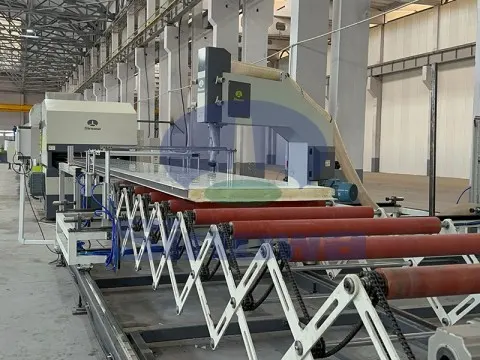
Precision cutting and post-processing operations determine the dimensional accuracy and finished product appearance of PU sandwich panels. After curing and shaping, the continuously molded long strip panels are transmitted to the fixed-length cutting unit. The cutting system adopts intelligent automatic positioning and induction technology, which can accurately identify the preset panel length specifications and complete fixed-size cutting in real time with the operation of the production line. Equipped with high-speed precision cutting tools, the unit realizes flat and smooth cutting sections without burrs, cracks or edge warping, effectively ensuring the dimensional consistency of each finished panel. The cutting speed is fully synchronized with the production line transmission speed, realizing uninterrupted online cutting and avoiding production stagnation. After cutting, the panels enter the post-processing link, including surface finishing, edge trimming and residual material cleaning. This process removes tiny burrs and residual foam on the panel surface and edges, further optimizing the appearance quality of finished products. The whole cutting and post-processing process is fully automated, reducing manual intervention errors, improving product qualification rate, and ensuring that each panel has accurate size and neat appearance.
Automatic Stacking and Finished Product Output
Automatic stacking and finished product output are the final links of the continuous PU sandwich panel manufacturing line, realizing orderly collection and standardized output of finished products. After post-processing, qualified panels are stably transmitted to the automatic stacking platform through the conveying system. The stacking device adopts intelligent induction and mechanical positioning technology, which can automatically adjust the stacking position and sequence according to panel specifications. It realizes neat and orderly stacking of panels, with consistent stacking spacing and flat placement, effectively avoiding panel scratching, collision damage or irregular stacking. The stacking speed is automatically matched with the front-end production rhythm, realizing seamless connection of the whole production process without material accumulation or production delay. After the stacking quantity reaches the preset standard, the system automatically prompts for material transfer, and the stacked finished panels can be directly transported to the storage area or packaging link. The fully automatic stacking mode replaces traditional manual stacking, greatly improving production efficiency, reducing labor costs, and effectively protecting the surface quality of finished panels. This link completes the whole closed-loop production process from raw material feeding to finished product output.
Core Performance Advantages of Continuous Production Mode
Compared with traditional intermittent panel production equipment, the continuous PU sandwich panel line has prominent core advantages in production efficiency, product quality and operational stability. In terms of production efficiency, the fully continuous linear operation mode eliminates frequent equipment start-stop and material switching links, realizing uninterrupted mass production, with a significant increase in hourly output compared with intermittent equipment. In terms of product quality, the whole-process synchronous parameter control ensures that the raw material ratio, foaming degree, curing effect and dimensional specification of each panel remain highly consistent, effectively solving the problems of unstable product performance and large quality difference in batch production. In terms of operational stability, the modular integrated structure and intelligent control system reduce manual operation links, lower the failure rate caused by human error, and ensure long-term stable operation of equipment. In addition, the continuous production mode optimizes the material utilization rate, reduces raw material waste in the start-stop stage of intermittent production, and achieves more economical production benefits. Meanwhile, the produced panels have denser foam structure, stronger bonding firmness and better overall flatness, with more stable comprehensive mechanical and thermal insulation properties.
Main Application Scenarios and Industry Value
PU sandwich panels produced by continuous production lines are widely applied in multiple fields such as industrial construction, commercial buildings, cold chain logistics and special environmental engineering, with high industry application value. In industrial factory buildings and warehouse construction, the panels serve as wall and roof enclosure materials, relying on excellent thermal insulation, heat preservation and weather resistance to reduce building energy consumption and improve indoor environmental stability. In commercial buildings such as shopping malls and exhibition halls, their lightweight and high-strength characteristics can reduce building load, while the diverse and neat appearance meets architectural aesthetic requirements. In cold chain warehouses and fresh-keeping logistics facilities, the efficient thermal insulation performance of PU core layers effectively locks indoor temperature, reduces refrigeration energy consumption and ensures the stable operation of cold storage systems. In addition, the panels are also applicable to temporary engineering buildings, purification workshops and windproof and thermal insulation enclosure projects. The continuous production line’s ability of high-efficiency and standardized production provides a large number of high-quality composite panel products for the construction and thermal insulation industries, promotes the upgrading of composite material production technology, and supports the high-quality development of energy-saving building and industrial thermal insulation fields.
Gallery of Continuous PU Sandwich Panel Line
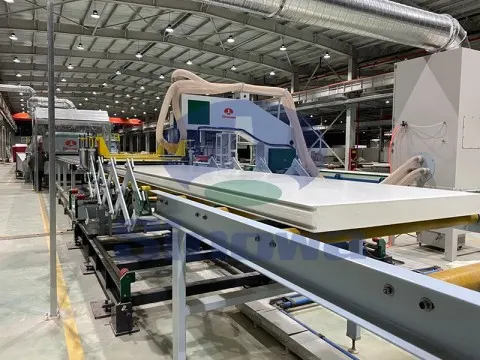
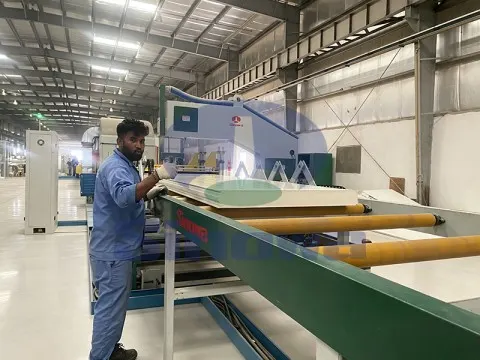
Tags: continuous pu sandwich panel line, continuous pu sandwich panel line manufacturer, continuous pu sandwich panel line supplier, china continuous pu sandwich panel line, continuous pu sandwich panel line for sale
Related Informations
Can One Foaming Machine Serve Both Continuous And Discontinuous PU Sandwich Panel Line?
How To Improve The Production Efficiency Of The Continuous PU Sandwich Panel Production Line?