How To Solve Panel Delamination Problems Of Continuous PIR Sandwich Panel Production Line?
Publication Date: Oct 14, 2026
Continuous PIR sandwich panel lines frequently lose the bond between the metal skins and the rigid foam core, producing panels that separate under bending, lifting, or service loads.
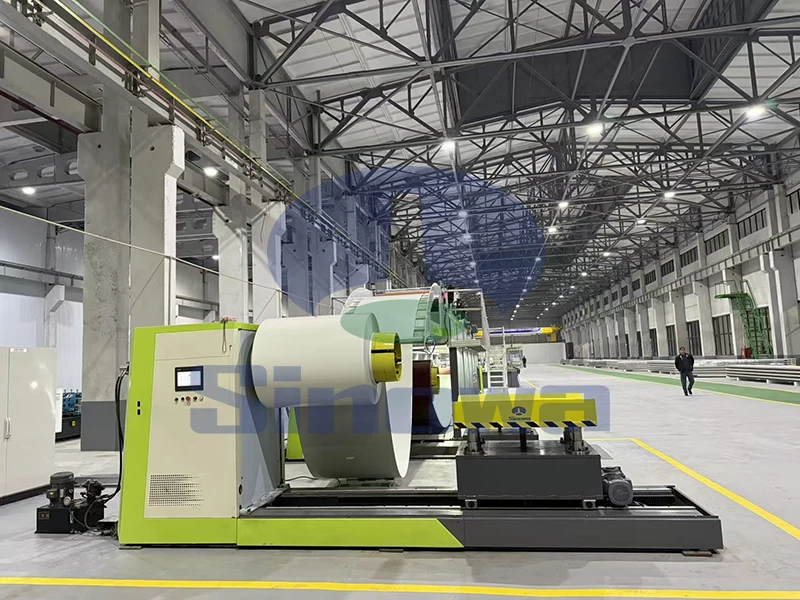
To solve delamination you first have to know where the bond is actually failing. A PIR panel is held together by three layers meeting at a narrow interface: the coated steel skin, a thin primer or protective film on that skin, and the integral skin of the rising foam. When a panel peels apart, the break rarely travels through strong bulk foam. It usually runs along the skin surface, lifts the primer layer, or tears a weak, undercured foam skin. You can tell which case you have by looking at the peeled face. If the metal side is shiny and free of foam, the foam never wetted it properly. If chunks of foam remain stuck to the skin but the break is uneven, the bond itself was weak. If the foam skin splits cleanly while the core stays attached, the chemical reaction or mixing was off. Each of these failure modes points to a different section of the line, so cutting and inspecting delaminated panels is always the first diagnostic step rather than blindly adjusting chemistry.
The most common source of interfacial failure is the condition of the incoming metal skin. Pre-painted steel coils arrive with drawing oils, passivation residues, protective film adhesive, and sometimes dust or finger grease from handling. Even a thin layer of oil prevents the liquid reacting mixture from spreading into intimate contact with the coating, and foam can only bond where it actually wets the surface. Operators can check this with a simple water-break test: wipe a small area of the cleaned skin, pour on a little clean water, and watch whether the film beads up or sheets out. Beading means the surface is still contaminated. Storage also matters. Coils left in humid conditions develop surface condensation that sits between the film and the steel when the line starts, and that water becomes a release layer. Routine practice is to verify surface cleanliness at the uncoiler, keep coils in a dry, conditioned area, remove protective film immediately before lamination, and inspect the primer coat for scratches, orange peel, or cured-on dust that would mechanically reduce contact.
When the skin is clean but adhesion still fails, the next place to look is the chemical system itself. PIR chemistry depends on a carefully balanced ratio of isocyanate to polyol plus catalysts, blowing agents, and optional crosslinkers. If the isocyanate stream is slightly low, the foam forms with incomplete polymerization, a soft outer skin, and almost no chemical grip on the primer. If it is too high, trimerization races ahead, the skin sets before the liquid has spread, and the panel delaminates in patches. Water content in the polyol component is another silent enemy. Water in the polyol reacts with isocyanate to produce carbon dioxide and urea, shifting the intended foam morphology and making an overly brittle, dusty skin that releases from the metal. Blowing agent choice and temperature also affect the way the skin forms; an over-loaded or too-cold gas can burst cell walls at the interface. The practical response is to verify daily stream ratios with calibrated flow meters, sample both components into a beaker and examine the rise profile, check moisture content of incoming drums, and compare against the reference batch the line was originally commissioned with.
Even with the right chemistry, poor mixing produces weak panels that delaminate in streaks. The mixing head on a continuous PIR line is an abrasive environment: isocyanate and polyol meet at high pressure, impinge, and are flung out by a high-speed impeller. Over time the nozzles wear, the chamber corners build up cured residue, the impeller loses balance, and the two streams stop meeting evenly. The result is visible as uneven cell structure, color streaks, soft bands along the panel, or foam that cures on one side of the head and is wet on the other. Any of these bands corresponds to an area where the foam skin never developed properly, and those bands peel apart first. Operators should inspect the head on schedule, run a clean solvent shot between color or formulation changes, replace wear parts at the recommended interval rather than waiting for visible defects, and verify impeller speed and hydraulic pressure match the recipe book. A weekly check of the pour pattern on a test strip of paper — showing an even, fan-shaped, continuous ribbon — catches most mixing problems before they reach full production.
Once the chemistry is mixed correctly, the way it is deposited onto the bottom skin decides how well it wets the surface. The traverse arm sweeps back and forth across the coil, laying a serpentine bead that must spread under its own rise pressure and under the top skin that follows. If the pour rate is too low relative to line speed, the bead leaves gaps; the top belt closes on bare bottom skin, and that area becomes a permanent delamination line. If the traverse is too slow, overlapping beads pile up in the center, starving the edges and producing weak bonds near the panel shoulders. Temperature of the poured mixture matters too: cold polyol and isocyanate have high viscosity, so the bead stays tight and does not wet the metal before skin formation freezes it. Adjustments here are mechanical as much as chemical — confirm traverse frequency matches line speed, confirm pour weight per square meter, verify nozzle angle so the bead strikes the bottom skin at the correct height, and watch the foam just before the top skin closes to ensure it has spread into a uniform continuous layer with dry-looking edges rather than wet beads.
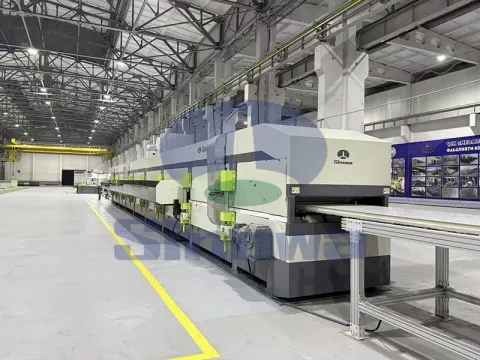
The double-belt laminator then decides whether that bond survives the critical minutes of rise. The bottom plate preheats the skin so the liquid mixture does not shock-freeze on contact, and the top belt controls the heat that drives the exothermic cure. If belt zones are too cold, the foam skin forms slowly, viscosity rises before it can grip the primer, and panels peel apart as soon as they leave the line. If zones are too hot, the surface scorches, the integral skin turns brittle and powdery, and the bond fractures internally under small bending loads. Line speed has to match the chemistry's cure time: faster lines need hotter belts or faster catalysts, slower lines need cooler belts or slower reactivity. Operators should log each zone temperature, compare against the recipe for that panel thickness, and watch the panel exiting the cut-off saw for softness — a panel that bows or squeaks when lifted is not fully cured and will likely delaminate days later as residual reaction continues inside.
Moisture, whether in raw materials or in the plant air, compounds every one of these problems. Polyol blends are hygroscopic; drums left open in a humid workshop pull in water within hours, and that water changes blowing behavior and weakens the interface. Isocyanate drums are sensitive too: any water introduced reacts to form carbon dioxide and urea, reducing the active NCO available for the bond. Ambient humidity in the lamination area condenses on cold coils that have just been uncoiled, leaving a microscopic water film right where the foam lands. The practical controls are straightforward but often skipped. Keep drums sealed until use, circulate material through closed heated tanks, monitor tank moisture regularly, store coils in a room whose temperature is above the dew point, and allow uncoiled skin to warm to line temperature before it enters the uncoiler. A dehumidified, temperature-controlled production area is one of the cheapest investments a PIR line can make, and it consistently removes a large share of unexplained delamination complaints.
Even when the line is well tuned, panels can arrive at customers apparently bonded and delaminate weeks later because they were handled before cure was complete. A PIR panel exits the saw still carrying residual exotherm; the trimer reaction continues for hours, and the foam shrinks slightly as it finishes curing. If freshly cut panels are stacked tightly on a pallet immediately, heat cannot escape, the stack bakes itself unevenly, and internal stresses form along the skin-to-core plane. The top and bottom skins also cool at different rates, setting up a permanent curl that opens the bond at the edges. The fix is to let panels cure flat on open racks for the recommended window, with air circulation, before banding or stacking them. Edge trims should be examined at this stage: delamination that shows up as a faint separation line near the shoulder is a sign of either under-cure, edge starvation during pour, or belt pressure too low to keep the skin in contact during rise. Build this inspection into the normal shift handover so defects are caught while the line is still running, not when a customer unloads the truck.
When delamination appears, the fastest resolution comes from a structured diagnostic rather than random knob-turning. Start by cutting representative panels into small samples and running a simple peel or bend test to identify the failure locus. Then work outward: confirm skin cleanliness with the water-break test, measure stream ratios and tank temperatures, inspect the mixing head and pour pattern, verify belt zone temperatures and line speed, and check ambient dew point. Change one variable at a time and run a short trial before adjusting again; changing three things at once means you never learn which one fixed the problem. Keep a small log of each episode — date, panel thickness, coil lot, formulation batch, temperatures, observed failure type — and over a few months the pattern becomes obvious. Most recurring delamination on a mature line traces back to one of a short list: a new coil lot with a different primer, a drum change with slightly different moisture, worn mixing parts, or a seasonal humidity shift. Treating it as a pattern rather than an isolated defect is what turns a chronic problem into a solved one.
Long-term, eliminating delamination is less about heroic troubleshooting than about preventing the conditions that cause it. Put simple statistical checks on pour weight per meter, stream ratio, belt zone temperatures, and ambient humidity, and review them at the start of each shift. Schedule mixing-head cleaning and wear-part replacement on a fixed calendar rather than reacting to streaks. Incoming coil lots should be spot-checked for surface energy and coating integrity, and every new formulation batch should be rise-tested before it is allowed on the line. Train operators to recognize the early signs — uneven cell structure, faint edge separation, soft panels off the saw — and to stop and report rather than letting defects go through cutting. Document every fix in a shared log so that when a problem returns, the next operator can find what worked last time. With these habits in place, skin-to-core adhesion on a continuous PIR line stops being a recurring headache and becomes a stable, controllable part of daily production.
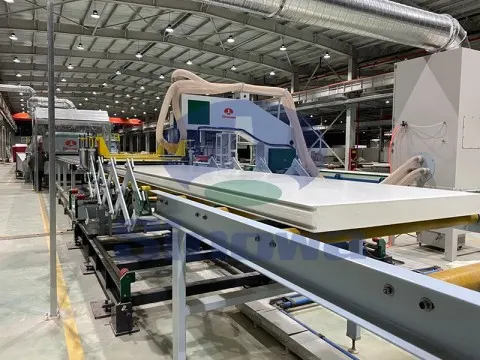
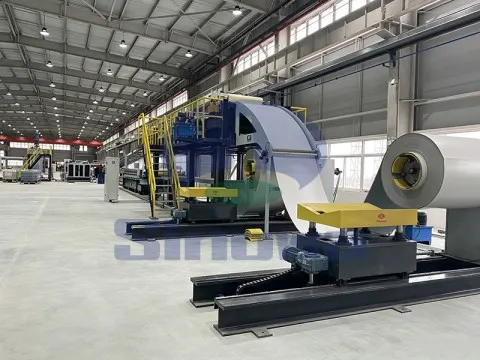
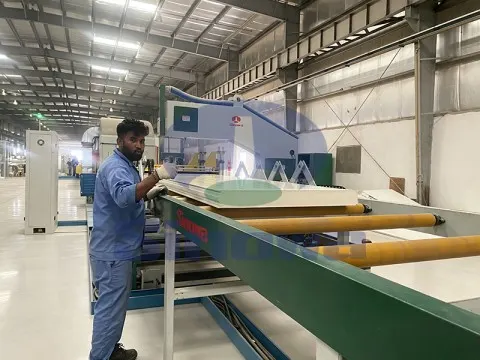
Tags: continuous pir sandwich panel production line, continuous pir sandwich panel production line manufacturer, continuous pir sandwich panel production line supplier, china continuous pir sandwich panel production line, continuous pir sandwich panel production line for sale
-
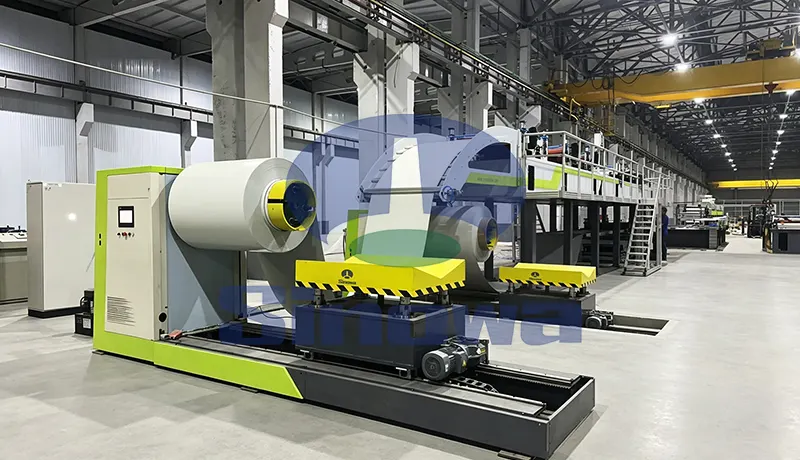
A reliable PU sandwich panel production line serves as the core equipment for manufacturing high-performance building insulation panels. This professional PU sandwich panel line features automated feeding, foaming and molding processes to ensure consistent panel thickness and structural stability. The well-designed polyurethane sandwich panel production line effectively improves production efficiency while reducing material waste in daily operation. Each calibrated polyurethane sandwich panel line can adapt to different panel sizes to meet diverse construction needs. With precise temperature and pressure control, the advanced continuous PU sandwich panel line produces panels with excellent thermal insulation and weather resistance. Meanwhile, the optimized PIR sandwich panel production line upgrades the foaming formula to enhance fire resistance performance. The high-efficiency PIR sandwich panel line maintains stable operation during long-term mass production, delivering durable and high-quality sandwich panels for various architectural and industrial applications.
-
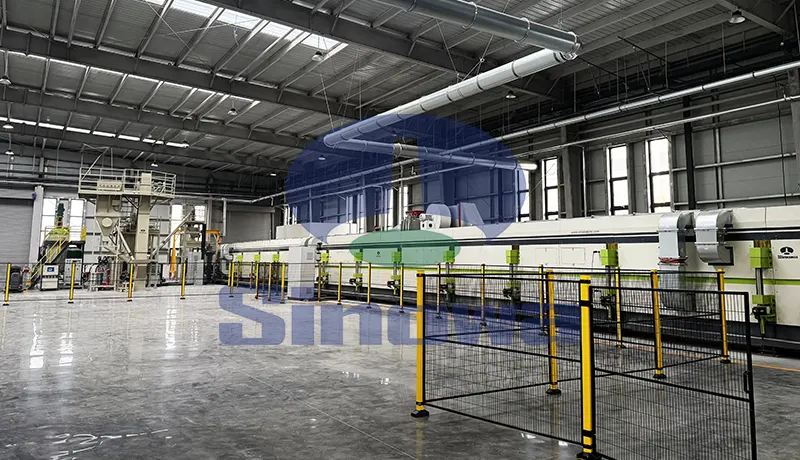
The phenolic panel production line realizes automated and continuous manufacturing of high-performance thermal insulation panels through streamlined and coordinated processing procedures.
-
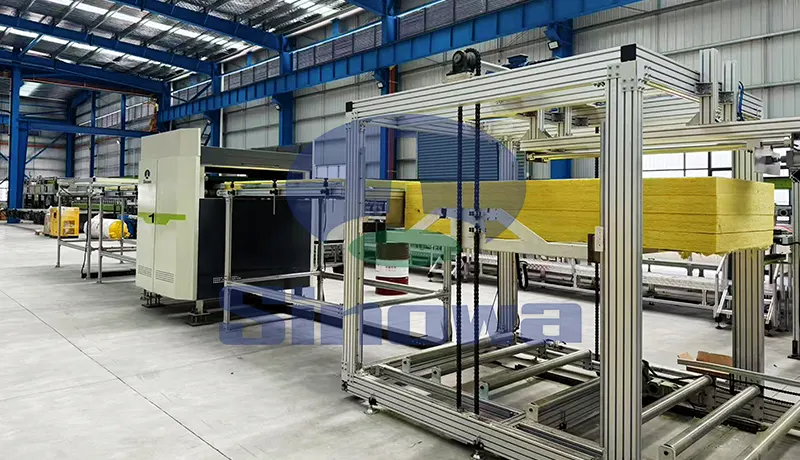
Modern insulation panel manufacturing relies on professional automated equipment to ensure stable product quality and high production efficiency. The rock wool sandwich panel production line features precise material lamination and forming processes to produce rigid, heat-insulating building panels. Meanwhile, the mineral wool sandwich panel production line adopts optimized assembly procedures to fabricate lightweight, soundproof panels widely used in architectural enclosure and thermal preservation projects.