What Is The Output Capacity Of A Continuous PUF Sandwich Panel Production Line?
Publication Date: Sep 28, 2026
The output capacity of a continuous PUF sandwich panel production line refers to its stable hourly, daily and annual panel output, determined by line speed, panel specifications and operational efficiency. It varies widely to fit different mass production demands in the construction industry.
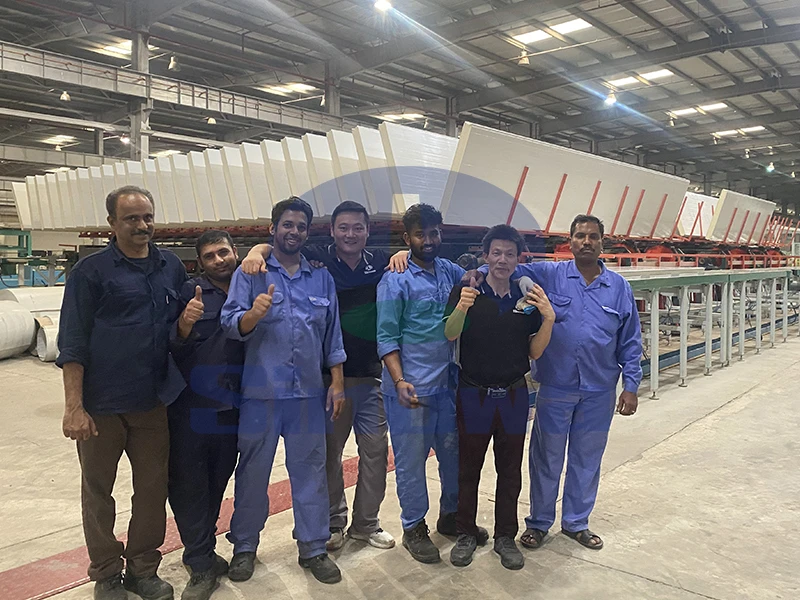
Continuous PUF sandwich panel production lines feature streamlined automated operation, which lays the core foundation for their stable and scalable output capacity. Unlike intermittent production equipment that requires frequent shutdowns for material replacement and mold adjustment, this fully continuous production model realizes uninterrupted feeding, foaming, composite forming, cutting and conveying of raw materials. The entire manufacturing process operates in a closed and cyclic state, eliminating production gaps caused by manual intervention and equipment debugging. This seamless operation mode greatly improves effective production time, directly endowing the line with far higher basic output than traditional discontinuous production systems. The standardized mechanical transmission and automatic control system also ensures consistent operating rhythm, avoiding output fluctuations from unstable manual operation.
Running speed serves as the most intuitive core factor affecting the output capacity of continuous PUF sandwich panel lines. Conventional production lines maintain a stable operating speed ranging from 3 meters to 12 meters per minute under normal working conditions, while optimized high-efficiency models can reach higher speed levels. The linear running speed directly determines the length of panels produced per unit time, forming the primary calculation basis of hourly output. It is worth noting that the running speed is not fixed blindly; it matches the foaming and curing cycle of PUF core materials. Excessively fast speed will lead to incomplete foaming and poor bonding performance, while overly slow speed will waste production efficiency, so professional speed calibration is required to balance output and product quality.
Panel thickness is a key parameter that causes obvious differences in the actual output capacity of the same production line. Thinner PUF sandwich panels, commonly used for building interior partition walls, have a simple forming process and short curing time, allowing the production line to maintain a high running speed and achieve a larger area output per hour. In contrast, thick panels applied for exterior wall insulation and cold storage enclosure require more PUF raw materials, longer foaming setting time and slower line operating speed. Under the same equipment configuration and operating hours, the hourly output area of thin panels is significantly higher than that of thick specifications, forming the most common output difference in actual industrial production scenarios.
Effective operating time directly converts the theoretical speed of the sandwich panel production line into actual achievable output capacity. Standard industrial production adopts shift-based operation modes, with single-shift effective working hours excluding equipment routine inspection and short debugging time. Most production lines support long-term continuous operation across multiple shifts, greatly expanding daily effective production duration. Reasonable production scheduling can minimize idle time of mechanical equipment and automated systems. Regular daily maintenance, including equipment lubrication, parameter calibration and raw material pipeline inspection, can reduce unexpected shutdown failures, further improve equipment operation stability and maximize the effective operating time that contributes to actual output.
The configuration level of core equipment components plays a decisive role in the stable output ceiling of continuous PUF sandwich panel production lines. High-precision raw material metering and mixing systems ensure uniform proportioning of PUF foaming materials, stable foaming reaction speed and consistent panel forming quality, avoiding frequent speed adjustments and shutdowns caused by material proportion deviation. Optimized roller pressing and forming structures ensure flat panel composite forming and continuous feeding without jamming. Advanced automatic cutting and stacking systems realize synchronous follow-up operation with the production line, eliminating post-process bottlenecks that restrict overall output. The overall coordination of each functional module determines whether the line can maintain high-speed and stable production for a long time.
Raw material supply stability is an invisible factor restricting the full release of production line output capacity. Continuous production requires continuous and stable supply of metal coil substrates, PUF foaming raw materials and auxiliary bonding materials. Intermittent raw material shortage, unstable material quality or inconsistent material feeding speed will force the production line to reduce operating speed or suspend operation temporarily. Sufficient raw material reserve and stable feeding rhythm can make the production line always run at the calibrated optimal speed, ensuring sustained and stable output. In actual production management, scientific raw material inventory scheduling is essential to avoid output loss caused by material supply interruption.
Automation and intelligent control levels effectively improve the effective output rate of continuous PUF sandwich panel manufacturing lines. Highly automated lines realize full-process automatic control from raw material feeding, foaming composite forming to finished product cutting and output, reducing manual operation errors and human-induced shutdowns. Intelligent parameter adjustment systems can automatically fine-tune operating speed and foaming parameters according to real-time production status and panel specifications, maintaining the best production state at all times. This intelligent operation mode reduces manual debugging time and failure rate, improves equipment operation efficiency, and enables the production line to maintain high-load stable output for a long time.
Daily and annual comprehensive output capacity is summarized from the superposition of hourly stable output and long-term operating efficiency. Under conventional configuration and standard operating conditions, medium-sized continuous PUF sandwich panel lines can achieve considerable hourly output area, and the daily output after multi-shift operation can meet the large-scale material demand of medium and large construction projects. On the premise of regular equipment maintenance and stable production conditions, the annual effective production days are sufficient, and the cumulative annual output can reach a large-scale level. This scalable output characteristic makes continuous lines far more suitable for industrial mass production than small batch discontinuous production equipment.
The output capacity of continuous PUF sandwich panel lines also needs to consider the effective yield rate of finished products. Even if the equipment runs at a stable speed, defective products caused by occasional process parameter deviation, material problems or minor equipment jitter will affect the actual qualified output. High-standard production operation management and standardized process control can effectively reduce the defective rate, improve the finished product yield, and make the actual effective output close to the theoretical output value. Excellent production management can maximize the utilization efficiency of equipment production capacity and avoid capacity waste caused by unqualified products.
In practical industrial application, the output capacity of continuous PUF sandwich panel production lines presents flexible adjustability to adapt to diverse market demands. Manufacturers can adjust production speed, operating shifts and product specifications according to project order volume and delivery cycle requirements, realizing flexible switching between high-volume mass production and stable conventional production. This flexible capacity characteristic not only ensures efficient production of large orders but also adapts to small-batch and multi-specification production demands, fully reflecting the production advantages of continuous automated lines in the modern building insulation material industry.






Tags: continuous puf sandwich panel production line, continuous puf sandwich panel production line manufacturer, continuous puf sandwich panel production line supplier, china continuous puf sandwich panel production line, continuous puf sandwich panel production line for sale
-

A reliable PU sandwich panel production line serves as the core equipment for manufacturing high-performance building insulation panels. This professional PU sandwich panel line features automated feeding, foaming and molding processes to ensure consistent panel thickness and structural stability. The well-designed polyurethane sandwich panel production line effectively improves production efficiency while reducing material waste in daily operation. Each calibrated polyurethane sandwich panel line can adapt to different panel sizes to meet diverse construction needs. With precise temperature and pressure control, the advanced continuous PU sandwich panel line produces panels with excellent thermal insulation and weather resistance. Meanwhile, the optimized PIR sandwich panel production line upgrades the foaming formula to enhance fire resistance performance. The high-efficiency PIR sandwich panel line maintains stable operation during long-term mass production, delivering durable and high-quality sandwich panels for various architectural and industrial applications.
-

The phenolic panel production line realizes automated and continuous manufacturing of high-performance thermal insulation panels through streamlined and coordinated processing procedures.
-

Modern insulation panel manufacturing relies on professional automated equipment to ensure stable product quality and high production efficiency. The rock wool sandwich panel production line features precise material lamination and forming processes to produce rigid, heat-insulating building panels. Meanwhile, the mineral wool sandwich panel production line adopts optimized assembly procedures to fabricate lightweight, soundproof panels widely used in architectural enclosure and thermal preservation projects.