Why Does Foaming Overflow Occur On The Continuous Rockwool Sandwich Panel Production Line?
Publication Date: Oct 14, 2026
Foaming overflow is a recurring defect on continuous rockwool sandwich panel lines, reducing edge quality, wasting adhesive, and forcing rework.
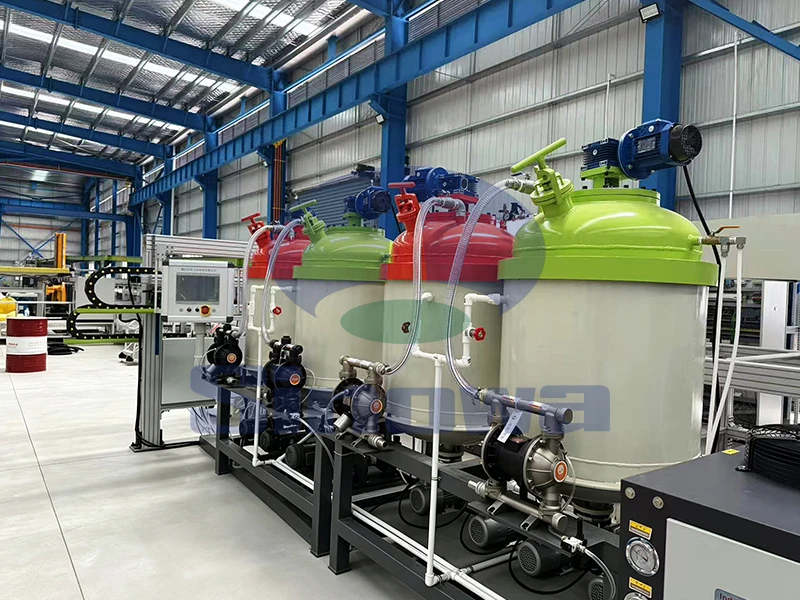
The polyurethane or polyisocyanurate adhesive used to bond the rockwool core to the facings is a two-component system whose expansion kinetics are highly sensitive to mixing ratio. When the metering unit drifts—often because of seal wear, piston leakage, or a blocked proportioning valve—the polyol-to-isocyanate balance shifts away from the design point. A slight excess of isocyanate can slow the reaction and leave a longer cream time, during which the rising foam continues to expand after it has already entered the nip of the double belt press, squeezing out sideways along the panel edges. Conversely, an excess of polyol accelerates the gel reaction but produces a weaker cell structure that collapses under belt pressure, creating localized overflow at the weaker margins of the foam bed. Operators typically notice this as uneven side-bead formation, streaky edge trim, or foam accumulating on the edge sealing knives. The first diagnostic step is always to verify shot ratio by collecting samples from the mixing head and comparing cured density with the reference batch, rather than adjusting line speed prematurely.
Temperature is the second major lever. Both chemical components must be held within a narrow band because reaction rate roughly doubles for every ten-degree rise in component temperature. If the polyol tank or its circulation loop develops a cooling fault, or if winter ambient air chills the supply lines, the reaction starts later and more slowly. By the time the foam reaches its maximum rise height, the panel has already traveled through several belt segments, so the pressure that should shape the foam is applied too early and squeezes an under-expanded slug out through the side dams. The same failure in reverse—overheated components in summer or after long idle periods—shortens the cream time, and the foam begins rising before it has even spread evenly across the rockwool surface. The result is a dry, crumbly edge with visible overflow at the injection zone rather than downstream. Checking component temperatures at the tank, at the heat exchanger outlet, and at the mixing head inlet usually reveals a gradient that explains the defect.
The rockwool itself is rarely uniform along its length. Fiber orientation varies between the spun mat and the compressed panel core, and density fluctuates with incoming batch quality, curing oven load, and even the humidity absorbed during storage. When a particularly dense or poorly oriented section of wool passes under the foam dispenser, the liquid adhesive cannot penetrate the mat evenly; instead, it pools on the surface and follows the path of least resistance toward the panel edges. Belt pressure then pushes this pooled foam outward, producing a thick, uneven bead. Moisture in the wool is especially damaging because water reacts with isocyanate to release carbon dioxide, generating extra gas volume that was never accounted for in the shot calculation. The operator may see bubbles at the edge, a spongy cut surface, or foam protruding through side joints. Monitoring wool moisture with a hand meter at the decoiler and preheating the mat before injection are the practical countermeasures.
Dispensing and mixing head behavior deserves separate attention. A mixing head that is not cleaned properly between color or formulation changes leaves residue that skins over during the next shot, causing localized islands of unreacted material. These islands do not participate in the gelation wave, so they behave like thin liquid pockets under belt pressure and ooze out through the side dams. Wear on the nozzle tip can also alter the spray pattern, turning what should be a uniform fan into a concentrated jet that over-saturates one strip of wool. The foam then migrates sideways rather than rising vertically. Operators should inspect the fan pattern on a test board at the start of each shift, listen for the characteristic change in head noise when mixing efficiency drops, and follow the purging cycle without shortcuts—because cleaning-related overflow usually appears right after a head stop or a recipe switch.
Double belt press settings form the mechanical heart of the process. The belt gap defines final panel thickness, and the side dam or edge sealing system confines the foam during rise. If the side dam belt is tensioned unevenly, or if its speed drifts slightly out of synchronization with the main belt, a small gap opens at one edge and foam escapes like toothpaste from a squeezed tube. More subtly, the gap profile along the length of the press matters: the initial zone must be open enough to let the foam rise freely, while downstream zones must close in gradually to reach final thickness. Pressing too hard too early flattens the foam bed and pushes material out the sides; pressing too late lets the foam set before it has filled the panel, leaving voids rather than overflow. Many overflow incidents trace back to a recent belt gap adjustment—after a coil change, a facing thickness change, or a panel thickness switch—where the operator did not rebalance the zone temperatures and gap profile along with the mechanical setting.
Line speed interacts directly with the chemical rise profile. A continuous line is essentially a time axis laid out in meters: the cream time, rise time, and gel time of the foam are translated into physical distances along the belt. If the line is slowed down without shortening the chemical times (usually by raising component temperature), the foam completes its rise before the panel reaches the shaping zone, and excess material is simply squeezed out the edges. If the line is speeded up without extending rise time, the foam has not yet set when it leaves the press, and it continues to expand after the cut, producing bulging edges and downstream overflow at the saw or stacker. The fix is rarely to chase speed with ratio changes; it is to re-map the rise profile against the new speed, adjust component temperatures, and verify by timing a free-rise cup test on the floor.
Ambient and seasonal effects are often underestimated. A production hall without climate control swings between cold mornings and warm afternoons, and the same chemical batch behaves differently at each end of the shift. Cold air also increases the risk of condensation on the steel facing coils, and water on the facing surface reacts with isocyanate at the interface, generating gas that lifts the facing and pushes foam sideways. Drafts from open loading bays can cool the belt surface locally, creating a cold spot where the reaction stalls—again, the un-gelled foam migrates toward the edge. Operators often report that overflow appears only on one side of the line, or only during the first hour after startup, and these clues almost always point to uneven thermal conditions rather than a chemical problem.
Edge construction and sealing design matter just as much as bulk foam behavior. Some panel profiles have folded or recessed edges where the rockwool is compressed more than the center, and the foam must fill a narrower channel at the side. If the dispenser is centered slightly off-axis, one side receives more adhesive than the other, and the over-fed side overflows while the under-fed side starves. Similarly, if the release film on the belt is torn or misaligned at the edge, it creates a local opening through which wet foam escapes. Inspecting edge trim samples after each run—measuring bead width, cell structure, and bonding to the facing—usually reveals whether the problem is symmetric (a bulk issue like ratio or temperature) or one-sided (a mechanical or alignment issue).
Finally, process stability and changeover discipline prevent most recurring overflow. Every time the line switches panel thickness, facing color, wool batch, or chemical lot, a small window of instability appears while the operator rebalances the settings. Overflow during these windows is normal, but it becomes chronic if the operator returns to the same reference settings without recording what actually worked. A simple shift log—recording component temperatures, line speed, gap profile, side dam condition, wool batch, and observed edge bead—lets the team converge on a repeatable recipe rather than rediscovering the same corrections every day. Most overflow is not a mysterious chemistry failure; it is the visible symptom of a small drift in one of the levers above. Tracing that drift back through ratio, temperature, wool, head, press, speed, environment, and edge alignment—then confirming the correction with a test panel before committing to a full run—is the most reliable way to keep the line clean, the edges straight, and the trim waste to a minimum.
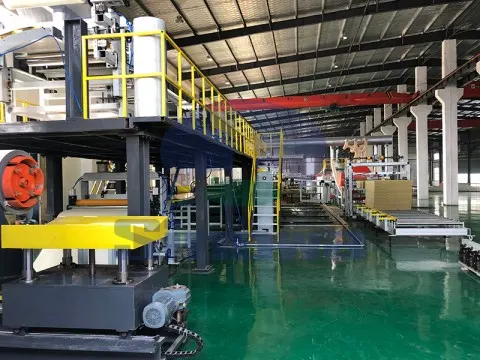
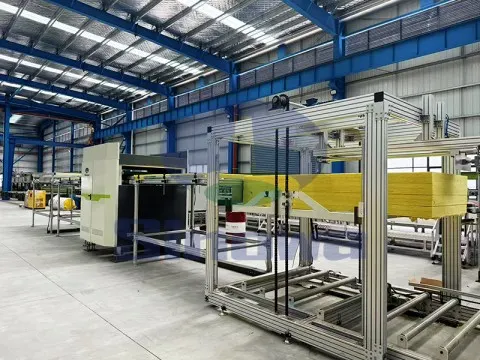
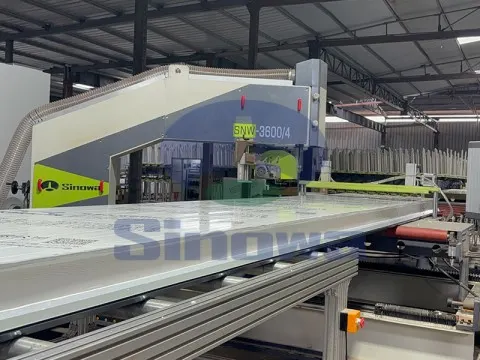
Tags: continuous rockwool sandwich panel production line, continuous rockwool sandwich panel production line manufacturer, continuous rockwool sandwich panel production line supplier, china continuous rockwool sandwich panel production line, continuous rockwool sandwich panel production line for sale
-
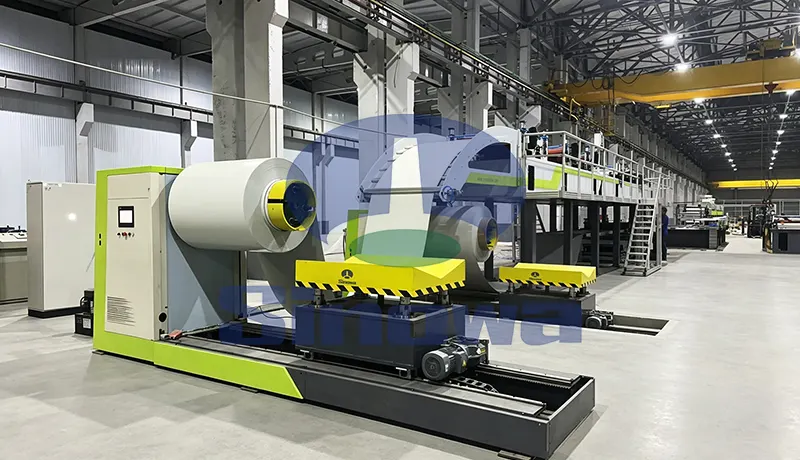
A reliable PU sandwich panel production line serves as the core equipment for manufacturing high-performance building insulation panels. This professional PU sandwich panel line features automated feeding, foaming and molding processes to ensure consistent panel thickness and structural stability. The well-designed polyurethane sandwich panel production line effectively improves production efficiency while reducing material waste in daily operation. Each calibrated polyurethane sandwich panel line can adapt to different panel sizes to meet diverse construction needs. With precise temperature and pressure control, the advanced continuous PU sandwich panel line produces panels with excellent thermal insulation and weather resistance. Meanwhile, the optimized PIR sandwich panel production line upgrades the foaming formula to enhance fire resistance performance. The high-efficiency PIR sandwich panel line maintains stable operation during long-term mass production, delivering durable and high-quality sandwich panels for various architectural and industrial applications.
-
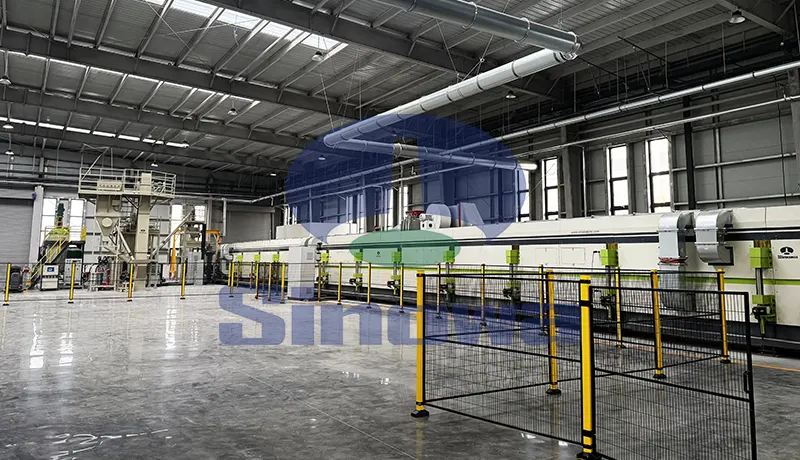
The phenolic panel production line realizes automated and continuous manufacturing of high-performance thermal insulation panels through streamlined and coordinated processing procedures.
-
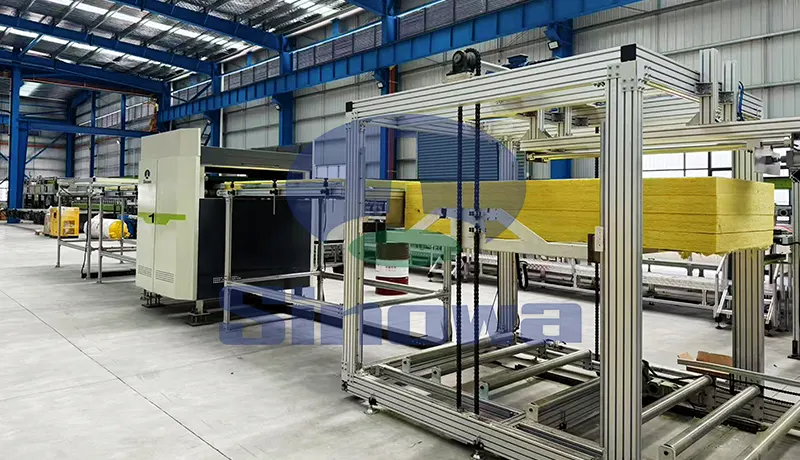
Modern insulation panel manufacturing relies on professional automated equipment to ensure stable product quality and high production efficiency. The rock wool sandwich panel production line features precise material lamination and forming processes to produce rigid, heat-insulating building panels. Meanwhile, the mineral wool sandwich panel production line adopts optimized assembly procedures to fabricate lightweight, soundproof panels widely used in architectural enclosure and thermal preservation projects.