What Are The Common Faults Of The Continuous PUF Sandwich Panel Production Line?
Publication Date: Oct 9, 2026
The continuous PUF sandwich panel production line often suffers from mechanical, chemical and process faults that undermine panel quality and production stability.
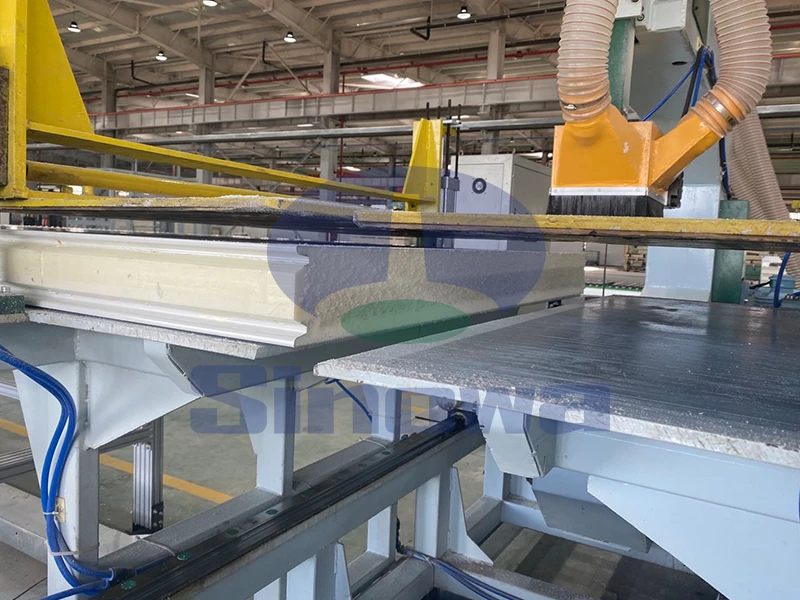
Panel thickness inconsistency is one of the most prevalent faults in continuous PUF sandwich panel production, frequently occurring in long-term continuous operation. This fault manifests as uneven thickness across panel surfaces, inconsistent edge thickness, or gradual thickness deviation during prolonged production runs. Multiple interrelated factors trigger this problem, with unstable laminator pressing gap being the core mechanical cause. Long-term vibration and component wear will displace the laminator’s adjusting structure, leading to uneven upper and lower belt gaps. Meanwhile, mismatched line speed and foam material output disrupt the filling uniformity of PUF core materials. Fluctuations in curing temperature also affect foam expansion efficiency, resulting in inconsistent core thickness. In addition, unstable feeding tension of surface metal sheets causes slight sheet stretching or sagging, further exacerbating thickness errors. Regular calibration of laminator gaps, synchronous adjustment of line speed and material feeding volume, and real-time monitoring of curing temperature can effectively mitigate this fault and stabilize panel dimensional accuracy.
Foam bubbling and pinhole defects seriously affect the compactness and insulation performance of PUF sandwich panels, and are common quality faults in foam forming stages. These defects appear as tiny open or closed pores on the foam surface and internal micro voids, which reduce the panel’s structural density and thermal insulation effect. The primary cause is excessive moisture in polyol raw materials, as water reacts with isocyanate to generate gas that forms residual bubbles inside the foam. Insufficient mixing of PUF raw materials is another key factor; uneven stirring of polyol, isocyanate and auxiliary materials leads to partial incomplete reaction and gas accumulation. Besides, residual release agent, dust and other impurities on the forming mold and conveyor belt will hinder uniform foam forming and create pinholes. Unreasonable raw material feeding ratios and unstable mixing pressure also aggravate the problem. Controlling raw material moisture content, cleaning production molds regularly, and optimizing mixing parameters can significantly reduce bubble and pinhole generation.
Panel delamination refers to the separation between the PUF foam core and metal surface sheets, a critical fault that damages the structural integrity of sandwich panels. This fault usually occurs after panel curing or during subsequent handling, showing as local or overall peeling of the composite interface. Abnormal raw material ratio is the main inducement, and unbalanced dosing of isocyanate and polyol will weaken the bonding activity of the foam core. Too low raw material temperature reduces the fluidity and adhesion of PUF materials, making it impossible to form a tight bond with surface sheets. Contamination on the surface of metal coils, such as oil stains and oxide layers, will also isolate the bonding interface. Moreover, uneven laminator pressure leads to inconsistent bonding force across the panel, and insufficient curing time fails to complete the interface bonding reaction fully. Timely calibration of dosing systems, pre-treatment of surface sheet impurities, and adjustment of laminator pressure and curing time can effectively solve delamination problems and enhance panel bonding firmness.
Unstable foam density is a hidden fault that affects the overall performance of PUF sandwich panels, featuring uneven density distribution inside the foam core and inconsistent density between different batches of products. Unreasonable PUF raw material ratio is the fundamental cause, and excessive or insufficient addition of auxiliary materials will change the cross-linking degree of foam molecules. Misalignment of the pendulum material distribution device in the production line leads to uneven raw material spreading, resulting in dense and sparse areas in the foam core. Fluctuations in curing temperature and line speed also impact foam density; high speed shortens the foaming reaction time, while low temperature causes incomplete foaming. In addition, unstable material feeding pressure leads to inconsistent raw material output per unit time, further widening density differences. Regular recalibration of raw material proportioning systems, correction of pendulum operation tracks, and stable control of production parameters can maintain uniform foam density and stable product quality.
Foam brittleness and poor toughness are typical performance faults of PUF cores, which cause the foam to crack or break easily when panels are bent or impacted. This fault is mainly derived from unreasonable raw material formula and improper reaction conditions. Excessively high isocyanate index leads to excessive cross-linking of foam molecules, making the foam structure rigid and losing flexibility. The use of high-functionality polyols will also increase foam brittleness and reduce its bending resistance. In addition, over-high curing temperature accelerates the foaming reaction speed, resulting in dense but brittle internal foam structure with poor toughness. Long-term high-temperature production will also cause aging of auxiliary catalysts, further deteriorating foam flexibility. Optimizing the raw material formula by adding flexible polyether components, controlling the isocyanate index within a reasonable range, and adjusting curing temperature and catalyst dosage can effectively improve foam toughness and avoid brittle cracking faults.
Raw material pipeline blockage is a common mechanical fault that disrupts continuous production and affects product stability. Long-term operation of the PUF feeding pipeline will lead to residual raw material accumulation, and unreacted polyol and isocyanate will solidify inside the pipeline to form blockages. Pipeline blockage causes unstable raw material output, insufficient feeding volume and intermittent material supply, which directly leads to incomplete foam foaming and uneven panel quality. Partial pipeline blockage also increases material conveying pressure, easily triggering equipment overload operation. In addition, impurities mixed in raw materials will adhere to the pipeline inner wall and gradually accumulate to form blockages, especially in fine-caliber valve ports and mixing joints. Regular pipeline dredging, cleaning of valve and filter components, and regular replacement of aging pipelines can ensure smooth material conveying and avoid intermittent production faults caused by blockages.
Unstable surface material tension is a frequent operational fault in the coil feeding stage, affecting the flatness and forming effect of sandwich panels. Excessive tension will stretch the metal surface sheet, resulting in sheet deformation and panel warping after curing, while insufficient tension will cause sheet sagging and wrinkling, leading to uneven composite interfaces. This fault is mainly caused by abnormal brake adjustment of the uncoiler device; long-term friction and wear make the brake tension unbalanced and unable to maintain stable coil conveying speed. Abnormal operation of the tension sensor and control system also leads to inaccurate tension regulation, causing real-time tension fluctuation during production. In addition, inconsistent coil material thickness and uneven coil winding will produce instantaneous tension changes during feeding. Regular inspection and calibration of uncoiler brake devices, cleaning and maintenance of tension sensors, and standardized coil feeding operation can stabilize surface material tension and ensure flat panel appearance.
Curing channel temperature deviation is a key process fault that affects foam forming and curing quality, triggering a series of secondary quality problems. The curing channel is responsible for providing a constant-temperature environment for PUF foam foaming and curing, and temperature deviation will disrupt the normal foaming reaction process. Excessively high local temperature causes over-foaming of partial foam, leading to hollow bulges on the panel surface and reduced structural strength. Too low overall temperature results in incomplete foam curing, making the panel soft, prone to deformation and poor bonding performance. Temperature deviation is mainly caused by aging heating components, uneven heat distribution in the channel, and blocked ventilation structures. Long-term equipment operation will also lead to inaccurate temperature sensor feedback, resulting in inconsistent actual temperature and set parameters. Regular detection of heating components, cleaning of ventilation channels, and calibration of temperature control systems can maintain constant curing temperature and ensure full foam curing.
Cutting dimensional inaccuracy and edge burrs are common post-forming faults that affect the finished product yield of sandwich panels. This fault manifests as inconsistent panel length and width dimensions, uneven cutting sections, and residual burrs on panel edges, which fail to meet finished product processing requirements. The core cause is positioning deviation of the cutting system, including delayed signal response of positioning sensors and displaced positioning fixtures. Long-term wear of cutting blades leads to unsharp cutting edges, resulting in uneven shearing and burr generation during cutting. Mismatched synchronization between cutting speed and production line speed also causes dimensional errors and oblique cutting surfaces. In addition, unstable panel conveying speed before cutting leads to panel displacement during cutting operation. Regular calibration of cutting positioning systems, regular polishing and replacement of cutting blades, and synchronous optimization of cutting and line operating speeds can effectively improve cutting accuracy and panel edge flatness.
Circuit signal and transmission faults are hidden equipment faults that affect the overall operational stability of the continuous production line. During long-term continuous production, the production line’s control circuit and signal transmission components are prone to aging, loosening and interference, resulting in abnormal equipment operation. Signal delay or loss will cause asynchronous operation of feeding, foaming, laminating and cutting processes, leading to sudden changes in production parameters and batch quality defects. Loose circuit connectors and dust accumulation in electrical components will cause intermittent signal interruption, resulting in equipment stalling or unstable operating speed. Abnormal operation of the transmission motor and wear of transmission parts will cause unsmooth power output, leading to jitter in conveyor belt operation and affecting panel forming uniformity. Regular inspection of circuit connections, cleaning of electrical control components, maintenance of transmission systems, and timely replacement of aging parts can eliminate hidden equipment faults and ensure stable and continuous production.






Tags: continuous puf sandwich panel production line, continuous puf sandwich panel production line manufacturer, continuous puf sandwich panel production line supplier, china continuous puf sandwich panel production line, continuous puf sandwich panel production line for sale
-

A reliable PU sandwich panel production line serves as the core equipment for manufacturing high-performance building insulation panels. This professional PU sandwich panel line features automated feeding, foaming and molding processes to ensure consistent panel thickness and structural stability. The well-designed polyurethane sandwich panel production line effectively improves production efficiency while reducing material waste in daily operation. Each calibrated polyurethane sandwich panel line can adapt to different panel sizes to meet diverse construction needs. With precise temperature and pressure control, the advanced continuous PU sandwich panel line produces panels with excellent thermal insulation and weather resistance. Meanwhile, the optimized PIR sandwich panel production line upgrades the foaming formula to enhance fire resistance performance. The high-efficiency PIR sandwich panel line maintains stable operation during long-term mass production, delivering durable and high-quality sandwich panels for various architectural and industrial applications.
-

The phenolic panel production line realizes automated and continuous manufacturing of high-performance thermal insulation panels through streamlined and coordinated processing procedures.
-

Modern insulation panel manufacturing relies on professional automated equipment to ensure stable product quality and high production efficiency. The rock wool sandwich panel production line features precise material lamination and forming processes to produce rigid, heat-insulating building panels. Meanwhile, the mineral wool sandwich panel production line adopts optimized assembly procedures to fabricate lightweight, soundproof panels widely used in architectural enclosure and thermal preservation projects.