What Safety Operating Norms Apply To The Continuous PU Sandwich Panel Production Line?
Publication Date: Oct 6, 2026
The continuous PU sandwich panel production line involves mechanical movement, chemical foaming and high-pressure operation, requiring standardized safety norms.
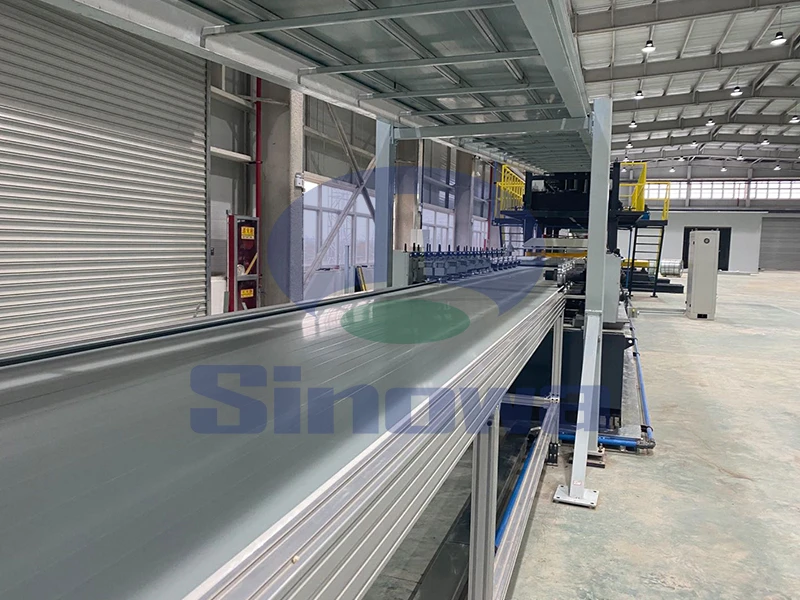
Standard pre-operation safety preparation is the primary norm for stable and safe operation of the continuous PU sandwich panel production line. Before starting any production task, operators must conduct a comprehensive visual and functional inspection of the entire production line covering all key functional units. It is essential to check the integrity of safety protection devices, including safety guards on rotating and moving components, emergency stop buttons at each operating station, and pressure monitoring accessories of the PU foaming system, to ensure no damage or failure. Meanwhile, operators need to clean up the production site, remove sundries that may hinder equipment operation or cause safety hazards, and confirm the neat placement of raw materials. In addition, all on-duty personnel must complete pre-job safety confirmation, wear complete and qualified personal protective equipment suitable for chemical and mechanical operation scenarios, and adjust their working state to ensure full concentration during subsequent operations.
Personnel management safety norms run through the entire production process of the PU sandwich panel line and cannot be ignored at any stage. Only professionally trained and qualified personnel are allowed to operate the production equipment, and untrained staff are strictly prohibited from approaching or touching any operating parts. The production line involves multi-station collaborative work, so a special person must be assigned to coordinate on-site work and unify operation commands. All operators must stick to their fixed posts during production, not leave their positions without permission, and avoid random walking across operating areas. It is forbidden for any personnel to lean on equipment, place body parts near rotating rollers, cutting mechanisms and high-pressure pipeline interfaces. Moreover, staff are not allowed to carry out private equipment debugging, parameter modification or auxiliary operation without the consent of the on-site supervisor to prevent misoperation-induced safety accidents.
Standardized equipment start-up operation norms are crucial to prevent sudden equipment failures and potential safety hazards. The production line must follow a gradual and standardized start-up sequence instead of one-key forced start-up. Operators should first turn on the power supply of the auxiliary control system, conduct a self-inspection of the equipment control program, and check whether the display data of temperature, pressure and running speed indicators is normal. After confirming the normal operation of the control system, start the conveying and rolling forming unit at a low speed for idle running test, lasting for an appropriate time to observe whether there is abnormal vibration, noise or jamming of mechanical parts. Then activate the PU raw material feeding and mixing system, check the smoothness of material conveying and the sealing of mixing pipelines to avoid material leakage. Only after all idle running and functional tests are confirmed fault-free can the formal feeding and batch production be started.
On-site operation safety norms in the formal production stage focus on real-time risk prevention and standardized operation habits. During continuous production, operators need to monitor the running state of each equipment module in real time, focusing on the working state of the PU foaming and laminating unit, the operating speed of the conveying system, and the cutting accuracy of the finishing unit. It is strictly prohibited to touch high-temperature surfaces, rotating mechanical parts and high-pressure material pipelines with hands or tools during equipment operation. When minor material blockage or surface sundry accumulation occurs, operators must stop the corresponding equipment module first and carry out cleaning and troubleshooting after the equipment completely stops running. In addition, production parameters must be kept within the normal operating range, and random adjustment of foaming ratio, laminating pressure and line speed is forbidden to avoid unqualified products and equipment overload operation risks.
High-pressure and chemical operation safety norms are targeted rules for the core PU foaming link of the production line. The PU foaming system belongs to the high-pressure operating unit, so operators must strictly abide by pressure control rules during operation. Real-time pressure changes of the mixing and injection system should be observed constantly, and once abnormal pressure fluctuation is found, the feeding system should be suspended immediately for inspection. All pipeline interfaces and sealing parts of the chemical raw material conveying system need regular observation to prevent leakage of chemical materials, which may cause skin irritation, respiratory discomfort or on-site environmental hazards. During material replacement and pipeline maintenance, the residual pressure in the pipeline must be completely released first, and residual raw materials should be cleaned up safely. It is also forbidden to mix different types of raw materials arbitrarily to avoid chemical reactions that affect production safety and product quality.
Mechanical safety protection norms aim to eliminate risks caused by moving and cutting equipment of the production line. All exposed rotating parts, roller sets and transmission mechanisms of the production line must be equipped with complete safety guards and protective baffles, and it is forbidden to disassemble or remove safety protection devices during equipment operation. For the cutting and trimming unit of sandwich panels, operators must keep a safe operating distance, and it is prohibited to place hands or auxiliary tools near the cutting stroke range. When the equipment has abnormal jamming and stalling during operation, forced startup is not allowed. Instead, the main power supply should be cut off in time, and professional maintenance personnel should be arranged to check and eliminate faults. Regular inspection of the tightness of mechanical transmission parts is also required to prevent part loosening and falling off during high-speed operation, which may cause equipment damage and safety accidents.
Emergency response safety norms specify standardized disposal measures for sudden abnormal situations in production. The production line is equipped with emergency stop devices at multiple key positions, and operators must master the accurate use method of emergency stop buttons. In case of equipment failure, material leakage, personnel accidental injury or other emergencies, the nearest emergency stop button should be pressed immediately to cut off the equipment operation state comprehensively. After emergency shutdown, operators must quickly evacuate from the dangerous area and report the abnormal situation to the on-site supervisor in detail. It is forbidden to restart the equipment without fault confirmation and hidden danger elimination. Meanwhile, the on-site emergency disposal channel must be kept unblocked at all times, and no raw materials or sundries are allowed to occupy the emergency passage to ensure rapid evacuation and rescue in case of accidents.
Standard equipment shutdown safety norms avoid potential hazards caused by irregular shutdown operations. When the daily production task is completed or production needs to be suspended temporarily, operators must follow the fixed shutdown process step by step, rather than directly cutting off the main power supply for forced shutdown. First, stop the PU raw material feeding and foaming injection system to terminate material supply and mixing work. Then keep the conveying and laminating system running for a period of time to ensure that all semi-finished products in the equipment are completely processed and conveyed out of the line. After all mechanical units finish working and stop running completely, turn off the auxiliary control system and main power supply in sequence. Finally, clean residual foam materials and metal debris on the equipment surface and working area to lay a safe foundation for the next startup.
Daily inspection and maintenance safety norms ensure the long-term stable and safe operation of the continuous production line. After daily shutdown, professional personnel need to conduct a comprehensive inspection of all equipment modules, focusing on the wear of mechanical parts, the sealing of chemical pipelines and the sensitivity of safety devices. Worn parts should be recorded in a timely manner and replaced regularly, and aging pipelines should be checked and updated to prevent leakage risks. Equipment lubrication maintenance should be carried out in strict accordance with operating requirements to ensure flexible operation of transmission parts and reduce mechanical wear and failure probability. All maintenance work must be carried out in a power-off and pressure-relief state, and maintenance records should be archived truthfully. It is forbidden to carry out maintenance and debugging work during equipment operation to avoid mechanical injury accidents.
On-site environmental and auxiliary safety norms guarantee the overall safety of the production operation environment. The production workshop where the PU sandwich panel line is located needs to maintain good ventilation conditions all the time to volatilize trace harmful gases generated in the foaming process and avoid gas accumulation. The on-site fire prevention management must be strictly implemented, and all flammable and explosive items are prohibited from being placed near the production equipment. Raw materials should be stored in classified and fixed areas, keeping a safe distance from operating equipment and heat sources. The on-site safety warning signs must be kept clear and complete to remind operators of potential operating risks. In addition, the on-site safety protection facilities and first-aid supplies should be checked regularly to ensure they are complete and available, providing effective safety guarantee for daily production operations.
Gallery of Continuous PU Sandwich Panel Production Line






Tags: continuous pu sandwich panel production line, continuous pu sandwich panel production line manufacturer, continuous pu sandwich panel production line supplier, china continuous pu sandwich panel production line, continuous pu sandwich panel production line for sale
-

A reliable PU sandwich panel production line serves as the core equipment for manufacturing high-performance building insulation panels. This professional PU sandwich panel line features automated feeding, foaming and molding processes to ensure consistent panel thickness and structural stability. The well-designed polyurethane sandwich panel production line effectively improves production efficiency while reducing material waste in daily operation. Each calibrated polyurethane sandwich panel line can adapt to different panel sizes to meet diverse construction needs. With precise temperature and pressure control, the advanced continuous PU sandwich panel line produces panels with excellent thermal insulation and weather resistance. Meanwhile, the optimized PIR sandwich panel production line upgrades the foaming formula to enhance fire resistance performance. The high-efficiency PIR sandwich panel line maintains stable operation during long-term mass production, delivering durable and high-quality sandwich panels for various architectural and industrial applications.
-

The phenolic panel production line realizes automated and continuous manufacturing of high-performance thermal insulation panels through streamlined and coordinated processing procedures.
-

Modern insulation panel manufacturing relies on professional automated equipment to ensure stable product quality and high production efficiency. The rock wool sandwich panel production line features precise material lamination and forming processes to produce rigid, heat-insulating building panels. Meanwhile, the mineral wool sandwich panel production line adopts optimized assembly procedures to fabricate lightweight, soundproof panels widely used in architectural enclosure and thermal preservation projects.