Why Does The Continuous PU Sandwich Panel Production Line Have Inaccurate Length Cutting?
Publication Date: Oct 12, 2026
Inaccurate length cutting is a common defect in continuous PU sandwich panel production, causing product waste and assembly troubles. This issue arises from mechanical, electrical, material and operational factors, and this article analyzes its core causes and related mechanisms in detail.
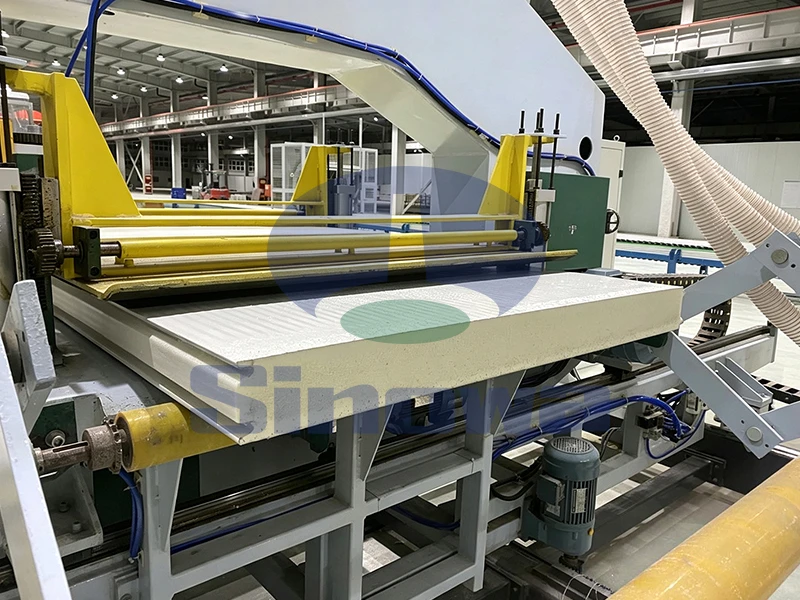
Mechanical feeding instability is one of the most fundamental causes of inaccurate length cutting in continuous PU sandwich panel production lines. The entire production process relies on traction rollers to steadily convey composite panels to the cutting station at a constant speed. After long-term high-load operation, the surface of traction rollers will gradually wear out, leading to reduced surface friction. When friction is insufficient, relative slippage occurs between the roller surface and the panel base material during high-speed conveying. This slippage makes the actual feeding distance inconsistent with the theoretical distance calculated by the system. In addition, uneven pressure distribution of the upper and lower traction rollers will cause partial slippage of the panel. If the roller pressure is too loose at local positions, the panel cannot be clamped tightly, while excessive pressure will cause minor deformation of the PU foam core layer, further disrupting the stability of linear feeding and resulting in cumulative length errors during continuous cutting.
Encoder failure and abnormal operation serve as key electrical factors triggering cutting length errors. The encoder is the core measuring component that records the panel’s feeding length by converting mechanical rotation into pulse signals. Long-term operation may cause wear of the encoder’s internal bearings and grating discs, reducing the accuracy of pulse signal collection. Meanwhile, improper installation of the encoder wheel will directly affect detection results. If the spring pressure of the encoder contact arm is unstable, the wheel cannot maintain close contact with the panel surface, leading to intermittent signal loss or pulse count deviation. Slick, color-coated or slightly oily panel surfaces will also increase the risk of encoder wheel slippage. Each tiny pulse error will accumulate in continuous production, eventually making the actual cutting length of PU sandwich panels deviate significantly from the preset standard value.
System parameter drift and incorrect PLC program settings are frequent hidden troubles of cutting inaccuracy. The production line’s cutting action is controlled by preset program parameters in the PLC system, which unifies feeding speed, cutting delay and fixed-length cutting data. After long-term uninterrupted operation, the system may experience program drift, causing original accurate parameter thresholds to gradually deviate. Many production operators fail to conduct regular parameter calibration and verification, leading to inconsistent matching between system theoretical data and on-site actual production conditions. In addition, improper manual parameter adjustment will also cause errors. Random modification of cutting delay time, feeding compensation coefficient and other core parameters without trial cutting verification will disrupt the synchronization between the feeding system and the cutting system, resulting in irregular length deviation of finished PU sandwich panels in batch production.
Unstable operating speed and inconsistent deceleration parameters before cutting greatly affect cutting precision. The continuous PU sandwich panel production line needs to maintain stable operating speed during batch production to ensure uniform feeding displacement per unit time. Frequent speed fluctuation caused by equipment load changes or motor operation instability will lead to variable panel feeding speed. When the cutting system executes fixed-length cutting according to fixed parameters, faster feeding speed will lead to over-length cutting, while slower speed will cause short-length cutting. Moreover, unreasonable deceleration settings before cutting are a prominent problem. Sudden speed reduction or inconsistent deceleration amplitude will make the panel produce inertial displacement at the moment of cutting. The inertial sliding of the panel cannot be accurately calculated by the fixed system program, thus generating random length errors in each cutting process.
Material surface characteristics and structural differences induce unnoticeable cutting length deviations. PU sandwich panels with different surface coatings and core layer densities have distinct friction characteristics and structural stability. Panels with smooth and low-friction surfaces are more prone to integral slippage on the traction rollers during conveying compared with conventional panels. Meanwhile, slight differences in the foaming density of the PU core layer will cause inconsistent material rigidity. Panels with low core density are prone to minor compression deformation under the clamping force of traction rollers, changing the actual linear conveying length. In continuous production, raw material batch replacement often occurs without timely adjustment of equipment operating parameters. The original parameters adapted to the previous material cannot match the new material’s conveying characteristics, resulting in continuous cutting length errors after material switching.
Guide rail misalignment and material conveying deviation affect linear feeding accuracy. The production line’s guide rails and limit devices are designed to ensure that panels are conveyed along a fixed straight path to the cutting station. Long-term vibration and mechanical impact in production will cause slight offset or deformation of guide rail positions. When the panel deviates from the standard conveying track, it will rub against the guide rail baffle during movement, generating resistance that changes the uniform feeding state. Conveying deflection will also make the panel enter the cutting station at a tiny inclined angle. Although the angle deviation is not obvious visually, it will cause changes in effective cutting length. The system calculates length based on linear horizontal displacement, while the inclined conveying state will produce actual dimensional deviation, leading to inconsistent length of finished panels after cutting.
Hydraulic and pneumatic system instability of the cutting unit causes cutting synchronization errors. Most continuous PU sandwich panel production lines adopt hydraulic or pneumatic driving cutting mechanisms to complete high-speed fixed-length cutting. Stable hydraulic pressure and air pressure are the prerequisites for synchronous coordination between cutting action and feeding action. Pressure fluctuation caused by insufficient hydraulic station power, aging sealing parts or air leakage in the pneumatic pipeline will lead to delayed or incomplete cutting action. When the cutting tool fails to act in place at the preset moment, the feeding system still continues to advance the panel, resulting in longer-than-standard cutting length. In addition, inconsistent pressure output will cause unbalanced cutting speed, making the panel produce position offset during cutting and further aggravating length dimensional errors of finished products.
Blade wear and abnormal cutting tool status indirectly trigger length inaccuracy. The cutting blade is a key execution component for panel forming and cutting. After long-term repeated cutting of PU composite materials, the blade edge will gradually become dull and deformed. A dull blade cannot complete cutting instantly, and the prolonged cutting process will form a time difference with the continuous feeding movement of the panel. During this time difference, the panel still maintains a forward conveying state, resulting in excessive cutting length. Meanwhile, loose blade installation and unbalanced blade gap will cause jitter during cutting. The tiny jitter displacement will change the effective cutting position, leading to irregular length deviation of individual panels. This error is easy to be ignored in daily inspection but will gradually amplify in continuous batch production.
Environmental temperature fluctuation affects equipment operation and material stability to induce cutting errors. The operating temperature of the production workshop has a subtle but lasting impact on cutting accuracy. Ambient temperature changes will cause thermal expansion and contraction of production line mechanical components such as traction rollers, guide rails and cutting brackets, changing the original precise mechanical matching gap. Temperature rise will also soften the PU foam core layer of the panel, reducing material rigidity and increasing compression deformation during conveying and cutting. In addition, temperature fluctuation will affect the operating stability of the motor and electrical control system, causing slight changes in operating speed and signal transmission efficiency. These subtle changes will accumulate in continuous production, resulting in batch fluctuation of panel cutting length.
Insufficient daily maintenance and non-standard manual operation amplify cutting length errors. Many length accuracy problems are not caused by equipment failure itself but by long-term neglected maintenance and irregular operation. Long-term accumulation of dust and debris on traction rollers and encoder wheels will reduce friction and affect signal detection accuracy, yet these details are often omitted in daily cleaning and inspection. Operators may also have non-standard operation behaviors such as random start-stop of equipment and frequent emergency pause in production, disrupting the stable operating rhythm of the production line and causing cumulative errors in system length calculation. Lack of regular equipment calibration, parameter debugging and component replacement makes minor errors continue to accumulate and evolve into obvious batch cutting length deviation problems.
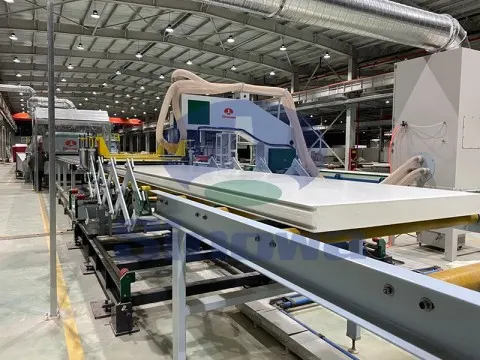
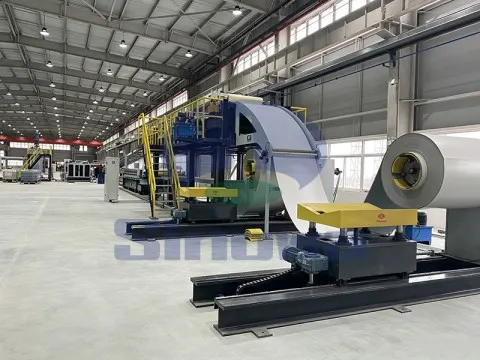
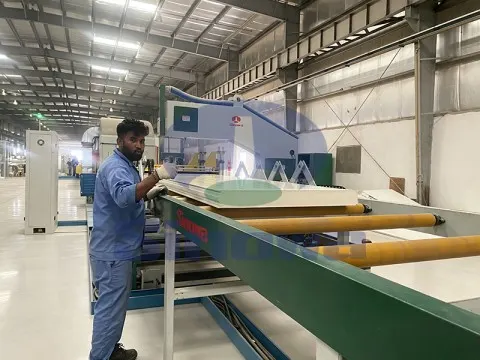
Gallery of Continuous PU Sandwich Panel Production Line
Tags: continuous pu sandwich panel production line, continuous pu sandwich panel production line manufacturer, continuous pu sandwich panel production line supplier, china continuous pu sandwich panel production line, continuous pu sandwich panel production line for sale
-
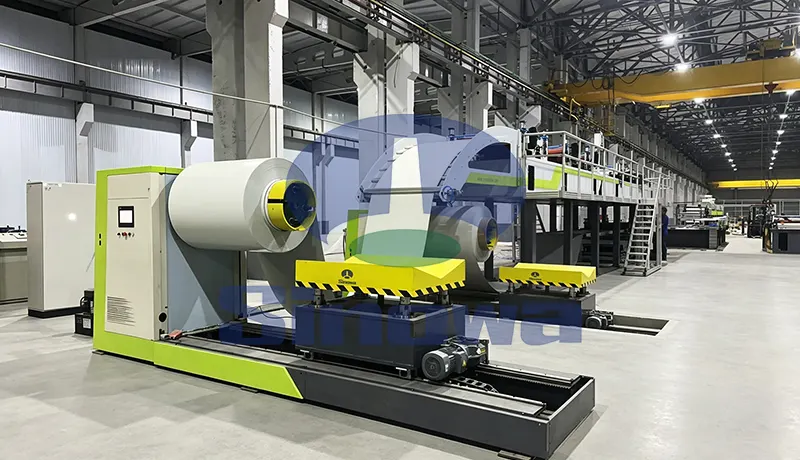
A reliable PU sandwich panel production line serves as the core equipment for manufacturing high-performance building insulation panels. This professional PU sandwich panel line features automated feeding, foaming and molding processes to ensure consistent panel thickness and structural stability. The well-designed polyurethane sandwich panel production line effectively improves production efficiency while reducing material waste in daily operation. Each calibrated polyurethane sandwich panel line can adapt to different panel sizes to meet diverse construction needs. With precise temperature and pressure control, the advanced continuous PU sandwich panel line produces panels with excellent thermal insulation and weather resistance. Meanwhile, the optimized PIR sandwich panel production line upgrades the foaming formula to enhance fire resistance performance. The high-efficiency PIR sandwich panel line maintains stable operation during long-term mass production, delivering durable and high-quality sandwich panels for various architectural and industrial applications.
-
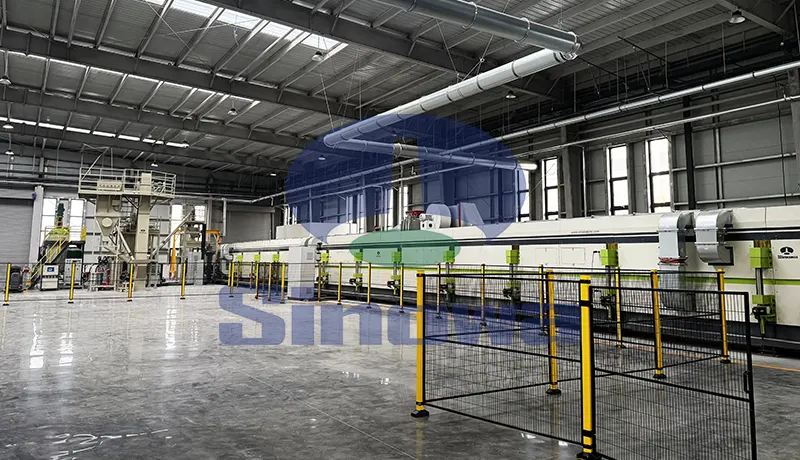
The phenolic panel production line realizes automated and continuous manufacturing of high-performance thermal insulation panels through streamlined and coordinated processing procedures.
-
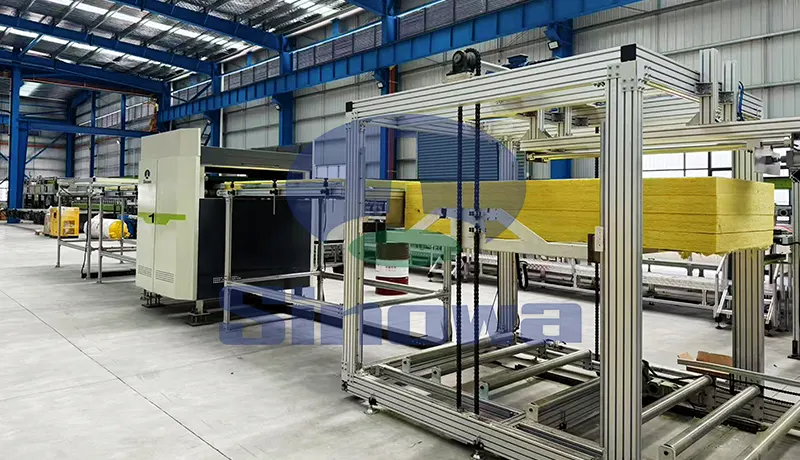
Modern insulation panel manufacturing relies on professional automated equipment to ensure stable product quality and high production efficiency. The rock wool sandwich panel production line features precise material lamination and forming processes to produce rigid, heat-insulating building panels. Meanwhile, the mineral wool sandwich panel production line adopts optimized assembly procedures to fabricate lightweight, soundproof panels widely used in architectural enclosure and thermal preservation projects.