How To Adjust The Production Speed Of A Continuous PUR Sandwich Panel Production Line?
Publication Date: Oct 9, 2026
Adjusting the speed of a continuous PUR sandwich panel production line is critical to balancing production efficiency and product quality.
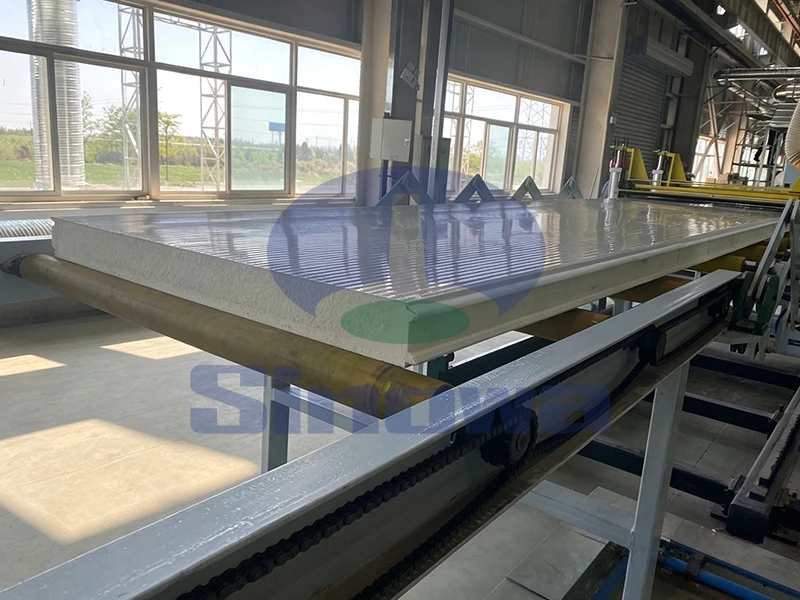
The foundation of reasonable production speed adjustment lies in clarifying the core correlation between line speed and PUR material curing characteristics, which determines the basic speed range of the entire production process. PUR foam relies on accurate chemical reaction and curing molding during continuous production, and the line speed directly affects the residence time of panels in the heating and pressing area. If the operating speed is excessively high, the PUR core layer cannot complete full foaming, gelling and curing, resulting in incomplete core filling, weak bonding between the core material and metal surface layer, and even delamination defects in finished panels. Conversely, overly low speed will cause excessive compression of the foam structure, damage the uniform cell distribution of PUR materials, reduce the thermal insulation and mechanical properties of panels, and also lead to low production efficiency and increased material energy consumption. Before any speed adjustment, operators need to confirm the curing cycle characteristics of the current PUR formula, and take this as the basic benchmark to formulate feasible speed adjustment schemes, avoiding blind speed changes that disrupt the production balance.
Matching production speed with panel specification parameters is a key step in accurate speed adjustment, as different panel thicknesses and structural designs require corresponding line speed configurations. Thin lightweight sandwich panels have a short curing cycle for the PUR core layer and can adapt to a relatively fast production speed without affecting molding quality. In contrast, thick panels used for thermal insulation and special enclosure structures need longer heat preservation and curing time in the pressing and molding section, so the line speed must be appropriately reduced to ensure the deep curing of the thick core layer. In actual adjustment, operators need to synchronize speed parameters according to real-time panel production specifications. When switching from thin to thick panel production, the speed should be reduced gradually in small increments rather than sudden deceleration, which can prevent sudden changes in material feeding and pressing pressure from causing panel surface unevenness and core layer density deviation. Meanwhile, the surface material type also needs to be considered, as different surface materials have different tension and bonding adaptation characteristics, requiring fine-tuning of speed to maintain composite stability.
Mastering the synchronous adjustment of the core control system is essential for stable speed regulation of continuous PUR sandwich panel production lines. Most modern production lines adopt integrated PLC and frequency conversion control systems, which support stepless speed adjustment of the entire line and synchronous linkage of each functional module. The core of speed adjustment is to unify the operating frequency of the main conveyor, feeding system, foaming injection system and post-processing cutting system. When increasing the production speed, operators need to first adjust the main line operating frequency through the human-machine interface, and the system will synchronously optimize the operating parameters of each linkage module. It is necessary to avoid independent speed adjustment of a single module, because mismatched speeds between material feeding, foaming injection and conveyor transmission will lead to uneven PUR material distribution, excessive or insufficient material supply, and defective panel molding. After each speed adjustment, the system linkage operation status should be checked briefly to ensure all functional sections run in coordination and eliminate production bottlenecks caused by asynchronous speed.
Adjusting PUR material feeding and foaming parameters synchronously with line speed is crucial to guarantee consistent product quality after speed modification. The foaming flow rate, material mixing ratio and injection pressure of the PUR two-component materials are closely linked to the production line speed. With the increase of line speed, the unit time material demand for panel molding rises correspondingly, so the foaming system’s material feeding flow rate needs to be increased proportionally to avoid insufficient core material filling. When the line speed decreases, the material feeding flow rate should be reduced synchronously to prevent redundant material accumulation, excessive foaming and core layer bulging. In addition, the material mixing efficiency and injection timing need fine calibration. Faster line speeds require more uniform material mixing and precise injection positioning to ensure the PUR material can spread evenly and foam stably in a short molding cycle. Reasonable matching of feeding and foaming parameters with operating speed can effectively avoid common quality problems such as hollow cores, uneven density and inconsistent panel thickness.
Temperature parameter optimization is an indispensable auxiliary measure for scientific production speed adjustment, as temperature directly affects PUR reaction efficiency and curing speed. The heating temperature of the pressing mold, preheating temperature of surface materials and constant temperature state of the foaming working area all restrict the maximum feasible production speed. Higher and stable working temperatures can accelerate the chemical reaction and curing speed of PUR materials, allowing the production line to operate at a relatively faster speed while ensuring full curing of the core layer. When the production environment or equipment temperature is low, the PUR curing rate slows down, and blindly increasing the line speed will definitely cause incomplete curing. In the speed adjustment process, operators need to adjust the heating system parameters in real time according to the set operating speed. For high-speed production, appropriately increase the mold and preheating temperature within the adaptable range of materials and equipment; for low-speed production, moderately reduce the temperature to avoid over-curing and material performance attenuation, realizing the dynamic balance of speed, temperature and curing effect.
Gradual speed trial and quality verification mechanisms ensure the safety and stability of speed adjustment for continuous production lines. It is impossible to complete large-scale speed adjustment in one go during formal production, and step-by-step trial adjustment is the standard operating procedure. Operators can adjust the line speed in small fixed increments, maintain each new speed for a certain continuous production cycle, and conduct comprehensive quality inspection on the produced panels. The inspection focuses on core layer curing degree, bonding firmness between layers, panel flatness, dimensional accuracy and internal cell structure. If no quality defects are found after stable operation, the speed can be further increased appropriately; once subtle quality problems appear, the speed should be reduced slightly and the parameters should be optimized again. This gradual trial method can effectively avoid batch quality losses caused by excessive speed adjustment, and help find the optimal speed range matching the current production conditions and material status.
Tension synchronization adjustment of surface material unwinding and conveying systems cannot be ignored in the overall production speed regulation process. The metal or composite surface materials of PUR sandwich panels are supplied through continuous unwinding equipment, and the unwinding speed and material tension must be highly synchronized with the main line production speed. When the production line speed increases, the unwinding system’s operating speed needs to be synchronously improved, and the tension control parameters should be fine-tuned to prevent material tension deviation. Excessively tight tension will cause surface material stretching and deformation, while loose tension will lead to material wrinkling and offset lamination. During speed reduction, the unwinding deceleration amplitude needs to match the main line to avoid material accumulation and conveying stagnation. Maintaining stable tension synchronization ensures that the surface materials are always flat and accurately positioned during high-speed or low-speed operation, providing a reliable foundation for accurate composite molding of PUR core materials.
Post-processing module speed matching is a key link to realize full-line stable operation after speed adjustment of the front-end molding system. The cutting, trimming, stacking and conveying equipment in the post-processing section needs to fully match the production rhythm of the front-end molding line. If the front-end molding speed is increased while the post-processing operating speed remains unchanged, finished panels will accumulate at the transition position, causing extrusion deformation and surface scratch damage. On the contrary, excessive post-processing speed will lead to unstable panel transmission and disordered stacking. In the speed adjustment process, the operating frequency and action rhythm of post-processing equipment should be linked with the main line speed in real time through the control system. Dynamic adjustment of cutting interval, trimming speed and stacking frequency ensures that each production link is closely connected, the production rhythm is smooth, and no process bottlenecks or material accumulation problems occur.
Real-time monitoring and dynamic fine-tuning of operating parameters help maintain long-term stable speed operation of the production line. The production state of continuous PUR sandwich panel lines is affected by subtle changes in ambient temperature, material batch differences and equipment operating wear, which require real-time dynamic adjustment of production speed. Operators need to observe the equipment operating data and product quality status during continuous production, and make tiny adjustments to the line speed and matching parameters according to actual conditions. For example, subtle changes in material activity will affect the curing speed, requiring slight speed correction to maintain molding quality. At the same time, the system’s automatic monitoring function can feed back abnormal data such as motor load, material flow and temperature deviation, and operators can adjust the speed in time according to early warning information to avoid equipment overload operation and product quality fluctuations.
Standardized speed adjustment maintenance and daily parameter optimization can effectively extend equipment service life and stabilize long-term production quality. Frequent unreasonable speed fluctuations will increase the operating load of motors, transmission parts and control systems, accelerating equipment wear and increasing failure risks. After each speed adjustment and parameter optimization, operators need to record the optimal matching parameters of speed, temperature, material flow and tension for different panel specifications, forming a complete production parameter database. In subsequent batch production of the same specification, mature parameter combinations can be directly invoked to realize rapid and accurate speed setting. In addition, daily equipment maintenance such as cleaning transmission parts, checking frequency conversion system stability and calibrating temperature sensors can ensure the accuracy of speed adjustment, maintain the consistent operation state of the production line, and finally realize the dual improvement of production efficiency and product qualification rate.






Tags: continuous pur sandwich panel production line, continuous pur sandwich panel production line manufacturer, continuous pur sandwich panel production line supplier, china continuous pur sandwich panel production line, continuous pur sandwich panel production line for sale
-

A reliable PU sandwich panel production line serves as the core equipment for manufacturing high-performance building insulation panels. This professional PU sandwich panel line features automated feeding, foaming and molding processes to ensure consistent panel thickness and structural stability. The well-designed polyurethane sandwich panel production line effectively improves production efficiency while reducing material waste in daily operation. Each calibrated polyurethane sandwich panel line can adapt to different panel sizes to meet diverse construction needs. With precise temperature and pressure control, the advanced continuous PU sandwich panel line produces panels with excellent thermal insulation and weather resistance. Meanwhile, the optimized PIR sandwich panel production line upgrades the foaming formula to enhance fire resistance performance. The high-efficiency PIR sandwich panel line maintains stable operation during long-term mass production, delivering durable and high-quality sandwich panels for various architectural and industrial applications.
-

The phenolic panel production line realizes automated and continuous manufacturing of high-performance thermal insulation panels through streamlined and coordinated processing procedures.
-

Modern insulation panel manufacturing relies on professional automated equipment to ensure stable product quality and high production efficiency. The rock wool sandwich panel production line features precise material lamination and forming processes to produce rigid, heat-insulating building panels. Meanwhile, the mineral wool sandwich panel production line adopts optimized assembly procedures to fabricate lightweight, soundproof panels widely used in architectural enclosure and thermal preservation projects.