What Causes Poor Bonding Strength Of PU Panels Made By The Continuous PU Sandwich Panel Line?
Publication Date: Oct 9, 2026
Poor bonding strength of continuously produced PU sandwich panels stems from intertwined material, equipment, process and environmental factors. These issues disrupt interfacial adhesion between PU foam cores and surface panels, causing delamination and reduced structural durability in finished products.
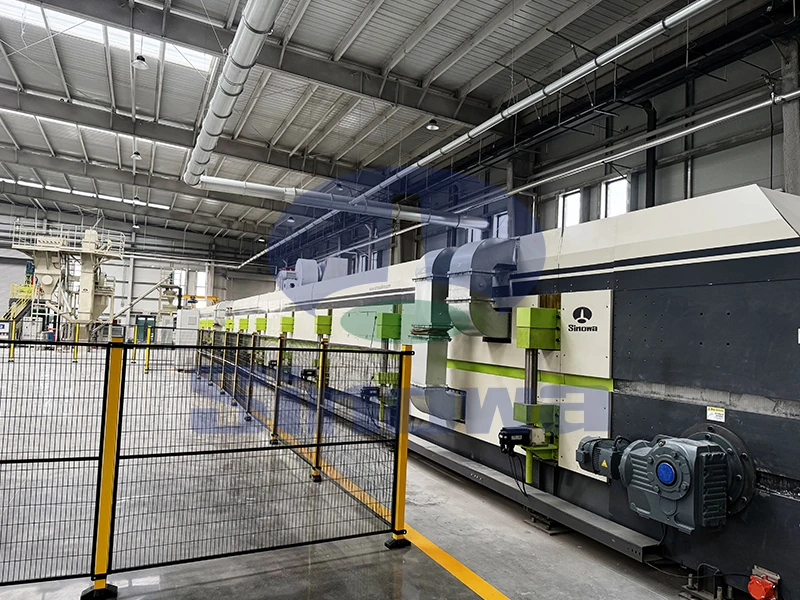
Improper ratio of polyurethane raw materials stands as one of the most prevalent causes of weak bonding in continuous PU sandwich panel production. PU foam bonding relies on the precise chemical reaction between isocyanate and polyol components, and any deviation from the optimal mixing proportion will directly undermine the cross-linking reaction efficiency. Excess isocyanate leads to brittle foam layers that fail to form flexible and tight interfacial bonds, while insufficient isocyanate results in incomplete reaction and low foam cohesion. In continuous production lines, automatic dosing system fluctuations often trigger subtle ratio imbalances that are hard to detect in real time. Such unbalanced mixing reduces the foam’s surface wettability, preventing the PU material from fully fitting the surface panel substrate. Over time, the incomplete chemical bonding interface gradually separates, drastically lowering the overall bonding strength of the sandwich panel and causing early delamination during use.
Surface contamination of facing materials severely impairs the bonding performance of continuous PU sandwich panels and is a frequently overlooked production defect. During continuous feeding, surface panels are prone to accumulating oil stains, dust, oxide layers and residual coating additives from processing and transportation. These contaminants form a thin isolation layer between the panel substrate and PU foam, blocking effective molecular contact and chemical bonding. Even tiny invisible oil films can reduce the surface energy of the facing material, making it impossible for the flowing PU foam to spread and wet the surface uniformly. In continuous line operation, high-speed production rhythms often simplify surface cleaning procedures, leaving residual contaminants on the substrate. Unlike obvious surface defects, bonding failure caused by contamination usually appears after product storage or application, leading to unstable bonding strength and latent quality risks for mass-produced panels.
Unreasonable temperature control throughout the continuous production process greatly affects PU foam curing and interfacial bonding quality. PU foaming and adhesion are typical exothermic reactions that require stable and appropriate temperature conditions to complete cross-linking and interface combination. Low temperature of the incoming facing materials acts as a heat sink, absorbing the heat released by PU foaming and slowing down the curing reaction speed. This results in insufficient maturation of the foam surface layer, forming a loose transitional layer between the foam core and the facing panel with extremely weak bonding force. Conversely, excessive local temperature in the laminator causes rapid surface curing of PU foam, forming a hardened outer layer that hinders internal heat dissipation and subsequent reaction. The internal foam fails to cure completely, creating inconsistent bonding strength across the panel. Continuous production lines with unstable temperature zoning will produce large batches of panels with uneven interfacial adhesion and reduced overall bonding stability.
Unstable laminator pressure in continuous production directly leads to insufficient and uneven bonding of PU sandwich panels. The double-belt laminator is the core equipment that provides pressure for foam fitting and curing, and uniform continuous pressure is essential for tight interfacial bonding. Insufficient overall pressure cannot drive the newly formed fluid PU foam to fully infiltrate the tiny gaps and textures on the facing material surface, resulting in incomplete contact between the foam core and the panel. Local pressure fluctuations caused by equipment vibration, belt wear or uneven gap adjustment lead to inconsistent compression degrees in different panel areas. Some sections form tight bonds while others generate voids and gaps at the interface. These weak pressure-induced bonding areas become stress concentration points, which are prone to peeling under slight external force or long-term environmental erosion, significantly reducing the overall bonding strength and service stability of the panels.
Defects induced by pentane blowing systems are a key factor behind poor bonding in modern continuous PU panel production. Pentane, a common blowing agent for environmental-friendly PU foam, has inherent compatibility limitations with conventional polyether and polyester polyol raw materials. Its low solubility difference with PU resin increases the initial viscosity of the mixed material, weakening the fluidity and spreadability of the foaming system. This poor fluidity prevents the PU mixture from fully wetting the facing surface during high-speed continuous pouring, leaving microscopic gaps at the bonding interface. In addition, pentane absorbs massive heat during vaporization to form foam pores, producing an obvious evaporative cooling effect. This local temperature drop slows the interfacial curing reaction, resulting in under-cured foam surface layers. The incomplete reaction interface cannot form stable chemical bonds, ultimately leading to decreased bonding strength and easy delamination of finished panels.
Inadequate curing time in continuous production cycles severely compromises the bonding integrity of PU sandwich panels. The continuous line operates at a fixed high-speed rhythm, and the curing time is strictly matched with the production pace. When the line speed is improperly increased to boost output, the PU foam fails to complete full cross-linking curing before leaving the laminator and entering subsequent cutting and stacking processes. Insufficient curing leaves the foam core with low green strength and incomplete interfacial molecular bonding. Although the panel appears intact visually after production, the bonding interface lacks durable structural force. In the follow-up storage and application process, residual unreacted components continue to react slowly or fail to react completely, causing gradual separation of the bonding interface. Short curing time also leads to inconsistent internal and external curing degrees of the foam, further reducing the overall bonding uniformity and mechanical strength of the panel.
Poor surface wettability of special facing materials causes persistent bonding weakness in continuous PU sandwich panels. Many functional facing panels adopt pre-painted, galvanized or silicone-modified coating processes to enhance corrosion resistance and weather resistance. These treated surfaces have low surface energy and smooth texture, which greatly reduce the wettability of fluid PU foam. In continuous production, the high-speed foaming and fitting process leaves no extra time for the PU material to adapt to low-energy surfaces, resulting in insufficient spreading and adhesion. The physical adsorption force between the foam and the facing is extremely weak, and effective chemical cross-linking bonds are difficult to form. Even if the initial bonding seems normal, external temperature changes and mechanical vibration in long-term use will easily break the fragile interface, leading to peeling and delamination. This problem is particularly prominent in mass continuous production, causing widespread weak bonding defects.
Irregular raw material storage and pre-treatment affect the bonding performance of continuously produced PU panels. PU raw materials including isocyanate and polyol are sensitive to humidity and temperature changes in the storage environment. Excessive ambient humidity causes isocyanate to react with water vapor in advance, producing invalid crystalline substances and reducing effective reaction components. Raw materials stored at too low temperatures will increase viscosity and reduce fluidity, leading to uneven mixing during continuous batching. In addition, insufficient preheating of raw materials before production makes the mixed foaming system have unstable initial reaction activity. Inconsistent reaction speed during continuous pouring and foaming results in uneven foam density and irregular interfacial bonding. Deteriorated raw material activity and invalid components directly weaken the chemical bonding force between foam and facing, forming inherent weak bonding defects in finished panels.
Unstable production line operation and equipment aging trigger cumulative bonding strength defects in long-term continuous production. Long-term operation of continuous PU sandwich line leads to gradual wear of conveyor belts, inaccurate dosing sensor calibration and unbalanced laminator gap. These aging problems cause subtle fluctuations in raw material mixing ratio, feeding speed and pressing pressure, which cannot be eliminated by conventional daily inspection. Vibration generated by unstable equipment operation disrupts the uniform spreading and stable curing of PU foam, resulting in local sparse foam structure and incomplete interface fitting. Meanwhile, accumulated dust and residual foam on equipment surfaces may fall onto the bonding interface during production, forming isolation impurities. These cumulative minor defects jointly reduce the overall bonding quality, leading to large-scale fluctuation of panel bonding strength and increased unqualified rate of finished products.
Uncontrolled workshop environmental conditions interfere with PU foaming and interfacial bonding in continuous production. Ambient temperature, humidity and air flow in the production workshop have a non-negligible impact on PU reaction efficiency. Excessively high workshop humidity accelerates side reactions of PU raw materials, consuming effective bonding components and reducing interfacial adhesion. Too low ambient temperature prolongs the foaming induction period and slows curing speed, making it difficult to form tight bonds. Strong air flow in the workshop causes rapid heat loss on the panel surface and partial drying of the foam surface, resulting in premature surface film formation and blocked internal curing. In continuous mass production, unstable environmental parameters lead to inconsistent reaction states of each batch of panels, causing irregular bonding strength attenuation and poor product bonding consistency.
Gallery of Continuous PU Sandwich Panel Line






Tags: continuous pu sandwich panel line, continuous pu sandwich panel line manufacturer, continuous pu sandwich panel line supplier, china continuous pu sandwich panel line, continuous pu sandwich panel line for sale
-

A reliable PU sandwich panel production line serves as the core equipment for manufacturing high-performance building insulation panels. This professional PU sandwich panel line features automated feeding, foaming and molding processes to ensure consistent panel thickness and structural stability. The well-designed polyurethane sandwich panel production line effectively improves production efficiency while reducing material waste in daily operation. Each calibrated polyurethane sandwich panel line can adapt to different panel sizes to meet diverse construction needs. With precise temperature and pressure control, the advanced continuous PU sandwich panel line produces panels with excellent thermal insulation and weather resistance. Meanwhile, the optimized PIR sandwich panel production line upgrades the foaming formula to enhance fire resistance performance. The high-efficiency PIR sandwich panel line maintains stable operation during long-term mass production, delivering durable and high-quality sandwich panels for various architectural and industrial applications.
-

The phenolic panel production line realizes automated and continuous manufacturing of high-performance thermal insulation panels through streamlined and coordinated processing procedures.
-

Modern insulation panel manufacturing relies on professional automated equipment to ensure stable product quality and high production efficiency. The rock wool sandwich panel production line features precise material lamination and forming processes to produce rigid, heat-insulating building panels. Meanwhile, the mineral wool sandwich panel production line adopts optimized assembly procedures to fabricate lightweight, soundproof panels widely used in architectural enclosure and thermal preservation projects.