What Is The Difference Between Continuous And Discontinuous PU Sandwich Panel Line?
Publication Date: Sep 28, 2026
Continuous and discontinuous PU sandwich panel lines are two core manufacturing devices for polyurethane sandwich panels, differing greatly in operational modes, production efficiency, process flexibility and product applicability.
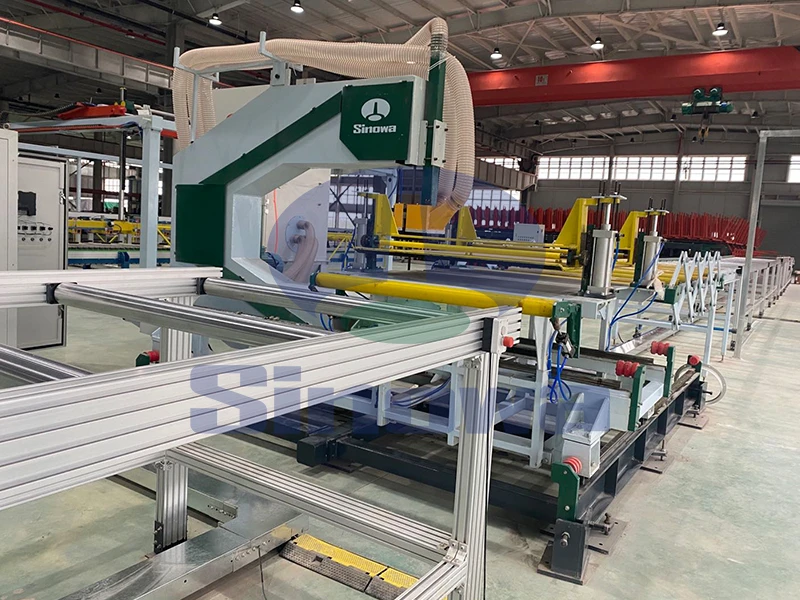
The most fundamental difference between continuous and discontinuous PU sandwich panel lines lies in their core production operation modes. A continuous line adopts an integrated and uninterrupted assembly line operation, where all production links including surface material unwinding, roll forming, PU material mixing and injection, lamination, curing, cutting and finished product stacking are closely connected into a closed-loop flow. Once the equipment starts running, it maintains a steady and continuous material transmission and processing state without frequent shutdowns in the production cycle. In contrast, the discontinuous line follows a batch and intermittent production logic, completing panel manufacturing through independent single-cycle operations. Each panel production process is relatively separate; the equipment suspends operation after finishing one batch of products, and workers adjust parameters or reset molds before launching the next production cycle, forming an intermittent processing rhythm.
Production efficiency and output capacity form another obvious gap between the two types of PU sandwich panel production lines. Benefiting from the seamless and non-stop operational design, continuous lines boast extremely high production speed and stable hourly output. The whole production process realizes full automation linkage, eliminating the time loss caused by equipment shutdown, mold replacement and parameter resetting. It can sustain long-hour stable operation, making it ideal for large-volume and long-term continuous production tasks. Discontinuous lines, however, have relatively limited overall output due to their batch production characteristics. Each production cycle requires waiting for PU material curing, mold opening and closing, and product demolding, which consumes extra auxiliary time. Although the single-panel processing quality is controllable, the unit time output is far lower than that of continuous lines, restricting its application in mass production scenarios.
Product customization flexibility varies significantly between continuous and discontinuous PU sandwich panel lines, catering to different market order demands. Discontinuous lines exhibit outstanding flexibility in product specification adjustment. Since each production batch is independent, technicians can easily modify panel thickness, length, surface material types and special structural designs before each production cycle. It can quickly respond to small-batch, diversified and customized orders with special requirements, covering complex panel shapes and non-standard sizes that are hard to achieve with continuous production. Continuous lines, with their highly integrated and fixed assembly line structure, are more suitable for standardized product production. Adjusting product specifications requires overall parameter debugging and equipment calibration of the entire line, which takes a long time and is not conducive to frequent specification changes, resulting in weak customization adaptability.
The internal technological process and curing mechanism of the two production lines have essential differences that affect product forming quality. Continuous lines adopt tunnel-type continuous curing, where panels move forward synchronously with the production line at a constant speed in a closed constant-temperature curing channel. The PU foaming and curing process proceeds steadily under fixed temperature, pressure and speed conditions, enabling uniform foaming density and consistent bonding strength between core materials and surface layers. Discontinuous lines rely on hydraulic press mold curing technology. After injecting PU materials into the fixed mold cavity, the press closes and maintains constant pressure and temperature for a certain period to complete foaming and curing. This static curing mode allows sufficient reaction of PU materials, ensuring excellent overall flatness and structural firmness of single panels, especially suitable for thick panels with high structural performance requirements.
Automation level and labor demand differ greatly between continuous and discontinuous PU sandwich panel production lines. Continuous production lines achieve full-process automated control from raw material feeding to finished product output. The entire production process is monitored and adjusted by intelligent control systems, with no need for manual intervention in intermediate links. Only a small number of operators are required to conduct equipment inspection, parameter monitoring and fault handling, greatly reducing labor dependence and human error. Discontinuous lines belong to semi-automated production equipment. Key links such as surface material placement, mold positioning and finished product taking out still require manual assistance. Each production cycle needs human participation in auxiliary operations, leading to higher labor demand, and product quality is more susceptible to manual operation proficiency.
Product quality consistency and stability show distinct characteristics under the two production modes. Continuous lines maintain unified production parameters such as material ratio, injection volume, curing temperature and operating speed during long-term operation. All finished panels are processed under identical technological conditions, so the product dimensional accuracy, foaming uniformity, thermal insulation performance and bonding tightness remain highly consistent. The batch operation of discontinuous lines leads to slight parameter fluctuations in different production cycles. Differences in manual operation and mold state may cause tiny gaps in the performance and size of different batches of panels. Although the quality of single qualified panels is excellent, the overall batch consistency is inferior to that of continuously produced products.
Equipment structure, floor space and production site requirements form another key distinction between the two lines. Continuous PU sandwich panel manufacturing lines feature a highly integrated and long linear structural layout, covering a large production area. The equipment integrates multiple functional units such as unwinding, forming, foaming, curing and cutting into one whole set, with complex internal structure and high overall equipment matching. It requires a standardized and spacious factory site to meet the layout and operational needs. Discontinuous lines adopt a modular and split structural design with compact overall layout and smaller floor space. Each functional unit is relatively independent, and the equipment assembly is more flexible, enabling normal production in small and medium-sized factory sites with limited space conditions, with lower requirements for site standardization.
Material utilization rate and production cost control effects vary between continuous and discontinuous production modes. Continuous lines realize precise and continuous raw material metering and feeding through automated systems, effectively avoiding raw material waste caused by repeated debugging and intermittent feeding. The long-term stable mass production mode also averages out equipment operation and maintenance costs, with low unit product production cost and high material utilization rate. Discontinuous lines have certain material loss in each batch of production due to repeated material injection, mold debugging and equipment start-stop operations. The relatively scattered production process leads to higher unit energy consumption and labor cost, resulting in higher comprehensive production cost for single products and lower overall material utilization rate compared with continuous production.
Equipment maintenance difficulty and operational stability differ greatly in long-term production. Continuous sandwich panel lines have integrated and sophisticated mechanical and electrical systems, with complex matching relationships between various functional units. Daily maintenance requires professional technical personnel to conduct systematic inspection and debugging of the whole line, and equipment failure may affect the entire production process, causing production suspension. However, its stable operational program reduces random failure probability in long-term continuous operation. Discontinuous lines have simple and independent modular structures; faults in a single unit will not affect other links, with low maintenance difficulty and fast fault recovery. But frequent equipment start-stop and manual auxiliary operations increase the wear of mechanical parts, leading to relatively higher long-term equipment failure frequency.
Applicable production scenarios and market positioning clearly distinguish the two types of PU sandwich panel lines. Continuous lines are mainly positioned for large-scale, standardized and high-volume industrial production, suitable for manufacturers focusing on mass supply of conventional specification panels to meet large market batch order demands. They pursue high production efficiency, stable batch quality and low unit cost. Discontinuous lines are oriented towards small and medium-sized production scales and customized market demands, adapting to special specification, small-batch and multi-variety order production. They rely on flexible technological adjustment capabilities to meet personalized panel production needs in special engineering and customized fields, making up for the limitations of continuous standardized production.
Gallery of Continuous PU Sandwich Panel Line






Tags: continuous pu sandwich panel line, continuous pu sandwich panel line manufacturer, continuous pu sandwich panel line supplier, china continuous pu sandwich panel line, continuous pu sandwich panel line for sale
-

A reliable PU sandwich panel production line serves as the core equipment for manufacturing high-performance building insulation panels. This professional PU sandwich panel line features automated feeding, foaming and molding processes to ensure consistent panel thickness and structural stability. The well-designed polyurethane sandwich panel production line effectively improves production efficiency while reducing material waste in daily operation. Each calibrated polyurethane sandwich panel line can adapt to different panel sizes to meet diverse construction needs. With precise temperature and pressure control, the advanced continuous PU sandwich panel line produces panels with excellent thermal insulation and weather resistance. Meanwhile, the optimized PIR sandwich panel production line upgrades the foaming formula to enhance fire resistance performance. The high-efficiency PIR sandwich panel line maintains stable operation during long-term mass production, delivering durable and high-quality sandwich panels for various architectural and industrial applications.
-

The phenolic panel production line realizes automated and continuous manufacturing of high-performance thermal insulation panels through streamlined and coordinated processing procedures.
-

Modern insulation panel manufacturing relies on professional automated equipment to ensure stable product quality and high production efficiency. The rock wool sandwich panel production line features precise material lamination and forming processes to produce rigid, heat-insulating building panels. Meanwhile, the mineral wool sandwich panel production line adopts optimized assembly procedures to fabricate lightweight, soundproof panels widely used in architectural enclosure and thermal preservation projects.