What Panel Thickness Can Continuous PIR Sandwich Panel Production Line Customize?
Publication Date: Oct 12, 2026
Continuous PIR sandwich panel production lines support flexible thickness customization to fit diverse building insulation needs.
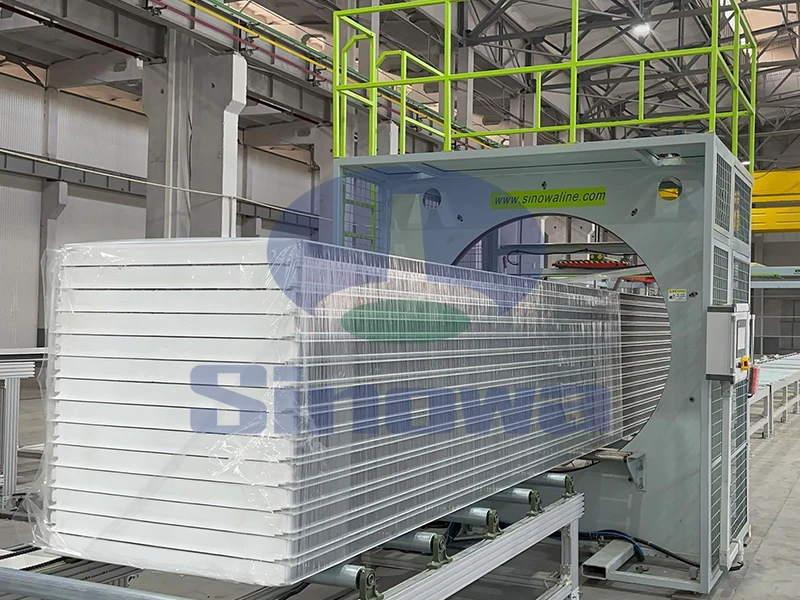
The continuous PIR sandwich panel production line features a highly flexible customizable thickness spectrum, covering conventional and extended specifications to accommodate various architectural and industrial insulation scenarios. The standard adjustable thickness range of mature continuous production equipment spans from 30mm to 250mm, which serves as the core parameter for mass production of mainstream PIR sandwich panels. For special engineering demands, the production system can also achieve extended thickness customization up to 300mm through fine mechanical parameter adjustment and process optimization. This wide coverage enables the production line to switch freely between thin decorative insulation panels and thick heavy-duty thermal insulation panels, eliminating the limitation of single-specification production in intermittent manufacturing equipment and greatly improving production versatility for diversified market demands.
The minimum customizable thickness of 30mm is designed for lightweight and space-saving insulation scenarios, balancing structural stability and basic thermal insulation performance. Panels with 30mm thickness are compact and lightweight, making them ideal for interior partition walls, ceiling insulation, and low-load decorative enclosure structures. The continuous production line ensures uniform PIR foam density and consistent surface bonding strength even at the minimum thickness. Its precise foaming control system avoids common defects such as foam hollowing, uneven thickness, and surface warping that often occur in thin-panel production. Meanwhile, the integrated pressing and forming mechanism maintains the flatness and structural integrity of thin panels, ensuring each finished product meets practical installation and usage requirements without compromising basic mechanical stability.
Medium thickness specifications ranging from 50mm to 150mm represent the most widely customized range for continuous PIR sandwich panel production lines, covering the majority of conventional building insulation projects. Panels in this thickness interval deliver balanced thermal insulation, fire resistance and mechanical bearing capacity, perfectly adapting to exterior wall insulation, roof enclosure, and workshop partition structures of ordinary industrial and civil buildings. The production line’s automated thickness calibration system can achieve stepless adjustment within this range, enabling customized production of arbitrary thickness values instead of fixed gear specifications. This stepless customization feature allows manufacturers to tailor panel thickness according to actual environmental insulation demands, avoiding material waste caused by using over-thick panels or insufficient insulation from undersized specifications.
High-thickness customization from 180mm to 250mm targets high-standard thermal insulation and low-temperature environmental application scenarios, relying on the continuous line’s advanced curing and foaming technology. In cold-region building enclosures, cold storage insulation, and constant-temperature industrial workshop projects, ultra-thick PIR sandwich panels are required to block heat transfer efficiently. The continuous production line optimizes the double-belt conveyor running speed and foam injection volume for high-thickness production, ensuring sufficient foaming and curing time for thick PIR core layers. This process adjustment guarantees uniform foam cell structure inside thick panels, stable overall thermal insulation performance, and enhanced structural compression resistance, preventing core layer deformation or performance attenuation under long-term use.
For special extreme insulation demands, the continuous PIR sandwich panel production line can realize extended thickness customization up to 300mm through targeted process upgrading and parameter tuning. This ultra-thick customization is mainly applicable to special low-temperature warehouses, industrial anti-freezing facilities, and high-energy-consumption building exterior protection structures that require ultra-high thermal insulation efficiency. Different from conventional thickness production, ultra-thick panel manufacturing requires coordinated adjustment of multiple core systems, including high-precision foam batching, delayed curing circulation, and constant-pressure pressing forming. The continuous line’s modular control system supports synchronous parameter matching of each link, ensuring the bonding firmness between the surface sheet and PIR core layer of ultra-thick panels, as well as the overall dimensional stability.
The thickness customization capability of the continuous production line is closely linked to the adaptive adjustment of its core production systems, which ensures product quality consistency across all customized thicknesses. The online foaming system is the core guarantee for thickness adaptation, as it can intelligently adjust PIR material injection amount and foaming pressure according to preset panel thickness parameters. Thinner panels require lower material injection density and faster foaming molding speed, while thicker panels need graded material filling and slow uniform foaming to avoid internal voids. In addition, the automatic thickness detection device installed on the production line conducts real-time monitoring of semi-finished panels, dynamically correcting parameter deviations to keep the thickness error of finished products within a tiny controllable range.
Surface material matching further optimizes the rationality of PIR sandwich panel thickness customization, enabling customized thicknesses to exert optimal comprehensive performance. The production line is compatible with multiple surface materials including color steel plates, aluminum sheets and stainless steel sheets with different thicknesses. When customizing thin panels, matching thin and lightweight surface materials can reduce the overall load of the panel while maintaining rigidity; for medium and high-thickness panels, moderately thickened surface materials can enhance impact resistance and structural durability. The continuous composite molding process realizes tight integration between surface materials and PIR core layers of different thicknesses, avoiding delamination or unbalanced stress caused by mismatched thickness and surface material parameters.
Different application scenarios dictate targeted thickness customization logic for continuous PIR sandwich panels, forming a differentiated production system. Indoor decorative and partition scenarios prioritize thin specifications of 30mm to 50mm to save indoor space and meet basic heat preservation and sound insulation needs. Conventional industrial plant walls and roofs mostly adopt 75mm to 120mm medium-thickness panels to balance cost, insulation and wind resistance performance. Cold chain logistics and low-temperature storage projects focus on 150mm to 250mm high-thickness panels to achieve ultra-low heat transfer coefficient. The production line’s flexible adjustment ability fully covers these scenario-based customization needs, supporting personalized production for diverse engineering projects.
Compared with traditional intermittent production equipment, the continuous production line has prominent advantages in thickness customization accuracy and production stability. Intermittent equipment is limited by manual operation and single-batch molding, prone to large thickness errors and unstable product consistency, and can only produce fixed conventional thickness specifications. In contrast, the fully automated continuous line realizes one-step molding from feeding, foaming, pressing to cutting, with all thickness adjustment parameters digitally controlled. It not only supports arbitrary thickness customization within the full range but also ensures consistent thickness accuracy for each panel in mass continuous production, greatly improving product qualification rate and production efficiency.
With the upgrading of building energy-saving standards and the diversification of industrial insulation demands, the thickness customization technology of continuous PIR sandwich panel production lines is constantly optimized and expanded. The equipment is gradually evolving toward more precise stepless adjustment, smarter parameter matching and wider thickness coverage. While maintaining the existing 30mm-300mm customizable range, the production line’s adaptive ability for special-shaped thick panels and ultra-thin high-precision panels is continuously improved. This technological progress enables PIR sandwich panels to adapt to more complex building and industrial scenarios, providing reliable customized insulation panel solutions for modern energy-saving building construction.






Tags: continuous pir sandwich panel production line, continuous pir sandwich panel production line manufacturer, continuous pir sandwich panel production line supplier, china continuous pir sandwich panel production line, continuous pir sandwich panel production line for sale
-

A reliable PU sandwich panel production line serves as the core equipment for manufacturing high-performance building insulation panels. This professional PU sandwich panel line features automated feeding, foaming and molding processes to ensure consistent panel thickness and structural stability. The well-designed polyurethane sandwich panel production line effectively improves production efficiency while reducing material waste in daily operation. Each calibrated polyurethane sandwich panel line can adapt to different panel sizes to meet diverse construction needs. With precise temperature and pressure control, the advanced continuous PU sandwich panel line produces panels with excellent thermal insulation and weather resistance. Meanwhile, the optimized PIR sandwich panel production line upgrades the foaming formula to enhance fire resistance performance. The high-efficiency PIR sandwich panel line maintains stable operation during long-term mass production, delivering durable and high-quality sandwich panels for various architectural and industrial applications.
-

The phenolic panel production line realizes automated and continuous manufacturing of high-performance thermal insulation panels through streamlined and coordinated processing procedures.
-

Modern insulation panel manufacturing relies on professional automated equipment to ensure stable product quality and high production efficiency. The rock wool sandwich panel production line features precise material lamination and forming processes to produce rigid, heat-insulating building panels. Meanwhile, the mineral wool sandwich panel production line adopts optimized assembly procedures to fabricate lightweight, soundproof panels widely used in architectural enclosure and thermal preservation projects.