Is The Continuous PUF Sandwich Panel Line Suitable For Cold Room Panel Production?
Publication Date: Oct 12, 2026
The applicability of continuous PUF sandwich panel lines in cold room panel production, analyzing their structural advantages, production performance, product quality, and practical adaptability to verify their fitness for professional cold storage manufacturing needs.
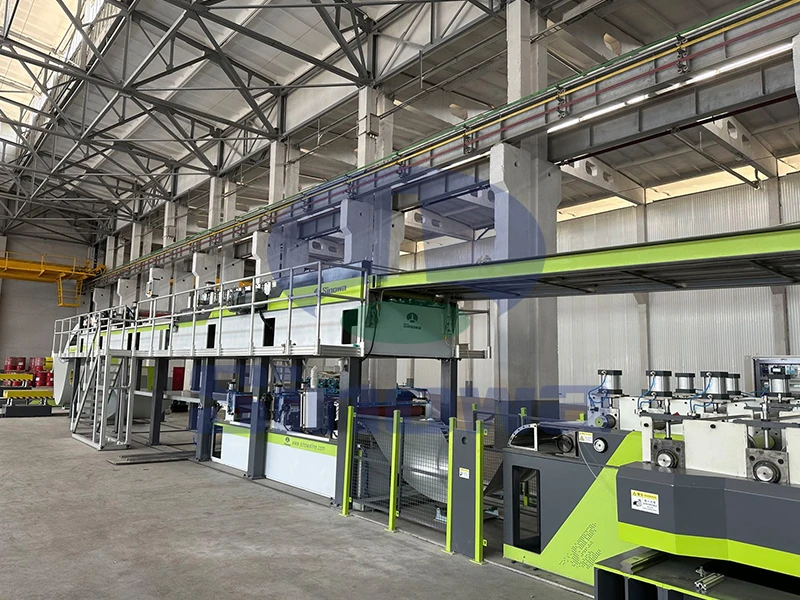
Continuous PUF sandwich panel production lines have gradually become mainstream equipment in the insulation panel manufacturing industry, and their compatibility with cold room panel production has drawn widespread attention from manufacturing practitioners. Cold room panels differ greatly from ordinary building insulation panels, as they require excellent thermal insulation, air tightness, structural stability, and low-temperature resistance to sustain long-term stable operation in low-temperature and high-humidity cold storage environments. Unlike intermittent production equipment that conducts segmented processing, continuous PUF lines integrate multiple production procedures into one uninterrupted workflow, including metal surface finishing, PUF core foaming, precise laminating, constant-temperature curing, and fixed-length cutting. This integrated working mode fundamentally avoids the quality inconsistencies caused by repeated startup and shutdown of traditional equipment, laying a solid foundation for producing high-standard cold room panels that meet strict usage requirements. The inherent automated and continuous production characteristics of the line perfectly match the large-scale and standardized production demands of modern cold room projects.
The core advantage of continuous PUF sandwich panel lines lies in their ability to deliver uniform and stable thermal insulation performance, which is the most critical indicator for qualified cold room panels. Cold storage facilities rely entirely on the insulation capacity of wall and roof panels to reduce cold air loss and control energy consumption, making consistent low thermal conductivity an essential feature of qualified panels. The continuous foaming system of the production line can precisely control the mixing ratio and foaming speed of PUF raw materials throughout the entire production process, ensuring uniform cell structure inside the foam core layer of each panel. This eliminates the uneven foaming, hollow gaps, and density deviations that often occur in intermittent production, which easily lead to local heat leakage. Meanwhile, the constant-temperature curing system of the line enables full and stable curing of the PUF core, preventing performance attenuation under long-term low-temperature operation and ensuring the panels maintain reliable thermal insulation effects throughout their service life.
Structural compactness and overall rigidity of finished panels are another key advantage that makes continuous PUF lines suitable for cold room panel production. Cold room panels need to withstand long-term internal and external temperature differences, air pressure changes, and external structural loads without deformation, cracking, or air leakage. The continuous laminating and pressing process of the production line achieves tight and seamless bonding between the metal surface layer and the PUF core layer. The whole-process uniform pressing force ensures no delamination or weak bonding areas inside the panels, effectively enhancing the overall structural integrity of finished products. Compared with panels produced by discontinuous equipment, continuous-produced panels feature higher overall rigidity and better anti-deformation ability, which can adapt to the harsh operating environment of cold rooms with frequent temperature fluctuations and high humidity, avoiding structural damage and insulation failure caused by environmental changes.
The high production efficiency of continuous PUF sandwich panel lines perfectly adapts to the batch production demand of large-scale cold room construction. Modern cold storage projects, whether large logistics cold chains or commercial low-temperature storage spaces, usually require a large number of standardized insulation panels with consistent specifications. Traditional intermittent production lines are limited by segmented processing cycles, with low single-day output and unstable production rhythm, making it difficult to meet the rapid delivery needs of large-scale projects. In contrast, continuous production lines operate stably for a long time without frequent shutdowns, realizing uninterrupted mass production of panels. The automated fixed-length cutting and synchronous finishing functions also reduce manual intervention and secondary processing procedures, greatly shortening the overall production cycle. This efficient production mode not only improves manufacturing capacity but also ensures the consistency of panel specifications in batch orders, which is crucial for unified installation and stable operation of cold room projects.
Precision production capability of continuous PUF lines effectively solves the dimensional accuracy requirements of cold room panels. Cold room installation requires precise matching between panels to avoid assembly gaps that cause cold air leakage and moisture penetration, which would reduce cold storage efficiency and even lead to internal frosting and equipment failure. Each processing link of the continuous production line adopts automated precision control, from metal coil leveling and feeding to final fixed-length cutting and edge trimming, with extremely high dimensional error control standards. All finished panels maintain unified length, width, and thickness specifications, and the edge sealing treatment is neat and standardized. Such high-precision panel products can realize tight splicing during on-site installation, effectively improving the overall air tightness and sealing performance of cold room enclosure structures, and avoiding energy waste and operational risks caused by assembly gaps.
The material adaptability of continuous PUF sandwich panel lines fully meets the customized production needs of diverse cold room scenarios. Different types of cold storage, including fresh-keeping cold rooms, low-temperature freezing rooms, and ultra-low temperature storage spaces, have different requirements for panel thickness, core density, and surface material properties. The continuous production line supports flexible adjustment of production parameters, enabling free switching of panel thickness and precise adjustment of PUF core foaming density according to actual usage needs. It can also match different types of metal surface materials to produce panels with different corrosion resistance and surface strength, adapting to high-humidity and corrosive environments in special cold storage. This flexible production feature enables the equipment to cover almost all conventional cold room panel types, meeting the personalized production demands of different cold storage construction projects.
Long-term quality stability of panels produced by continuous PUF lines highlights their professionalism in cold room applications. Cold room panels belong to long-term building enclosure materials, and their service life directly affects the operating cost and service cycle of cold storage facilities. Panels produced by continuous processes have uniform internal structure, stable physical properties, and excellent moisture resistance. The dense closed-cell structure of the PUF core layer can effectively block moisture and water vapor penetration, preventing the core material from absorbing water and deteriorating insulation performance in high-humidity cold storage environments. In addition, the integrated bonding process avoids layer separation caused by long-term temperature cycling, ensuring that the panels maintain stable structural and thermal insulation performance for a long time, reducing later maintenance and replacement costs of cold storage facilities.
Compared with discontinuous production equipment, continuous PUF sandwich panel lines have obvious advantages in product consistency and defect rate control. Intermittent production is prone to quality fluctuations due to manual operation differences, equipment startup and shutdown temperature changes, and parameter adjustment deviations, resulting in a high proportion of defective panels. The continuous production system adopts full-process automated parameter locking and real-time monitoring, with all production links operating in a stable and standardized state. The unified production environment and process parameters make the quality of each batch of panels highly consistent, and the product defect rate is effectively controlled at a low level. For cold room projects that require high overall quality uniformity of enclosure panels, this stable quality control capability is an irreplaceable core advantage.
The operational and cost advantages of continuous PUF lines also make them suitable for long-term cold room panel manufacturing. Although continuous production lines have higher overall automation configuration, their long-term operating cost is more economical. The precise raw material ratio control reduces the waste of PUF foaming materials and metal raw materials, and the automated production mode reduces labor input and human error losses. Meanwhile, the stable product quality reduces the rate of product rework and replacement, optimizing the overall production cost of enterprises. For manufacturers focusing on long-term supply of cold room panels, continuous production lines can balance production efficiency, product quality, and production cost, forming a stable and efficient production system suitable for professional cold storage panel manufacturing.
In conclusion, continuous PUF sandwich panel lines are fully suitable for formal and large-scale cold room panel production, with comprehensive advantages in product performance, production efficiency, precision control, and quality stability. Their automated continuous processing mode perfectly matches the core requirements of cold room panels for high insulation, high air tightness, high stability, and batch standardization. Whether for conventional large-scale cold storage projects or customized medium-sized cold room supporting panels, this type of production line can deliver qualified and high-performance finished products, becoming the preferred equipment for modern cold room panel manufacturing.
Gallery of Continuous PUF Sandwich Panel Line






Tags: continuous puf sandwich panel line, continuous puf sandwich panel line manufacturer, continuous puf sandwich panel line supplier, china continuous puf sandwich panel line, continuous puf sandwich panel line for sale
-

A reliable PU sandwich panel production line serves as the core equipment for manufacturing high-performance building insulation panels. This professional PU sandwich panel line features automated feeding, foaming and molding processes to ensure consistent panel thickness and structural stability. The well-designed polyurethane sandwich panel production line effectively improves production efficiency while reducing material waste in daily operation. Each calibrated polyurethane sandwich panel line can adapt to different panel sizes to meet diverse construction needs. With precise temperature and pressure control, the advanced continuous PU sandwich panel line produces panels with excellent thermal insulation and weather resistance. Meanwhile, the optimized PIR sandwich panel production line upgrades the foaming formula to enhance fire resistance performance. The high-efficiency PIR sandwich panel line maintains stable operation during long-term mass production, delivering durable and high-quality sandwich panels for various architectural and industrial applications.
-

The phenolic panel production line realizes automated and continuous manufacturing of high-performance thermal insulation panels through streamlined and coordinated processing procedures.
-

Modern insulation panel manufacturing relies on professional automated equipment to ensure stable product quality and high production efficiency. The rock wool sandwich panel production line features precise material lamination and forming processes to produce rigid, heat-insulating building panels. Meanwhile, the mineral wool sandwich panel production line adopts optimized assembly procedures to fabricate lightweight, soundproof panels widely used in architectural enclosure and thermal preservation projects.