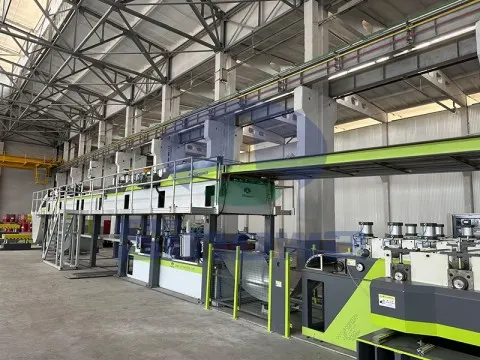
PUF Sandwich Panel Production Line
Publication Date: Sep 28, 2026
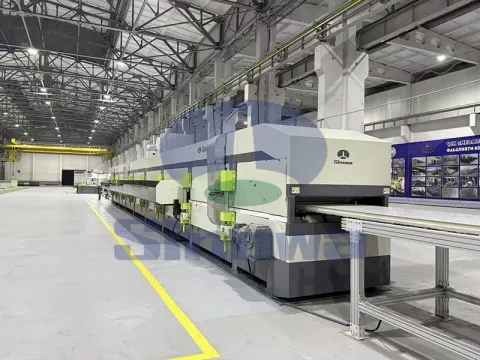
The PUF sandwich panel production line is a fully automated continuous manufacturing system for rigid polyurethane foam composite panels. It integrates material feeding, foaming, laminating, cutting and stacking, delivering consistent insulation panels for construction and industrial thermal insulation applications.
Basic Overview and Core Operational Logic
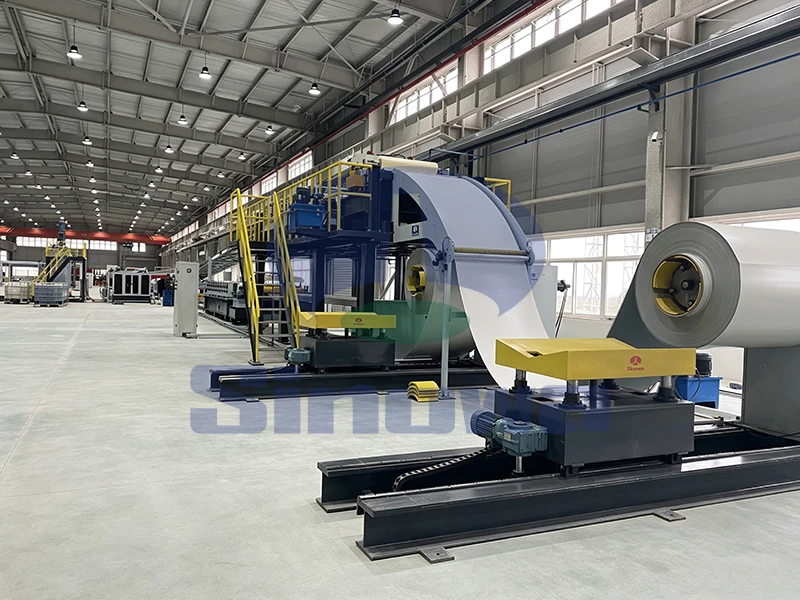
A modern PUF sandwich panel line represents a continuous automated manufacturing system built for mass fabrication of rigid polyurethane foam sandwich panels. It merges mechanical forming, chemical foaming, thermal curing and precision cutting into one uninterrupted workflow, removing the low efficiency and unstable quality of semi-manual production. The core working principle depends on synchronized coordination between every functional module. Each unit’s running speed is fine-tuned to match adjacent stations, preventing production halt or material waste from mismatched operating rhythms. This linked operation boosts throughput and stabilizes finished panel quality. By controlling all process parameters across the manufacturing chain, the line maintains uniform foam cell structure and strong adhesion between foam core and surface skins. Stable bonding performance is critical because weak interfaces will reduce mechanical strength and thermal insulation capacity. Every adjustment on the line targets consistent panel properties. Such a systematic production mode makes the end products suitable for many demanding working environments, laying a solid foundation for reliable long-term performance of PUF sandwich panels in various engineering projects.
Main Structural Components of the Production Line
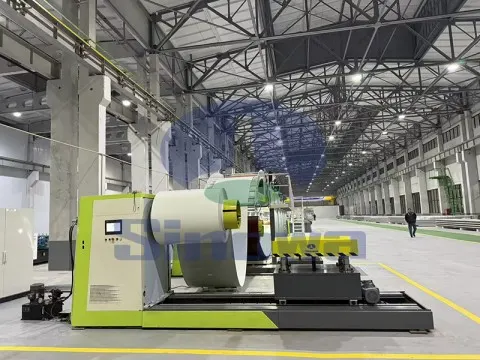
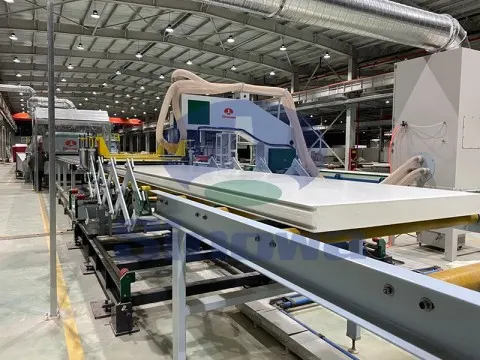
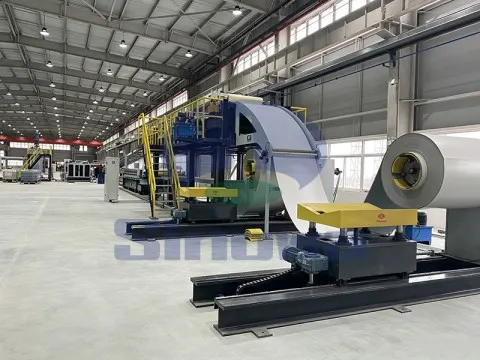
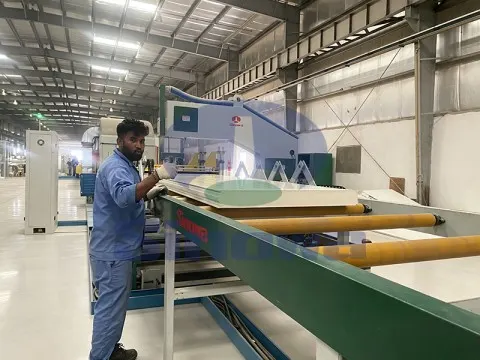
A complete PUF sandwich panel production line contains multiple connected functional units, each undertaking designated tasks to form a full closed-loop manufacturing workflow. The front substrate unwinding unit feeds continuous coil materials and carries out leveling and edge trimming to guarantee flat and dimensionally regular surface skins. Next comes the preheating unit, which moderately raises substrate temperature and improves adhesive compatibility with polyurethane foam. The foaming and mixing station is the heart of the whole line, where polyol and isocyanate are metered, blended and injected evenly between upper and lower face sheets. The double-belt laminator applies constant pressure and temperature to support foam expansion, chemical curing and composite bonding. Downstream modules include flying saw cutting, product conveying and automatic stacking equipment for finished panel handling. All these units operate under linked control. When one station adjusts speed, other sections respond correspondingly to maintain continuous production. No single part can run independently without affecting the whole line. This integrated layout realizes automatic processing from raw coil feeding to finished panel stacking and minimizes manual operation throughout the manufacturing cycle.
Substrate Pretreatment Process and Functions
Substrate pretreatment is a vital preliminary stage that directly influences surface appearance and bonding quality of PUF sandwich panels. Raw face materials are normally supplied in coil rolls. The unwinding mechanism releases the coil with stable tension to avoid stretching or wrinkling during continuous feeding. The leveling system removes minor bends and creases formed during coil storage and transportation, ensuring flatness of the final panel surface. Edge trimming equipment cuts off irregular edges on both sides to keep consistent panel width and clean margins. The subsequent preheating step serves two major purposes: removing surface moisture and activating surface chemical activity. Moisture on the substrate can interfere with polyurethane reaction and cause poor adhesion. Warmed substrate surfaces enable liquid polyurethane to create tighter bonding once foaming starts. Proper pretreatment reduces rejected panels caused by flawed substrates and lifts overall production yield. Even tiny defects at this stage may evolve into serious quality issues after foaming and curing. Operators monitor substrate condition continuously during production to keep pretreatment parameters stable and maintain uniform substrate quality entering the foaming section.
PUF Raw Material Mixing and Injection Technology
Raw material mixing and injection are decisive steps that define thermal insulation performance and structural stability of sandwich panels. The line adopts high-precision metering pumps to deliver polyol and isocyanate at a controlled ratio. Accurate proportioning supports complete chemical reactions and forms uniform closed-cell foam after expansion. High-pressure mixing heads blend two components instantly before injection. Insufficient mixing leads to uneven foam density, local voids and inconsistent thermal performance. After blending, liquid polyurethane mixture is spread evenly onto the moving lower substrate through specialized spray nozzles. Injection volume and spray width are adjusted automatically according to preset panel thickness. The liquid material expands and fills the cavity between upper and lower skins under controlled pressure. Uniform injection prevents common defects such as hollow cores, variable thickness and foam voids. If injection distribution is uneven, some areas will have thin foam layers while others become overfilled, causing warping after curing. Stable injection parameters ensure every panel from the same production run has consistent foam core properties, which is essential for reliable batch production of composite insulation panels.
Foaming, Curing and Composite Molding Process
Foaming, curing and composite molding form the core stage to create the integrated sandwich panel structure. After liquid polyurethane is injected between upper and lower substrates, the composite semi-finished panel immediately enters the double-belt laminator. Inside the thermally controlled chamber, polyurethane undergoes rapid chemical reaction, expands and forms continuous closed-cell foam. The laminator maintains steady pressure on both panel surfaces to limit excessive foam expansion and lock in target panel thickness and flatness. Constant temperature provides ideal reaction conditions for foam curing, helping the foam matrix solidify quickly and form firm bonding interfaces with face sheets. The curing duration is carefully maintained to guarantee complete chemical reaction and full composite shaping. Once molded, the integrated structure of top skin, foam core and bottom skin is permanently bonded together. This unified structure delivers good mechanical strength and structural integrity. Any fluctuation in temperature or pressure during molding will damage foam cell structure and weaken adhesion. Operators keep monitoring chamber environment to ensure stable reaction conditions, so that finished panels retain stable mechanical and thermal properties after leaving the laminating section.
Precision Cutting and Finishing Processing
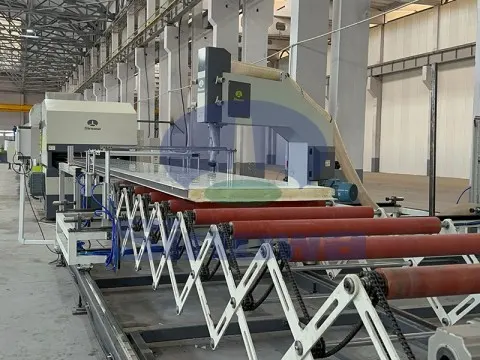
After composite molding and primary curing, continuous long panels move to precision cutting and finishing. The line uses flying saw cutting equipment that cuts fixed lengths while the panel keeps moving. Non-stop cutting preserves production continuity and avoids efficiency losses caused by frequent machine start and stop. Cutting blades are made of wear-resistant materials to generate clean, burr-free cut edges without panel deformation. Accurate length control ensures every finished panel matches dimensional requirements. After cutting, the finishing station removes minor cutting residues and trims edge imperfections. Some lines install surface protective film applicators to attach protective films on panel surfaces, preventing scratches and contamination during later transport and stacking. Standard finishing treatment unifies appearance quality across all finished panels. Rough edges or surface scratches not only affect visual quality but also may create weak points during later installation. This processing step polishes panel edges and surfaces to achieve consistent finished quality. After finishing, panels are ready to enter the cooling conveyor for further stabilization before stacking and warehousing.
Cooling Shaping and Performance Stabilization
Cooling shaping is an essential post-processing procedure to stabilize overall panel performance. Newly molded panels still carry residual heat and contain internal stress formed during foaming and curing. Direct stacking at high temperature will lead to subtle warping, bending and long-term dimensional instability. The production line uses an extended cooling conveyor system to transport cut panels at a constant speed within a ventilated temperature-controlled environment. During gradual cooling, the foam core’s internal molecular structure continues stabilizing, releasing residual stress accumulated in the molding stage. This process effectively reduces the risk of panel deformation in later storage and application. Complete cooling also fully solidifies the bonding interface between foam core and substrates, further strengthening adhesion and lowering delamination risks. Only after full cooling do thermal insulation, compression resistance and structural stability reach optimal levels. Without adequate cooling time, panels may slowly deform after packing. Controlling cooling speed avoids rapid temperature drop that creates new internal stress, ensuring finished panels maintain stable physical properties over long service cycles.
Automatic Stacking and Intelligent Output System
The automatic stacking and output system realizes intelligent finished product handling and raises the overall automation level of the whole production line. After cooling and shaping, qualified panels travel to the stacking station via conveying tracks. Robotic stacking mechanisms pick and arrange panels following preset stacking patterns, forming neat stacks of finished goods. The system can adjust stacking quantity and layout automatically according to panel specifications to prevent chaotic stacking and surface damage. Built-in sensing devices identify products with appearance defects or dimensional deviations and separate defective panels automatically from qualified ones, completing preliminary quality screening on the production line. The stacking process works without manual intervention, cutting labor demand and avoiding surface contamination or panel damage caused by human contact. Neat stacked panels simplify subsequent handling, storage and loading operations in the workshop. This downstream automation matches the high output speed of upstream continuous foaming and laminating sections. Smooth product output prevents finished panel accumulation and bottlenecks at the end of the production line, supporting stable long-run continuous manufacturing.
Core Performance Advantages of Line-Produced Panels
Panels manufactured on a dedicated PUF sandwich panel production line possess superior comprehensive performance compared with products made by manual or semi-automatic methods. The closed-cell foam formed by accurate raw material proportioning and constant-pressure foaming offers outstanding thermal insulation, slowing heat transfer and cutting energy consumption for buildings and industrial equipment. Integrated composite molding combines face sheets and foam core into a single entity, bringing high structural rigidity and strong resistance to compression and bending. The dense closed-cell foam also has good moisture resistance, blocking water penetration into the core layer. Reduced moisture ingress inhibits mold growth and material aging, extending panel service life. Standardized continuous production ensures stable quality between batches. Panel thickness, foam density and surface appearance remain consistent for every unit produced. Such reliable performance allows these panels to serve many demanding application environments. The uniform quality characteristic simplifies engineering design and installation work. Designers can predict panel performance reliably, which makes PUF sandwich panels a preferred insulation enclosure material for modern construction and industrial thermal insulation projects.
Application Scenarios and Industrial Value
PUF sandwich panels produced by automated production lines have broad application ranges and remarkable industrial value. In the construction sector, these panels are widely adopted for enclosure structures of industrial plants, clean rooms and temporary buildings, taking advantage of lightweight weight, high mechanical strength and excellent thermal insulation. Within cold chain logistics, panels serve as core materials for cold storage rooms and refrigerated truck bodies, maintaining stable low-temperature environments and reducing cold loss. Besides these fields, the panels are also used for industrial equipment insulation, roof thermal and waterproof systems and environmental facility enclosures. Automated production lines enable large-scale, standardized and high-quality mass production of PUF panels. They resolve the low productivity and inconsistent quality problems of traditional manual fabrication methods and drive the overall standardization progress of the sandwich panel industry. While meeting market demand for high-performance insulation materials, this manufacturing technology also supplies reliable material solutions for energy-saving upgrades in construction and industrial sectors. As energy efficiency requirements keep growing, automated PUF panel production technology will continue to expand its influence across multiple related industries.
Gallery of PUF Sandwich Panel Production Line
Tags: puf sandwich panel production line, puf sandwich panel production line manufacturer, puf sandwich panel production line supplier, china puf sandwich panel production line, puf sandwich panel production line for sale
Related Informations
How To Adjust The Pouring Rate Of The PUF Sandwich Panel Production Line?
What Thickness Range Can The Continuous PUF Sandwich Panel Production Line Produce?