Why Does The Continuous PU Sandwich Panel Line Produce Panels With Uneven Thickness?
Publication Date: Oct 8, 2026
Uneven thickness of PU sandwich panels from continuous production lines stems from multiple interconnected mechanical, procedural, and material factors.
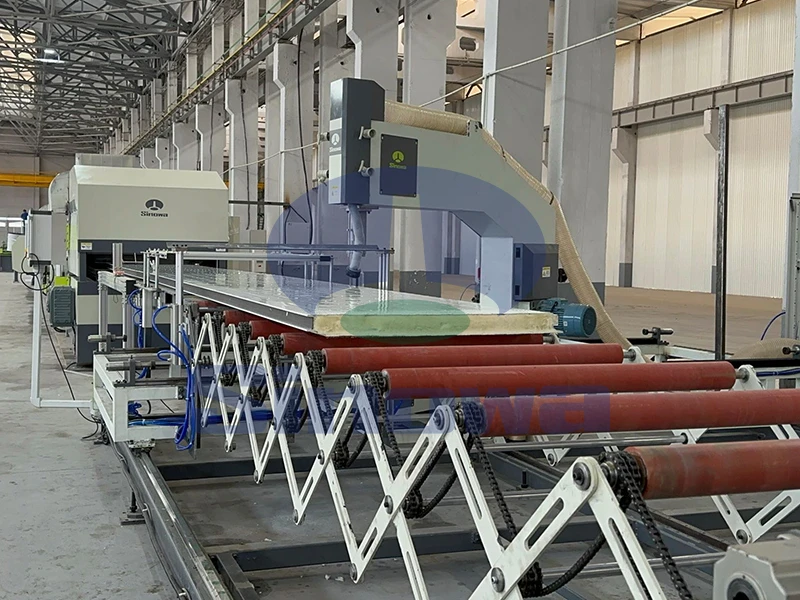
Mechanical deviation of the double-belt laminator serves as one of the most prevalent causes of uneven panel thickness in continuous PU sandwich panel production. The laminator’s upper and lower conveyor belts and pressing rollers determine the final forming thickness of panels, and long-term continuous operation easily leads to subtle structural changes in these components. After prolonged friction and pressure bearing, local wear on the belts and rollers becomes uneven, creating inconsistent gaps across different positions of the pressing area. When the gap on one side of the laminator is wider than the other, the PU foam expands excessively at the wider gap and gets overly compressed at the narrower gap, resulting in obvious thickness differences between the left, middle and right parts of a single panel. Additionally, minor deformation of the laminator frame caused by long-term vibration will disrupt the parallelism of the upper and lower pressing structures, further exacerbating cross-directional thickness deviation that cannot be eliminated by simple parameter adjustment during regular production.
Unstable matching of production line operating speeds is another key factor triggering panel thickness inconsistency. A continuous PU sandwich panel production line consists of multiple interconnected units including surface material unwinding, PU foaming, laminating, traction and cutting, all of which require precise speed synchronization. In actual production, slight speed fluctuations often occur in individual units due to electrical signal instability and motor aging. For instance, if the traction speed is slightly higher than the foaming and laminating speed, the unformed PU foam core will be stretched thinly, reducing the overall panel thickness; conversely, a lower traction speed will cause foam accumulation and excessive local thickening. Periodic speed jitter of the entire line will also lead to alternating thick and thin sections along the panel length. These asynchronous speed states usually occur intermittently, making thickness deviation irregular and difficult for operators to detect and correct in a timely manner during continuous production.
Inaccurate and unstable PU chemical dosing directly disrupts foam forming uniformity and leads to uneven panel thickness. The foaming effect of PU materials relies on the precise proportion and stable output of various chemical raw materials. When the dosing system has minor faults such as pump pressure fluctuation, pipeline blockage or nozzle abrasion, the output of foaming agents, catalysts and main materials will deviate in real time. Insufficient chemical dosage will result in incomplete foam expansion and low core thickness, while excessive dosage will cause overexpansion and partial thickening. Moreover, uneven material spraying from the foaming mix head will lead to inconsistent raw material distribution on the surface material base. Areas with dense materials form thicker foam cores, while sparse areas form thinner cores, forming fixed thickness differences in the cross-section of each panel, which remains consistent in long-batch production and seriously affects overall product uniformity.
Fluctuations in production temperature conditions significantly affect PU foam expansion and cause panel thickness variations. PU foaming and curing are temperature-sensitive chemical reactions, and ambient temperature, laminator belt temperature and material preheating temperature all influence foam expansion efficiency. When the production environment temperature drops suddenly, the foam reaction speed slows down, the expansion degree is insufficient before lamination forming, and the final panel thickness is generally thin. On the contrary, excessive ambient temperature accelerates the foaming reaction, leading to overexpanded foam that cannot be fully compressed by the laminator, resulting in thicker panels. Local temperature differences on the laminator belt also cause inconsistent foam curing speeds: fast-curing areas fix the thickness in advance, while slow-curing areas continue to expand slightly after lamination, forming subtle thickness gaps on the panel surface. Long-term temperature drift without targeted adjustment is a hidden cause of continuous thickness deviation in mass production.
Unstable feeding of core and surface materials contributes greatly to irregular panel thickness. In continuous production, flat and consistent feeding of surface materials and uniform paving of auxiliary core materials are the basis for uniform panel forming. When the surface material unwinding system has tension instability, offset or wrinkling, the materials will not be laid flat in the laminator, causing local material accumulation or stretching. Accumulated areas occupy more space in the pressing gap and form thicker panels, while stretched areas lead to thinner finished thickness. In addition, uneven density and loose paving of auxiliary filling materials will cause inconsistent compression resistance of different parts of the panel during lamination. Parts with loose materials are easily compressed thinly, while dense parts maintain a larger thickness, forming scattered thickness defects on the panel surface that vary randomly with feeding status.
Residual mechanical errors and insufficient equipment calibration lead to cumulative thickness deviation in long-term production. After daily startup, shutdown and parameter adjustment, the continuous production line will produce subtle mechanical position errors. If the laminator gap, roller parallelism and spraying position are not calibrated regularly, these tiny errors will accumulate with continuous operation. Minor gap deviations that are negligible in short-term production will be amplified after hours of continuous processing, resulting in gradual thickness drift of finished panels. Many production lines lack regular daily calibration mechanisms, and operators only adjust parameters when obvious thickness defects appear. This delayed correction mode leads to large batches of panels with gradual thickening or thinning trends, forming continuous and regular thickness inconsistency problems.
Abnormal foam expansion and edge restriction effects cause differentiated thickness between panel edges and middle areas. In the PU foaming process, the edge areas of the panel are restricted by the production line’s side baffle structures, which limit the lateral expansion of foam materials. In contrast, the middle part of the panel has no lateral restriction and can expand freely during the reaction process. This structural difference leads to insufficient expansion at the edges and excessive expansion in the middle, forming a common defect of thick middle and thin edges. Meanwhile, the edge parts contact the ambient air more directly, resulting in faster heat dissipation and slower curing speed, while the middle part retains heat longer and cures more fully. The asynchronous curing state further widens the thickness gap between different areas, and this edge-middle thickness difference is particularly prominent in wide-format PU sandwich panels.
Improper operational parameter setting and unreasonable process debugging induce persistent thickness unevenness. Different production environments and material batches require matched process parameters, and fixed parameter settings cannot adapt to variable production conditions. Operators often retain traditional parameters for long-term production without fine-tuning according to real-time material activity and environmental changes. Excessively high lamination pressure will compress the overall panel too thinly, and uneven pressure distribution will cause local thinning; insufficient pressure cannot restrain excessive foam expansion, leading to partial thickening. In addition, unreasonable setting of foaming reaction time makes the foam either expand inadequately before forming or finish expanding before lamination, both of which will disrupt the uniform forming state and produce panels with irregular thickness fluctuations in the length and cross directions.
Aging and wear of auxiliary production components indirectly trigger panel thickness inconsistency. Many easily worn auxiliary parts in the production line affect the stability of the overall production state. Aging tension rollers cause unstable surface material conveying tension, worn sealing parts lead to local material leakage during foaming, and blocked ventilation structures result in uneven heat dissipation inside the laminator. These subtle component failures do not directly cause large-scale defects, but they disrupt the stable environment required for PU foam forming. Long-term operation of worn components leads to continuous small fluctuations in the foaming and forming process, resulting in scattered and irregular thickness differences in finished panels. Such hidden equipment problems are often overlooked in daily maintenance, making thickness unevenness a recurring production issue.
Lack of real-time thickness monitoring and timely process correction aggravates the degree of panel thickness unevenness. Most continuous production lines rely on periodic manual sampling inspection instead of full-process real-time thickness detection. Manual sampling can only check the thickness of individual panel sections, failing to capture intermittent and gradual thickness changes in the production process. When subtle parameter drift or mechanical failure occurs, thickness defects continue to accumulate without timely intervention. By the time obvious uneven thickness is detected, a large number of unqualified panels have been produced. The absence of dynamic adjustment mechanisms that link monitoring data and process parameters makes it impossible to eliminate thickness deviation in the initial stage, resulting in unstable and inconsistent thickness of finished PU sandwich panels.
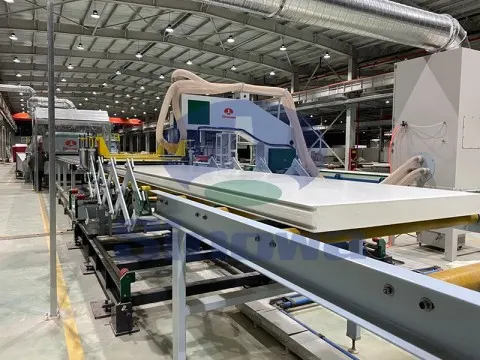
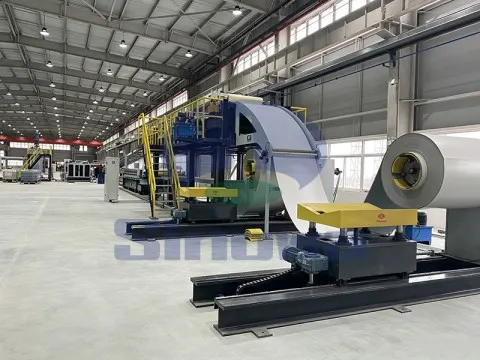
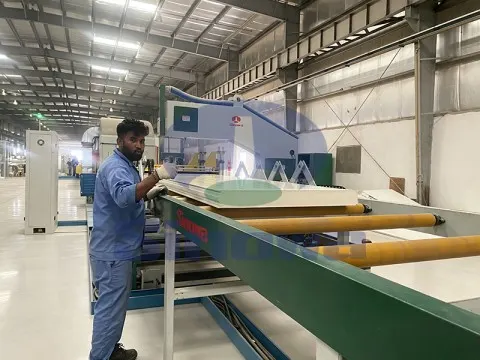
Gallery of Continuous PU Sandwich Panel Line
Tags: continuous pu sandwich panel line, continuous pu sandwich panel line manufacturer, continuous pu sandwich panel line supplier, china continuous pu sandwich panel line, continuous pu sandwich panel line for sale
-
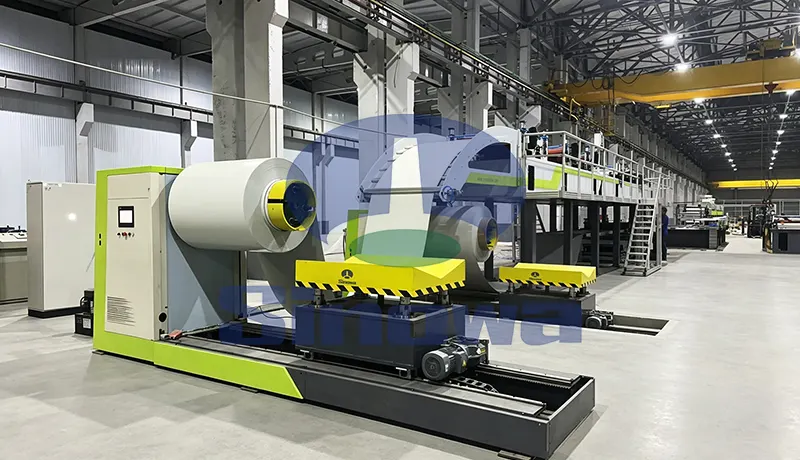
A reliable PU sandwich panel production line serves as the core equipment for manufacturing high-performance building insulation panels. This professional PU sandwich panel line features automated feeding, foaming and molding processes to ensure consistent panel thickness and structural stability. The well-designed polyurethane sandwich panel production line effectively improves production efficiency while reducing material waste in daily operation. Each calibrated polyurethane sandwich panel line can adapt to different panel sizes to meet diverse construction needs. With precise temperature and pressure control, the advanced continuous PU sandwich panel line produces panels with excellent thermal insulation and weather resistance. Meanwhile, the optimized PIR sandwich panel production line upgrades the foaming formula to enhance fire resistance performance. The high-efficiency PIR sandwich panel line maintains stable operation during long-term mass production, delivering durable and high-quality sandwich panels for various architectural and industrial applications.
-
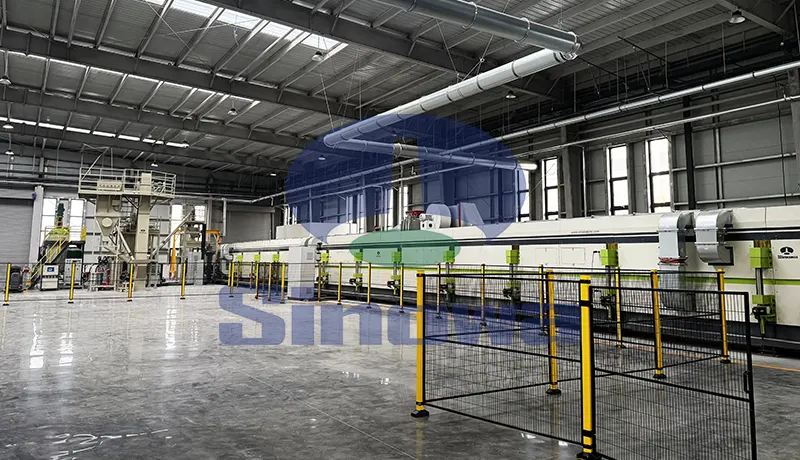
The phenolic panel production line realizes automated and continuous manufacturing of high-performance thermal insulation panels through streamlined and coordinated processing procedures.
-
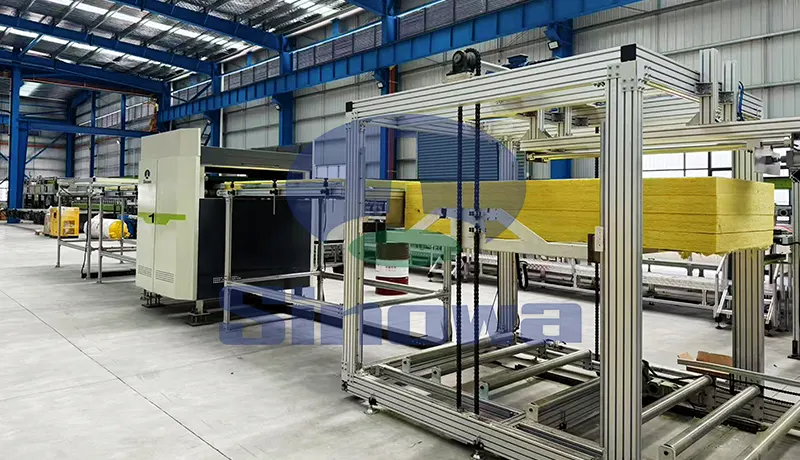
Modern insulation panel manufacturing relies on professional automated equipment to ensure stable product quality and high production efficiency. The rock wool sandwich panel production line features precise material lamination and forming processes to produce rigid, heat-insulating building panels. Meanwhile, the mineral wool sandwich panel production line adopts optimized assembly procedures to fabricate lightweight, soundproof panels widely used in architectural enclosure and thermal preservation projects.