Why Does The PUR Sandwich Panel Manufacturing Line Produce Uneven Foam Panels?
Publication Date: Oct 28, 2026
This explains why PUR sandwich panel lines make uneven foam panels: wrong chemical ratio, poor mixing, mismatched line speed & injection volume, fluctuating curing temperature, uneven double‑belt press pressure and unstable raw material temperature. Check these key factors for stable, uniform foam core quality.
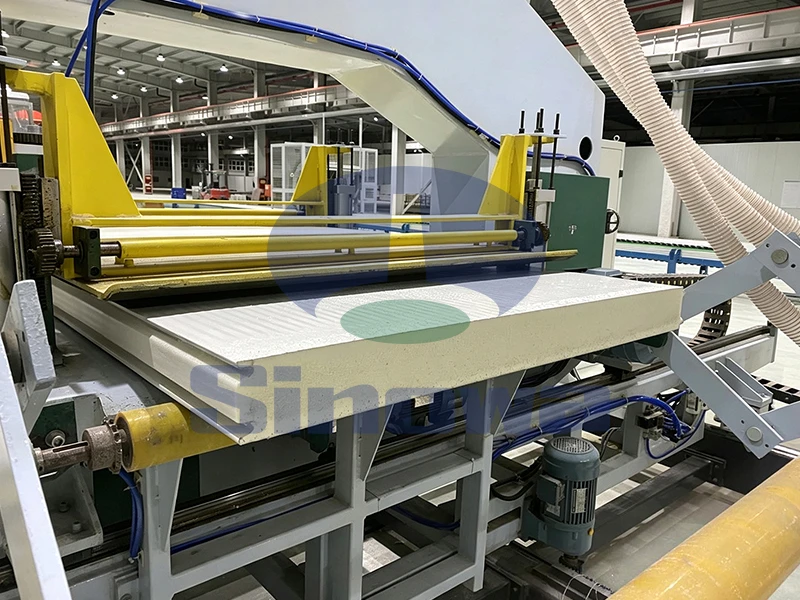
The production of PUR sandwich panels relies on precise coordination between raw material feeding, mixing, foaming, and continuous lamination processes, and uneven foam inside finished panels remains one of the most frequent quality challenges encountered during stable line operation. Many operators first notice this defect through visual inspection, where some sections of the panel surface show subtle depressions, raised bumps, or inconsistent color shading, while cross-section cutting further reveals varying foam cell sizes, dense compact layers in local areas, and hollow voids scattered within the foam core. A large number of production trials confirm that unstable metering of the two main PUR reaction components serves as the foundational trigger for most uneven foaming issues. The polyol and isocyanate streams must maintain a fixed mixing ratio at all times, and even minor fluctuations in delivery flow can break the chemical balance required for uniform cross-linking and foaming. When one component is supplied in excess, the reaction proceeds too quickly in that zone, forming overly dense foam structures before the mixture can spread evenly across the substrate surface. Conversely, insufficient dosage of a reactive component slows the curing reaction significantly, leaving thin, weak foam layers that cannot fully fill the space between the upper and lower face sheets. Pulsation inside metering pumps, worn sealing components in delivery pipelines, and inconsistent pressure from storage tanks all create irregular flow changes that are hard to detect from simple pressure gauge readings alone. Temperature variation of raw materials before entering the mixing chamber amplifies this imbalance, because viscosity of PUR materials changes sharply with temperature, altering flow resistance and mixing efficiency even if the pump speed stays unchanged. Operators often overlook gradual viscosity drift during long continuous runs, assuming steady pump settings guarantee consistent material delivery, and this misunderstanding allows small ratio deviations to accumulate and produce widespread uneven foam across batches of panels. The reaction rate difference across different positions of the panel then locks in structural inconsistencies, which cannot be corrected once the foam enters the curing stage inside the double belt conveyor.
The mixing quality of PUR raw materials in the mixing head directly determines whether the reaction mixture can form a homogeneous liquid layer before foaming expansion, and poor mixing will inevitably lead to localized uneven foaming on sandwich panels. The mixing head depends on high-speed turbulent collision of material streams to achieve molecular-level blending, and any decline in mixing intensity creates pockets of partially blended material that react at different speeds. Over time, residual cured PUR deposits adhere to the inner wall of the mixing chamber and the outlet nozzle, narrowing flow channels and disrupting the symmetrical collision pattern of incoming material streams. These hardened residues are not always visible during routine visual checks, and they slowly redirect material flow so that some areas receive rich mixtures while other areas receive under-mixed material with segregated reactants. Wear of the internal stirring rotor or uneven clearance between the rotor and the housing further weakens shear force during mixing. When shear force is inadequate, material streams slide past one another without thorough blending, forming alternating strips of fast-reacting and slow-reacting mixture as the liquid flows out onto the moving lower face sheet. The position and angle of the mixing head outlet also exert a subtle influence on material distribution. If the outlet is tilted slightly or offset relative to the centerline of the substrate, the liquid mixture tends to pile up toward one side of the panel width before foaming starts. Even if mixing itself is adequate, uneven spreading across the horizontal plane creates thickness differences in the liquid layer, and subsequent foaming expansion magnifies these initial thickness variations into obvious uneven foam layers. Frequent start-stop cycles of the production line worsen mixing defects, because leftover material inside the mixing head partially cures during downtime, and newly injected materials mix with these semi-cured fragments when production restarts, introducing discrete non-uniform regions that extend along the length of continuous panels.
Temperature control across the entire foaming and curing tunnel system acts as a critical environmental factor governing PUR foaming behavior, and inconsistent temperature distribution stands as a major cause of uneven foam formation. The PUR foaming reaction releases heat internally, and external heating from the double belt conveyor and surrounding tunnel structure must complement this internal heat release to maintain a consistent reaction rate across the full width and length of the panel. Hot spots develop when heating elements degrade or heat circulation fans fail to distribute warm air evenly, raising local temperatures far above the target range. In these hotter zones, the foaming reaction accelerates rapidly, gas bubbles form and expand in a very short window, and the polymer matrix cures quickly to lock in large, irregular cells. Cooler regions lag behind in reaction progress; bubble nucleation happens slowly, and rising viscosity restricts bubble expansion, resulting in compact, fine-cell foam that contrasts sharply with the coarse structure in overheated areas. Temperature differences between the upper belt and lower belt surfaces create vertical unevenness through the foam thickness. If one belt runs noticeably hotter than the other, the side closer to the warmer belt finishes curing much earlier, limiting upward or downward expansion of foam bubbles and creating a density gradient from one face sheet to the other. Long panels are especially vulnerable because heat loss occurs along the edges of the conveyor, where the surrounding ambient air cools the panel margins continuously. Edge areas often produce denser foam while the central section foams fully, forming a consistent pattern of unevenness from the middle to both sides of finished panels. Operators sometimes respond to slow curing by simply raising the overall tunnel temperature, but this approach widens temperature gaps between hot zones and cool zones instead of eliminating them, compounding unevenness rather than solving the root thermal distribution problem.
The speed matching relationship between the raw material output rate and the running speed of the continuous lamination line controls the material loading per unit area of the face sheet, and mismatched speed parameters generate regularly repeated uneven foam defects. The mixing head discharges liquid PUR mixture at a fixed volumetric rate under stable metering conditions, and the moving face sheet carries this liquid forward into the foaming zone. When the conveyor speed increases without a corresponding increase in material output, less liquid material is spread over each unit area, and the foam cannot expand sufficiently to reach the designed core thickness, forming thin, low-bulk sections with uneven cell development. On the opposite condition, slower conveyor speed with unchanged material feed causes excessive liquid accumulation in local zones. The surplus mixture expands violently, generating oversized bubbles and internal voids as expanding foam presses against the upper face sheet before the polymer network gains enough strength to hold its shape. Speed fluctuations of the conveyor system, rather than a static mismatch of set values, create periodic uneven patterns along the length of panels. Slippage between drive rollers and the conveyor belt, aging drive chains, or unstable frequency converter signals can produce tiny cyclic variations in line speed. These rhythmic speed changes create repeating bands of dense and loose foam at fixed intervals, which are easy to mistake for mixing defects if the operating team only inspects the mixing head. Synchronization between the upper belt and lower belt is equally important. If one belt runs slightly faster than the other, shear force acts on the semi-liquid foam layer during expansion, stretching bubble structures and distorting uniform cell geometry. This shear deformation creates elongated, broken cells in certain layers of the foam core, reducing uniformity even when material ratio, mixing quality, and temperature settings all remain within the intended range. Fine adjustment of line speed and material feed must be carried out gradually, with sufficient waiting time after each modification to allow the whole system to stabilize before evaluating foam quality.
Surface condition and tension control of the upper and lower face sheets affect how the expanding PUR foam spreads and fills the cavity between sheets, and unstable sheet handling introduces unevenness that originates before the chemical foaming reaction completes. Face sheets must maintain consistent flatness and stable tension as they enter the lamination zone. Excessive tension pulls the sheet tight and creates a rigid boundary that resists foam expansion, while insufficient tension allows the sheet to sag and form local bulges as liquid material accumulates underneath. Uneven tension across the width of a face sheet causes wavy deformation; some areas offer more space for foam expansion and develop lighter foam, while tightly stretched regions restrict expansion and form denser core material. Residual wrinkles, oil contamination, or dust particles on the inner surface of face sheets interfere with the adhesion between foam and sheet, and these contaminated spots disrupt the lateral flow of liquid PUR mixture. The liquid tends to bypass contaminated areas and pile up nearby, creating raised foam bumps adjacent to the contaminated points. Alignment offset of the two face sheets is another common factor. When the upper sheet drifts left or right relative to the lower sheet, the clearance gap between them changes across the panel width. A narrower gap limits foam expansion, and a wider gap allows over-expansion, producing a continuous density gradient from one side to the other. In addition, preheating of face sheets before contact with PUR mixture influences reaction starting speed. Cold face sheets absorb heat from the reacting mixture and slow foaming locally, while inconsistently preheated sheets create scattered cool points across the panel surface. Many production teams focus heavily on the PUR chemical system while neglecting face sheet unwinding and preheating stations, so uneven foam defects persist after repeated adjustments to metering and mixing parameters.
Additive dosage uniformity inside the PUR formulation, including blowing agents, catalysts, and surfactants, plays a subtle yet decisive role in regulating bubble nucleation, growth, and stabilization, and uneven distribution of these additives creates heterogeneous foam structures. Surfactants reduce surface tension inside the reacting mixture, enabling stable formation of tiny, evenly distributed bubbles. If surfactant concentration varies across different material streams, some regions support abundant small bubbles while other regions fail to stabilize bubbles and develop large open voids. Catalysts control the balance between foaming reaction and gelation reaction. Too much catalyst in a localized area speeds up polymer curing so quickly that gas cannot expand fully, forming compact foam. Areas with insufficient catalyst let gas expand for too long before the matrix solidifies, leading to bubble coalescence and collapse. Blowing agents provide the gas required for foam expansion, and inconsistent dispersion of blowing agent in polyol storage tanks causes concentration differences in the liquid feed. Long-term storage without continuous agitation allows heavier additive components to settle at the bottom of storage tanks. At the start of a production run, the drawn material carries higher additive concentrations, while later material taken from upper tank layers has lower additive levels, leading to gradual quality drift along the production sequence. Even when bulk tank agitation works properly, small dead zones near tank outlets can hold settled sediment, which is occasionally drawn into the feed pipeline and enters the mixing head as concentrated additive clusters. These clusters create isolated spots of abnormal foaming within panels. Replenishing raw materials into storage tanks without adequate mixing of new and old material also creates concentration stratification. Operators often assume that additive proportions set in the initial formula remain constant throughout the tank, ignoring sedimentation and stratification effects that slowly break foam uniformity during long production runs.
The clearance calibration and parallelism of the double belt conveyor define the final thickness space available for foam expansion, and mechanical deviation of the belt system produces structured unevenness across sandwich panels. The two endless belts form a closed cavity where PUR foam expands, rises, and cures under controlled pressure. If the belts are not kept strictly parallel, the gap distance changes from one side of the panel width to the other. In wider gap sections, foam has extra room to expand, resulting in lower density and larger cells, while narrower gap sections compress the foam into denser structures. Frame deformation of the conveyor after long operating hours, worn spacer blocks, or uneven adjustment of the hydraulic clamping mechanism all contribute to non-parallel belt alignment. Even when the overall gap setting is correct, local indentations or scratches on the belt surface transfer shape defects to soft, newly cured foam. Damaged belt segments press deeper into the semi-solid foam, creating depressed areas on the panel surface and compressed foam core underneath. Vibration of the conveyor frame during operation is another mechanical disturbance. Continuous vibration shakes the liquid PUR mixture before gelation, disrupting forming bubbles, merging small bubbles into large cavities, and causing liquid material to flow toward low points. Vibration usually originates from unbalanced drive rollers, loose mounting bolts, or nearby rotating equipment transferring vibration to the lamination platform. Unlike chemical defects that appear randomly, unevenness caused by belt misalignment and vibration often follows fixed geometric patterns tied to the mechanical layout of the line. Repeated measurement of belt gap at multiple positions across the width and length is necessary to detect hidden parallelism errors, because single-point thickness readings cannot reveal cross-width gap variation. Many teams only measure finished panel thickness at the panel edge, missing thickness deviation in the central zone of wide panels.
Ambient environmental conditions surrounding the PUR lamination line affect foaming stability, especially humidity and air movement inside the production workshop, and uncontrolled ambient conditions trigger scattered uneven foam defects. Moisture in the air reacts readily with isocyanate components, producing carbon dioxide gas and urea structures that interfere with the designed foaming reaction. When local humidity fluctuates, for example near open workshop doors or ventilation outlets, airborne moisture contacts the surface of the freshly applied PUR mixture and creates extra gas generation at those exposed positions. Extra gas bubbles form near the panel surface, breaking the uniform cell structure and creating porous, loose surface foam layers. Dry air zones away from airflow sources do not experience this secondary reaction, so foam structure there follows the normal reaction path. Strong, directed airflow across the foaming zone accelerates surface cooling of the liquid mixture and disturbs the free expansion of bubbles. A draft hitting one side of the wet foam layer cools the surface prematurely, forming a solid skin that restricts further outward expansion, while the interior foam continues to expand and creates internal stress and voids. Ambient temperature fluctuation in the workshop also indirectly changes raw material temperature after they leave the temperature-controlled storage cabinets. Material pipelines running through uninsulated workshop areas gain or lose heat based on surrounding air temperature, introducing extra temperature variation before materials reach the mixing head. Seasonal shifts bring larger ambient changes, and production parameters optimized for stable indoor conditions in one season often fail to maintain foam uniformity when humidity and temperature rise or fall sharply. Isolating the foaming section from direct ventilation and stabilizing workshop air conditions reduces this type of unevenness, but these environmental factors are easy to dismiss as minor background influences until systematic observation links defect locations to airflow and humidity distribution.
Post-expansion pressure stability inside the curing channel influences how PUR foam retains its uniform cell structure as the polymer transitions from liquid to solid state, and fluctuating pressure leads to irreversible deformation of forming foam. After the liquid mixture is applied between face sheets, initial foaming generates gas pressure inside each bubble. The double belt system applies moderate confinement pressure to prevent excessive expansion and maintain consistent panel thickness. Sudden pressure drops reduce confinement force, allowing bubbles to expand beyond their stable size and merge together into large voids. Spikes in confinement pressure squeeze semi-gelled foam, collapsing fragile small bubbles and creating dense compressed zones. Pressure instability can stem from hydraulic control response lag, uneven loading on different sections of the belt, or temporary jamming of moving components inside the tunnel. Pressure differences between the central and edge regions of the panel also emerge when escaping gas cannot release evenly. PUR foam releases a small volume of gas during curing, and if gas escape paths are blocked in some areas, trapped gas builds up local pressure and pushes the foam structure out of shape. The timing of pressure change matters greatly. Pressure disturbance in the early foaming stage produces severe unevenness because the polymer network has not formed enough strength to resist deformation. The same pressure fluctuation has much less impact once the foam reaches full gel strength and enters the late curing phase. Operators sometimes adjust confinement pressure aggressively to fix thickness deviation, but frequent pressure adjustments during active foaming introduce new unevenness instead of correcting existing defects. Stable pressure settings require matching the pressure profile to the reaction progress curve of the specific PUR formulation, holding steady pressure during the critical bubble growth window and allowing gradual relaxation as curing proceeds.
Eliminating uneven foam defects on PUR sandwich panels requires systematic troubleshooting that distinguishes chemical, mechanical, thermal, and environmental influencing factors rather than focusing adjustment on a single part of the manufacturing line. Defect patterns observed on finished panels provide important clues for locating root causes. Regular repeating bands of uneven foam usually relate to conveyor speed oscillation, drive component wear, or mixing head fouling. Gradual quality drift over long production runs points to raw material stratification, additive sedimentation, or slow degradation of metering pump seals. Defects concentrated along panel edges are often connected to edge heat loss, belt parallelism error, or uneven tension of face sheets. Random scattered voids and dense spots typically come from poor mixing, moisture interference, or sporadic contamination on face sheet surfaces. A structured inspection workflow starts with recording the position, shape, frequency, and timing of uneven foam defects, then isolates variables one by one. Teams can run short test segments with fixed raw material temperature, verified metering ratio, cleaned mixing head, and stabilized line speed to check whether unevenness disappears. If defects persist after stabilizing chemical parameters, attention shifts to mechanical alignment of belts, tension control systems, and vibration sources. Thermal mapping of the curing tunnel identifies hidden hot spots and cool zones that simple thermometer readings miss. Even after stable production parameters are established, gradual component wear and raw material property changes mean that foam uniformity cannot be maintained by static settings alone. Routine maintenance schedules for cleaning mixing chambers, checking pump performance, calibrating belt parallelism, and inspecting heating elements reduce the chance of defects developing unexpectedly. Understanding that PUR foaming is a coupled process where chemical reaction, fluid spreading, heat transfer, and mechanical confinement happen simultaneously helps production teams avoid superficial adjustments. Consistent uniform foam quality ultimately comes from keeping every linked process variable within a stable, matched operating window throughout the full length of the continuous sandwich panel line.
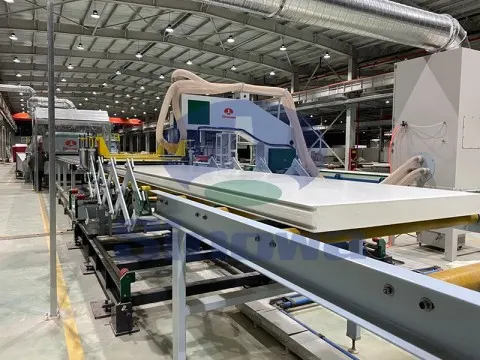
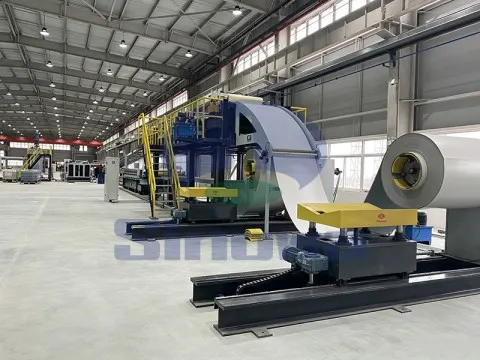
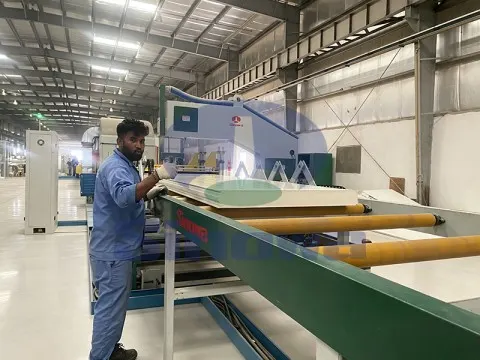
Gallery of PUR Sandwich Panel Manufacturing Line
Tags: pur sandwich panel manufacturing line, pur sandwich panel manufacturing line manufacturer, pur sandwich panel manufacturing line supplier, china pur sandwich panel manufacturing line, pur sandwich panel manufacturing line for sale
-

A reliable PU sandwich panel production line serves as the core equipment for manufacturing high-performance building insulation panels. This professional PU sandwich panel line features automated feeding, foaming and molding processes to ensure consistent panel thickness and structural stability. The well-designed polyurethane sandwich panel production line effectively improves production efficiency while reducing material waste in daily operation. Each calibrated polyurethane sandwich panel line can adapt to different panel sizes to meet diverse construction needs. With precise temperature and pressure control, the advanced continuous PU sandwich panel line produces panels with excellent thermal insulation and weather resistance. Meanwhile, the optimized PIR sandwich panel production line upgrades the foaming formula to enhance fire resistance performance. The high-efficiency PIR sandwich panel line maintains stable operation during long-term mass production, delivering durable and high-quality sandwich panels for various architectural and industrial applications.
-

The phenolic panel production line realizes automated and continuous manufacturing of high-performance thermal insulation panels through streamlined and coordinated processing procedures.
-

Modern insulation panel manufacturing relies on professional automated equipment to ensure stable product quality and high production efficiency. The rock wool sandwich panel production line features precise material lamination and forming processes to produce rigid, heat-insulating building panels. Meanwhile, the mineral wool sandwich panel production line adopts optimized assembly procedures to fabricate lightweight, soundproof panels widely used in architectural enclosure and thermal preservation projects.