PU Sandwich Panel Equipment
Publication Date: Sep 28, 2026
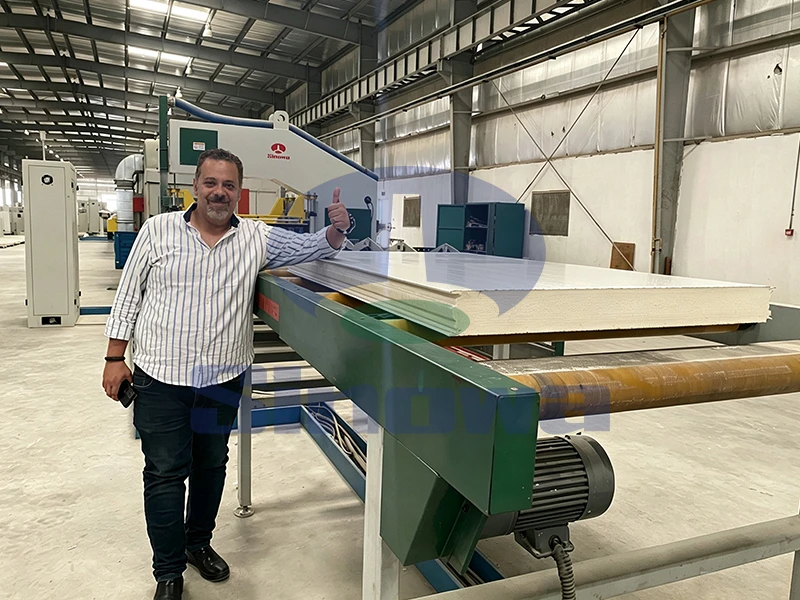
PU sandwich panel equipment is an integrated automated production system for manufacturing polyurethane composite panels. It integrates multiple processing procedures to produce lightweight, heat-insulating and high-strength building panels, supporting large-scale and standardized industrial production efficiently.
Basic Overview and Core Working Principle
PU sandwich panel equipment refers to a complete set of automated industrial machinery specially developed for continuous molding of polyurethane composite sandwich panels. Different from discrete processing equipment, this integrated production system combines mechanical transmission, fluid precise metering, constant temperature control and automatic composite molding technologies to realize one-stop production from raw material input to finished panel output. The core working principle focuses on the composite reaction of polyurethane foam materials and surface substrates. During operation, the equipment first completes the leveling and conveying of upper and lower surface plates, then precisely mixes polyurethane raw materials in a fixed proportion, and injects the liquid mixed materials evenly between the two layers of substrates. Through continuous pressure maintaining and constant temperature curing, the liquid materials expand, foam and solidify stably, forming a compact porous foam core layer that is tightly bonded with the surface plates. This integrated molding mode eliminates intermittent operation links in traditional production, ensures the overall structural consistency of each panel, and lays a solid foundation for the stable physical properties of finished products. The whole reaction and molding process is automatically regulated by the equipment system, which avoids manual operation errors and effectively improves the uniformity of product bonding strength and internal structure.
Overall Structural Composition of the Production Line
A complete PU sandwich panel line consists of multiple interconnected and synchronously operating functional units, each undertaking independent and collaborative production tasks. The front-end feeding unit is responsible for automatic unwinding, leveling and trimming of metal or non-metal surface materials, ensuring the flatness and dimensional standard of raw materials before molding. The middle core functional area includes a high-pressure foaming and mixing system, which is the core component that determines the foaming quality of polyurethane materials. This unit can realize accurate proportioning of different chemical components, uniform stirring and stable high-pressure injection, avoiding uneven foaming or material waste. Followed by the laminating and curing unit, which provides constant temperature and constant pressure environment for material foaming and bonding, promoting sufficient chemical reaction of polyurethane materials and firm compounding with surface plates. The rear-end processing unit covers fixed-length cutting, edge trimming and automatic stacking functions, which can cut continuous composite plates into standard sizes according to set parameters and complete neat stacking of finished products. All functional units are linked by an intelligent synchronous control system, realizing uninterrupted continuous production and coordinating the operation speed of each link to avoid production stagnation or quality defects caused by speed mismatch.
Key Advantages of Automated Production Mode
Modern PU sandwich panel equipment adopts a fully automated production mode, which has completely overturned the limitations of traditional semi-manual and semi-mechanical production methods and brought comprehensive improvements in production efficiency and product quality. In terms of production efficiency, the continuous operation design enables the equipment to realize non-stop batch production, greatly shortening the single-panel molding cycle compared with intermittent production equipment. The intelligent synchronous control system can automatically adjust the operating parameters of each unit according to production demands, avoiding manual debugging delays and improving overall production continuity. In terms of product quality control, the equipment’s precise metering and constant temperature control system ensures that the foaming density, core layer thickness and bonding tightness of each batch of panels remain stable. It effectively solves common problems in traditional production such as uneven foaming, weak bonding and inconsistent product specifications. In addition, automated production reduces manual intervention links, lowers the risk of human error, and improves the yield rate of finished products. Meanwhile, the standardized production process makes the dimensional accuracy and structural performance of panels more unified, which is conducive to subsequent installation and engineering application, and meets the large-scale production needs of modern construction and industrial manufacturing fields.
Foaming and Injection System Core Technology
The foaming and injection system is the most critical core component of PU sandwich panel equipment, directly determining the thermal insulation performance, structural strength and service life of finished panels. This system adopts high-pressure dynamic mixing technology, which can fully mix polyurethane polyether materials and curing agents in a closed environment. Different from ordinary low-pressure mixing equipment, high-pressure mixing can make the chemical components react more fully, forming a fine and uniform porous foam structure inside the core layer, without coarse pores or hollow defects. The system is equipped with an intelligent proportional adjustment module, which can flexibly adjust the material mixing ratio according to different production requirements, so as to produce panels with different densities and hardness to adapt to diverse application scenarios. In addition, the injection unit supports uniform linear injection, which can evenly distribute liquid materials between the upper and lower substrates, avoiding local material accumulation or shortage. The built-in temperature sensing and pressure sensing devices can monitor the material reaction state in real time, automatically adjust injection pressure and temperature parameters, ensure the stability of the foaming reaction process, and prevent quality problems such as core layer collapse and insufficient curing caused by abnormal reaction parameters. This precise control technology endows PU sandwich panels with excellent thermal insulation and compression resistance.
Laminating and Curing Process Characteristics
The laminating and curing process is a key link to realize firm compounding and stable molding of PU sandwich panels, and the process design of professional equipment fully adapts to the chemical reaction characteristics of polyurethane materials. The laminating unit adopts multi-group roller pressing structure, which can apply uniform and stable pressure to the composite plate surface during the material foaming process. This uniform pressure design can ensure that the expanding foam materials are evenly spread, make the core layer thickness consistent, and promote the tight combination between the foam core and the surface plates without gaps or degumming. The curing area is equipped with a constant temperature circulation system, which can maintain a stable temperature environment required for polyurethane curing. Moderate and constant temperature can accelerate the cross-linking reaction of polymer materials, make the foam structure more compact and stable, and effectively improve the structural strength and durability of the panel. The equipment adopts segmented curing design, which divides the curing area into multiple temperature gradient sections to adapt to different reaction stages of polyurethane materials. In the initial foaming stage, low-temperature slow curing is adopted to avoid rapid surface solidification affecting internal foaming; in the later molding stage, constant-temperature deep curing is carried out to ensure complete reaction of internal materials. This scientific segmented process effectively improves the overall molding quality of panels.
Post-processing and Finishing Functional Modules
The post-processing module of PU sandwich panel production line undertakes the final shaping and finishing work of finished panels, ensuring that the products meet standardized application requirements. This module mainly includes fixed-length cutting, edge trimming, surface finishing and automatic stacking subsystems, realizing one-stop finishing of semi-finished continuous plates. The fixed-length cutting system adopts high-precision numerical control positioning technology, which can accurately cut panels into customized lengths according to production settings, with smooth and flat cutting sections without burrs or deformation. The edge trimming unit can trim the irregular edges of composite plates generated in the molding process, ensuring consistent plate width and neat edges, which is convenient for subsequent assembly and splicing in engineering applications. Some upgraded equipment is also equipped with a surface finishing function, which can slightly polish and correct the surface of panels to remove minor scratches and indentations generated during production. After finishing, the automatic stacking system will neatly stack the qualified finished panels according to fixed specifications, replacing manual stacking operation. This automated post-processing mode not only improves the flatness and aesthetic degree of finished products, but also greatly improves the sorting and storage efficiency of products, reduces manual handling damage, and ensures the integrity and consistency of each batch of finished panels.
Equipment Adaptability and Product Diversification
Modern PU sandwich panel manufacturing equipment has excellent production adaptability and can support the production of diversified composite panels to meet the needs of different application fields. In terms of surface materials, the equipment can adapt to various metal and non-metal substrates, realizing composite molding of different surface materials and polyurethane foam cores. In terms of product specifications, the equipment’s adjustable structural design allows flexible adjustment of panel thickness, width and density parameters. By modifying the operating parameters of the foaming system and laminating unit, it can produce thin lightweight panels for decoration and thick high-strength panels for thermal insulation and load-bearing. In addition, the equipment can produce panels with different functional characteristics by adjusting material formulas and production processes, including conventional thermal insulation panels, high-toughness anti-pressure panels and low-temperature resistant panels. This strong adaptability enables a single set of equipment to complete the production of multiple types of sandwich panels, avoiding the need to purchase multiple sets of professional equipment for different products. It effectively reduces production investment costs for manufacturers and improves the flexibility and comprehensiveness of production lines, making the equipment widely applicable in construction, cold chain, purification workshops and other fields.
Operational Stability and Maintenance Performance
PU sandwich panel production equipment is designed with industrial-grade stability and convenient maintenance performance, ensuring long-term stable operation in high-intensity production environments. The whole machine adopts high-rigidity mechanical structure and wear-resistant accessories, which can withstand long-term continuous mechanical operation and material impact, reducing the failure rate of mechanical parts. The transmission system adopts synchronous driving design, which ensures the coordinated and stable operation of each functional unit, avoids jitter and deviation in the production process, and guarantees the continuous and stable progress of production. In terms of system control, the equipment is equipped with an intelligent fault self-diagnosis function, which can monitor the operating state of each component in real time. Once abnormal parameters or potential faults are detected, the system will automatically prompt and record fault information, helping operators quickly locate and solve problems. In terms of daily maintenance, the modular structural design enables each functional unit to be disassembled and maintained independently, without affecting the normal operation of other units. The key working parts are equipped with detachable protective structures, which are convenient for daily cleaning, lubrication and replacement of vulnerable parts. This humanized maintenance design reduces equipment downtime, improves the overall operation efficiency of the production line, and extends the service life of the equipment.
Energy-saving and Environmental Protection Operational Features
With the continuous improvement of industrial environmental protection requirements, modern PU sandwich panel making equipment is optimized and upgraded in terms of energy saving and environmental protection, realizing green and low-consumption production. In terms of energy consumption control, the equipment adopts variable-frequency energy-saving driving technology, which can automatically adjust the operating power of the motor according to the production load. It avoids the invalid energy consumption caused by constant-power operation of traditional equipment, and effectively reduces the overall power consumption of the production line. The constant temperature curing system adopts heat circulation recycling design, which recycles the waste heat generated in the curing process for secondary utilization, reducing heat energy loss and improving energy utilization efficiency. In terms of environmental protection production, the equipment is equipped with a closed material conveying and mixing system, which effectively prevents the volatilization and leakage of polyurethane chemical materials, reduces the generation of harmful gases. The optimized foaming process improves the material utilization rate, minimizes material residue and waste, and reduces production waste discharge. In addition, the automated precise production mode reduces defective product rate, avoids resource waste caused by unqualified products. These energy-saving and environmental protection features not only reduce the production operating costs of enterprises, but also make the production process more in line with green industrial development trends.
Application Value and Industrial Development Significance
PU sandwich panel equipment plays an irreplaceable important role in the modern building materials and industrial manufacturing industry, with prominent practical application value and industrial development significance. As the core equipment for producing high-performance thermal insulation composite panels, it provides efficient and standardized production solutions for the manufacturing of lightweight, energy-saving and high-strength building materials. The panels produced by this equipment have excellent thermal insulation, sound insulation, compression resistance and weather resistance, and are widely used in prefabricated buildings, cold storage engineering, purification workshops, industrial plant enclosure and other scenarios, effectively improving the construction efficiency and energy-saving performance of engineering projects. From the perspective of industrial development, the popularization and upgrading of PU sandwich panel equipment promotes the standardized and large-scale development of the sandwich panel manufacturing industry, replaces backward manual and semi-mechanical production modes, and improves the overall industrial production level. With the continuous development of prefabricated construction and green building industries, the market demand for high-performance PU sandwich panels continues to grow, which further drives the technical iteration and performance upgrading of related equipment. The continuous optimization of equipment technology also provides more high-quality and diversified composite material products for downstream industries, promoting the coordinated development of the entire industrial chain.
Gallery of PU Sandwich Panel Equipment






Tags: pu sandwich panel equipment, pu sandwich panel equipment manufacturer, pu sandwich panel equipment supplier, china pu sandwich panel equipment, pu sandwich panel equipment for sale
-

A reliable PU sandwich panel production line serves as the core equipment for manufacturing high-performance building insulation panels. This professional PU sandwich panel line features automated feeding, foaming and molding processes to ensure consistent panel thickness and structural stability. The well-designed polyurethane sandwich panel production line effectively improves production efficiency while reducing material waste in daily operation. Each calibrated polyurethane sandwich panel line can adapt to different panel sizes to meet diverse construction needs. With precise temperature and pressure control, the advanced continuous PU sandwich panel line produces panels with excellent thermal insulation and weather resistance. Meanwhile, the optimized PIR sandwich panel production line upgrades the foaming formula to enhance fire resistance performance. The high-efficiency PIR sandwich panel line maintains stable operation during long-term mass production, delivering durable and high-quality sandwich panels for various architectural and industrial applications.
-

The phenolic panel production line realizes automated and continuous manufacturing of high-performance thermal insulation panels through streamlined and coordinated processing procedures.
-

Modern insulation panel manufacturing relies on professional automated equipment to ensure stable product quality and high production efficiency. The rock wool sandwich panel production line features precise material lamination and forming processes to produce rigid, heat-insulating building panels. Meanwhile, the mineral wool sandwich panel production line adopts optimized assembly procedures to fabricate lightweight, soundproof panels widely used in architectural enclosure and thermal preservation projects.