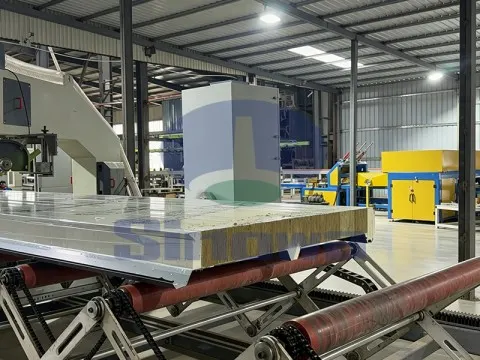
Mineral Wool Sandwich Panel Production Line
Publication Date: Sep 28, 2026
The mineral wool sandwich panel production line is an integrated automated manufacturing system for high-performance building composite panels. It completes full-process production from raw material processing to finished panel forming, delivering fireproof, thermal-insulating and structurally stable panels for construction industries.
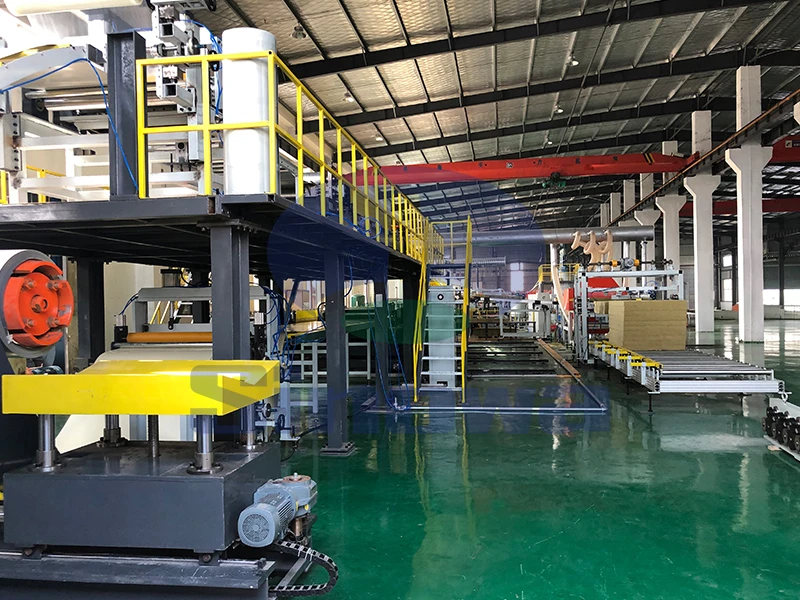
Overall Structural Composition of the Production Line
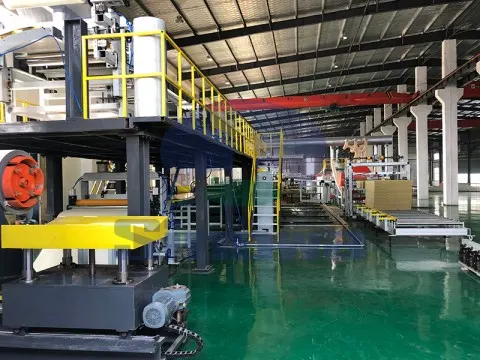
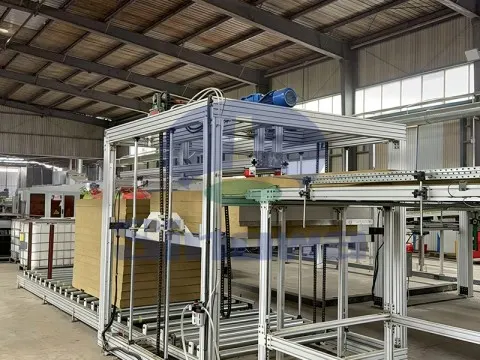
The mineral wool sandwich panel line is a highly integrated and modularized automated manufacturing system composed of multiple interconnected functional units, each undertaking independent and coordinated production tasks to ensure continuous and stable operation. The entire system mainly covers raw material feeding modules, surface material pretreatment units, core material processing and laying systems, adhesive coating mechanisms, composite pressing and curing units, fixed-size cutting devices, as well as finished product conveying and sorting auxiliary systems. All functional modules are linked by synchronous transmission equipment, realizing seamless connection of each production procedure without manual intervention in the main process. Different from ordinary single-function processing equipment, this production line features a compact structural layout and reasonable process sequence, which effectively avoids production delays and precision errors caused by independent operation of scattered equipment. The electrical control system runs through the entire production line, realizing unified parameter adjustment, operation monitoring and fault feedback for all modules. Each mechanical component is designed with targeted structural optimization to adapt to the physical characteristics of mineral wool materials, ensuring that the fibrous core materials will not be damaged or deformed during mechanical processing, while maintaining the flatness and structural integrity of metal surface layers. Such a scientific structural layout lays a solid foundation for high-efficiency and high-quality continuous panel production.
Raw Material Selection and Preprocessing Mechanism
Raw material pretreatment is the primary and pivotal link in the entire production process, directly determining the bonding quality and overall performance of finished mineral wool sandwich panels. The main raw materials involved include metal surface coils and mineral wool core materials, both of which require standardized pretreatment before formal composite processing. For metal surface materials, the production line is equipped with professional unwinding, leveling and cleaning devices. The unwinding mechanism steadily releases metal coils at a constant speed to avoid tensile deformation and wrinkling, while the leveling system corrects subtle structural distortions of the metal plate surface to ensure overall flatness. Meanwhile, the automatic cleaning unit removes surface dust, oil stains and oxide layers, eliminating barriers for subsequent adhesive bonding. As for mineral wool core materials, the pretreatment process focuses on material sorting, loose fiber removal and uniform thickness calibration. The equipment screens out unqualified mineral wool fragments and uneven fiber blocks, and adjusts the stacking density of mineral wool layers to ensure consistent thickness and uniform fiber distribution. This pretreatment process effectively solves the problems of unstable core material quality and poor bonding uniformity in traditional manual processing. By standardizing raw material pretreatment standards, the production line eliminates most quality hidden dangers in the initial stage, providing qualified raw material conditions for subsequent composite molding and greatly improving the yield rate of finished panels.
Intelligent Core Material Laying Technology
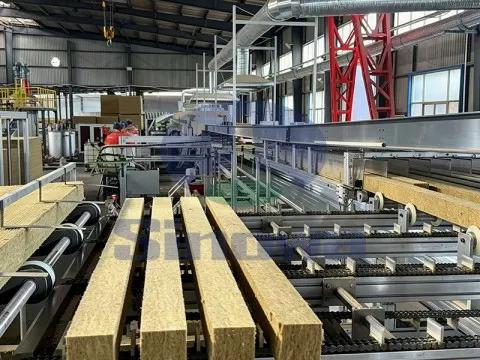
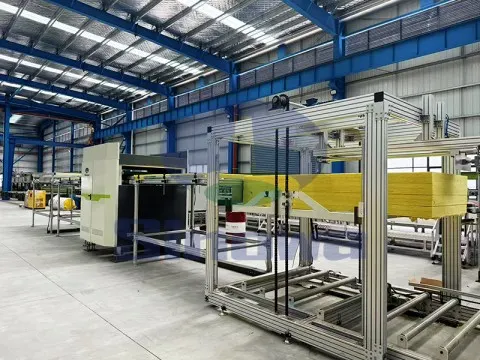
Core material laying is a core procedure that determines the thermal insulation, sound insulation and fire resistance performance of mineral wool sandwich panels, and the mineral wool sandwich panel production line adopts advanced intelligent laying technology to realize precise and standardized core material arrangement. Mineral wool, as an inorganic porous fiber material, has special structural characteristics, and its fiber arrangement direction and density distribution directly affect the comprehensive performance of finished panels. The intelligent laying system of the production line can automatically adjust the laying direction of mineral wool strips, realizing vertical fiber arrangement of the core layer. This vertical laying mode effectively enhances the overall structural rigidity and pressure resistance of the core material, avoiding the problem of easy compression and deformation caused by horizontal fiber stacking in traditional processing methods. In addition, the equipment is equipped with a real-time density monitoring device, which dynamically adjusts the feeding amount and laying speed of mineral wool according to production parameters, ensuring uniform density distribution of the entire core layer without local sparse or dense areas. The fully automated laying process completely replaces manual paving, solving the problems of low efficiency, uneven paving and large material waste in traditional manual operation. Meanwhile, the closed laying environment prevents external dust and impurities from mixing into the core material, ensuring the purity and performance stability of the mineral wool core layer. This refined laying technology enables the finished panels to maintain consistent functional performance in different parts, greatly improving the overall product quality uniformity.
High-Precision Adhesive Coating Process
Adhesive coating is a key link that connects the metal surface layer and mineral wool core layer, and its coating uniformity and dosage accuracy directly determine the bonding strength and structural stability of sandwich panels. The production line adopts an automatic high-precision adhesive coating system matched with high-performance environmentally friendly polymer adhesives, which are characterized by fast curing speed, strong adhesion, aging resistance and no corrosion to metal and mineral wool materials. Different from traditional single-sided coating methods, the equipment realizes synchronous and uniform coating on the inner surfaces of upper and lower metal plates. The coating system is equipped with intelligent flow control components, which can automatically adjust the adhesive dosage and coating thickness according to the production speed and plate specifications, avoiding excessive adhesive overflow or insufficient local coating. The atomized coating technology enables the adhesive to form a uniform and dense film on the metal plate surface, without missing coating points or accumulated glue blocks. This uniform coating mode ensures that every contact area between the surface layer and core layer can form a tight bonding interface. In addition, the system is designed with an automatic cleaning function, which regularly cleans the coating nozzle and conveying pipeline to prevent adhesive solidification and blockage, ensuring long-term stable operation of the coating process. The standardized adhesive coating process effectively improves the bonding firmness of composite panels, avoiding quality problems such as core layer peeling and plate separation in later use, and enhancing the structural durability of finished products.
Constant Temperature Composite Pressing Molding
Composite pressing and curing is the molding core procedure of mineral wool sandwich panels, which realizes the tight integration of metal surface layers and mineral wool core layers through constant temperature and constant pressure treatment. After the completion of adhesive coating and core material laying, the semi-finished products are automatically sent to the pressing and curing unit through the transmission system. The production line adopts a double-track constant pressure pressing structure, which can maintain stable and uniform pressure on the entire panel surface during the molding process, avoiding local uneven stress caused by single-point pressing. The pressure value can be intelligently adjusted according to the thickness and specification of the panel, ensuring that the mineral wool core layer is tightly attached to the metal plate without excessive compression leading to fiber structural damage. Meanwhile, the constant temperature curing system provides a stable temperature environment for adhesive curing, which accelerates the molecular reaction of the polymer adhesive and shortens the curing cycle. The closed curing space ensures uniform temperature distribution, enabling the adhesive to cure synchronously on the entire bonding interface, forming a high-strength integrated composite structure. The whole pressing and curing process operates continuously and automatically, with precise control of pressure, temperature and time parameters. Compared with intermittent pressing equipment, this continuous production mode not only greatly improves production efficiency, but also ensures consistent molding quality of each batch of panels. The finished panels after pressing and curing have high overall rigidity, tight internal combination and no hollow gaps, with significantly improved structural stability and load-bearing performance.
Precision Sizing and Cutting Processing
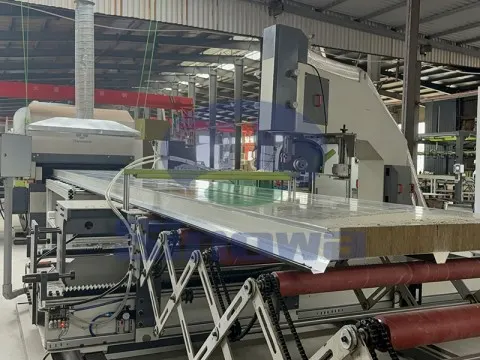
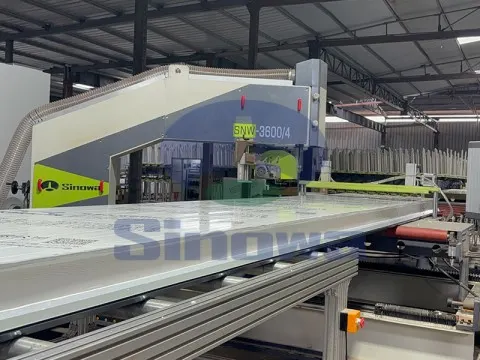
After the completion of composite molding and curing, the continuous long-strip semi-finished panels will enter the precision sizing and cutting process to meet the dimensional specifications of finished products. The production line is equipped with high-speed numerical control cutting equipment, which realizes automatic fixed-length cutting according to preset parameter settings. The system supports flexible adjustment of cutting length and width, adapting to the diversified size requirements of different application scenarios. Before cutting, the intelligent positioning device automatically calibrates the horizontal and vertical flatness of the panel, corrects subtle positional deviations in the transmission process, and ensures high cutting dimensional accuracy. The cutting tool adopts high-hardness wear-resistant materials, which can achieve smooth and flat cutting sections without burrs, cracks or fiber falling off, effectively maintaining the structural integrity of the panel end face. In addition, the equipment is equipped with a dust removal and chip collection device, which timely collects mineral wool fibers and metal debris generated during cutting, keeping the production environment clean and avoiding debris adhesion affecting subsequent processing. The cutting process is highly automated, with real-time parameter monitoring and error correction functions. Once abnormal dimensional deviation is detected, the system will automatically alarm and adjust parameters to ensure the consistency of finished product dimensions. This precision cutting process eliminates the dimensional errors and section damage caused by manual cutting, improving the qualification rate and appearance quality of finished panels.
Finished Product Inspection and Automatic Sorting
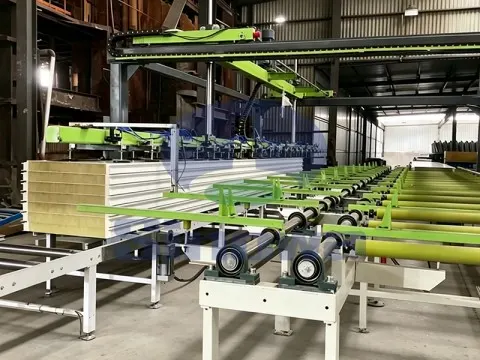
Finished product inspection and sorting is the final quality control link of the production line, which screens qualified products and eliminates unqualified panels to ensure that all delivered products meet quality requirements. The production line is equipped with a full set of online intelligent inspection devices, which conduct real-time non-destructive testing on the structural performance, appearance quality and dimensional accuracy of the cut finished panels. The inspection items include surface flatness, bonding compactness, overall thickness uniformity and section integrity. The intelligent detection system can accurately identify subtle quality defects such as local hollowing, uneven thickness and surface scratches that are difficult to distinguish manually. After inspection, the automatic sorting system classifies and conveys panels according to detection results. Qualified finished products are transmitted to the stacking area through a special conveyor belt, while unqualified products are automatically sent to the rework area for subsequent processing. The whole inspection and sorting process realizes full automation without manual screening, which not only improves detection efficiency, but also avoids missed detection and misjudgment caused by human factors. Meanwhile, the system can record all inspection data in real time, forming a complete production quality traceability file, which provides data support for production process optimization and quality improvement. This strict online quality control mechanism ensures the stability and reliability of batch product quality.
Core Performance Advantages of Produced Panels
The mineral wool sandwich panels produced by this professional production line have multiple outstanding performance advantages, making them widely applicable in modern construction fields. Benefiting from the precise production process and optimized structural design, the finished panels have excellent fire resistance performance. The inorganic mineral wool core material has non-combustible characteristics, which can effectively block flame propagation and resist high-temperature erosion, providing reliable fire protection guarantees for buildings. In terms of thermal insulation performance, the porous fiber structure of mineral wool forms a stable air insulation layer, which can effectively block indoor and outdoor heat transfer, reduce building energy consumption and achieve good energy-saving and heat preservation effects. The panels also have superior sound insulation and noise reduction performance; the internal porous fiber structure can absorb and isolate sound waves, reducing noise transmission and improving indoor acoustic environment. Structurally, the composite structure of metal surface layer and mineral wool core layer endows the panels with high overall rigidity and good wind pressure resistance and load-bearing capacity, which can adapt to complex building use environments. In addition, the panels have good moisture resistance, corrosion resistance and aging resistance, with stable performance in long-term use and no easy deformation or performance attenuation. All these excellent performances are derived from the standardized and refined processing of the full-automatic production line, which maximizes the functional advantages of mineral wool materials and composite structures.
Production Line Operational Efficiency Characteristics
This mineral wool sandwich panel manufacturing line has remarkable advantages in operational efficiency and production stability compared with traditional production equipment. The whole production process adopts continuous streamlined operation mode, with all functional modules operating synchronously and cooperatively, realizing uninterrupted production from raw material feeding to finished product output. The highly automated operation mode minimizes manual participation, effectively reduces human error and labor cost, and greatly improves production continuity. The production line is equipped with an intelligent linkage control system, which can dynamically adjust operating parameters such as transmission speed, coating dosage and pressing pressure according to production load and product specifications, realizing adaptive production of different types of panels. The equipment has a high start-up speed and stable operation state, with low failure rate in long-term continuous operation, avoiding frequent production shutdowns caused by equipment faults. In terms of material utilization, the refined pretreatment and laying process reduces mineral wool and adhesive waste, improving the comprehensive utilization rate of raw materials. Meanwhile, the integrated production mode shortens the production cycle of single panels and greatly improves hourly output and annual production capacity. In addition, the production line has good compatibility and scalability, which can adapt to the production of panels with different thicknesses and specifications, meeting the diversified production needs of manufacturers and improving the overall production flexibility and market adaptability.
Application Scenarios and Industry Value
The mineral wool sandwich panels manufactured by this advanced production line have broad application scenarios and important industry value in the modern construction and building materials industry. Relying on excellent fire resistance, thermal insulation and structural stability, the panels are widely used in the construction of industrial plants, warehouse buildings, public facilities and commercial buildings. They are suitable for building exterior wall enclosure systems, roof thermal insulation structures, indoor partition walls and fire-proof isolation zones, meeting the high safety and functional requirements of different building spaces. In the field of special buildings with high fire protection standards, the panels can provide reliable fire safety guarantees, effectively reducing building fire risks. In terms of energy-saving buildings, their excellent thermal insulation performance helps reduce building heating and cooling energy consumption, conforming to the development trend of green and energy-saving buildings. From the perspective of industry development, the popularization and application of this automated production line promotes the standardized and large-scale production of mineral wool sandwich panels, replacing the traditional backward manual and semi-automatic production modes. It improves the overall product quality level of the industry, reduces production costs, and accelerates the upgrading and iteration of building enclosure material technology. With the continuous improvement of building safety and energy-saving requirements, the high-quality mineral wool sandwich panels produced by this production line will occupy a more important position in the building materials market, driving the sustainable development of the construction industry.
Gallery of Mineral Wool Sandwich Panel Production Line
Tags: mineral wool sandwich panel production line, mineral wool sandwich panel production line manufacturer, mineral wool sandwich panel production line supplier, china mineral wool sandwich panel production line, mineral wool sandwich panel production line for sale
Related Informations
High Quality Mineral Wool Sandwich Panel Machine