Phenolic Foaming Production Line
Publication Date: Oct 7, 2026
Phenolic Foaming Production Line for continuous automatic phenolic foam insulation panels. Accurate metering, mixing, foaming, curing & cutting. Fireproof, low thermal conductivity, for construction insulation sandwich boards. Custom speed & size, reliable after-sales support.
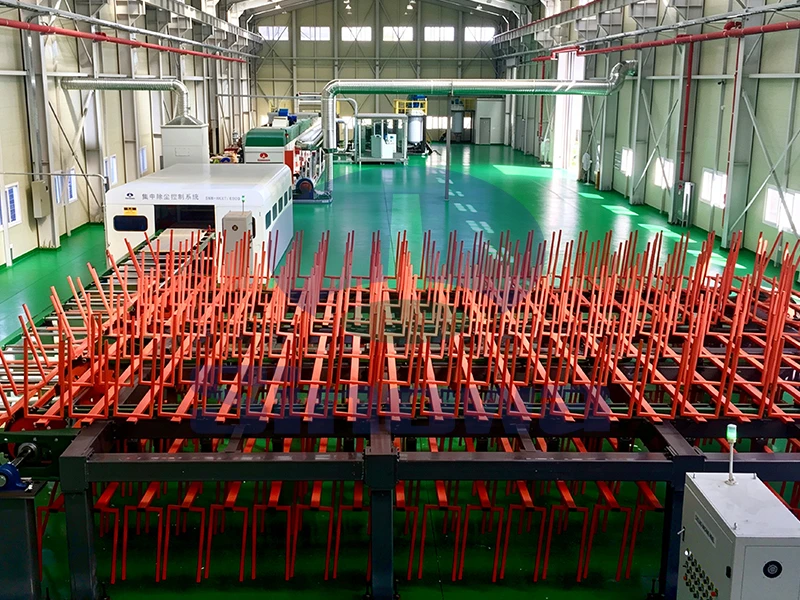
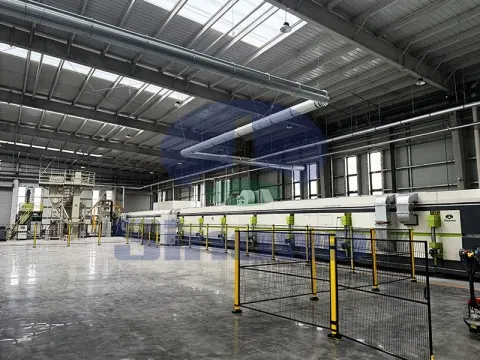
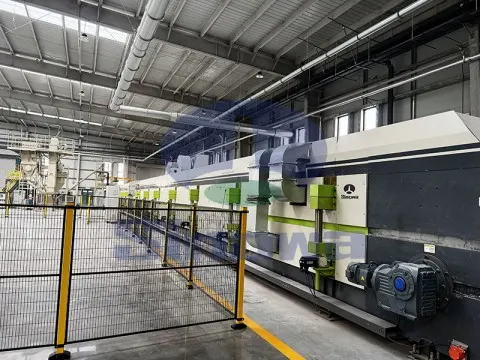
The phenolic foaming production line is a specialized integrated industrial system for continuous manufacturing of high-performance phenolic foam materials. It integrates raw material processing, precise mixing, controllable foaming, curing molding and post-processing, delivering lightweight, heat-insulating and flame-retardant foam products for diverse industrial and construction scenarios.
Basic Composition and Overall Operational Logic
A complete phenolic foaming production line is composed of multiple interconnected functional modules that cooperate systematically to realize automated and continuous material manufacturing. The core structural units cover raw material feeding systems, intelligent proportioning devices, high-precision mixing units, sealed foaming channels, constant-temperature curing tunnels, fixed-size cutting mechanisms and automatic conveying and finishing systems. Each module is designed with independent adjustment functions while maintaining synchronous linkage to ensure the stability of the overall production process. The operational logic of the line follows a linear and uninterrupted processing mode. Liquid and powdery raw materials are transported to the proportioning unit in real time, mixed into homogeneous composite materials under precise parameter control, and then sent to the foaming and curing area for phase change and structural molding. Finally, semi-finished products are trimmed and shaped to form qualified finished materials. This integrated layout effectively avoids intermittent production errors, reduces manual intervention, and lays a solid foundation for consistent product quality and stable production efficiency. Different from discrete processing equipment, the whole line focuses on dynamic balance of material flow, temperature control and reaction progress, realizing standardized large-scale production of phenolic foam materials.
Raw Material Selection and Preprocessing Standards
Raw material preparation is the primary prerequisite for high-quality phenolic foam production, directly determining the pore structure, mechanical properties and service durability of finished products. The main raw materials include phenolic resin as the base matrix, foaming agents, curing agents, surfactants and various functional auxiliary additives. Phenolic resin used in production features good viscosity stability and cross-linking activity, which ensures sufficient chemical reaction during foaming and curing stages. Foaming agents are selected based on environmental adaptability and foaming uniformity, capable of stable gasification under set temperature conditions to form dense and tiny foam pores. Surfactants play a key role in homogenizing mixed materials, eliminating bubble merging and collapse phenomena, and optimizing the internal structural compactness of foam materials. Before formal production, all raw materials need standardized preprocessing procedures. Liquid raw materials are filtered and temperature-adjusted to remove impurities and stabilize viscosity, while powdery additives are screened and dispersed to avoid agglomeration. Strict raw material pretreatment can effectively prevent production defects such as uneven foaming, local hollowing and inconsistent material density. It also optimizes the subsequent reaction process, enabling the production line to maintain a stable operating state and produce foam products with uniform performance and stable structure in long-term continuous operation.
Precision Proportioning and Dynamic Mixing Process
Precision proportioning and dynamic mixing are core links that determine the uniformity and molding effect of phenolic foam materials. The production line is equipped with intelligent closed-loop proportioning systems, which can accurately control the feeding amount of each raw material according to preset process parameters. Different from traditional manual proportioning modes, the automatic proportioning unit realizes real-time monitoring and fine adjustment of material ratios, effectively avoiding product performance fluctuations caused by proportion deviation. After proportioning, all raw materials enter the high-speed dynamic mixing unit for homogeneous blending. The mixing device adopts a multi-dimensional stirring structure, which can fully fuse viscous resin, volatile foaming agents and powdery auxiliaries in a short time. During the mixing process, the system maintains constant temperature and pressure conditions to prevent premature gasification of foaming agents and local curing of resin. The whole mixing process is carried out in a fully sealed environment, which not only ensures the uniformity of the mixed material system, but also avoids material loss and external environmental interference. Well-mixed composite materials present stable fluidity and uniform component distribution, which provides a reliable material basis for the subsequent controllable foaming reaction and ensures that each batch of foam products has consistent structural and performance indicators.
Core Principle of Continuous Foaming Reaction
The continuous foaming reaction is the most critical stage in the entire production process, where phenolic materials complete phase transformation and porous structure formation. The uniformly mixed liquid materials are continuously injected into the closed foaming channel through a pressure conveying device. Inside the sealed channel, the materials are affected by dual factors of constant temperature induction and catalytic reaction, triggering cross-linking polymerization of phenolic resin and gasification of foaming agents simultaneously. The low-boiling foaming agent rapidly vaporizes to generate a large number of tiny and uniform gas bubbles, which are stably wrapped by the viscous resin matrix to form a preliminary closed-cell structure. As the materials move forward along the foaming channel, the polymerization reaction continues to deepen, the resin gradually changes from liquid to viscous solid state, and the bubble structure is fixed and shaped. The production line adopts a gradient temperature control mode in the foaming area, which can accurately regulate the foaming speed and expansion range, avoiding defects such as excessive bubble expansion, bubble rupture and uneven pore distribution. This controllable foaming mode enables the phenolic foam to form a dense and uniform closed-cell structure, endowing the material with excellent thermal insulation, sound insulation and pressure resistance, and realizing efficient and stable continuous foaming production.
Constant Temperature Curing and Structural Molding Technology
Curing and molding is a key process to finalize the physical structure and mechanical properties of phenolic foam products. After the initial foaming reaction, the semi-molded foam materials enter the constant-temperature curing tunnel for continuous curing treatment. The curing area is equipped with a multi-section independent temperature control system, which forms a gradient temperature field adapting to the resin cross-linking reaction law. In the early curing stage, moderate temperature promotes the continuous cross-linking of phenolic resin molecular chains, strengthening the bonding force between material molecules and preliminarily stabilizing the foam pore structure. In the later curing stage, constant low-temperature heat preservation is adopted to eliminate internal stress of the materials, prevent product deformation and improve structural compactness. The entire curing process is carried out in a dust-free and constant-humidity closed environment, which avoids the influence of external temperature and humidity changes on product molding. With the gradual completion of the curing reaction, the liquid composite materials are completely transformed into solid porous foam structures with stable shapes and fixed dimensions. Reasonable curing parameter setting can effectively improve the mechanical strength, dimensional stability and anti-aging performance of finished products, and avoid common problems such as surface pulverization, structural looseness and easy deformation of phenolic foam.
Automatic Cutting and Size Trimming Process
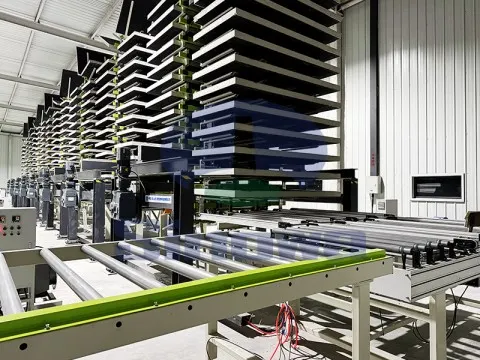
After curing and molding, the continuous phenolic foam base materials need to go through automatic cutting and size trimming to meet the specifications of finished products. The production line is equipped with high-precision synchronous cutting systems, which operate synchronously with the conveying speed of foam materials to realize fixed-length and fixed-width cutting without stopping production. The cutting unit adopts high-speed blade cutting technology with stable operation and neat incision, which will not cause edge collapse, crack or deformation of foam materials. Before formal cutting, the system automatically detects the overall dimensions and surface flatness of continuous foam base materials, and fine-tunes the cutting parameters according to the actual molding situation to ensure the consistency of product specifications. In addition to fixed-size cutting, the trimming process also includes edge trimming and surface finishing links to remove irregular residual edges and tiny burrs generated during the molding process. The fully automatic cutting and trimming process replaces traditional manual processing, greatly improves processing accuracy and production efficiency, and ensures that the dimensional error of finished products is controlled within a tiny range. Standardized trimming treatment also optimizes the assembly and application effect of subsequent products, making the foam materials more adaptable to different application scenarios.
Online Quality Monitoring and Parameter Adjustment Mechanism
Real-time quality monitoring and dynamic parameter adjustment are important guarantees for the production line to output high-stability phenolic foam products in long-term continuous operation. The entire production process is equipped with multi-point online monitoring sensors, which real-timely collect key production data including material proportion, mixing uniformity, foaming temperature, curing time, product density and pore structure uniformity. The monitoring system transmits the collected data to the intelligent control terminal in real time, and automatically compares it with the preset standard parameter range. Once slight parameter deviation or potential quality risk is detected, the system will trigger automatic fine adjustment, synchronously correcting the feeding speed, temperature, pressure and conveying parameters of each functional module. For abnormal conditions that cannot be automatically adjusted, the system will issue early warning prompts to remind operators of manual inspection and processing. This real-time monitoring and closed-loop adjustment mechanism realizes full-process quality control from raw material input to finished product output. It effectively avoids batch quality problems caused by parameter drift during long-term production, greatly improves the yield of finished products, and ensures that each batch of phenolic foam materials maintains stable and reliable comprehensive performance.
Energy Saving Design and Operational Safety Control
Modern phenolic foaming production lines integrate advanced energy-saving design and comprehensive safety control systems to realize efficient, low-consumption and safe industrial production. In terms of energy saving, the production line adopts heat circulation utilization technology in the foaming and curing areas. The waste heat generated by temperature control equipment is recycled and reused for preheating raw materials and maintaining tunnel temperature, which effectively reduces invalid energy consumption. All power equipment adopts frequency conversion speed regulation design, which can automatically adjust operating power according to production load, avoiding energy waste caused by no-load and low-load operation. In terms of safety control, the whole line is equipped with perfect safety protection devices, including over-temperature protection, over-pressure protection, material blockage alarm and emergency stop linkage systems. All closed reaction areas are equipped with pressure relief and ventilation devices to ensure the stability of the internal reaction environment. The equipment operation area is isolated by safety protection structures to avoid contact risks between operators and high-temperature and high-pressure operating parts. In addition, the production line is equipped with regular self-inspection functions, which can automatically check the operating status of each module, eliminate potential safety hazards in advance, and ensure long-term stable and safe operation of the production equipment.
Product Performance Characteristics and Application Advantages
Phenolic foam products produced by professional foaming production lines have outstanding comprehensive performance and broad application advantages compared with traditional foam materials. Relying on precise process control and standardized production flow, the finished phenolic foam has a uniform closed-cell porous structure, which endows the material with excellent low thermal conductivity and efficient thermal insulation performance. Meanwhile, the material has good flame retardancy and low smoke density, showing stable safety performance in high-temperature environments, which is superior to many ordinary thermal insulation foam materials. In terms of physical properties, qualified phenolic foam products feature light weight, high structural compactness and good compression resistance, which are not easy to deform during long-term use and have strong durability. In addition, the material has good chemical stability, corrosion resistance and moisture resistance, and can adapt to complex and harsh application environments. These excellent performance characteristics make phenolic foam widely applicable in building thermal insulation, industrial pipeline insulation, equipment heat preservation and fire-proof protection fields. The stable production capacity of the production line ensures the continuous supply of high-performance products, providing reliable material support for energy-saving and safety upgrading of various industries.
Industry Development Trends and Technical Optimization Directions
With the continuous upgrading of new energy-saving material industry, phenolic foaming production line technology is also developing towards higher intelligence, higher efficiency and more environmental protection. At present, the traditional single-function production mode is gradually replaced by integrated intelligent production systems. The new generation of production lines realizes full-process digital control, and the whole production link from raw material proportioning to finished product output can be monitored and adjusted remotely, which further improves production precision and automation level. In terms of technical optimization, the industry is constantly exploring new raw material formulas and low-carbon foaming processes to reduce energy consumption in the production process while maintaining product performance. The structural design of the production line is also continuously optimized, with more compact module layout and more flexible parameter adjustment functions, which can adapt to the customized production of phenolic foam products with different densities, specifications and performance requirements. In addition, the post-processing technology of production waste is gradually improved to realize resource recycling of residual materials and reduce production waste. In the future, phenolic foaming production lines will further integrate intelligent sensing, big data analysis and green manufacturing technology, continuously improve production efficiency and product quality, and expand the application boundary of phenolic foam materials in more emerging fields.
Gallery of Phenolic Foaming Production Line
Tags: phenolic foaming production line, phenolic foaming production line manufacturer, phenolic foaming production line supplier, china phenolic foaming production line, phenolic foaming production line for sale
-

A reliable PU sandwich panel production line serves as the core equipment for manufacturing high-performance building insulation panels. This professional PU sandwich panel line features automated feeding, foaming and molding processes to ensure consistent panel thickness and structural stability. The well-designed polyurethane sandwich panel production line effectively improves production efficiency while reducing material waste in daily operation. Each calibrated polyurethane sandwich panel line can adapt to different panel sizes to meet diverse construction needs. With precise temperature and pressure control, the advanced continuous PU sandwich panel line produces panels with excellent thermal insulation and weather resistance. Meanwhile, the optimized PIR sandwich panel production line upgrades the foaming formula to enhance fire resistance performance. The high-efficiency PIR sandwich panel line maintains stable operation during long-term mass production, delivering durable and high-quality sandwich panels for various architectural and industrial applications.
-

The phenolic panel production line realizes automated and continuous manufacturing of high-performance thermal insulation panels through streamlined and coordinated processing procedures.
-

Modern insulation panel manufacturing relies on professional automated equipment to ensure stable product quality and high production efficiency. The rock wool sandwich panel production line features precise material lamination and forming processes to produce rigid, heat-insulating building panels. Meanwhile, the mineral wool sandwich panel production line adopts optimized assembly procedures to fabricate lightweight, soundproof panels widely used in architectural enclosure and thermal preservation projects.