How To Adjust The Feeding Amount Of PU Raw Materials In The PU Sandwich Panel Line?
Publication Date: Oct 28, 2026
Learn how to adjust PU raw material feeding on sandwich panel lines. Tune metering pump flow by matching line speed, panel thickness, foam state and temperature. Fix poor adhesion, overflow, uneven density and hollow defects with step-by-step dosing calibration.
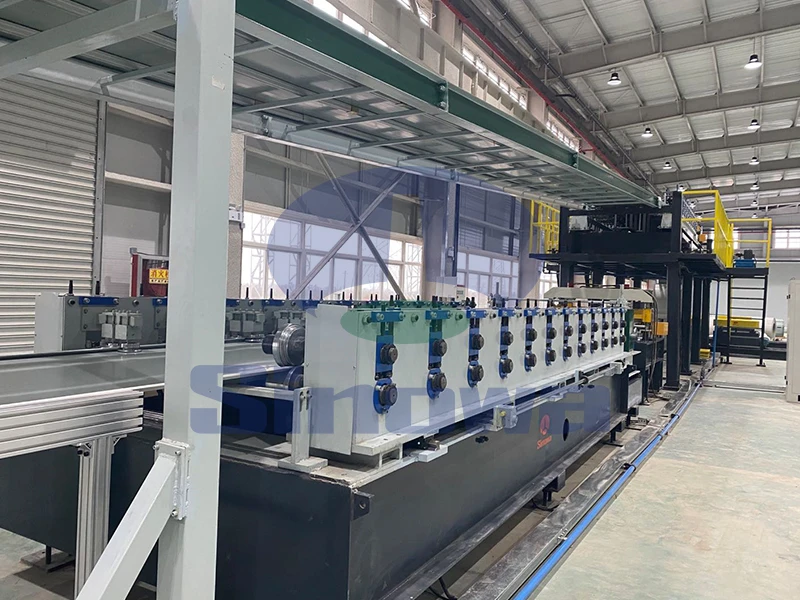
Controlling the feeding amount of PU raw materials on a PU sandwich panel production line is one of the core operations that directly shapes the quality stability of finished panels, and it requires operators to build a complete adjustment logic based on real-time production conditions rather than relying on fixed parameter settings. The two main components of PU raw materials, polyether polyol and isocyanate, need to be delivered through independent metering pumps before mixing inside the foaming head, and the total feeding volume and the matching ratio between the two materials work together to decide the foaming reaction speed, foam density and cell structure inside the sandwich core. Before making any adjustment to the feeding amount, operators first need to observe the basic state of the foam that has just formed after mixing. If the foam expands too quickly and appears loose with large and uneven air holes, it often means the overall feeding volume is not matched with the running speed of the panel line, or the flow rate of one raw material deviates from the reasonable range. On the contrary, when the foam cures too slowly and keeps flowing along the surface of the face sheet without forming a stable supporting structure, insufficient feeding or improper ratio control is usually the main cause. Operators should keep in mind that the feeding amount adjustment cannot be carried out in a large range at one time. Each fine tuning should be limited to a small change of the pump output, and sufficient time must be reserved for the adjusted raw materials to pass through the mixing system and form foam on the continuous line. During this waiting period, it is necessary to continuously track the appearance of the foam layer, the adhesion condition between foam and face sheets, and the surface flatness of the semi-finished panel. It is also essential to check the temperature of raw material storage tanks and circulating pipelines, because raw material viscosity changes with temperature will affect the actual output of metering pumps even if the set numerical value remains unchanged. Ignoring the influence of temperature will lead to misjudgment of feeding parameters, making the adjustment direction deviate from the actual demand of production. Only by combining visual inspection of foam state and stable raw material temperature control can operators lay a solid foundation for accurate feeding adjustment and avoid frequent blind changes of pump parameters that bring fluctuations to the whole production process.
The running speed of the continuous sandwich panel line is an important reference index when adjusting the feeding amount of PU raw materials, and these two parameters must maintain a coordinated matching relationship in the whole production process. When the line speed increases to raise the production output, the raw material feeding amount needs to be increased synchronously to ensure that enough mixed foaming material can be evenly laid on the moving face sheet, forming a core layer with consistent thickness. If the line speed goes up while the feeding volume stays the same, the foam layer will become thinner, and some areas may appear discontinuous or lack sufficient material to fill the space between the upper and lower face sheets. In this situation, the finished panel will have local hollow defects and decline in overall structural performance. In contrast, when the production line slows down for inspection of equipment or replacement of raw material batches, the feeding amount must be reduced correspondingly. Excessive raw material supply under low line speed will cause excessive accumulation of mixed foam, which cannot release expansion heat in time during the foaming reaction. The overheated foam will generate coarse cells, shrink after complete curing, and even cause the face sheet to deform under the pushing force of excessive foaming pressure. Operators need to establish a stable matching habit between line speed and feeding flow, and each adjustment of line speed should trigger a corresponding check and fine tuning of the metering pump settings. It is not advisable to pursue a simple fixed proportional formula mechanically, because the fluidity of raw materials and foaming activity will change slightly after long-time circulation. After modifying the feeding parameters according to line speed changes, operators should sample the foam core from the produced panels at regular intervals to feel its texture and observe the cross-section pore distribution. The cross-section can intuitively show whether the material distribution is uniform throughout the thickness direction of the core. If one side of the core is dense while the other side is porous, it indicates that the feeding layout on the foaming head also needs to be optimized together with the total feeding amount. Maintaining the coordination between line speed and feeding supply helps to stabilize the forming environment of the PU foam core and reduce the probability of batch defective products caused by mismatched parameters.
The ambient temperature around the production line and the surface temperature of metal face sheets exert an indirect but obvious influence on the foaming reaction, which requires operators to revise the feeding amount plan properly to adapt to these changing thermal conditions. In a high-temperature working environment, the chemical reaction between polyether polyol and isocyanate accelerates significantly after mixing. If the original feeding amount is kept unchanged, the mixed material will finish expansion and curing in a shorter time, which may leave insufficient time for the foam to spread evenly across the width of the face sheet. This phenomenon often leads to a thicker core in the middle part and thinner edges of the sandwich panel, and the edge area may have poor bonding with the face sheet. Under such high-temperature conditions, operators can slightly reduce the overall feeding amount and make small adjustments to the material ratio to slow down the reaction activity appropriately, so that the foam can have enough flowing time to cover the whole laying area uniformly. When the workshop environment is cold, the reaction rate slows down obviously, and the foam tends to flow too freely before curing. If the feeding amount remains at the original level, the flowing foam will easily squeeze out from both sides of the panel and cause material waste, and the cured core may have uneven density distribution. At this time, a moderate increase of feeding amount can compensate for the delayed reaction, ensuring that the foam can fill the preset core space before losing fluidity. The temperature of the upper and lower face sheets also cannot be ignored. Cold face sheets will absorb heat from the foaming system and inhibit the reaction near the contact surface, which may create a weak bonding layer between foam and sheet. Operators need to observe the bonding edge continuously when ambient or sheet temperature changes, and adjust the feeding amount step by step until the foam can form tight adhesion without overflowing. All adjustments under variable temperature conditions must be gradual, and operators should avoid making large parameter changes just because of a single abnormal foam sample, as temporary local temperature fluctuation may not represent the stable state of the whole production environment.
The mixing state of PU raw materials at the foaming head is closely related to the feeding amount setting, and unreasonable feeding flow will directly destroy the uniform mixing effect of the two components. The metering pumps send polyether polyol and isocyanate into the mixing chamber of the foaming head at set flow rates, and the stirring structure inside the head relies on a stable material inflow speed to achieve sufficient shearing and blending. If the feeding amount is set too low, the material flow speed entering the mixing chamber is slow, and the two components cannot be fully stirred and blended in the limited residence time. Partially mixed material will form isolated clusters of incomplete reaction on the panel, appearing as hard spots or soft sticky areas scattered inside the foam core. These abnormal areas will become hidden quality risks, reducing the thermal insulation performance and structural uniformity of the finished sandwich panel. When the feeding amount is set excessively high, the material fills the mixing chamber rapidly and shortens the effective stirring time. The mixed material may leave the foaming head before reaching a homogeneous state, and the foam will show alternating dense and loose strips along the running direction of the panel line. Besides, excessive feeding flow will increase the back pressure inside the foaming head, which may affect the stable operation of the metering pumps and cause periodic fluctuation of the actual output. When adjusting feeding amount, operators need to pay attention to the running sound and pressure feedback of the foaming head. Stable pressure reading means the material inflow matches the mixing capacity of the equipment, while frequent pressure jump usually signals that the feeding flow has gone beyond the reasonable range of the mixing structure. After each adjustment of feeding parameters, it is necessary to check whether the material jet coming out of the foaming head is continuous and homogeneous. A uniform and steady material stream is the prerequisite for forming qualified foam. If the jet is intermittent or separated into two different streams, operators need to reduce the feeding amount and check the pump and mixing chamber simultaneously, instead of continuing production under unstable mixing conditions. Keeping the feeding amount within the processing capacity of the foaming head guarantees consistent mixing quality and lays the foundation for stable foaming of PU raw materials.
The target thickness of the PU sandwich panel core is a fundamental reference standard for determining the reasonable feeding amount, and the total supply of raw materials must match the volume space reserved for the foam core between the two face sheets. Each specification of sandwich panel has a designed core thickness, and the foamed PU material needs to fill this space completely without excessive overflow or insufficient filling. When switching production to a panel specification with a thicker core, the feeding amount needs to be raised to provide enough raw materials for expansion. If the feeding amount is not increased correspondingly, the foam cannot expand to the required thickness, and the finished panel will be thinner than the design size, accompanied by insufficient supporting force of the core layer. When switching to a thinner core specification, reducing the feeding amount is necessary. Too much raw material for a narrow core space will generate excessive foaming pressure, pushing the upper and lower face sheets outward and resulting in wavy deformation of the panel surface. Operators should combine the width and line speed of the panel together with core thickness when calculating the basic feeding range, because the total volume of the core layer produced per unit time is determined by these three factors. After adjusting feeding amount for a new thickness specification, the first several panels need to be measured at multiple positions along the width and length direction. Thickness deviation at different positions reflects whether the feeding distribution and total flow are appropriate. If the middle of the panel meets the thickness requirement but both edges are thin, it may be necessary to adjust the material distribution mode of the foaming head while maintaining the total feeding amount. If the thickness is generally larger than the target value across the whole panel, the total feeding flow should be decreased gradually. It is worth noting that the expansion ratio of PU foam will not stay completely fixed under different reaction conditions. Even with the same feeding amount, the final cured thickness may have slight changes when reaction speed shifts. Therefore, operators cannot treat the feeding parameter as a fixed value corresponding to a certain thickness forever. Regular thickness measurement and small feeding correction are required during continuous production to offset the subtle changes of foaming expansion characteristics and keep the finished panel dimensions within the expected stable range.
Foam density of the PU core is another key quality indicator affected directly by feeding amount adjustment, and operators need to balance feeding supply to maintain density consistency throughout continuous production. The density of cured PU foam depends on the mass of raw materials used to fill a unit volume of core space. When the core volume is fixed, increasing the feeding mass will raise the foam density, while reducing feeding mass will lower the density. Higher density foam usually has better compression resistance and structural strength, but excessive density brought by too much feeding will consume more raw materials and make the thermal insulation performance decline slightly. Insufficient feeding leads to low-density foam with oversized cells, which is easy to deform under pressure and cannot provide reliable supporting effect for the sandwich panel. When operators find that the foam core is too light and the pore structure is too open, they can increase the feeding amount slowly to add more raw material mass into the foaming system. Each adjustment should be followed by waiting for the new material to form foam and cure fully before judging the density change. Cutting open the panel core and weighing standardized foam samples is a reliable way to evaluate density changes after feeding adjustment. If the foam sample is too heavy and feels hard and compact, reducing the feeding amount is the proper operation. In actual production, density deviation often appears gradually instead of suddenly. Raw material activity changes after long-time circulation will alter the expansion multiple, so the same feeding amount may produce foam with different density in different production stages. Operators should avoid adjusting feeding amount only according to density without checking other foam characteristics. A qualified foam needs to have uniform pore structure besides suitable density. Sometimes abnormal density comes from mismatched material ratio rather than total feeding amount, so operators need to distinguish these two causes carefully. If the cross-section shows uneven pores along with abnormal density, priority should be given to checking the ratio of the two PU components before modifying the total feeding flow. Only when the material mixing ratio stays stable can feeding amount adjustment effectively control foam density and keep the core performance consistent for batches of sandwich panels.
Material overflow at the side edges of the sandwich panel is a common phenomenon closely related to improper feeding amount, and learning to judge and solve overflow problems is an essential skill for operators responsible for feeding adjustment. When the feeding amount exceeds the volume that the core space can hold after foaming, the expanded foam will be squeezed out from the gaps on both sides of the panel, forming solid PU waste strips. Severe overflow not only raises raw material consumption and increases production cost, but also brings extra burden to the cutting equipment at the rear section of the line. In some cases, the overflowing material solidifies on the side guide rollers and blocks the panel running path, which may scratch the surface of the face sheet or cause the panel to deviate from the conveying track. When overflow occurs frequently, operators can first try to reduce the total feeding amount by a small margin, and observe whether the overflow disappears after the adjusted material arrives at the forming section. It should be noted that overflow is not always caused by excessive feeding. If the foaming reaction becomes too fast, the foam expands rapidly before being confined by the upper and lower plates, and overflow can also happen even when the feeding amount is within the normal range. In this situation, blindly cutting feeding amount will lead to insufficient filling of the core after the reaction speed returns to normal. Operators need to distinguish overflow caused by oversupply from overflow caused by accelerated reaction by observing the foaming state. If the foam rises quickly right after leaving the foaming head, reaction speed adjustment should be taken as the main measure, and feeding amount only needs auxiliary fine tuning. When overflow disappears after feeding reduction, operators still need to check the core thickness and internal pore condition to make sure the core is fully filled without hollow gaps. After solving the overflow issue, continue monitoring for a period of time, because the change of raw material temperature and ambient temperature may trigger overflow again later. Maintaining feeding amount at the critical point that just fills the core space without extrusion overflow is the ideal state for stable production and efficient utilization of PU raw materials.
Adhesion performance between PU foam core and metal face sheets is highly sensitive to feeding amount changes, and improper material supply will damage the bonding interface and reduce the overall reliability of sandwich panels. Adequate and properly distributed PU raw materials can maintain appropriate foaming pressure during expansion, which pushes the fresh foam to closely contact the inner surface of the face sheet and complete chemical bonding before the surface of the foam loses activity. If the feeding amount is too low, the foaming pressure generated in the core space is insufficient. The foam cannot fit tightly with the face sheet surface, and tiny gaps will form at the bonding interface. These gaps are difficult to identify from the panel appearance, but they will become separation points under external force or temperature cycling later. When checking semi-finished panels, operators can perform simple peeling tests on the edge area occasionally. If the foam separates easily from the face sheet and the separation surface is smooth without torn foam residue, weak adhesion caused by insufficient feeding is a possible reason. On the contrary, excessive feeding brings excessive foaming pressure. The strong expansion force may destroy the formed bonding interface, and the foam will tear away from the sheet after curing, or the face sheet will bulge and separate locally. Excessive feeding also makes the foam cure faster at the contact surface, forming a dense skin layer that blocks effective bonding between the bulk foam and the sheet. When poor adhesion is found, operators need to check the feeding amount together with the foaming reaction speed. If the reaction speed is stable, adjust the feeding amount slightly upward to raise foaming pressure for better contact. If the reaction is too fast, slow down the reaction first and then fine tune feeding to reach the suitable pressure range. It is also important to ensure that the mixed raw materials can cover the whole bonding area evenly. Even if the total feeding amount is correct, uneven material laying from the foaming head will lead to partial poor adhesion. Operators need to combine the adhesion test result with foam laying state to adjust feeding flow and material distribution synchronously, so that every position of the panel can form a firm bonding interface between foam core and face sheet.
Long-term continuous production will bring subtle wear and performance change to the metering pump system, which will create deviation between the set feeding value and the actual material output, requiring operators to correct feeding parameters dynamically during operation. The metering pumps are the core equipment to control PU raw material feeding, and their conveying accuracy depends on the sealing parts and internal transmission components. After running for a long time, slight wear of sealing rings will cause internal leakage inside the pump. Under this condition, the reading set on the control panel cannot reflect the real flow delivered to the foaming head. The actual feeding amount will be lower than the setting value, and operators may mistakenly increase the setting number repeatedly, which further disturbs the matching ratio between the two PU components. Regular inspection of pump pressure stability and material flow feedback can help find this kind of hidden deviation. When operators notice that the same feeding setting gradually produces foam with obvious density change or unstable reaction state, they should suspect the accuracy drift of the metering system instead of modifying feeding parameters blindly. After confirming that the pump performance has drifted, the feeding setting needs to be recalibrated according to the actual measured flow, rather than continuing to use the old parameter records. Even after calibration, continuous monitoring is still necessary, because wear develops slowly during long shifts. Operators should record the stable feeding parameters corresponding to qualified foam state under fixed production conditions, and use these records as reference benchmarks when abnormal situations appear. When restarting the production line after shutdown for maintenance or overnight stop, the raw material circulation system needs to run for a certain time to stabilize pump pressure and material temperature. The feeding amount should not be adjusted to the formal production value immediately at startup. A low-flow pre-running stage helps to stabilize the whole conveying system, and feeding can be raised step by step only after the material stream from the foaming head becomes uniform and stable. This startup adjustment routine effectively avoids defective panels produced by unstable feeding at the initial stage of line operation and protects the consistency of long-batch production.
Accumulating practical adjustment experience and forming a systematic judgment habit is the final key to master PU raw material feeding control on the sandwich panel line, as every production environment has its unique characteristics that cannot be fully covered by simple fixed parameter tables. Skilled operators do not only rely on numerical values on the control screen, but integrate multiple on-site signals including foam appearance, cross-section pore structure, panel dimension, adhesion condition and equipment feedback to make comprehensive judgment before adjusting feeding amount. Every small adjustment should be recorded mentally or in simple notes, including the original feeding setting, the direction and range of modification, the change of foam state after adjustment, and external conditions such as workshop temperature and line speed at that moment. These accumulated records help operators build intuitive judgment ability, so they can quickly locate the root cause when similar abnormal situations appear again. It is important to maintain a stable adjustment rhythm and avoid frequent parameter changes out of impatience. The PU foaming process has inherent hysteresis. The feeding change made at the foaming head needs a period of time to pass through the forming section, cure completely and show the final quality result. Hasty repeated adjustments often superimpose multiple changes together, making it impossible to distinguish which parameter causes the quality fluctuation. Operators should also communicate with the team members responsible for raw material transfer and face sheet feeding regularly, because changes in raw material batch characteristics or face sheet flatness may require coordinated adjustment of PU feeding amount. Maintaining careful observation and patient fine tuning is the core principle running through all feeding adjustment work. With continuous practice, operators can grasp the balance point of raw material feeding under various working conditions, reduce the occurrence of defective products, stabilize the core quality of PU sandwich panels, and ensure the continuous and smooth operation of the whole foaming and forming process on the production line.
Gallery of PU Sandwich Panel Line






Tags: pu sandwich panel line, pu sandwich panel line manufacturer, pu sandwich panel line supplier, china pu sandwich panel line, pu sandwich panel line for sale
-

A reliable PU sandwich panel production line serves as the core equipment for manufacturing high-performance building insulation panels. This professional PU sandwich panel line features automated feeding, foaming and molding processes to ensure consistent panel thickness and structural stability. The well-designed polyurethane sandwich panel production line effectively improves production efficiency while reducing material waste in daily operation. Each calibrated polyurethane sandwich panel line can adapt to different panel sizes to meet diverse construction needs. With precise temperature and pressure control, the advanced continuous PU sandwich panel line produces panels with excellent thermal insulation and weather resistance. Meanwhile, the optimized PIR sandwich panel production line upgrades the foaming formula to enhance fire resistance performance. The high-efficiency PIR sandwich panel line maintains stable operation during long-term mass production, delivering durable and high-quality sandwich panels for various architectural and industrial applications.
-

The phenolic panel production line realizes automated and continuous manufacturing of high-performance thermal insulation panels through streamlined and coordinated processing procedures.
-

Modern insulation panel manufacturing relies on professional automated equipment to ensure stable product quality and high production efficiency. The rock wool sandwich panel production line features precise material lamination and forming processes to produce rigid, heat-insulating building panels. Meanwhile, the mineral wool sandwich panel production line adopts optimized assembly procedures to fabricate lightweight, soundproof panels widely used in architectural enclosure and thermal preservation projects.