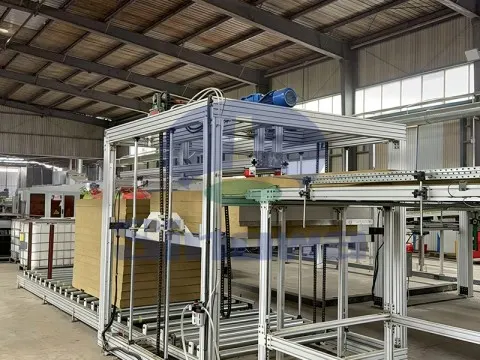
Rock Wool Sandwich Panel Production Line
Publication Date: Sep 30, 2026
The rock wool sandwich panel production line is an integrated automated manufacturing system for producing high-performance composite panels. It integrates multiple processing procedures to create panels with excellent insulation, fireproof and soundproof properties for construction and industrial applications.
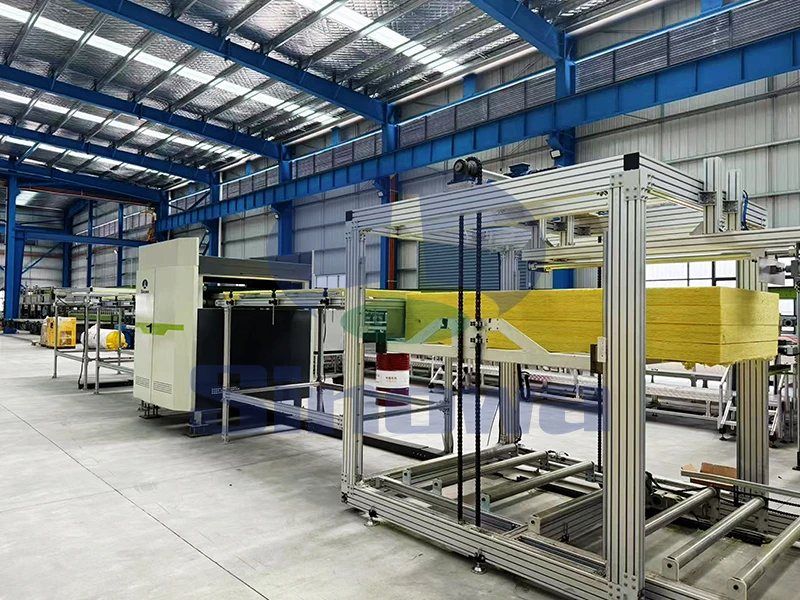
Basic Overview of the Production Line Composition
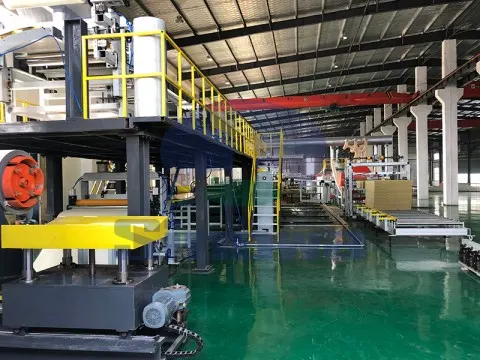
A modern rock wool sandwich panel production line is a highly integrated automated manufacturing system composed of multiple interconnected functional units, each undertaking independent and collaborative processing tasks to complete the full production of composite panels. The core components cover raw material unwinding systems, surface plate forming units, rock wool core material processing equipment, adhesive coating systems, composite pressing devices, cutting mechanisms and finished product conveying and stacking modules. All units operate in a linked manner through automated control systems, realizing continuous and uninterrupted production from raw material input to finished product output. Unlike ordinary single-process machinery, this production line focuses on the matching precision of each procedure, ensuring that the forming quality of metal surface plates, the uniformity of rock wool core materials and the bonding firmness of composite structures reach a stable state. The modular design of the production line also endows it with strong adaptability, allowing flexible adjustment of production parameters according to different panel thicknesses, widths and structural requirements, which can meet the diversified production needs of different application scenarios. Each functional module is optimized for structural stability and operational efficiency, effectively reducing manual intervention and improving the overall continuity and consistency of the production process.
Raw Material Preparation and Unwinding Process
Raw material preparation is the initial and foundational link of the entire rock wool sandwich panel production process, directly determining the stability of subsequent processing and the quality of finished panels. The main raw materials involved include color-coated metal coils for surface layers and rock wool substrates for the core insulation layer, both of which require standardized pretreatment before entering the production line. The metal coil unwinding unit adopts a stable hydraulic unwinding structure, which can stably release coiled metal materials at a uniform speed and avoid material deviation, tension fluctuation and surface scratch problems during unwinding. Equipped with automatic tension adjustment components, the unit can adapt to metal coils of different specifications to ensure the flatness of surface plates before forming. For rock wool core materials, the production line supports the feeding of integrated rock wool slabs, and the supporting sorting and conveying equipment will preliminarily sort and arrange rock wool materials to remove damaged and uneven raw materials. In addition, the system is equipped with a protective film covering function in the unwinding stage, which covers a layer of protective film on the surface of metal plates to prevent surface abrasion and pollution in subsequent processing, effectively guaranteeing the appearance quality of finished panels and reducing post-processing repair procedures.
Surface Plate Roll Forming Technology
Roll forming of metal surface plates is a key procedure to shape the outer structure of rock wool sandwich panels, which determines the dimensional accuracy and structural adaptability of panel products. After unwinding and film covering, the flat metal plate is continuously sent to the roll forming unit composed of multiple groups of precision rolling rollers. The rolling rollers are arranged in a gradient structural design, which gradually bends and presses the flat metal plate into the required wall panel or roof panel profile through multiple rolling procedures, avoiding one-time excessive extrusion that causes material deformation and structural damage. Each group of rolling rollers adopts precise positioning calibration, which can effectively control the flatness, edge straightness and overall dimensional tolerance of the formed plate. The roll forming unit supports flexible parameter adjustment, and workers can adjust the rolling gap and forming speed according to the production requirements of panels with different specifications, realizing rapid switching between different product types. At the same time, the unit is equipped with an edge trimming device, which can trim the uneven edges of the formed metal plate to ensure the consistency of the plate width and provide accurate matching conditions for the subsequent composite bonding of rock wool core materials. The entire forming process is fully automated, with stable operation and high forming precision, laying a solid foundation for the assembly quality of subsequent composite structures.
Professional Rock Wool Core Material Processing
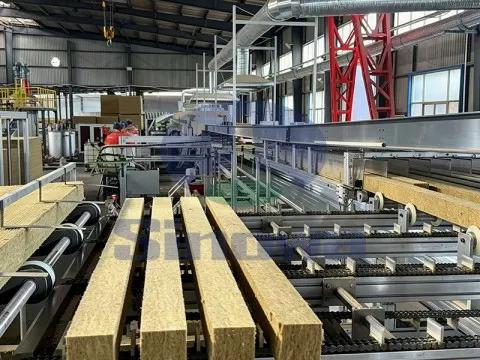
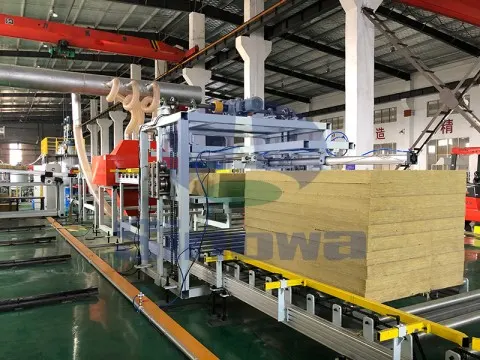
The processing quality of rock wool core materials is the core factor affecting the thermal insulation, fire resistance and sound insulation performance of sandwich panels, and the production line adopts professional targeted processing technology for rock wool materials. Different from ordinary foam core materials, rock wool is an inorganic fiber material with porous structure, which needs special processing to ensure uniform density and stable structural performance after compounding. The production line is equipped with a special rock wool cutting and arranging system, which cuts the whole rock wool slab into uniform strip core materials according to the panel width specifications. The key pendulum laying technology is adopted in the laying process, which uses a mechanical pendulum structure to evenly spread rock wool strips between the upper and lower metal plates in a continuous and orderly manner. This laying method avoids the hollow and uneven density problems caused by traditional flat laying, and makes the internal fiber arrangement of rock wool more regular. In addition, the system can adjust the laying thickness and density of rock wool according to product performance requirements, realizing flexible matching of different insulation and fire protection grades. The sealed conveying and laying structure also reduces the floating of rock wool fibers during processing, optimizing the production operating environment while ensuring the internal compactness and uniformity of the panel core layer.
Precision Adhesive Coating System Operation
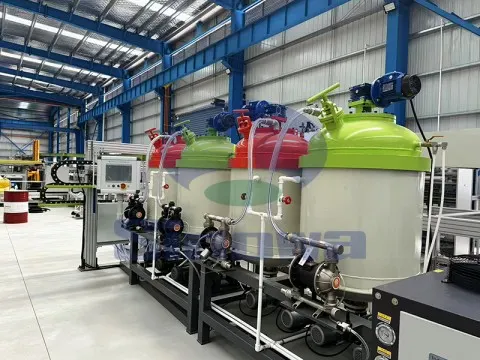
Adhesive coating is a crucial link to realize the firm combination of metal surface plates and rock wool core materials, and the precision of coating directly affects the bonding strength and overall structural stability of sandwich panels. The production line is equipped with an automatic high-precision gluing system, which can evenly spray special composite adhesive on the inner surfaces of upper and lower metal plates. The system adopts intelligent flow control technology, which can automatically adjust the adhesive output and coating thickness according to the production speed and panel specifications, avoiding the quality problems of insufficient bonding caused by uneven glue application or residual glue overflow affecting the appearance. Different from chemical fusion molding of organic core materials, rock wool composite relies entirely on physical adhesive bonding, so the uniformity and consistency of glue coating are particularly important. The gluing process is carried out in a closed and constant-temperature environment, which ensures the stable activity of the adhesive and avoids the influence of external temperature and humidity on the bonding effect. Meanwhile, the system is equipped with a glue recovery and filtering device, which can recycle excess adhesive, reduce material waste, and ensure the cleanliness of the production process. The standardized gluing procedure enables the metal plate and rock wool core layer to form an integrated firm structure after composite pressing, effectively preventing delamination and cracking in subsequent use.
Integrated Composite and Pressure Curing Process
Composite pressing and curing are the core molding procedures of rock wool sandwich panels, which complete the integration of metal surface plates and rock wool core materials into a whole. After the completion of glue coating and rock wool laying, the semi-finished panel is sent to the double-belt composite pressing unit for continuous pressing and curing treatment. The pressing unit adopts a symmetrical double-belt structure, which can apply uniform and stable pressure on the upper and lower surfaces of the panel, ensuring that the metal plate and rock wool core layer are closely fitted without local extrusion deformation. The pressing pressure and running speed can be intelligently adjusted according to the panel thickness and material characteristics, adapting to the production of different specification products. In the pressing process, the constant-temperature curing system works synchronously, providing a stable temperature environment for adhesive curing, accelerating the bonding and forming speed of composite structures, and improving production efficiency. The continuous composite mode avoids the intermittent gaps of traditional batch production, ensures the overall flatness and structural consistency of the long panel, and effectively eliminates quality defects such as internal hollowing and local delamination. After continuous pressing and curing, the scattered raw materials are completely compounded into a stable integrated sandwich panel structure with excellent overall rigidity and structural firmness.
Accurate Fixed-Length Cutting Process
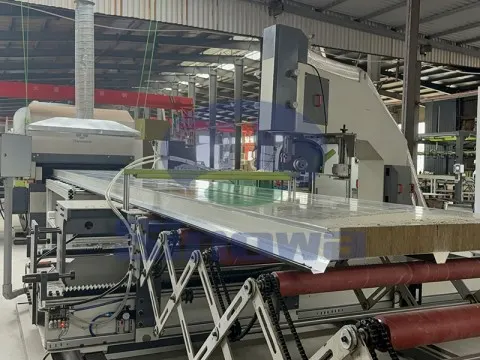
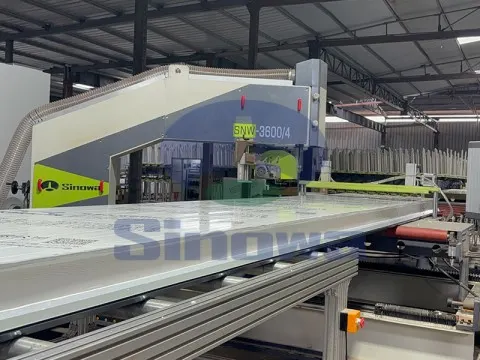
Fixed-length cutting is the finishing procedure of panel molding, which cuts continuous long composite panels into finished products of standard specifications. The production line is equipped with an automatic tracking and cutting device, which can realize real-time tracking and fixed-length cutting according to the preset panel length parameters. The cutting mechanism adopts high-precision hydraulic cutting technology, with smooth and flat cutting sections, no burrs and no structural damage to the panel edge. Before cutting, the intelligent positioning system will automatically calibrate the panel position to avoid dimensional errors caused by material transmission deviation, ensuring that the length tolerance of each finished panel is controlled within a tiny range. The cutting process is highly automated, and the system can automatically complete positioning, clamping and cutting operations without manual auxiliary measurement and operation, which greatly improves cutting efficiency and dimensional accuracy. In addition, the cutting device has a protective structure, which can avoid the scattering of rock wool fibers and adhesive residues during cutting, maintaining the cleanliness of the production site. For panels with special edge requirements, the system can also complete edge trimming and shaping synchronously during the cutting process, ensuring that the edge structure of finished panels is neat and uniform, and meeting the requirements of subsequent installation and assembly.
Post-Processing and Surface Finishing
Post-processing and surface finishing procedures further optimize the appearance quality and structural performance of finished rock wool sandwich panels, solving minor quality problems generated in the production process. After cutting and forming, the panels will be automatically transported to the post-processing station for surface inspection and finishing. The staff and intelligent detection system jointly check the panel surface for scratches, glue marks, uneven coating and other appearance defects, and carry out fine repair and cleaning treatment. At the same time, the edge sealing treatment is carried out on the cut panel ends, which effectively seals the internal rock wool fiber layer, prevents fiber falling off and moisture penetration, and improves the durability and weather resistance of the panel. For panels used in special environments, the production line can support additional surface anti-corrosion and wear-resistant finishing treatments according to demand. The standardized post-processing procedure makes up for the minor deficiencies in the continuous production process, unifies the appearance and structural quality of all finished panels, and ensures that each product has stable performance and neat appearance, laying a good foundation for subsequent storage, transportation and engineering installation.
Automatic Stacking and Finished Product Output
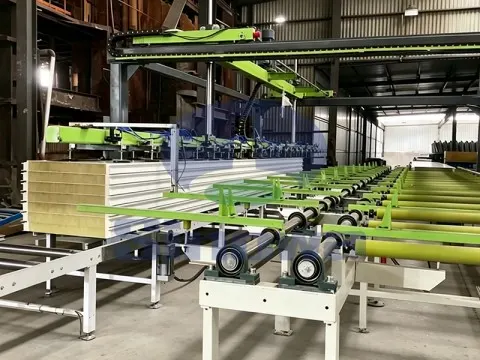
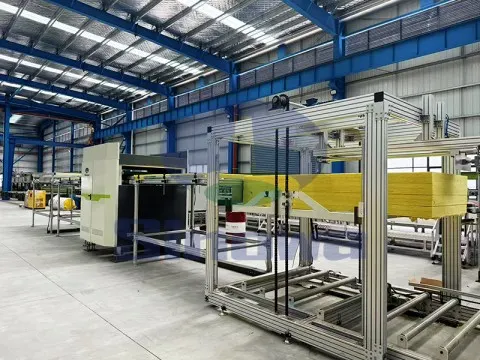
Automatic stacking and output are the final links of the entire production line, realizing the orderly collection and standardized output of finished panels and completing the closed-loop of automated production. The finished panels after post-processing are stably transported to the stacking station through the automatic conveying roller table. The intelligent stacking device adopts mechanical automatic grabbing and stacking technology, which can neatly stack the panels according to the preset number and height specifications. The stacking process is stable and orderly, avoiding collision, extrusion and surface damage between panels. The system has an automatic counting and sorting function, which can classify and stack panels of different specifications separately, facilitating subsequent batch management and transportation. After stacking is completed, the equipment will automatically send the stacked finished products out of the production line, and the staff only need to carry out regular handling and storage. The fully automated stacking and output mode completely replaces manual stacking, greatly improving production efficiency, reducing labor costs, and avoiding product quality problems caused by manual operation errors. It also ensures the neatness and standardization of finished product storage, which is convenient for subsequent sales and engineering construction application.
Production Line Operation Advantages and Application Value
The rock wool sandwich panel production line has prominent operational advantages and wide industrial application value, becoming the core equipment for the production of high-performance building insulation materials. In terms of production performance, the integrated automated production mode realizes the seamless connection of all processes from raw material processing to finished product output, with high production continuity and stable operation, which can efficiently complete large-scale batch production tasks. The modular and adjustable design enables the production line to flexibly switch product specifications, meeting the diversified production needs of wall panels, roof panels and special-shaped composite panels. In terms of product quality, the precise processing procedures ensure that the produced rock wool sandwich panels have uniform density, firm bonding, excellent fire resistance, thermal insulation and sound insulation effects, and strong structural stability. In terms of production cost and environmental protection, the production line is equipped with material recovery and dust prevention structures, which reduces raw material waste and fiber pollution, realizes green and low-consumption production. The products produced by the line are widely used in industrial plants, public buildings, cold storage insulation, clean workshops and other fields, providing high-quality lightweight composite building materials for modern architectural engineering, and effectively promoting the development of energy-saving and environmental protection building industry.
Gallery of Rock Wool Sandwich Panel Production Line
Tags: rock wool sandwich panel production line, rock wool sandwich panel production line manufacturer, rock wool sandwich panel production line supplier, china rock wool sandwich panel production line, rock wool sandwich panel production line for sale
Related Informations
Why Does Foaming Overflow Occur On The Continuous Rockwool Sandwich Panel Production Line?
Continuous Rock Wool Sandwich Panel Line