Why Does The Cutting System Of The PU Sandwich Panel Production Line Produce Uneven Cuts?
Publication Date: Oct 14, 2026
Uneven cuts on a PU sandwich panel production line usually trace back to the cutting system rather than the foam core itself.
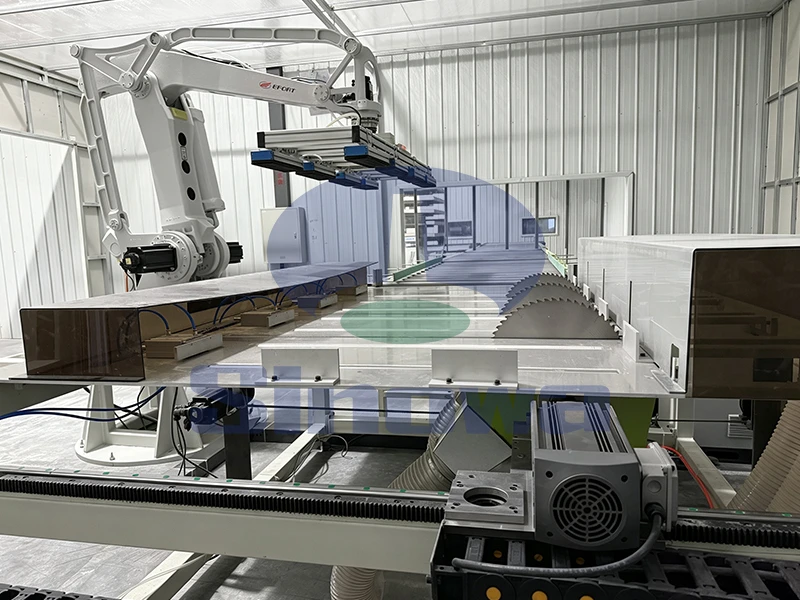
The most frequent culprit is simply a blade that has lost its edge. PU sandwich panels combine two rigid metal facing sheets with a compressed polyurethane foam core, and the cutting saw has to shear through all three layers in a single pass. When the carbide teeth on the circular saw or the reciprocating knife begin to wear, they no longer slice cleanly through the facing; instead, they drag, chatter, and push against the metal. The result is a cut edge that looks straight from a distance but shows micro-step irregularities, burrs on the bottom skin, and slight foam tear-out where the tooth finally breaks through. Operators often notice this as a gradual drift rather than a sudden failure: one day the edge is clean, a week later it feels rough. Because wear accumulates tooth by tooth, the unevenness tends to appear first on one side of the panel width and then spread, since the teeth on the leading edge of the saw typically do more work and dull faster. A worn blade also forces the drive motor to draw more current, which is why line supervisors who watch the amp meter often catch this defect before quality control does. Replacing or regrinding the blade on a fixed schedule, rather than waiting for visible defects, is the single most effective way to keep cut edges consistent.
Closely related to blade wear is the question of whether the blade itself is the right geometry for the panel being cut. A saw designed for thin, light panels will behave very differently when the line switches to a denser foam core or a thicker steel facing, and operators who keep the same tooling across product variants often start seeing unevenness without understanding why. Tooth pitch matters here: too coarse a tooth will bite aggressively and grab the facing, pulling the panel slightly sideways mid-cut; too fine a tooth will load up with melted PU chips and begin to rub rather than cut. Hook angle, clearance angle, and the number of teeth in contact with the work at any moment all determine whether the cut is sheared cleanly or torn. When the geometry is wrong, the panel does not simply get a worse surface—it shifts on the conveyor during the cut, because the sideways forces generated by an aggressive or rubbing blade exceed the friction holding the panel down. That lateral shift is what produces the diagonal or stepped edges that customers reject. Matching the saw specification to the actual facing gauge and foam density on each run is therefore not a fine-tuning exercise; it is the baseline condition required for any consistent cut at all.
Even a sharp, correctly specified blade will produce uneven cuts if it is not aligned properly with the direction of panel travel. The cut must be perfectly square to the conveyor, and the saw's plane must be perpendicular to both the top and bottom facing sheets. In practice, mounting bolts loosen over months of vibration, the saw arbor develops tiny play, and the pivot points that lift the saw into the cut wear into oval holes. Any of these defects makes the blade tilt or wobble slightly during the pass, and that wobble translates directly into a cut that is thicker in the middle of the panel width than at the edges, or that leaves a slight bevel on one corner. Operators typically diagnose this by cutting a test panel and measuring the squareness of the edge with a square along the entire length; if the deviation grows toward one end, the arbor or pivot is the likely source. A second alignment issue is parallelism between the two supporting clamps that hold the panel down during the cut. If one clamp grips harder than the other, the panel twists a fraction of a degree at the moment the saw enters, and that twist is locked into the edge as a subtle wave that shows up only when two panels are stacked together and the light catches the seam.
Feed speed and saw speed mismatch is another classic source of uneven cuts, and it is especially common when production staff try to push line throughput without adjusting the cutting station. The saw must complete its pass across the panel width in the exact time the line advances one panel length, and the saw carriage must travel at a velocity synchronized to the belt speed. If the carriage is even slightly slow, the blade drags along the facing instead of slicing, producing a ragged edge with pulled foam. If it is too fast, the teeth skip across the top skin, leaving a scalloped pattern. The synchronization is usually handled by an encoder and drive controller, but belt slip on the conveyor, wear in the reduction gearbox of the saw carriage, and encoder mounting drift all introduce errors that grow over time. Operators notice this as cut positions that drift a few millimeters from the scribed mark, and then as edge quality that depends on which minute of the shift the panel was produced in. Re-synchronizing the carriage to the line speed, and verifying that the encoder wheel is still pressed firmly against the conveyor belt, restores the relationship that makes a clean, square cut possible.
Temperature is a quieter but powerful factor in cut quality, because polyurethane foam is strongly temperature-dependent. PU sandwich panels leave the laminating line with the core still slightly warm and the adhesive layers partially cured. If the cutting station is expected to trim panels too soon after they exit the double belt press, the foam is soft and rubbery, and the blade compresses it rather than shearing it. When the spring-back happens a fraction of a second later, the edge is no longer where the blade passed it, and the cut surface shows a concave curve instead of a flat one. In cold conditions the opposite problem appears: the facing sheets contract slightly and the foam becomes brittle, so the blade chips the skin and leaves micro-cracks in the core that look like uneven cutting but are actually a thermal stress response. Seasonal temperature changes in the plant, or the difference between a Monday morning startup and a mid-shift steady state, can shift cut quality enough that operators blame the saw when the real issue is the panel's temperature at the moment of cutting. Allowing the panel to reach a stable temperature before the cut, and insulating or heating the cutting bay in winter, removes an entire category of edge irregularity that no amount of blade adjustment can fix.
Vibration and resonance in the cutting station are responsible for a large share of the fine, regular waviness that shows up on otherwise acceptable edges. A PU panel line runs continuously, and the saw, the conveyor gearbox, the laminating press, and the uncoiler all introduce periodic forces into the steel frame of the machine. When the natural frequency of the saw carriage coincides with the tooth-pass frequency of the blade, the saw begins to oscillate up and down by a few tenths of a millimeter during the cut. The panel edge then carries a fine, evenly spaced ripple that is invisible until the panel is placed against a straight edge and rolled under a light. This is particularly common after a speed change, because the new tooth-pass frequency lands on a resonance that was harmless at the old setting. Tightening the foundation bolts, checking the condition of the spring couplings between motor and arbor, and ensuring that the saw carriage slides on clean, lubricated linear guides rather than on worn bushings, all reduce the amplitude of these oscillations. Operators can identify vibration as the cause by listening to the cut: a clean sawing sound is even and continuous, while a resonant cut has a characteristic buzz or whine that changes pitch as the saw crosses the panel.
The condition of the hold-down and back-up support directly determines whether the panel flexes during the cut, and flex is one of the most common reasons edges come out uneven. The saw must enter a panel that is rigidly supported from below directly under the cut line, and clamped from above at points close to the blade. If the support table has worn pads, or if the hold-down fingers are out of adjustment, the panel lifts a fraction of a millimeter as the saw pushes into it. The blade then cuts at a slightly different height on entry than on exit, leaving an edge that is not straight but gently curved. This defect is easy to mistake for blade wear, because both produce rough edges, but it has a telltale signature: the unevenness correlates strongly with panel width. On narrow panels the hold-down grips enough to keep the work still, but on wide panels the middle of the panel is unsupported and flexes. Operators chasing this problem often replace three blades before checking the support pads. A related issue is the condition of the scrap support table on the exit side of the saw: if the offcut piece can tip downward as the cut completes, it drags on the blade for the last few centimeters and tears the corner off the good panel.
Chip and debris management is an often-overlooked cause of uneven cuts, because its effect accumulates rather than appearing immediately. PU foam generates fine, dust-like chips when cut, and these chips mix with tiny metal filings from the facing sheets to form a sticky paste that adheres to the blade gullets. As the gullets fill, the blade can no longer clear material out of the cut zone, and the friction between blade and work rises sharply. The blade begins to heat up, the adjacent foam melts slightly and sticks to the teeth, and the cut quality degrades within minutes. Operators typically see this as a cut that starts out clean and gradually gets worse across a production run, then recovers after a blade change or a cleaning stop. A blower or suction duct aimed at the cut zone is the standard defense, but it must be checked periodically: the nozzle drifts, the filter clogs, and the suction fan loses pressure, all of which quietly reintroduce the problem. Residual adhesive from the panel edges can also build up on the saw guide bars, causing the carriage to bind slightly at one point in its stroke. A simple wipe-down of the saw body, guide rails, and blade gullets at shift changes prevents most of this accumulation and is far cheaper than the blade damage it causes.
Wear and play in the mechanical drivetrain of the saw carriage produce a different signature: the cut begins to wobble later in each pass. The carriage usually rides on linear bearings driven by a gear rack or a ball screw. Over months of operation, the rack teeth develop backlash, the ball screw loses preload, and the bearing blocks develop small clearances. When the saw is moving across the panel, these clearances are taken up in one direction by the drive force, and the motion is smooth. But at the moment the blade enters the panel, the resistance spikes, and the carriage deflects backward by the amount of the backlash. That deflection appears as a small step at the start of every cut. At the end of the pass, when the blade exits the far skin, the resistance drops and the carriage springs forward, producing a second step. The result is a panel edge that is straight in the middle but marked at both ends—the classic "entry/exit defect" that maintenance teams learn to associate with a worn drivetrain. Measuring the backlash at the rack pinion, checking the ball screw preload with a dial indicator, and replacing bearing blocks that have developed play are the standard remedies. Once the drivetrain is rigid, the entry and exit steps disappear even if the blade and alignment are left unchanged.
Finally, uneven cuts are often the result of compounding small setup errors rather than a single broken part. A blade that is 80 percent worn, a hold-down that sits half a millimeter too high, a conveyor belt that has stretched and needs re-tensioning, and a saw speed set for the previous panel thickness can each be within the tolerance that engineering drawings specify, but together they push the cutting system past the threshold where edge quality holds. This is why two lines running the same product can produce visibly different edges, and why a line that was cutting perfectly last month can develop a vague, hard-to-diagnose roughness after a routine maintenance stop. The practical response is to treat cut quality as a system property and to inspect all the contributing variables on a checklist: blade condition, alignment, hold-down pressure, support pad wear, carriage backlash, encoder synchronization, chip removal, panel temperature, and line speed. Recording the measured values on each shift lets the team see which parameter is drifting before it crosses the threshold and produces a customer rejection. In the end, most uneven cuts are not mysteries at all; they are the visible result of a cutting system whose individual adjustments have slowly wandered away from the narrow window that a clean, square PU sandwich panel cut requires.
Gallery of PU Sandwich Panel Production Line






Tags: pu sandwich panel production line, pu sandwich panel production line manufacturer, pu sandwich panel production line supplier, china pu sandwich panel production line, pu sandwich panel production line for sale
-

A reliable PU sandwich panel production line serves as the core equipment for manufacturing high-performance building insulation panels. This professional PU sandwich panel line features automated feeding, foaming and molding processes to ensure consistent panel thickness and structural stability. The well-designed polyurethane sandwich panel production line effectively improves production efficiency while reducing material waste in daily operation. Each calibrated polyurethane sandwich panel line can adapt to different panel sizes to meet diverse construction needs. With precise temperature and pressure control, the advanced continuous PU sandwich panel line produces panels with excellent thermal insulation and weather resistance. Meanwhile, the optimized PIR sandwich panel production line upgrades the foaming formula to enhance fire resistance performance. The high-efficiency PIR sandwich panel line maintains stable operation during long-term mass production, delivering durable and high-quality sandwich panels for various architectural and industrial applications.
-

The phenolic panel production line realizes automated and continuous manufacturing of high-performance thermal insulation panels through streamlined and coordinated processing procedures.
-

Modern insulation panel manufacturing relies on professional automated equipment to ensure stable product quality and high production efficiency. The rock wool sandwich panel production line features precise material lamination and forming processes to produce rigid, heat-insulating building panels. Meanwhile, the mineral wool sandwich panel production line adopts optimized assembly procedures to fabricate lightweight, soundproof panels widely used in architectural enclosure and thermal preservation projects.