What Panel Sizes Can A Standard PUR Sandwich Panel Production Line Produce?
Publication Date: Oct 14, 2026
A standard PUR sandwich panel production line can produce a wide range of panel sizes, balancing flexibility, structural performance, and manufacturing efficiency.
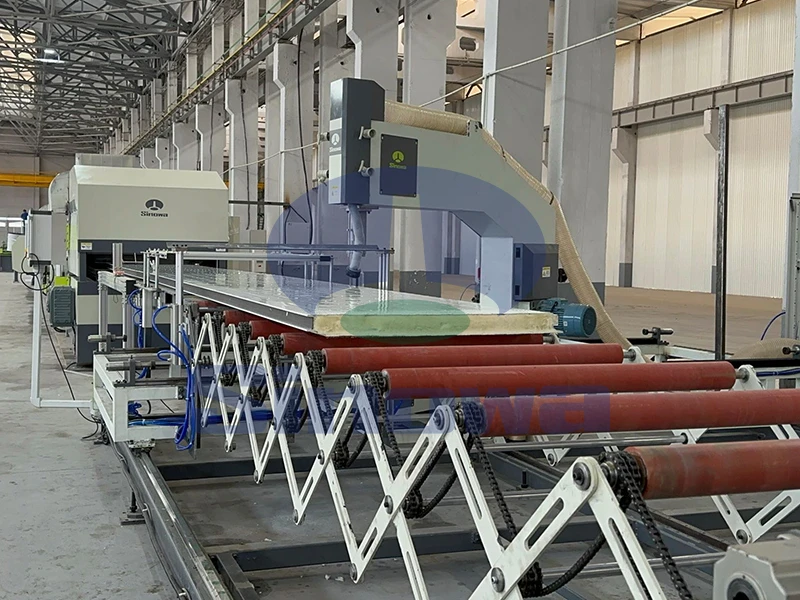
The width of PUR sandwich panels is one of the most constrained and yet most frequently specified dimensions on a production line. Most standard lines are engineered to handle a continuous metal coil that, after forming and folding, yields a finished panel width somewhere between roughly 900 millimeters and 1200 millimeters. This range reflects the typical roll-forming geometry of wall and roof cassettes, the width of common steel and aluminum coils, and the practical needs of building envelope designers. Narrower panels, often starting around 600 millimeters, are sometimes produced for decorative interiors, acoustic ceilings, or small prefabricated cabins, while wider panels approaching 1150 to 1200 millimeters are favored for large industrial warehouses, cold storage rooms, and commercial façades where fewer joints mean faster installation and better air tightness. Changing width on a continuous line usually involves swapping or adjusting the roll-forming stations, resetting the edge-folding rollers, and repositioning the laminating press width guides. Modern lines are designed so that these width changes can be completed within a few hours, allowing a single machine to serve multiple product families without major retooling.
Panel thickness is where PUR lines show the greatest versatility, because the polyurethane foam core determines thermal performance, structural rigidity, and weight. A typical production line can pour and cure foam cores from about 20 millimeters up to 200 millimeters or more, depending on the design of the double-band laminator and the density range of the foam. Thin panels in the 20 to 50 millimeter range are used for interior partitions, cleanroom walls, and lightly insulated rooms where thermal demand is modest. Medium thicknesses from 60 to 100 millimeters cover the bulk of commercial wall and roofing applications, offering a reasonable balance between insulation value and panel stiffness. Thicker panels, from 120 to 200 millimeters, are reserved for cold storage warehouses, frozen food facilities, refrigerated trucks, and process industries where energy loss must be minimized. On a continuous line, thickness is controlled by the speed of the double-band conveyor, the foam metering output, the geometry of the side dams, and the profile height of the metal skins. The line can be tuned in small increments, often every 10 or 20 millimeters, so that architects and clients can match the panel thickness to their insulation requirements rather than being locked into a single standard.
Length is the dimension that makes continuous PUR sandwich panel lines uniquely powerful. Unlike discrete molding or press-based systems, a continuous line can produce panels of virtually any length up to several tens of meters, because the foaming, laminating, and cutting process runs along a moving band. The flying saw or guillotine cutter at the end of the line can be programmed to cut at any point, so panels can be 2 meters, 6 meters, 12 meters, or even longer, limited mainly by transportation restrictions, lifting capacity on site, and the span of the building. For wall panels, typical cut lengths range from 3 to 8 meters, matching floor-to-floor heights or the modular grid of a façade. For roof panels, lengths of 8 to 15 meters are common, allowing a single sheet to run from eave to ridge without horizontal joints, which dramatically reduces leakage paths. For cold storage rooms, panels are often cut to exact room dimensions so that walls, ceilings, and floors fit together with minimal trimming. The ability to cut to length on demand means manufacturers can tailor each batch to a specific project rather than shipping stock lengths that require wasteful cutting on site.
Wall panels represent the largest share of output from most PUR lines, and their dimensions are shaped by both structural and aesthetic considerations. A common wall panel has a finished width of about 1000 millimeters, a thickness between 50 and 100 millimeters, and a length matched to the storey height. The face skin is usually embossed, micro-ribbed, or flat, and the joint system is designed as a hidden or exposed interlock that ensures weather resistance and visual continuity. Some lines can produce both vertical and horizontal wall profiles by changing the roll-forming tools, which means the same machine can serve buildings where panels are stacked floor by floor or laid in long horizontal strips. The depth of the rib, the height of the return flange, and the width of the male and female joints are all set by the forming rolls, and changing between profiles can be done during a scheduled tooling change. Wall panels are often specified with tight dimensional control because they are visible, and uneven widths or twisted edges would be immediately noticeable on a finished façade.
Roof panels differ from wall panels in that they must resist ponding water, wind uplift, and thermal movement, which pushes their dimensions toward wider, thicker, and longer forms. A typical roof panel might be 1000 to 1200 millimeters wide, 60 to 150 millimeters thick, and 10 to 20 meters long, with a concealed or standing-seam joint that keeps water out. The top skin is often given a trapezoidal or corrugated profile to increase spanning capability and shed rain. On a PUR line, roof panels are produced on the same continuous band as wall panels, but the roll-forming section produces the specific roof profile, and the foam density may be slightly higher to improve compressive strength under foot traffic and snow loads. Because roof panels span long distances, their dimensional consistency along the length is critical; any local variation in foam density or skin thickness can create weak spots. The line's cooling and curing section must therefore be long enough to ensure the foam reaches handling strength before the panel exits the laminator.
Interior and decorative panels occupy a smaller but growing niche on many PUR lines. These panels are thinner, often 20 to 60 millimeters, with smooth or laminated faces that are suitable for cleanrooms, hospitals, laboratories, food processing areas, and office fit-outs. Widths tend to be narrower, around 600 to 900 millimeters, because interior walls are lighter and the panels need to be handled by two people. Lengths are typically 2 to 5 meters, matching the modular dimensions of suspended ceilings and partition systems. Some lines can produce panels with special faces, such as anti-bacterial coatings, film laminate, or woven metal finishes, by feeding pre-laminated coils into the line. The core foam for interior panels is usually of higher quality, with finer cell structure and lower density variation, because surface flatness is more important than extreme insulation. The ability to switch from exterior to interior panels on the same line gives manufacturers flexibility during seasonal demand shifts.
Changing the width on a PUR sandwich panel line is a deliberate process rather than an instant operation. The coil must be changed, the uncoiler and leveler reset, and the roll-forming stations adjusted to the new profile width. The side dams on the laminator, which contain the liquid foam as it rises, must be moved to match the new panel width, and the cutting table programs must be updated. On modern lines, many of these adjustments are motorized or servo-driven, and recipe-based control systems can store settings for each product, so an operator can recall a recipe and let the machine set the rollers to within millimeters. The practical result is that a line with a 1000-millimeter wall tooling can, within half a day or so, be converted to produce 950-millimeter or 1100-millimeter panels. This flexibility is what allows a single production line to serve multiple customers, building types, and regional preferences without requiring dedicated machines for every variant.
Thickness adjustment is equally important for meeting insulation targets. The polyurethane foam is poured onto the moving bottom skin as it enters the laminator, and the top skin is laid on top before the foam expands and cures between the two steel bands. The gap between the bands determines the finished thickness, and this gap can be adjusted by raising or lowering the upper belt, often through a series of screw jacks or hydraulic actuators along the length of the press. Because foam rise is sensitive to temperature, line speed, and chemical formulation, changing thickness is not simply a matter of setting a gap; the metering guns, mixing head output, and side-dam geometry must all be rebalanced. A well-tuned line can move between a 50-millimeter panel and a 100-millimeter panel in a few hours, with the first few meters of output typically scrapped or downgraded until the process stabilizes. Over time, operators build experience in tuning the foam density and cure profile for each thickness, so that panels coming off the line have consistent core structure and no voids.
Dimensional accuracy is what separates a well-maintained line from a marginal one. Even though panels can be cut to almost any length, the width, thickness, and squareness of each panel must stay within tight tolerances, because the interlocking joints depend on them. A panel that is a few millimeters too wide will not seat into the previous panel, while one that is too narrow will leave a visible gap. A panel that varies in thickness along its length will show up as an uneven wall line or a leaking roof joint. Modern lines use encoders on the cutting saw, laser measurement of the exiting panel, and automatic width controls to keep these dimensions stable. The flying saw must cut perpendicular to the line direction while the panel is moving, and its acceleration and deceleration are synchronized to the belt speed so that the cut edge is square. Operators routinely sample panels from each batch, measuring width, thickness, length, and diagonals, and adjust the line if any drift appears.
In practice, the dimensions a manufacturer chooses to offer depend on the target market, the building types served, and the logistics network. A line optimized for industrial warehousing will emphasize wide, long roof and wall panels in the 1000 to 1200 millimeter width range and 60 to 120 millimeter thickness. A line serving cold storage will push thickness toward 150 to 200 millimeters and tighter joint seals. A line focused on commercial interiors will produce narrower, thinner, smoother panels with laminated finishes. What unites all these applications is that a single continuous PUR sandwich panel line can, through roll-forming changes, thickness adjustments, and length programming, deliver the dimensions each application needs. This versatility is the core reason why PUR sandwich panels have become a standard solution for fast, energy-efficient building envelopes around the world.
Gallery of Standard PUR Sandwich Panel Production Line






Tags: standard pur sandwich panel production line, standard pur sandwich panel production line manufacturer, standard pur sandwich panel production line supplier, china standard pur sandwich panel production line, standard pur sandwich panel production line for sale
-

A reliable PU sandwich panel production line serves as the core equipment for manufacturing high-performance building insulation panels. This professional PU sandwich panel line features automated feeding, foaming and molding processes to ensure consistent panel thickness and structural stability. The well-designed polyurethane sandwich panel production line effectively improves production efficiency while reducing material waste in daily operation. Each calibrated polyurethane sandwich panel line can adapt to different panel sizes to meet diverse construction needs. With precise temperature and pressure control, the advanced continuous PU sandwich panel line produces panels with excellent thermal insulation and weather resistance. Meanwhile, the optimized PIR sandwich panel production line upgrades the foaming formula to enhance fire resistance performance. The high-efficiency PIR sandwich panel line maintains stable operation during long-term mass production, delivering durable and high-quality sandwich panels for various architectural and industrial applications.
-

The phenolic panel production line realizes automated and continuous manufacturing of high-performance thermal insulation panels through streamlined and coordinated processing procedures.
-

Modern insulation panel manufacturing relies on professional automated equipment to ensure stable product quality and high production efficiency. The rock wool sandwich panel production line features precise material lamination and forming processes to produce rigid, heat-insulating building panels. Meanwhile, the mineral wool sandwich panel production line adopts optimized assembly procedures to fabricate lightweight, soundproof panels widely used in architectural enclosure and thermal preservation projects.