How To Solve Uneven Thickness Problems Of Panels From The Rockwool Sandwich Panel Line?
Publication Date: Oct 8, 2026
Uneven thickness is a prevalent quality defect in rockwool sandwich panel production, compromising panel flatness and application performance.
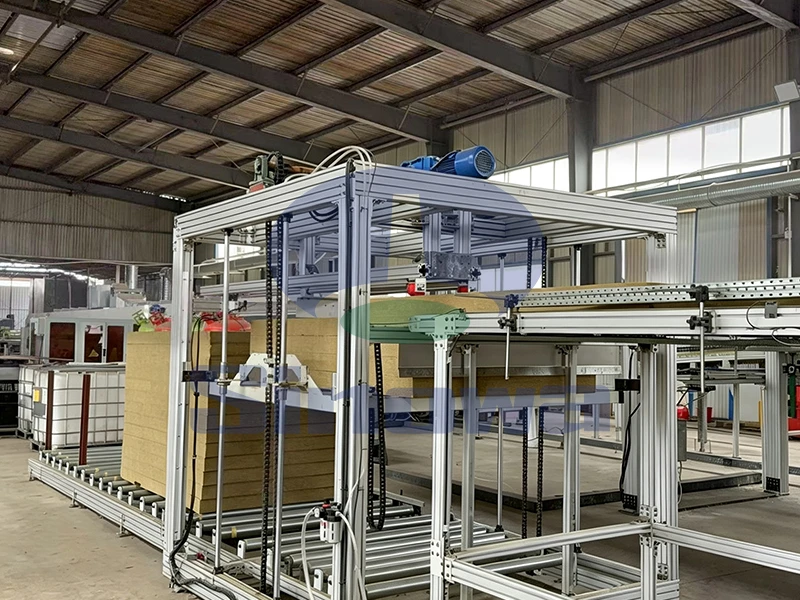
Uneven thickness in rockwool sandwich panels manifests in various forms during continuous production, including inconsistent thickness between panel edges and centers, gradual thickness fluctuations along the panel length, and sporadic thickness deviations in individual product batches. These irregularities primarily stem from the unique structural characteristics of rockwool core materials and the continuous lamination production mode of sandwich panel lines. Unlike homogeneous foam core materials, rockwool consists of stacked fibrous wool blocks, whose loose and porous structure makes them highly susceptible to external force changes and feeding fluctuations. Even minor variations in production parameters or equipment operation can lead to uneven compression and forming of the rockwool core, ultimately resulting in inconsistent overall panel thickness. Long-term unaddressed thickness problems will not only cause product appearance defects but also affect the assembly fit and overall structural stability of finished panels in practical usage.
Unstable rockwool core feeding is one of the most fundamental causes of panel thickness unevenness in daily production. In automated production lines, rockwool raw materials are continuously conveyed, split, and laid to form the core layer of sandwich panels. Irregular feeding speed often leads to uneven stacking density of rockwool fibers, with excessive fiber accumulation in local areas causing thicker core layers and insufficient fiber supply leading to thinner sections. Additionally, inconsistent manual or mechanical cutting of rockwool raw materials results in irregular edge sizes of wool blocks, which produce uneven core thickness after lamination. Loose placement and gaps between adjacent rockwool blocks also create thin spots on finished panels. To resolve this problem, producers need to optimize the core feeding system, stabilize the conveying speed of rockwool raw materials, and adopt uniform cutting standards for wool blocks. Regular sorting and arrangement of raw materials can eliminate gaps between rockwool blocks and ensure consistent core fiber density throughout production.
Malfunctions and parameter drift of the double-belt laminator, the core forming equipment of the production line, are key factors triggering thickness deviations. The laminator controls the final forming thickness of sandwich panels by adjusting the gap between upper and lower conveyor belts. Long-term continuous operation often causes minor wear of equipment rollers, belt tension imbalance, and gradual deviation of preset gap values, leading to inconsistent compression degrees on different parts of the panel. Lateral offset of the conveyor belt during operation also results in uneven pressure on the left and right sides of the rockwool core, forming thickness differences on both panel edges. Moreover, unstable operating temperature of the laminator affects the compression molding state of rockwool fibers, causing elastic deformation differences that further amplify thickness inconsistencies. Regular professional calibration of the laminator gap, timely adjustment of belt tension, and correction of belt tracking deviations can effectively eliminate equipment-induced thickness defects.
Inconsistent production line speed and adhesive spraying parameters also contribute significantly to uneven panel thickness. Synchronized operation of line speed and adhesive supply is essential for uniform panel forming. Fluctuations in production line running speed lead to varying dwell time of rockwool cores in the laminator, resulting in inconsistent compression forming effects. When the line speed is too fast, the rockwool core fails to achieve full and uniform compression, retaining partial loose structure and forming thicker panels. When the speed is unstable in fluctuations, alternating thick and thin sections appear on the same panel. Meanwhile, uneven adhesive spraying volume and coverage cause inconsistent bonding and curing degrees between rockwool core and metal surface plates. Excess adhesive leads to local thickening after curing, while insufficient adhesive causes partial core delamination and thinning. Stabilizing line speed and adjusting spraying parameters to ensure uniform adhesive distribution can effectively improve thickness uniformity.
Abnormal working temperature in the production environment and curing process is an easily overlooked cause of uneven panel thickness. Rockwool fiber compression molding and adhesive curing are highly temperature-dependent processes. Inconsistent ambient temperature in the production workshop leads to different thermal expansion and contraction states of rockwool fibers and metal plates during processing, resulting in slight thickness differences in finished panels. Unstable temperature of the curing equipment further exacerbates this problem: local overheating accelerates adhesive curing and causes premature shaping of partial core layers, while low-temperature areas lead to incomplete curing and delayed shaping. This asymmetric curing state makes the overall panel thickness uneven. Producers need to maintain a stable production environment temperature and regularly detect and adjust the temperature uniformity of curing equipment to ensure consistent curing and forming effects of all panel parts during production.
Improper daily equipment maintenance leads to accumulated minor faults that induce persistent thickness unevenness. Long-term operation of the production line inevitably causes resin residue, rockwool fiber debris, and dust to adhere to equipment rollers, conveyor belts, and feeding guides. These attachments change the flatness and friction of equipment working surfaces, resulting in uneven pressure transmission during panel forming and local thickness deviations. In addition, worn equipment bearings, loose connecting parts, and inaccurate sensor data can cause unsynchronized operation of various production units, disrupting the stability of core feeding and lamination processes. Many minor faults are difficult to detect in daily production but will continuously affect product thickness consistency. Establishing a regular equipment cleaning and maintenance mechanism, regularly removing surface attachments, inspecting and replacing worn parts, and calibrating detection sensors can eliminate hidden equipment faults.
Unreasonable raw material pretreatment and storage methods also affect rockwool core uniformity and trigger panel thickness problems. Rockwool raw materials are prone to moisture absorption in humid storage environments, and damp fibers have poorer compression stability compared with dry fibers. Damp rockwool sections produce different compression thicknesses under the same laminator pressure, forming uneven panel surfaces. Meanwhile, improper pretreatment such as insufficient fiber loosening and uneven wool block splitting leads to local dense or sparse areas in the rockwool core layer. Dense fiber areas are difficult to compress thoroughly, resulting in local thickening, while sparse areas are overly compressed and become thinner. Standardizing raw material storage conditions to keep rockwool dry and ventilated, and completing sufficient fiber loosening and uniform splitting pretreatment before production, can effectively improve core layer uniformity and reduce thickness deviations.
Deficient real-time production monitoring and quality inspection mechanisms amplify uneven thickness problems. In many production scenarios, traditional periodic sampling inspection cannot timely capture real-time thickness fluctuations in continuous production. Local abnormal thickness changes caused by instantaneous equipment jitter, parameter drift, or raw material differences often continue to produce defective products before being detected. Manual inspection also has limitations in accuracy and coverage, failing to comprehensively detect tiny thickness deviations at panel edges, centers, and different length positions. Installing real-time laser thickness monitoring devices on the production line can realize full-process thickness tracking. Meanwhile, formulating a comprehensive inspection standard that covers four corners and the center of each panel ensures timely detection and adjustment of thickness abnormalities to avoid batch defects.
Unstandardized manual operation and parameter adjustment errors are human factors leading to repeated thickness unevenness. Production line operators’ irregular adjustment of feeding speed, laminator pressure, gap distance, and curing temperature according to subjective experience often causes parameter mismatches in the production system. Different operating habits of staff in raw material feeding, equipment startup and shutdown, and product picking also lead to inconsistent production states of different batches of panels. For example, excessive manual intervention in rockwool core arrangement will destroy the uniform fiber stacking state, resulting in local thickness deviations. Standardizing production operation procedures, unifying parameter adjustment standards, and conducting regular professional training for operators can eliminate human-induced thickness defects and ensure consistent production process stability.
Systematic process optimization and closed-loop management are the fundamental solutions to completely solve the uneven thickness problem of rockwool sandwich panels. Single partial adjustment can only alleviate temporary defects, while long-term stable product quality requires overall optimization of raw material management, equipment operation, production parameters, and quality inspection. Enterprises need to establish complete production process files, record optimal production parameters for different raw material states, and form standardized production schemes. Regularly summarize thickness defect causes, track improvement effects of adjustment measures, and form a closed-loop management mechanism of problem discovery, analysis, adjustment, and verification. Combining regular equipment maintenance, standardized operation, real-time monitoring, and scientific parameter optimization can fundamentally reduce the occurrence of uneven thickness problems and steadily improve the overall production quality of rockwool sandwich panels.
Gallery of Rockwool Sandwich Panel Line
Tags: rockwool sandwich panel line, rockwool sandwich panel line manufacturer, rockwool sandwich panel line supplier, china rockwool sandwich panel line, rockwool sandwich panel line for sale
-

A reliable PU sandwich panel production line serves as the core equipment for manufacturing high-performance building insulation panels. This professional PU sandwich panel line features automated feeding, foaming and molding processes to ensure consistent panel thickness and structural stability. The well-designed polyurethane sandwich panel production line effectively improves production efficiency while reducing material waste in daily operation. Each calibrated polyurethane sandwich panel line can adapt to different panel sizes to meet diverse construction needs. With precise temperature and pressure control, the advanced continuous PU sandwich panel line produces panels with excellent thermal insulation and weather resistance. Meanwhile, the optimized PIR sandwich panel production line upgrades the foaming formula to enhance fire resistance performance. The high-efficiency PIR sandwich panel line maintains stable operation during long-term mass production, delivering durable and high-quality sandwich panels for various architectural and industrial applications.
-

The phenolic panel production line realizes automated and continuous manufacturing of high-performance thermal insulation panels through streamlined and coordinated processing procedures.
-

Modern insulation panel manufacturing relies on professional automated equipment to ensure stable product quality and high production efficiency. The rock wool sandwich panel production line features precise material lamination and forming processes to produce rigid, heat-insulating building panels. Meanwhile, the mineral wool sandwich panel production line adopts optimized assembly procedures to fabricate lightweight, soundproof panels widely used in architectural enclosure and thermal preservation projects.