How To Adjust The Speed Of PUF Sandwich Panel Production Line?
Publication Date: Nov 17, 2026
Adjust PUF sandwich panel line speed via VFD & PLC HMI. Sync all stations, match speed to panel thickness, foam curing time and workshop temperature. Tune gradually, check foam quality, density and bonding to avoid defects. Keep master-slave synchronization stable for consistent panels.
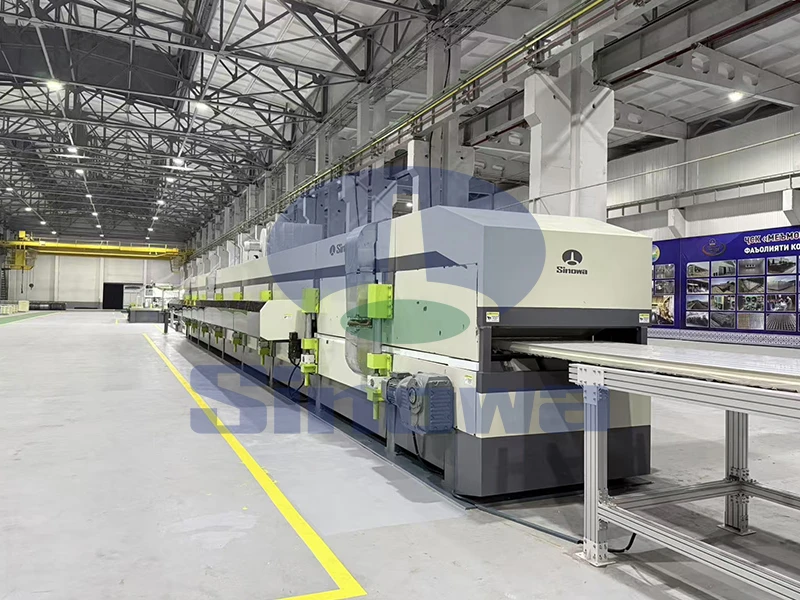
Adjusting the operating speed of a PUF sandwich panel production line is a systematic task that requires full consideration of the linkage of every single processing unit instead of simply turning up or down a single speed controller on the main operation panel. The core goal of speed adjustment is to keep the forming quality of foam core and composite panels stable while matching the rhythm of material feeding, foaming reaction, curing and cutting processes. Before any speed modification begins, operators need to make a full inspection of the running status of all auxiliary equipment along the line, including raw material delivery pumps, mixing heads, conveyor rollers, surface material unwinding racks and pressing modules. Any hidden fault such as unstable raw material flow, loose roller transmission chains or lagging unwinding tension will be amplified once the line speed changes, which can easily cause uneven foam density, wrinkled metal facings or inconsistent panel thickness. Operators should record the original speed parameters of each station as a baseline reference, so they can restore the previous running state quickly if abnormal quality issues emerge after adjustment. It is also necessary to arrange dedicated staff to observe the real-time foaming condition at the mixing and pouring section, because PUF foaming has a fixed reaction window that cannot be stretched or compressed arbitrarily. If the line runs too fast, the mixed foam will not get enough time to expand and fill the cavity between two surface sheets, leading to hollow areas and weak bonding interfaces. If the line moves too slowly, excessive foam expansion may cause bulging on the panel surface and internal stress that damages the structural integrity of finished products. All preliminary checks should be completed under low-speed jogging mode, avoiding direct large-range speed adjustment during normal continuous production, and minor parameter tweaks should be adopted first to test the adaptability of the whole production system.
The coordination of raw material feeding rate is the first priority after confirming the basic baseline speed of the production line, as the output of polyol and isocyanate directly determines whether the foaming effect can adapt to the new line speed. When raising the overall line speed, the delivery flow of two main chemical raw materials needs to be increased proportionally rather than adjusted separately, and the mixing ratio must remain consistent within the reasonable reaction range of PUF materials. Independent adjustment of only one raw material pump will break the chemical balance of foaming, resulting in brittle foam, poor adhesion performance or long residual tackiness on the foam surface. Operators need to monitor the pressure of feeding pipelines and the rotating frequency of metering pumps continuously during adjustment, and eliminate pulsating flow that causes intermittent pouring volume fluctuation. Meanwhile, auxiliary additives used for foaming, such as catalysts and surfactants, also need corresponding flow matching, because these additives control the reaction rate and cell structure of polyurethane foam. If the line speed is increased greatly but the catalyst dosage stays unchanged, the foam curing speed will fall behind the advancing speed of the conveyor, and semi-cured foam will enter the follow-up pressing and cutting section, bringing permanent deformation to finished panels. On the contrary, when reducing line speed, raw material feeding flow should be lowered synchronously to prevent redundant foam overflowing from the side of panels and wasting raw materials. After modifying feeding parameters, a small number of test panels should be produced and sampled for visual inspection of foam cells, to confirm that the internal bubble structure is fine and uniform without large holes or crack defects before formal batch production resumes.
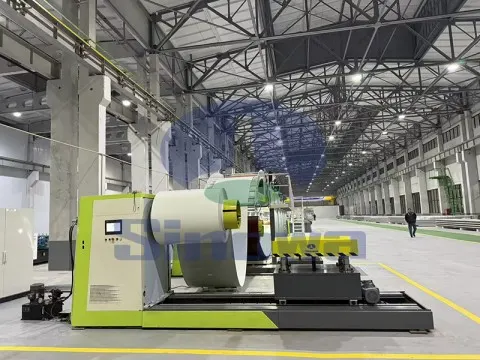
Tension control for upper and lower surface facings is another critical factor closely related to line speed adjustment, and mismatched tension is one of the common causes of surface wrinkling, offset facings and uneven panel thickness. Most PUF sandwich panels adopt metal or non-metal continuous facings unwound from large rolls, and the unwinding speed must keep pace with the conveyor running speed all the time. When accelerating the production line, the tension output of the unwinding brake system needs to be moderately increased to avoid slack facings that deviate from the guide rollers and fold into the foaming area. Excessively high tension under high speed will stretch the surface material and leave residual tensile stress; after the panel cools and releases stress, warping and bending defects will appear. When slowing down the line, the tension value should be reduced accordingly, otherwise the facing material will be pulled too tight and form local indentation on the surface of semi-liquid foam. Guide roller groups and deviation correction devices along the facing conveying path also need to be checked synchronously, and the response sensitivity of automatic deviation correction should be optimized according to the new line speed. Under high-speed operation, the deviation correction system needs to respond faster to slight offset of the sheet, while low-speed operation allows a gentler correction range to prevent frequent jitter of the sheet. Operators should watch the combining position of upper and lower facings and pouring foam continuously, ensuring that the two layers of facings maintain parallel spacing and stable alignment before entering the double belt pressing machine, so that the foam can be wrapped evenly without side leakage.
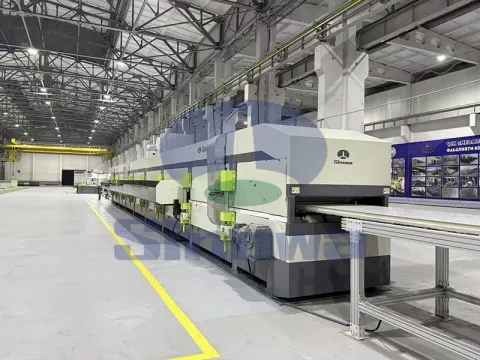
The double belt pressing section serves as the core forming station of PUF sandwich panels, and its running speed, pressing gap and heating temperature curve must be matched with the overall line speed to guarantee dimensional accuracy and bonding strength. The speed of upper and lower pressing belts must be completely synchronized with the front pouring conveyor, and asynchronous speed between different belts will create shear force inside uncured foam, tearing the foam cell structure and damaging the bonding layer between foam and facings. The pressing gap decides the final thickness of finished panels, and the gap setting usually does not change with speed, but the stability of gap locking structure should be rechecked after speed adjustment. Under high-speed working conditions, the impact and vibration of material entering the pressing area will rise, and loose locking parts may lead to gradual thickness drift of panels. The temperature setting of the heating system on the pressing belt also needs adaptive adjustment. Higher line speed shortens the residence time of panels inside the pressing tunnel, so the heating temperature can be raised appropriately to supply enough heat for foam cross-linking and curing. If the line speed drops, the heating temperature should be reduced, because prolonged heating in the tunnel will cause over-curing of the foam core, making the foam lose toughness and become prone to cracking under external force. The surface temperature of the pressing belt should be monitored by real-time temperature sensors, and temperature fluctuation should be controlled within a narrow range. After adjusting speed and temperature, operators need to check the surface flatness of panels exiting the pressing section, and feel whether the panel surface has uniform hardness without soft sticky areas or over-baked discoloration marks.
Curing time inside the constant temperature tunnel is determined directly by production line speed, and sufficient curing is the foundation to stabilize the physical performance of PUF sandwich panels. The total length of the curing tunnel is fixed, so higher line speed means less time for panels to stay inside the tunnel, while lower speed extends the curing period. If the speed is raised beyond the supporting capacity of the curing tunnel, panels coming out from the tunnel still contain uncompleted chemical reactions inside the foam core. These semi-cured panels will continue to release heat and expand after cutting and stacking, which can lead to size change, separation between foam and facings, and even deformation of stacked finished products. Before raising the line speed, operators need to evaluate whether the existing curing tunnel can provide the minimum required curing duration for the foam formula in use. If the tunnel length is limited and cannot meet the curing requirement at higher speed, the expected speed target should be lowered instead of forcing acceleration. When reducing the line speed for special panel specifications, excessive long curing should also be avoided, as long-time high-temperature environment will degrade part of the foam polymer structure and weaken thermal insulation performance. Air circulation fans inside the curing tunnel should be adjusted together with speed changes, to keep uniform temperature distribution and eliminate local hot spots or cold zones. Test panels taken from the tunnel outlet can be placed aside for a period of standing observation, to check whether their size and shape remain stable and whether there is no post-expansion phenomenon after leaving the production line.
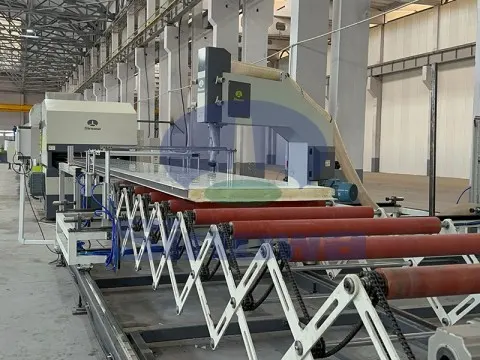
The cutting and sawing station at the rear of the line also needs parameter synchronization after the main line speed is adjusted, otherwise fixed-length cutting accuracy will fail and produce panels with wrong lengths or jagged cutting edges. The tracking system of the cutting machine collects the real-time moving signal of the panel, and its tracking response frequency must match the new conveying speed. At higher line speed, the tracking sampling frequency should be increased, and the cutting blade moving speed and acceleration curve need to be optimized to complete the cutting action within the limited travel distance. If the cutting tracking response lags behind, the actual cut length will deviate from the preset value, and continuous length errors will appear on successive panels. When the line runs at low speed, the cutting system should reduce the moving speed of the saw blade properly to avoid rough cutting sections, burrs on metal facings and tearing of foam core at the cutting edge. The clamping device that fixes panels during cutting also needs to adjust clamping force. High-speed incoming panels have greater inertia, so clamping force should be increased to prevent panel sliding during cutting, while low-speed production uses mild clamping force to avoid denting the panel surface. The waste edge collection conveyor after cutting should also synchronize its operating speed, to timely take away foam scraps and cut-off waste materials, preventing accumulated scraps from blocking the panel conveying path and scratching the surface of qualified products. After speed adjustment, multiple continuous fixed-length cutting tests should be carried out, and the actual length of cut panels should be measured one by one until the length error is kept within the acceptable range of production requirements.
The material turnover, stacking and packaging section at the end of the production line is easy to be ignored during speed adjustment, but mismatched handling rhythm will form bottlenecks and force the front forming section to stop frequently. When the main line speed increases, the panel output per unit time rises, so the transmission speed of the discharging roller table, the action cycle of the panel flipping mechanism and the stacking manipulator all need to be accelerated correspondingly. If the stacking system cannot keep up with the output rhythm, finished panels will pile up at the discharging port, trigger safety interlock protection and pause the whole front production process. Each mechanical action of stacking equipment has its own mechanical limit, so the acceleration of action cycle cannot exceed the safe load range of motors, cylinders and transmission parts. When lowering the line speed, the stacking equipment should extend its action interval to avoid frequent start and stop that causes unnecessary mechanical wear. Operators also need to arrange enough staff for inspection and sorting at the discharging end after speed adjustment, because higher production speed reduces the available time for manual visual check of panel surface defects. The protective film laminating device before stacking also needs speed matching, and asynchronous film laying speed will result in bubbles, film wrinkling and deviation of protective film on the panel surface. Stable cooperation between the forming front section and the rear handling section eliminates intermittent pause of the whole line, and continuous stable operation is more beneficial to maintain consistent panel quality than frequent speed fluctuation caused by back-end blockage.
In the process of speed adjustment, the safety interlock and protection system of the whole production line must be re-verified, because the risk level of many hidden hazards changes along with running speed. Safety gratings, emergency stop buttons, over-limit alarm sensors and material blockage detection sensors are distributed in feeding, pressing, cutting and discharging areas, and their trigger threshold and response delay need to adapt to new line speed. At high speed, the moving speed of panels and moving mechanical parts increases, and the response delay of safety sensors may lead to untimely protection actions. For example, blockage detection sensors at the cutting entrance need shorter judgment delay, so that the system can stop the line before a large amount of panels stack and cause equipment collision. All emergency stop loops should be tested separately after major speed adjustment, confirming that pressing any emergency stop button can cut off the power of driving units rapidly and brake the conveyor belt steadily without sliding for an excessive distance. The protective covers of transmission chains, gears and high-speed rotating saw blades should be checked for fastening condition, and any loose protective component must be fixed before formal production. Operators must follow the jogging test procedure and avoid staying in the running path of moving panels and mechanical actuators during speed debugging. The alarm log of the control system should be observed for a certain period after adjustment, and repeated minor alarms should not be ignored, because they often indicate that some link is in a critical mismatched state under the new speed and may evolve into quality accidents or equipment damage later.
Data recording and continuous quality monitoring run through the whole cycle of speed adjustment, and stable production parameters are accumulated from repeated comparison of test results rather than one-time setting. Every time the speed of the production line is modified, operators need to record the main parameters including line speed, raw material pump frequency, tension set value, pressing belt temperature, curing tunnel temperature and cutting tracking parameters together with the corresponding quality performance of panels. Sampling inspection should cover multiple dimensions, including foam internal cell uniformity, bonding condition between foam and facings, panel thickness, surface flatness, cutting section quality and dimensional stability after standing. If partial defects appear, the adjustment direction should be judged according to defect types instead of blindly changing the overall speed. For example, hollow foam inside panels usually indicates insufficient pouring volume or too fast line speed, while surface bulging mostly relates to excessive foaming dose or insufficient curing time. After a set of parameters achieves qualified products, the line should keep running continuously for a long time to observe whether quality can remain stable, because short-time test products may hide potential problems that only appear after continuous heat accumulation of equipment. The collected parameter records can serve as reference for future production of different panel specifications, shortening the debugging time when switching production states next time and reducing waste generated during parameter exploration.
Long-term maintenance optimization after successful speed adjustment helps the PUF sandwich panel production line keep stable operation under the new speed state and extend the service life of equipment. The change of operating speed will bring different load distribution to motors, reducers, belts and bearings of each station, so the lubrication cycle and inspection focus should be adjusted accordingly. Under long-term high-speed operation, the temperature rise of driving motors increases, and the wear of conveyor belts and guide rollers accelerates, requiring more frequent inspection of lubricating oil level, belt tension and bearing noise. Low-speed long-time operation may lead to partial heat accumulation of metering pumps and poor fluidity of chemical raw materials, so heat preservation and circulation of raw material pipelines need regular check. Daily production should avoid frequent large-range speed switching, as repeated impact load will loosen connecting parts of equipment and cause gradual parameter drift. Operators should form the habit of tracking quality trends every shift, and make tiny compensatory parameter adjustments when slow quality drift occurs, instead of waiting until obvious defective panels are produced. Reasonable speed management is not pursuing the highest possible production speed blindly, but finding the balanced point among production capacity, product quality, raw material characteristics and equipment bearing capacity. With matched feeding, forming, curing and post-processing parameters, the production line can run steadily at the target speed, outputting PUF sandwich panels with consistent quality while controlling the generation of defective products and reducing unnecessary consumption of raw materials and energy.
Gallery of PUF Sandwich Panel Production Line
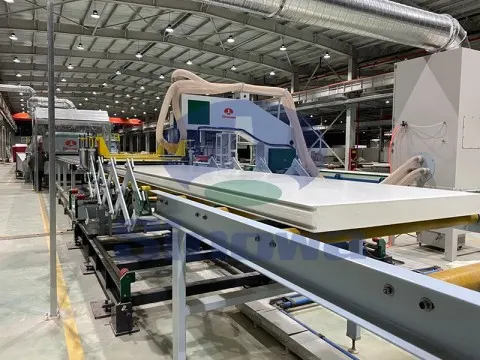
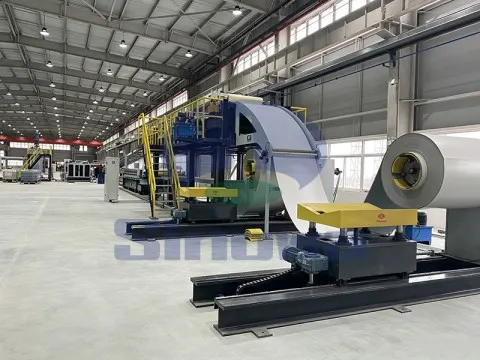
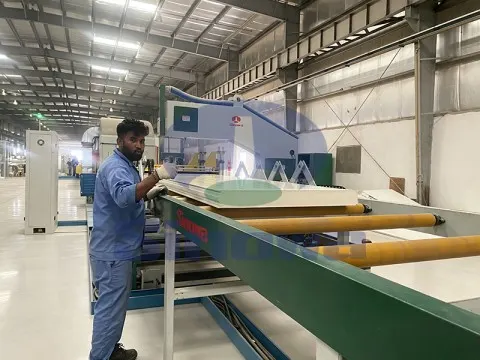
Tags: puf sandwich panel production line, puf sandwich panel production line manufacturer, puf sandwich panel production line supplier, china puf sandwich panel production line, puf sandwich panel production line for sale
-
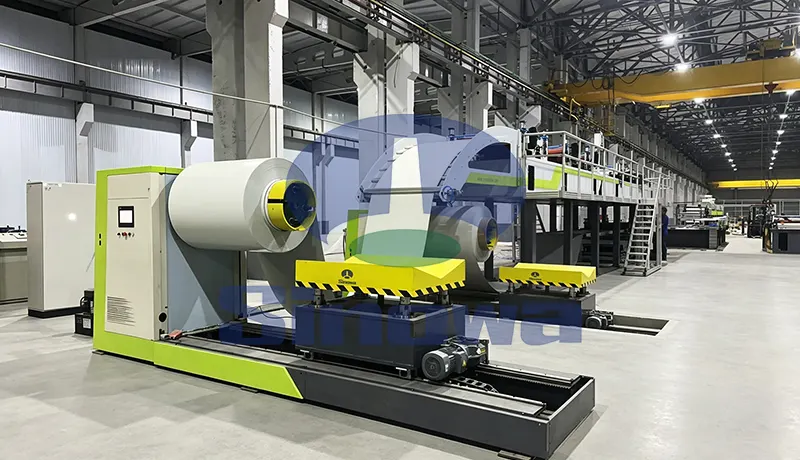
A reliable PU sandwich panel production line serves as the core equipment for manufacturing high-performance building insulation panels. This professional PU sandwich panel line features automated feeding, foaming and molding processes to ensure consistent panel thickness and structural stability. The well-designed polyurethane sandwich panel production line effectively improves production efficiency while reducing material waste in daily operation. Each calibrated polyurethane sandwich panel line can adapt to different panel sizes to meet diverse construction needs. With precise temperature and pressure control, the advanced continuous PU sandwich panel line produces panels with excellent thermal insulation and weather resistance. Meanwhile, the optimized PIR sandwich panel production line upgrades the foaming formula to enhance fire resistance performance. The high-efficiency PIR sandwich panel line maintains stable operation during long-term mass production, delivering durable and high-quality sandwich panels for various architectural and industrial applications.
-
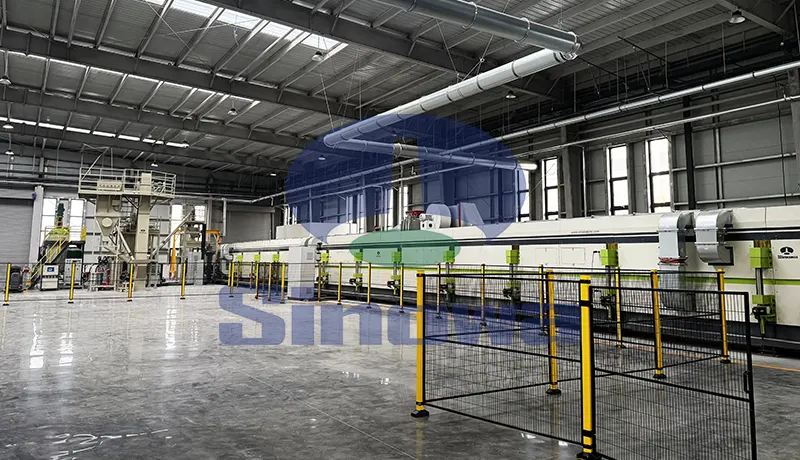
The phenolic panel production line realizes automated and continuous manufacturing of high-performance thermal insulation panels through streamlined and coordinated processing procedures.
-
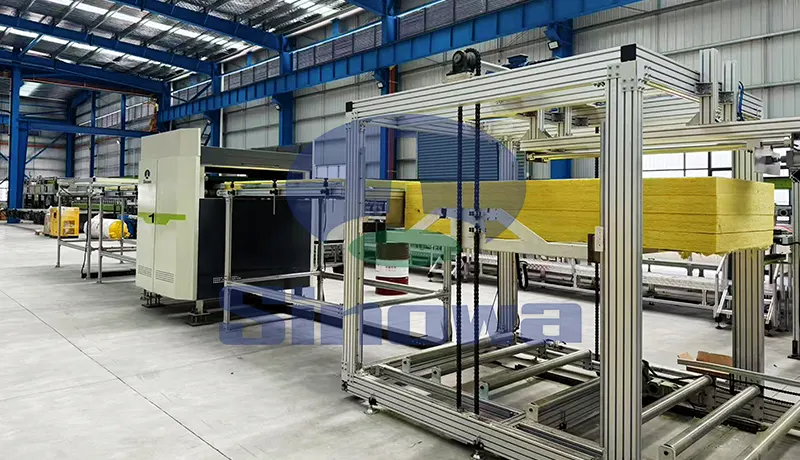
Modern insulation panel manufacturing relies on professional automated equipment to ensure stable product quality and high production efficiency. The rock wool sandwich panel production line features precise material lamination and forming processes to produce rigid, heat-insulating building panels. Meanwhile, the mineral wool sandwich panel production line adopts optimized assembly procedures to fabricate lightweight, soundproof panels widely used in architectural enclosure and thermal preservation projects.