Mineral Wool Sandwich Panel Machine
Publication Date: Nov 17, 2026
Chinese Mineral Wool Sandwich Panel Machine manufacturer. Fully automatic line for fireproof, thermal-insulated rock wool wall & roof panels. Stable running, precise cutting, custom sizes.
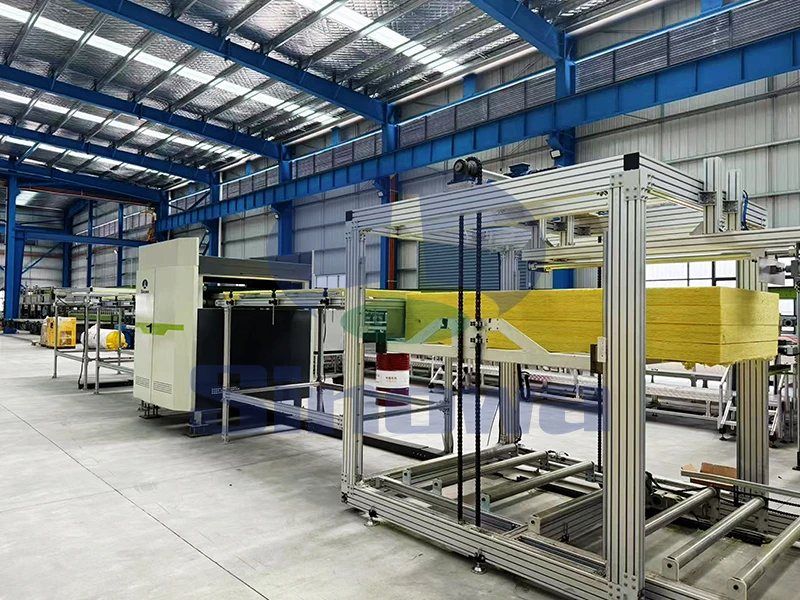
Core Composition and Basic Working Principle of Mineral Wool Sandwich Panel Machine
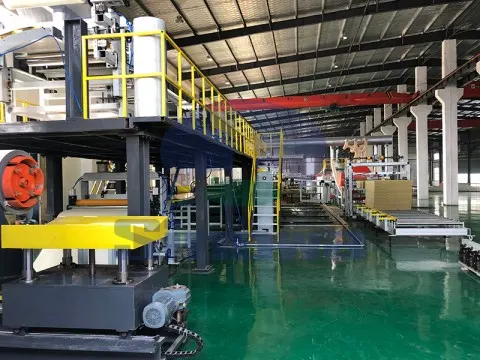
A mineral wool sandwich panel machine is a continuous integrated production system designed to combine mineral wool core materials with metal surface sheets into finished composite panels. The whole set of equipment connects multiple functional units in sequence, realizing automated feeding, positioning, pressing, gluing, curing, trimming and cutting in one continuous production line. Unlike discrete processing equipment that handles single procedures separately, this machine is built to maintain stable material transmission speed and consistent composite pressure throughout the whole manufacturing cycle. At the very beginning of the workflow, rolled metal sheets are unwound and sent into a forming section, where rollers shape the flat metal strips into profiles with pre-set rib structures. These shaped metal skins move forward synchronously on both the upper and lower sides of the line. Meanwhile, loose or semi-rigid mineral wool blocks are conveyed from the core material feeding station, arranged and aligned to fill the gap between two metal layers. Adhesive is evenly coated on the bonding surfaces of mineral wool and metal skins through precision spraying or roller coating devices. After the materials are stacked into a sandwich structure, they enter the pressing and curing zone, where controlled pressure and temperature support the adhesive to form a firm bond between dissimilar materials. Every movement of the machine is coordinated by a central control system, which adjusts running speed, glue dosage and pressing parameters according to the thickness and width requirements of target panels. Small deviations in feeding position or coating thickness can affect the flatness and bonding strength of final products, so sensor modules are installed at key stations to monitor material status in real time. Operators can observe running data on the control interface and make fine adjustments without halting the whole line frequently. The basic logic of this equipment lies in matching the physical characteristics of mineral wool, which is porous and lightweight, with the high tensile performance of metal sheets, turning separate raw materials into structural panels with multi-functional properties. This working mode greatly reduces manual intervention compared with manual composite methods, and lays the foundation for stable mass production of sandwich panels.
Raw Material Adaptability and Matching Requirements for Production
The production performance of a mineral wool sandwich panel machine largely depends on its compatibility with different raw material variants, and each type of raw material has specific matching requirements for equipment parameters. The core raw material, mineral wool, is available in different fiber arrangement states, bulk densities and fiber lengths. Some mineral wool materials are supplied as continuous blanket rolls, while others are supplied as cut blocks that need automatic splicing and alignment on the production line. When processing block-type mineral wool, the machine needs a special arranging mechanism to eliminate gaps between adjacent blocks, because voids inside the core layer will reduce the overall thermal insulation and sound absorption performance of finished panels. For mineral wool blankets, the feeding unit should control tension steadily to prevent stretching or wrinkling during high-speed transmission. The metal surface materials commonly used include coated metal rolls with different surface treatments, and the surface condition of metal sheets directly affects bonding effects. Oily or uneven metal surfaces will weaken adhesive adhesion, so the machine can be equipped with auxiliary cleaning stations to remove surface dust and impurities before gluing. Adhesive selection also needs to match the working temperature of the curing section of the machine. Some adhesives react quickly under medium temperature conditions, while others need longer curing time at relatively low temperature, which requires the equipment to adjust the length of the curing channel and transmission speed accordingly. If the production line runs too fast, the adhesive cannot complete cross-linking reaction fully, and delamination may occur after panels are stored for a period of time. On the contrary, excessively low running speed will drag down production efficiency and increase energy consumption. The machine structure also needs to reserve adjustment space for panel thickness changes. When switching between thick and thin specifications of mineral wool core, the clearance between upper and lower pressing belts must be adjusted synchronously, and the feeding height of the core material station needs to be recalibrated. Raw material moisture content is another factor that cannot be ignored. Excessively damp mineral wool will slow down adhesive curing and may cause hidden quality troubles inside panels. Experienced operators will combine raw material test results to adjust the machine’s auxiliary heating and ventilation parameters, creating a suitable micro-environment for composite forming. Good raw material adaptability enables the same production line to produce panels for different usage scenarios, as long as the parameter matching logic is followed strictly.
Metal Forming Section: Structure and Functional Characteristics
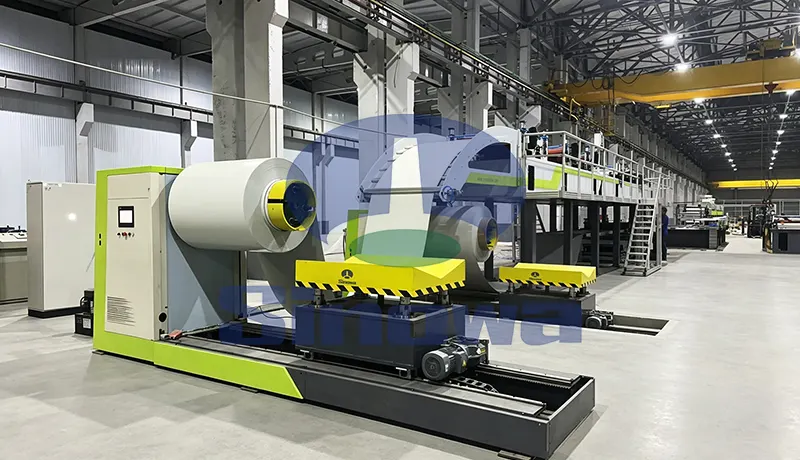
The metal forming section serves as the front-end core unit of the mineral wool sandwich panel machine, undertaking the task of transforming flat metal coils into profiled skins that fit the sandwich structure. This section is composed of an uncoiler, guiding rollers, multiple groups of forming roller sets, leveling devices and trimming auxiliary mechanisms. The uncoiler supports heavy metal coils and releases raw materials at a constant linear speed, and it is equipped with a tension control structure to avoid loose winding or over-tight pulling that may deform metal sheets. After unwinding, the metal strip first passes through a leveling unit, which eliminates inherent warping and ripples generated during coil storage and transportation. Leveling ensures that the subsequent forming process can produce uniform profiles without local distortion. The forming roller groups are arranged in gradient sequence. Each group of rollers bends the metal plate by a small margin step by step, instead of completing all bending in one stroke. This gradual forming method avoids excessive stress concentration on metal materials, effectively reducing cracking and micro-cracks on the bent parts of metal skins. The shape of rollers can be replaced according to the required surface profile of panels, including flat surface, small corrugated surface and deep ribbed surface. Profiled ribs are designed to improve the bending resistance and rigidity of finished panels, so the precision of roller processing directly determines the dimensional consistency of ribs on every panel. After forming, the metal skin enters an edge trimming station, where rotating cutting tools trim the side edges of the profile to guarantee consistent panel width and neat bonding edges. If the edges of metal skins are jagged or uneven, overlapping or gaps will appear when combining with mineral wool core, which will bring hidden risks to the sealing and appearance of finished products. All rollers in this section are driven by synchronous power systems, so the linear speed of upper and lower metal skins can keep consistent with the core material feeding speed. Once speed mismatch appears, the metal sheet will be pulled or accumulated, leading to shutdown and material waste. The forming section also installs safety protection covers and emergency stop sensors around rotating moving parts. When abnormal material jamming occurs, the system can cut off power rapidly to prevent equipment damage and safety accidents. As the first shaping procedure of the whole production chain, stable operation of the metal forming section sets the quality baseline for subsequent gluing, composite and curing processes.
Gluing System: Precision Control and Uniform Coating Technology
The gluing system is the key functional unit that determines the bonding reliability between mineral wool core and metal skins in the mineral wool sandwich panel machine. This system is designed to deliver adhesive quantitatively and distribute it evenly on target bonding surfaces, avoiding problems such as insufficient glue, glue accumulation or local missing coating. Two mainstream coating forms are widely adopted in this equipment: roller coating and air-assisted spraying. Roller coating uses rubber rollers to transfer adhesive onto the material surface, which is more suitable for continuous mineral wool blankets and smooth metal surfaces. The gap between the glue storage roller and transfer roller controls the thickness of adhesive film, and the rotating speed ratio of rollers can be adjusted to change glue application volume. Spraying devices use atomizing nozzles to scatter adhesive into fine droplets, which can better cover the uneven surface of block mineral wool with irregular fiber structures. The nozzle array moves along the width direction of panels to ensure that every area of the core material gets enough adhesive. The whole gluing system is equipped with a glue supply circulation loop, which keeps adhesive flowing continuously to prevent solidification and precipitation inside pipelines during standby periods. Heating and heat preservation components are installed on glue tanks and conveying pipelines for adhesives sensitive to ambient temperature. Low temperature will increase adhesive viscosity, make atomization difficult and cause uneven coating, while over-high temperature will shorten the usable time of mixed adhesive and lead to premature curing inside pipelines. The control module of the gluing system links with the main transmission speed of the production line. When the line speed increases, the glue output rises proportionally automatically, maintaining stable glue dosage per unit area. Manual adjustment mode is also reserved for operators to make compensation for special raw materials. Excessive glue not only raises production cost, but also causes adhesive overflow at panel edges, which is hard to clean and affects appearance. Too little glue cannot form a continuous bonding layer, and delamination will happen under external force or temperature change in later use. In addition to coating control, the gluing system includes cleaning functions. After production tasks are finished, cleaning solvent can be introduced into pipelines and nozzles to remove residual adhesive, preventing nozzle blockage and pipeline clogging. Reasonable maintenance of the gluing system can extend the service life of nozzles and rollers, and keep long-term coating accuracy. A well-calibrated gluing system supports the machine to produce panels with stable bonding performance for a long run.
Core Material Arranging and Feeding Mechanism
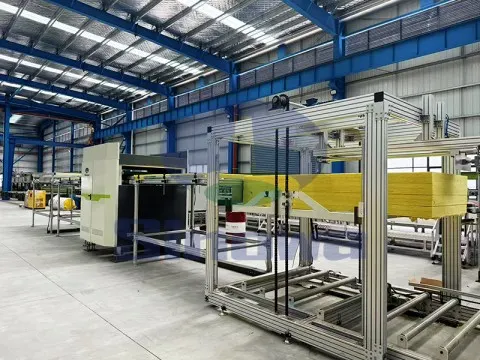
The core material arranging and feeding mechanism is specially developed to handle mineral wool, which has loose fiber characteristics and is easy to shift and collapse during transportation. This unit receives mineral wool raw materials from the material storage area and arranges them into continuous, neatly aligned core layers ready for composite. For block mineral wool, the feeding conveyor sends individual blocks to an arranging platform, where positioning baffles and pushing cylinders adjust the horizontal position of each block to make end faces closely fit together. A pressing auxiliary belt lightly compresses the spliced mineral wool blocks to reduce internal gaps and prevent separation when moving into the pressing section. For continuous mineral wool blanket, the feeding station is equipped with a unwinding frame and tension rollers to release the blanket steadily. Since mineral wool fiber has low tensile strength, excessive pulling force will tear the blanket, so the tension setting of this mechanism is much lower than that used for metal coils. Some production lines add a fiber fluffing auxiliary device before arrangement, which gently disperses compacted mineral wool fiber clusters to restore uniform bulk density of the core layer. After arrangement, the mineral wool core material is centered automatically, so its center line keeps coinciding with the center line of upper and lower metal skins. Misalignment of core material will lead to uneven edge width of finished panels, and some positions will lack core support, reducing the overall load-bearing capacity. Detection photoelectric sensors are distributed along the feeding path to identify material shortage, block tilting and material breakage. Once abnormal signals are captured, the system will send prompts to operators or slow down the production line temporarily. The conveying surface of the feeding mechanism uses anti-abrasion, low-friction materials to avoid scraping mineral wool fibers and leaving debris on the production line. Mineral wool dust generated during feeding will be collected by an auxiliary dust removal structure, improving the working environment and reducing dust accumulation on other equipment stations. The height of the feeding outlet can be adjusted synchronously with the thickness setting of panels. When manufacturing panels with different core thickness, the lifting frame of the feeding station changes the discharging height to match the gap of the pressing section. This mechanism needs to balance feeding speed and arranging quality. Pursuing ultra-high feeding speed blindly will increase the probability of splicing gaps and dislocation. Reasonable matching between feeding capacity and the rhythm of subsequent composite procedures ensures that mineral wool core can enter the pressing zone in ideal forming state.
Continuous Pressing and Curing Station: Forming the Composite Structure
The continuous pressing and curing station is the central area where metal skins and mineral wool core are bonded and shaped into an integrated sandwich panel. This station mainly consists of upper and lower circulating pressing belts, pressure adjustment assemblies, temperature control cabins and supporting transmission rollers. After metal skins with adhesive and arranged mineral wool core enter this station together, the upper and lower pressing belts apply uniform static pressure on the whole surface of the composite blank. Unlike point-type pressing equipment, circulating belts can maintain stable pressure along the whole curing channel, avoiding local pressure difference that causes inconsistent bonding. The pressure value is adjusted according to core material density and panel thickness. Too high pressure will excessively compress mineral wool, destroy its internal fiber structure and reduce thermal insulation performance. Too low pressure cannot make metal skins fully contact with adhesive and mineral wool surface, resulting in weak bonding points. The curing cabin wraps the pressing path and provides a stable temperature environment for adhesive reaction. Heat is transferred to the composite material through air circulation or heat conduction plates inside the cabin, and temperature sensors feed back real-time data to the control system to keep the internal temperature within the target range. The length of the curing cabin determines the maximum curing time that panels can obtain. Panels requiring slow curing need longer cabin length or lower line speed to gain enough reaction time. During pressing and curing, the composite blank moves forward at the same speed as the pressing belts, so there is no relative sliding between belts and panel surfaces, which protects the coating on metal skins from scratch. The side limiting baffles on both sides of the cabin restrain the horizontal expansion of mineral wool under pressure, controlling the overall width of panels. Some mineral wool will slightly rebound after pressure relief, and equipment parameters are preset to reserve allowance for this rebound characteristic. After passing through the whole curing channel, the adhesive completes curing basically, and the three-layer structure forms a stable whole. The panel at this stage already has the basic shape and bonding strength, but still needs follow-up trimming and cutting. The working state of the pressing and curing station directly decides the internal quality of panels. Slight fluctuation of pressure or temperature may not cause immediate defective products, but will bring hidden quality risks that only appear after long-time use. Regular calibration of pressure sensors and temperature modules is essential to maintain stable output of qualified panels.
Post-forming Trimming, Sawing and Cutting Unit
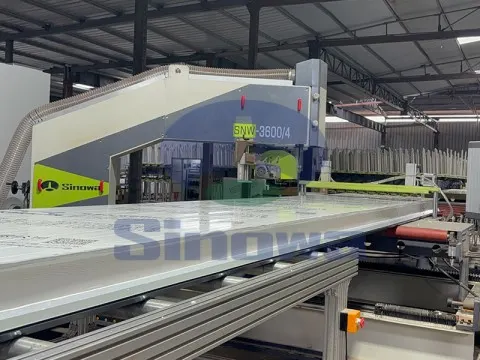
After the composite panel exits the curing station, it enters the post-forming trimming, sawing and cutting unit to finish dimensional shaping according to order requirements. This unit contains edge trimming saws, length positioning sensors, flying cutting saws and waste conveying channels. First of all, the two side edges of the continuous long panel pass through rotating trimming saws, which cut off irregular excess parts overflowing from the composite process. The trimming saws run synchronously with the moving panel, and the cutting speed matches the linear speed of the production line to ensure smooth cutting sections without burrs and fiber pulling. The mineral wool scraps and metal fragments generated during trimming fall into a closed waste conveyor and are transported out of the equipment area in a centralized way, preventing scraps from winding into transmission rollers or polluting other stations. After edge trimming, the panel keeps moving forward until the length measuring system detects that the delivered length reaches the set value. The flying cutting mechanism locks the panel position quickly, and the cutting saw moves forward together with the running panel to complete transverse cutting. The flying cutting mode avoids stopping the whole continuous line for cutting, which is the key to realize non-stop continuous production. If intermittent static cutting is adopted, frequent start and stop will cause speed fluctuation of the front forming and pressing section, and easily induce bonding defects. The cutting saw blade is specially selected to adapt to composite materials containing metal and mineral wool. Ordinary blades are prone to rapid wear when cutting hard metal layers and abrasive mineral wool fibers. The cutting unit also has a pressing fixture to fix the panel firmly during cutting, preventing vibration that leads to inclined cutting surfaces. After cutting, finished panels are separated into single boards of fixed length, and sent to the discharging platform by the rear conveyor. The system can store multiple sets of length parameters, and operators can switch specifications through the control interface without mechanical disassembly and adjustment. Besides fixed-length cutting, the unit can support special cutting modes for special-shaped end structures according to production needs. The precision of cutting size directly affects on-site installation of panels. Large dimensional error will increase the difficulty of assembly and leave larger splicing gaps between panels. Operators will periodically sample and measure the size of cut panels, and fine-tune the position of length sensors and saw calibration parameters to maintain cutting accuracy. This unit is the last shaping procedure of the production line, turning endless continuous composite blanks into independent finished panels that meet transportation and application requirements.
Central Control System and Automated Operation Logic
The central control system is the brain of the mineral wool sandwich panel machine, coordinating the action sequence, speed matching and parameter linkage of all functional stations. This system is composed of a main controller, touch operation interface, distributed sensors, frequency converters and signal transmission modules. All key running parameters, including line speed, glue application amount, pressing pressure, curing temperature, cutting length and feeding state, are displayed visually on the touch screen. Authorized operators can call parameter groups, modify production settings and view real-time running data through the interface. The core of automated operation lies in synchronous linkage control. The speed of the uncoiler, forming rollers, glue coating rollers, core feeder, pressing belts and cutting mechanism are bound together logically. When the main speed is adjusted, the speed of every single station changes proportionally at the same time, avoiding speed mismatch that causes material accumulation or pulling damage. The system supports automatic operation mode and manual jog mode. Automatic mode is used for stable mass production, while manual jog mode is used for equipment debugging, threading raw materials and troubleshooting after shutdown. A large number of safety interlock programs are built into the control logic. If one key station sends an alarm signal such as material jam, motor overload or abnormal temperature rise, the interlock program will trigger graded responses. For minor anomalies, the system reduces line speed and sends warning prompts; for serious faults that may damage equipment, the whole line stops immediately and locks the driving output. The system records historical running data and fault logs automatically. Operators can check the time, parameter state and alarm content of past anomalies, which provides basis for equipment maintenance and quality traceability. For example, if a batch of panels have bonding problems, technicians can check whether the glue dosage and curing temperature deviated from the standard range during production from the log. The control system also has permission management. Different operator accounts have different operation authorities, preventing irrelevant personnel from modifying core parameters by mistake. Remote signal transmission interfaces are reserved on some control systems, supporting real-time data uploading to on-site monitoring platforms. Although the control system realizes high automation, it cannot completely replace manual supervision. Operators still need to patrol the equipment regularly to observe the actual state of raw materials and finished products, because some subtle material changes cannot be fully identified by sensors. Proper understanding of the control logic helps operators judge alarm information accurately, reduce unnecessary shutdown and improve overall production efficiency of the line.
Daily Maintenance, Wear Parts Replacement and Fault Handling
Long-term stable operation of a mineral wool sandwich panel machine relies on standardized daily maintenance, regular replacement of vulnerable parts and scientific fault handling workflows. Wear parts are concentrated in moving and friction positions of each station, including forming rollers, glue transfer rollers, cutting saw blades, circulating pressing belts, transmission chains and guide bearings. Forming rollers bear continuous extrusion friction with metal sheets. After long-time operation, the surface profile will wear, which changes the shape accuracy of metal skins. Operators need to check the surface of rollers regularly, and polish or replace rollers when obvious wear marks appear. Glue rollers and nozzles are easy to be adhered and abraded by adhesive and mineral wool dust. Daily cleaning after shutdown is the most effective preventive measure. If residual adhesive accumulates and hardens, the coating uniformity will deteriorate rapidly. Cutting saw blades suffer dual wear from metal and mineral wool fibers. Blunt blades lead to rough cutting surfaces, increased cutting noise and heavier load of cutting motors. The replacement cycle of saw blades depends on daily output and raw material hardness. Circulating pressing belts work under combined action of pressure, temperature and adhesive pollution. Belt surface aging, cracking and local deformation will affect the flatness of panels. The tension of pressing belts needs to be checked and adjusted every week to prevent deviation during circulation. Lubrication maintenance is required for all transmission bearings and chain sets. Suitable lubricant reduces friction resistance and avoids abnormal heating and noise caused by dry friction. Lubrication points are marked on the equipment body, and maintenance personnel follow the cycle list to add lubricant. Common faults include material jamming, glue blockage, speed out of sync and sensor misdetection. When material jamming occurs, operators must cut off power first before clearing blocked materials, instead of trying to pull materials out while the machine runs. Glue pipeline blockage is usually caused by incomplete cleaning after previous production. Minor blockage can be dredged by circulating cleaning solvent, while serious blockage needs disassembly to clean internal pipelines. Sensor misdetection often comes from dust coverage on the sensing surface. Wiping photoelectric sensors and position sensors regularly can reduce false alarms. Maintenance records should be kept completely, including replacement time of wear parts, fault phenomenon, handling methods and maintenance personnel. These records help summarize the failure law of equipment and formulate more targeted maintenance plans. Scientific maintenance can effectively extend the service life of the whole production line and reduce unexpected downtime losses.
Production Efficiency Influencing Factors and Optimization Approaches
The production efficiency of a mineral wool sandwich panel machine is not only determined by the maximum design line speed, but also affected by multiple interrelated factors covering raw material quality, equipment state, parameter setting and operation management. Blindly pursuing the highest line speed will often backfire. When the speed exceeds the matching capacity of gluing, curing and cutting units, defective rate rises sharply, and the effective qualified output drops instead. Raw material consistency is the primary factor. If mineral wool delivered to the production line has unstable bulk density, irregular block size or frequent breakage, the core arranging mechanism will trigger alarms frequently and force the line to slow down. Metal coils with uneven thickness, poor coiling quality or frequent joint positions also interrupt continuous production. Therefore, stabilizing the quality of incoming raw materials is the foundation of efficiency improvement. Equipment health status is another core factor. Weary saw blades, aging pressing belts, uncalibrated sensors and clogged glue nozzles all limit stable running speed. Many production teams only adjust speed parameters but ignore equipment maintenance, resulting in low actual effective operation rate. Parameter matching optimization needs to take the whole production chain into consideration. The curing time required by adhesive determines the upper limit of line speed. If the curing cabin length is fixed, raising speed shortens the residence time of panels in the high-temperature area. Operators can properly adjust curing temperature within the allowable range of adhesive characteristics to match higher speed, but this adjustment must be verified through small batch tests to avoid hidden bonding defects. The time consumed for specification switching also occupies part of production capacity. Switching panel thickness, width or surface profile requires replacing forming rollers, adjusting pressing clearance, recalibrating glue dosage and resetting cutting parameters. Standardized switching procedures and pre-prepared parameter groups can greatly shorten changeover time. On-site operation management also creates efficiency space. Reasonable arrangement of raw material feeding sequence reduces frequent switching between different specifications. Timely cleaning of waste and dust prevents scraps from accumulating and interfering with equipment movement. Operator skill level influences response speed when facing small anomalies. Skilled operators can judge simple problems quickly and dispose of them without long shutdown. Data-based optimization is an advanced method. By sorting production log data, managers can count the proportion of time occupied by automatic running, fault shutdown, specification switching and raw material waiting, find out the main bottleneck restricting output, and carry out targeted improvement. Efficiency optimization is a systematic project that balances output speed, product quality and equipment protection, rather than simply pursuing faster running speed.
Product Performance Characteristics of Panels Produced by This Machine
Panels manufactured by the mineral wool sandwich panel machine integrate the advantages of metal surface layers and mineral wool core materials, and exhibit unique comprehensive performance characteristics that adapt to many application scenarios. The metal outer skins provide high surface rigidity, impact resistance and weather resistance. After proper surface treatment, the metal layer can resist the erosion of ambient humidity and ultraviolet radiation to a certain extent, maintaining stable appearance and structural performance in changing external environments. The mineral wool core endows the panel with outstanding thermal insulation performance, because the countless tiny air cavities inside mineral wool fibers slow down heat conduction and heat transfer. The thermal insulation effect helps reduce energy exchange between the two sides of the panel, which brings obvious energy-saving benefits for building envelope structures and equipment enclosures. Besides thermal insulation, the porous fiber structure of mineral wool has good sound absorption capacity. When sound waves pass through the panel, fiber friction inside the core consumes sound energy, reducing noise transmission. This characteristic makes the panels suitable for spaces requiring noise control. The mineral wool core also has inherent non-combustible properties, which brings excellent fire resistance to composite panels. When exposed to high temperature, the core layer will not release a large amount of flammable gas or spread flame rapidly, forming a reliable fire barrier structure. The continuous composite forming mode of the machine ensures that mineral wool and metal skins are bonded closely as a whole, so the panel can bear certain bending load and distributed load as a lightweight structural component. Compared with traditional solid wall materials, these sandwich panels have much lower weight, which reduces the load on the supporting structure of buildings and facilities and facilitates transportation and installation. The finished panels have flat and neat surfaces, and can be assembled rapidly through matching connecting accessories on site. The standardized dimensional consistency guaranteed by the machine reduces assembly gaps and improves the sealing effect of the enclosure system. However, the performance of finished panels is constrained by production quality control. If internal bonding is poor, delamination will destroy the overall structural integrity and weaken thermal insulation and fire resistance performance. Gaps inside mineral wool core caused by improper arrangement will form heat bridges and reduce insulation effect. Reasonable production parameter control of the machine is the premise to fully release the inherent advantages of panel materials. Understanding these performance characteristics helps users select suitable panel types and set correct production targets when operating the mineral wool sandwich panel machine.
Application Scenarios and Development Trend of Mineral Wool Sandwich Panel Production Equipment
Mineral wool sandwich panels produced by this type of machine are widely adopted in various enclosure engineering fields, and the equipment itself keeps evolving along with the changing market demands for panel products. In building engineering, these panels are used as exterior wall cladding, internal partition walls, roof covering and ceiling components for different types of buildings. The lightweight, fast installation and multi-functional advantages of panels meet the construction needs of temporary buildings, industrial workshops and public buildings with high requirements for fire prevention and thermal insulation. In industrial fields, panels are applied for equipment isolation enclosures, sound insulation rooms and temperature-controlled production spaces, where stable thermal environment and noise reduction are required. Cold storage and temperature regulating facilities also select these panels to build enclosure structures to reduce cooling or heating energy consumption. In addition, the panels are used for clean space partitions, where flat surface and convenient cleaning are required while maintaining fire safety standards. Diversified application demands continuously put forward new requirements for mineral wool sandwich panel machines. The development trend of this equipment focuses on higher automation and intelligence. New generation equipment strengthens the automatic identification function of raw material state, and the control system can self-adjust partial parameters according to detected material changes, lowering the dependence on operator experience. The optimization of equipment structure is oriented toward wider specification coverage. One single production line can realize rapid switching between more panel thicknesses and profiles without a large number of roller replacement operations, improving the flexibility of small-batch and multi-variety production. Environmental protection design is another important development direction. New equipment strengthens closed dust collection, waste centralized collection and residual adhesive recovery structures, reducing dust and chemical pollutant emission during production. Energy-saving transformation is carried out on heating and pressing sections, optimizing heat circulation paths to cut down energy consumption per unit product. The precision of forming and cutting is further improved to reduce raw material scrap rate. Meanwhile, modular design is gradually applied to equipment manufacturing. Each functional unit can be disassembled, transported and assembled separately, which brings convenience for factory layout adjustment, equipment relocation and later upgrade reconstruction. As the market pays more attention to the comprehensive performance of enclosure materials, the mineral wool sandwich panel machine will continue to integrate new sensing technology, transmission technology and control technology. The core development direction remains to steadily produce high-quality composite panels, balance production economy, product performance and environmental protection requirements, and continuously adapt to the diverse application needs from downstream industries.
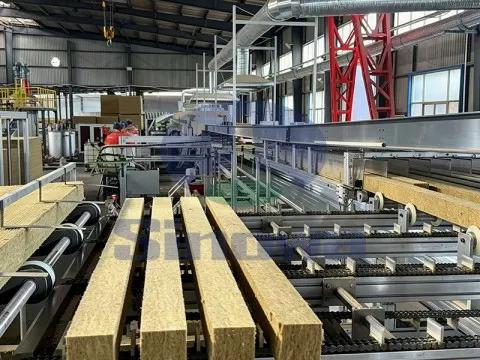
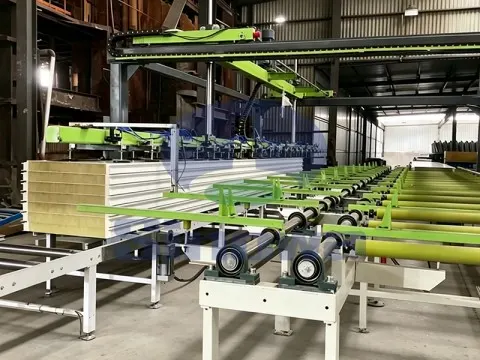
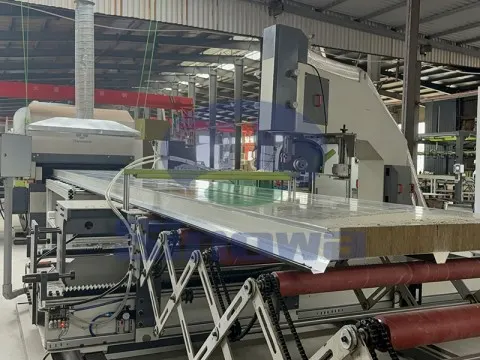
Gallery of Mineral Wool Sandwich Panel Machine
Tags: mineral wool sandwich panel machine, mineral wool sandwich panel machine manufacturer, mineral wool sandwich panel machine supplier, china mineral wool sandwich panel machine, mineral wool sandwich panel machine for sale
-
A reliable PU sandwich panel production line serves as the core equipment for manufacturing high-performance building insulation panels. This professional PU sandwich panel line features automated feeding, foaming and molding processes to ensure consistent panel thickness and structural stability. The well-designed polyurethane sandwich panel production line effectively improves production efficiency while reducing material waste in daily operation. Each calibrated polyurethane sandwich panel line can adapt to different panel sizes to meet diverse construction needs. With precise temperature and pressure control, the advanced continuous PU sandwich panel line produces panels with excellent thermal insulation and weather resistance. Meanwhile, the optimized PIR sandwich panel production line upgrades the foaming formula to enhance fire resistance performance. The high-efficiency PIR sandwich panel line maintains stable operation during long-term mass production, delivering durable and high-quality sandwich panels for various architectural and industrial applications.
-
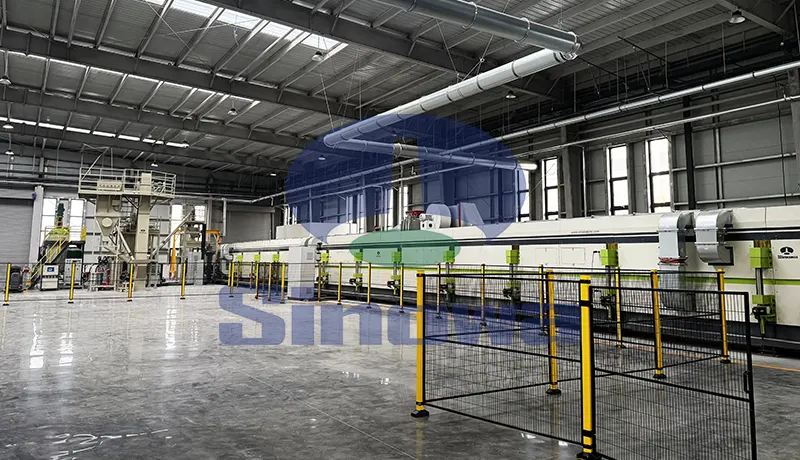
The phenolic panel production line realizes automated and continuous manufacturing of high-performance thermal insulation panels through streamlined and coordinated processing procedures.
-
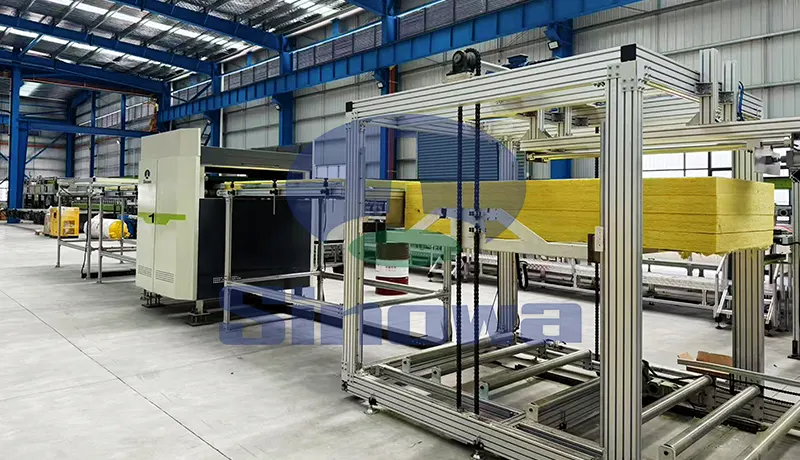
Modern insulation panel manufacturing relies on professional automated equipment to ensure stable product quality and high production efficiency. The rock wool sandwich panel production line features precise material lamination and forming processes to produce rigid, heat-insulating building panels. Meanwhile, the mineral wool sandwich panel production line adopts optimized assembly procedures to fabricate lightweight, soundproof panels widely used in architectural enclosure and thermal preservation projects.