PU Sandwich Panel Machine
Publication Date: Nov 17, 2026
PU Sandwich Panel Machine supplier in China, automatic continuous PU/PIR sandwich panel production line for insulated roof & wall panels. Stable, high speed, customizable thickness.
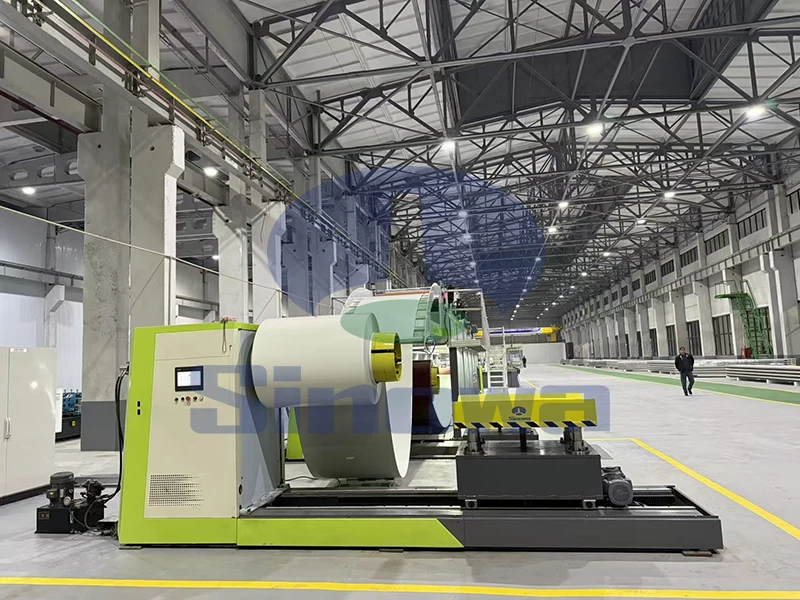
Understanding the Basic Working Logic of PU Sandwich Panel Machine
A PU sandwich panel machine is a continuous forming production system built for manufacturing polyurethane composite sandwich panels, integrating raw material feeding, high-pressure foaming, continuous lamination, shaping, curing, cutting and conveying into one connected workflow. At its heart lies the reaction mechanism of polyurethane raw materials, where two primary liquid components are accurately metered, mixed and injected between two layers of surface materials to trigger the foaming and cross-linking reaction that creates the rigid PU foam core. Unlike intermittent manual or semi-automatic forming equipment, this continuous production setup maintains stable material pressure, mixing ratio and reaction temperature throughout the whole run, which directly decides the uniformity of foam density, cell structure and bonding strength between foam core and facings. Operators prepare surface rolls such as metal sheets, fiber cement boards or composite film materials at the unwinding stations first, guiding the upper and lower facings into the forming section with adjustable guide rollers and tension control units to avoid wrinkling, offsetting or uneven stretching during movement. The liquid PU components are pumped from sealed storage tanks through precision metering pumps into a high-pressure mixing head, where rapid collision mixing takes place before the mixed liquid is evenly distributed across the width of the moving lower facing. Once the liquid contacts the surface material, it starts to expand gradually under controlled temperature, and the upper facing is pressed down synchronously to enclose the expanding foam, forming a three-layer composite structure. Every parameter in this stage is mutually restricted; minor fluctuations in mixing proportion can lead to incomplete foaming, brittle foam or weak adhesion, so the machine’s control system is designed to track real-time flow, pressure and temperature data and make subtle adjustments automatically. This foundational working principle separates continuous PU sandwich panel machinery from simple foam pouring devices, focusing on stable, long-run composite forming rather than single-piece casting, and it supports consistent panel dimensions and performance batch after batch for construction, cold storage and enclosure applications.
Key Structural Modules of the PU Sandwich Panel Production Line
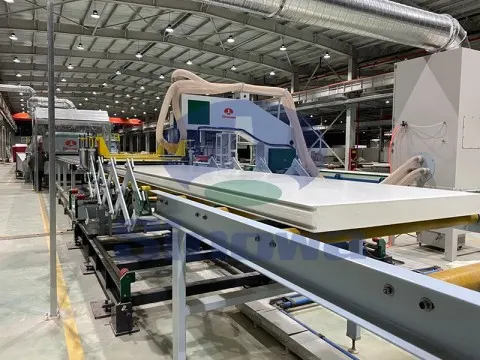
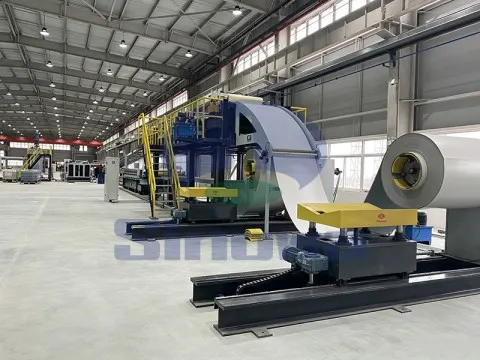
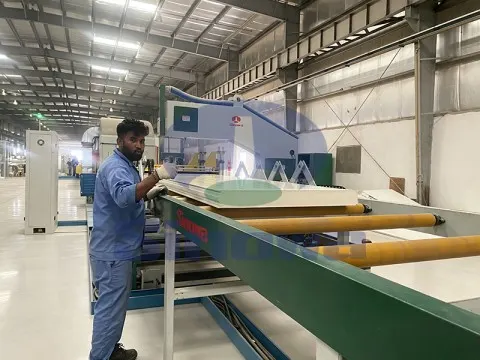
The complete PU sandwich panel machine consists of multiple independent but coordinated functional modules, each undertaking a specific task in the panel forming sequence, and the matching degree between modules determines the overall production efficiency and finished panel quality. The unwinding module is the starting point of the line, equipped with hydraulic or pneumatic unwinding shafts and automatic tension regulators to hold large rolls of facing materials and release them at a constant linear speed. Some versions of this module also carry edge trimming and pre-cleaning attachments to remove surface dust, oil stains or irregular edge burrs before facings enter the lamination zone, eliminating impurities that may weaken the bonding interface between foam and facings. Next comes the raw material feeding and metering module, which hosts insulated storage tanks for polyol and isocyanate, circulating heating pipelines, filter assemblies and precision metering pumps. These pumps deliver liquid materials at a fixed volumetric ratio, and the pipeline insulation prevents temperature drift caused by ambient conditions, as raw material viscosity changes greatly with heat and cold and will affect mixing effect. The high-pressure foaming and mixing module is widely regarded as the core component, featuring a self-cleaning mixing head that uses high-speed fluid collision to blend the two PU components thoroughly; after each production cycle, automatic flushing removes residual cured material inside the head to avoid blockage. Following the mixing station is the double-belt laminating and curing module, which uses two endless heat-resistant conveyor belts to clamp the upper and lower facings together with the foaming PU material inside. The belts move at a synchronized speed, and adjustable clamping pressure maintains the preset panel thickness while the foam expands and cures. Heating channels inside the laminating section provide stable thermal conditions to support the cross-linking reaction, and the length of the curing tunnel is customized based on required production speed and foam curing time. After curing, the cutting module uses flying saw cutting units that move synchronously with the running panel, cutting panels to set lengths without halting the whole production line. Finally, the discharging and stacking module receives finished panels, performs surface inspection and arranges panels neatly for packaging. Every module can be fine-tuned separately while remaining linked by the central control system, allowing flexible adjustment for different panel specifications without large-scale disassembly or modification of the whole line.
Raw Material Matching and Foaming Control in Panel Manufacturing
Raw material preparation and precise foaming control form the foundation of stable panel quality when operating a PU sandwich panel machine, and operators need to master the characteristics of polyurethane formulations and the machine’s adjustment logic to avoid common defects. The two main liquid raw materials are polyol blend and isocyanate, and their mixing ratio is the most critical setting on the equipment. Different formulation recipes bring different foam properties: some recipes prioritize low thermal conductivity for thermal insulation purposes, while others focus on higher compressive strength and dimensional stability for load-bearing enclosure panels. The metering pumps of the machine lock the delivery ratio, but the viscosity of raw materials shifts with storage temperature, so constant-temperature circulation in the storage tanks keeps fluid properties steady before mixing. Before formal production starts, workers usually conduct small test injections to observe foaming speed, foam expansion ratio and surface adhesion state, adjusting feed flow and mixing head pressure accordingly. The foaming reaction proceeds in several phases: induction time after mixing, rapid expansion, gel formation and final curing. The induction time must match the moving speed of the panel line; if foaming starts too fast, the liquid will expand before being fully spread across the panel width and cause uneven core thickness, while excessively slow foaming may lead to liquid flowing sideways, thin edges and foam sagging. Ambient humidity also exerts an influence, as isocyanate reacts with water vapor, which can generate excess carbon dioxide, create large voids inside the foam core and reduce insulation performance. For this reason, the production workshop where the machine runs often maintains controlled humidity, and raw material tanks are kept sealed with dry nitrogen protection when necessary. Surface facing materials also interact with the foaming process: porous facings can form mechanical interlocking with foam for stronger bonding, while smooth non-porous facings sometimes require auxiliary interface treatment to prevent delamination after long-term use. Operators must avoid arbitrarily changing raw material brands or formulations without recalibrating the machine, because new raw materials alter reaction kinetics, and old parameter settings will no longer fit. Reasonable raw material management paired with real-time foaming monitoring helps the machine produce panels with fine, closed-cell foam structures, uniform density and reliable bonding between layers, reducing reject rates effectively.
Adjustable Panel Specifications and Production Flexibility
One prominent advantage of a PU sandwich panel machine lies in its strong adjustability, which enables the same production line to output panels with different thicknesses, widths, facing materials and surface profiles to satisfy diverse usage scenarios. Panel thickness adjustment is completed mainly through changing the gap between the upper and lower laminating belts of the curing section, with the support of precision lead screws and digital readouts to lock the gap accurately. Thickness ranges cover thin panels used for interior partition decoration and thick panels designed for ultra-low temperature cold storage insulation, and the machine’s clamping system must provide even pressure across the full panel width to prevent thickness deviation at edges and the middle. The production width is limited by the effective working width of the mixing head, laminating belts and cutting saw, and many line designs reserve space for width adaptation by replacing guide molds and adjusting the distribution range of mixed PU liquid. Apart from flat panels, some machine configurations support continuous forming of profiled panels by installing customized forming rollers before the laminating zone, pressing corrugations, ribs or other geometric shapes on metal facings before foaming and composite bonding. This avoids secondary shaping after panel production and keeps the foam core closely attached to the shaped surface without empty gaps. The equipment also supports switching between different facing materials: color-coated metal sheets, aluminum alloy sheets, glass fiber mats, non-woven fabrics and other composite facings can be used, as long as the unwinding tension, guide roller surface and pre-treatment station are adjusted to match the rigidity and surface property of new facings. Production speed can be modulated within a reasonable interval by synchronizing the speed of unwinding, metering pumps, laminating belts and flying saw. Lower speed gives longer curing time for thick panels or slow-reacting PU formulas, while higher speed is suitable for thin panels with fast-curing formulations. However, speed adjustment cannot exceed the matching capacity of all modules; speeding up only one single unit will break the coordination of the whole workflow and trigger quality defects. This flexible adjustment capacity means a single set of PU sandwich panel machine can serve multiple downstream markets, helping producers respond quickly to changing order demands without investing in extra separate production lines for each panel type.
Quality Control Points During Continuous Production
Rigorous in-line quality control is essential for a PU sandwich panel machine, because continuous production proceeds rapidly, and undetected parameter deviations can create large batches of defective panels in a short time. The first inspection point sits right after the mixing head, where operators observe the state of mixed PU liquid to check for color inconsistency, uneven flow or delayed reaction. If the mixed material shows obvious streaks, it indicates insufficient mixing inside the mixing head, and the pressure or flow rate of the metering system needs inspection. The second inspection zone is inside the laminating and curing tunnel, where the running composite panel is monitored for foam overflow at side edges, bubble bulges on the surface or separation between facings and foam. Foam overflow usually happens when the gap between laminating belts is too large or the injection volume of PU liquid exceeds the space available for expansion, while local bulges often relate to trapped air or uneven temperature distribution in the curing channel. After the curing section, before the flying saw cuts the panel, staff check the overall flatness, surface wrinkles and alignment of upper and lower facings; offset facings will result in panels with uneven edge margins that cannot meet processing requirements. Once cut to fixed lengths, finished panels go through sampling checks covering foam core density, bonding condition between layers, surface smoothness and edge integrity. Simple destructive spot checks can verify whether delamination occurs under pulling force, and visual inspection identifies open holes, large cavities or collapsed foam areas inside the core. The machine’s central control system automatically records all running parameters including material flow, mixing pressure, curing temperature, line speed and thickness setting, forming production traceability data. When quality problems emerge, technicians can review historical records to locate whether the fault comes from raw material supply, parameter drift, mechanical wear of rollers or unstable tension of facings. Regular calibration of metering pumps, mixing head pressure sensors and thickness detection sensors is also part of routine quality control, because sensor drift over long operating hours gradually reduces the accuracy of automatic adjustment. Combining real-time online observation, sampling testing and parameter logging builds a complete quality control system for the continuous production process of PU sandwich panels.
Maintenance and Daily Operation Specifications of the Equipment
Long-term stable operation of a PU sandwich panel machine relies on standardized daily operation procedures and systematic maintenance plans, as this line contains precision hydraulic, pneumatic, metering, heating and transmission components that are sensitive to dirt, wear and improper operation. Before starting production each day, operators carry out pre-start checks: inspect raw material pipeline connections for leakage, confirm that heating and circulation systems reach the preset working temperature, test the action of the mixing head self-cleaning function and check whether tension rollers, guide rollers and laminating belts run smoothly without jamming. Any residual cured PU foam attached to rollers, belt edges or the mixing cavity must be cleared before startup, because hardened foam scraps can scratch facing materials or enter the composite zone to form foreign body defects inside panels. During production, operators should avoid opening protective covers of moving modules randomly, and they must not touch the high-temperature curing section or high-pressure mixing pipeline to prevent scalding and injection injury from pressurized liquid raw materials. When stopping production for a short break, the metering system switches to circulation mode to keep raw materials flowing inside pipelines and prevent static curing and blockage. After finishing the daily production task, the mixing head goes through a full automatic cleaning cycle with dedicated cleaning agents to wash away leftover reactive PU material; incomplete cleaning is the top cause of mixing head blockage and uneven mixing in the next production run. Periodic maintenance tasks follow different cycles. Daily maintenance focuses on cleaning, leakage checking and lubrication of rotating bearings. Weekly maintenance includes checking the filter elements in raw material pipelines, testing pressure sensors and inspecting the surface condition of heat-resistant laminating belts for cracks, scratches and aging deformation. Monthly maintenance covers calibration of metering pumps, tightening of transmission chain and belt tension, inspection of heating pipes and electrical control cabinets, and removal of accumulated dust inside cooling fans and control components. Wear parts such as sealing rings in pumps, scraper blades and guide sleeves are monitored for replacement in advance, instead of waiting for sudden failure to interrupt production. If the machine will stay idle for a long period, raw material tanks and pipelines are emptied and cleaned thoroughly, and anti-corrosion treatment is applied to metal transmission parts. Strict operation and maintenance rules reduce unexpected shutdown frequency, extend the service life of core components and keep the machine’s production capacity and product consistency stable year by year.
Safety Design and Operational Risk Prevention
A PU sandwich panel machine involves high-pressure fluid delivery, exothermic chemical reactions, high-temperature curing and rotating moving parts, so the whole line integrates multiple built-in safety designs, and risk awareness is mandatory for all on-site personnel. The high-pressure metering and mixing circuit is equipped with pressure relief valves and pressure alarm sensors; when pipeline pressure exceeds the safe threshold, the system triggers an alarm and automatically stops material pumping to avoid pipe rupture and raw material spray. All rotating rollers, flying saw cutting mechanisms and chain transmission sections are fitted with closed protective guards, and emergency stop buttons are distributed at multiple positions along the line, within easy reach of operators. The control cabinet uses isolated electrical components with dustproof and waterproof grades suitable for workshop environments, and overload protection prevents motor burnout caused by stuck mechanical parts. The polyurethane raw materials used in foaming carry inherent risks: isocyanate vapor can irritate respiratory tracts and skin, and liquid contact may cause allergic reactions. Therefore, the machine’s raw material feeding area has local exhaust ventilation structures to draw away volatile gas, and operators must wear protective gloves, goggles and respiratory protective equipment when handling raw material tanks, connecting pipelines or dealing with leakage accidents. The foaming reaction releases heat, and the curing tunnel maintains a continuous high-temperature environment, so temperature monitoring and overheat protection modules are installed to stop heating if abnormal temperature rises appear, lowering the risk of scorching foam or overheating the conveyor belts. In case of raw material leakage during running, the first step is to cut off the material supply and depressurize the pipeline, rather than wiping spilled liquid directly without protection; spilled PU liquid will cure quickly once mixed, and special absorbent materials are used for collection and disposal. Training for operators includes emergency response drills: how to activate emergency stop, how to handle skin contact with raw materials and how to respond to pipeline blockage and overheating alarms. Interlock protection logic is programmed into the control system: certain modules cannot start unless related auxiliary systems such as ventilation and heating have reached ready status. Safety design does not eliminate risks completely, and it works only when operators follow the operation boundaries, avoid bypassing alarm systems and never modify safety interlock settings arbitrarily to pursue higher production speed.
Energy Consumption Characteristics and Energy Saving Optimization Directions
Energy consumption of a PU sandwich panel machine mainly comes from several parts: raw material circulation heating, curing tunnel heating, motor drive for transmission and pumping units, and auxiliary systems including ventilation and hydraulic power. Understanding the energy distribution helps producers carry out reasonable optimization without sacrificing panel quality. The curing tunnel usually accounts for the largest share of energy use, because stable and uniform temperature must be maintained continuously to support foam cross-linking, especially when producing thick panels that require longer curing residence time. Raw material heating and circulation consume steady energy throughout production, as raw materials need to stay within a narrow temperature window to keep viscosity stable for accurate metering and mixing. Drive motors for unwinding, laminating belts, metering pumps and flying saws consume power proportional to production speed; higher line speed increases mechanical load and power demand. Many machines adopt frequency conversion motor drives for most rotating units, which is a basic energy-saving measure. Variable frequency control adjusts motor output power according to actual speed requirements instead of running at fixed rated power, cutting idle energy loss during standby and low-speed production. Thermal insulation layers wrapped around curing tunnels and raw material pipelines reduce outward heat dissipation significantly. Without proper external insulation, a large amount of heat escapes into the workshop, raising ambient temperature and increasing the load of ventilation systems. Reasonable production scheduling also contributes to energy saving: continuous long-run production reduces the energy waste from repeated heating up and cooling down of the whole line. Frequent short batches with repeated startup and shutdown make the machine spend much energy reaching working temperature again and again. Operators can also optimize formulation and parameter matching to shorten required curing time where formulation allows, which raises production capacity under the same heating energy input. However, energy saving adjustments cannot damage panel performance. Reducing curing temperature excessively or cutting curing time will lead to incomplete foam curing, low bonding strength and unstable dimensional performance of finished panels. Optimization work should always take stable panel quality as the bottom line, balancing energy cost control and product qualification rate.
Comparison Between Continuous PU Sandwich Panel Machine and Discontinuous Equipment
It is helpful to clarify the positioning of continuous PU sandwich panel machines by comparing them with discontinuous foaming and pressing equipment, as the two types target different production scales and operational modes. Discontinuous equipment works in a batch mode: workers place facings into fixed molds, pour mixed PU liquid manually or by a simple pouring gun, then close the mold and hold pressure for curing before opening the mold and taking out a single panel. This approach has low initial investment and flexible mold switching for small, customized orders, but its obvious drawbacks are low output and unstable consistency. Each mold filling, closing and demolding cycle takes considerable time, and manual pouring easily causes uneven material distribution, inconsistent foam density and large differences between individual panels. In contrast, the continuous PU sandwich panel machine forms panels on an endless moving line, and production runs nonstop once parameters are stabilized. Output per hour is far higher, suitable for mass orders with fixed panel specifications. The continuous line maintains consistent mixing ratio, injection volume, pressure and temperature over thousands of meters of panels, so dimensional tolerance and foam performance show much smaller batch-to-batch variation. Discontinuous molds are limited by mold size, and producing extra-long panels is difficult, while continuous machines can make panels of any preset length via flying saw cutting. On the other hand, continuous lines require a larger workshop space to arrange unwinding, curing tunnel and stacking sections, and the cost of commissioning and calibration before formal production is higher. Switching to a completely new panel specification often takes more time to readjust all linked modules, while discontinuous mold equipment can change a mold and start small-batch production quickly. The labor allocation model also differs: discontinuous production needs more workers for mold loading, pouring and demolding, while a continuous PU sandwich panel machine only needs a small team to monitor parameters, replenish raw materials and collect finished panels. Therefore, the choice between the two equipment types depends on order volume, product repeatability, required panel length and acceptable quality consistency level, rather than a simple judgment of which type is universally better.
Downstream Application Scenarios of Panels Produced by the Machine
Panels manufactured by a PU sandwich panel machine are widely adopted across multiple downstream sectors, and the machine’s adjustable features make its output fit the unique functional needs of each scenario. Cold storage and low-temperature warehouse construction form one of the largest application fields, where PU foam’s low thermal conductivity reduces heat infiltration and helps refrigeration systems maintain stable interior temperatures. Thick PU sandwich panels produced on this line are assembled into wall and roof enclosures for cold rooms, freezing warehouses and refrigerated transit hubs, cutting long-term refrigeration operating costs. Industrial factory buildings and large-span steel structure workshops use these panels as exterior wall and roof enclosure materials. The composite panel integrates structural support, thermal insulation and surface decoration into one layer, simplifying the building envelope construction process and shortening site installation cycles. Cleanroom projects for pharmaceutical workshops, food processing plants and electronic manufacturing workshops also select these panels, because smooth panel surfaces can be made easy to wipe clean and resist dust accumulation when matched with suitable facing materials. In temporary and modular construction systems, PU sandwich panels serve as wall units for prefabricated cabins, field offices and emergency accommodation buildings; the panels are lightweight, easy to transport and fast to assemble on site. Besides building enclosures, panels from this machine are used for the interior lining of refrigerated transport vehicles and containers, forming insulated compartments that keep goods stable within required temperature ranges during transit. Some special customized panels are applied for sound insulation enclosure and temperature-controlled agricultural greenhouses, with formulations tuned to balance heat preservation and other auxiliary properties. Different scenarios set different priorities: cold storage products emphasize insulation performance, cleanroom panels focus on surface compactness and sanitation, and factory roof panels need good weather resistance and mechanical strength. It is the adjustability of the PU sandwich panel machine that allows producers to tune foam formulas, panel thickness and facing combinations to match these diverse functional requirements, expanding the market coverage of finished sandwich panels.
Future Development Trends of PU Sandwich Panel Machine Technology
The evolution direction of PU sandwich panel machine technology centers on higher automation, smarter process monitoring, better adaptability to low-carbon raw material systems and improved operational friendliness. Modern new-generation lines are gradually reducing manual intervention points by adding automatic raw material feeding and material level monitoring systems, which can automatically send supply reminders or trigger auxiliary pumping when tank levels drop to the preset threshold, avoiding unexpected material shortage in the middle of continuous production. Visual inspection units are being integrated into the line after the curing section; high-speed cameras combined with image recognition algorithms automatically identify surface scratches, delamination marks, foam voids and edge defects, marking defective segments synchronously without relying entirely on human visual inspection, which improves defect detection speed and accuracy. Intelligent control platforms connect all sensor data of the machine into a unified system, which can record the correlation between parameter settings and finished panel quality over long periods. After accumulating enough production data, the system can provide parameter recommendation schemes for new panel specifications, reducing the time spent on trial runs and manual debugging. Another important trend is the adaptation of equipment to new low-carbon polyurethane formulations. As the demand for lower carbon footprint foam materials rises, raw material reaction characteristics change, requiring metering pumps, mixing heads and curing temperature curves to support these new formulas. Equipment manufacturers optimize mixing head structures and temperature control loops to accommodate slower or faster reaction rates of modified polyol systems while maintaining stable foaming quality. There is also growing attention to the integration of waste collection structures on the machine, to collect edge trims and offcut foam generated during cutting for centralized recycling treatment, reducing scattered workshop waste. Human-machine interface design continues to be simplified: large touchscreen displays visualize line speed, pressure, temperature and alarm information clearly, and fault diagnosis functions give text prompts for abnormal points instead of only simple alarm codes, helping maintenance staff locate problems faster. Meanwhile, modular design of the whole line becomes more mainstream, allowing users to expand functional sections step by step, such as adding a profiling roller station or automatic packaging unit later when business grows, instead of purchasing a fully configured large line at the beginning. These technological advances will make PU sandwich panel machines more stable, efficient and adaptable, supporting the long-term development of lightweight insulated composite panel industry.
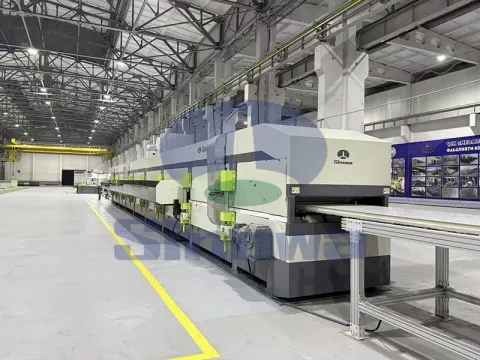
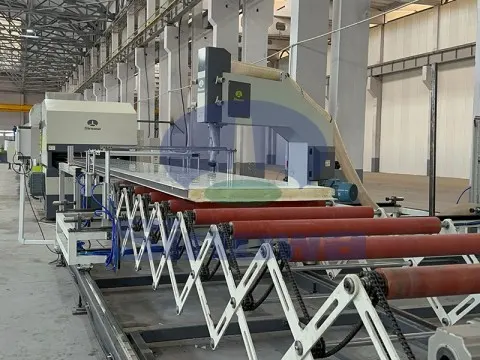
Gallery of PU Sandwich Panel Machine
Tags: pu sandwich panel machine, pu sandwich panel machine manufacturer, pu sandwich panel machine supplier, china pu sandwich panel machine, pu sandwich panel machine for sale
-
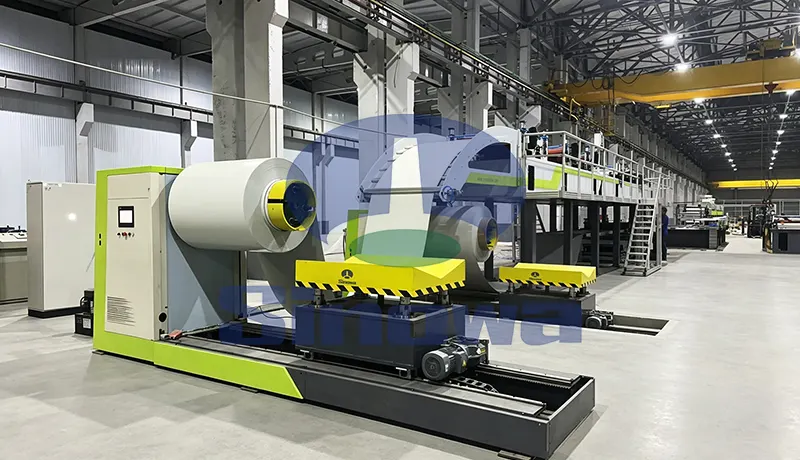
A reliable PU sandwich panel production line serves as the core equipment for manufacturing high-performance building insulation panels. This professional PU sandwich panel line features automated feeding, foaming and molding processes to ensure consistent panel thickness and structural stability. The well-designed polyurethane sandwich panel production line effectively improves production efficiency while reducing material waste in daily operation. Each calibrated polyurethane sandwich panel line can adapt to different panel sizes to meet diverse construction needs. With precise temperature and pressure control, the advanced continuous PU sandwich panel line produces panels with excellent thermal insulation and weather resistance. Meanwhile, the optimized PIR sandwich panel production line upgrades the foaming formula to enhance fire resistance performance. The high-efficiency PIR sandwich panel line maintains stable operation during long-term mass production, delivering durable and high-quality sandwich panels for various architectural and industrial applications.
-
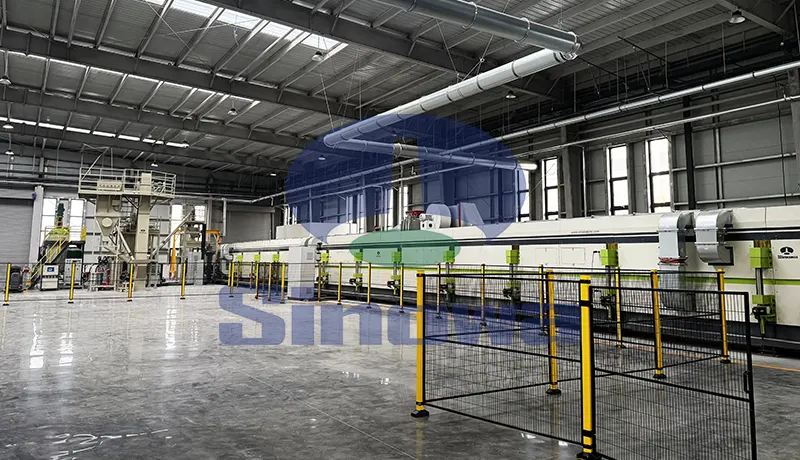
The phenolic panel production line realizes automated and continuous manufacturing of high-performance thermal insulation panels through streamlined and coordinated processing procedures.
-
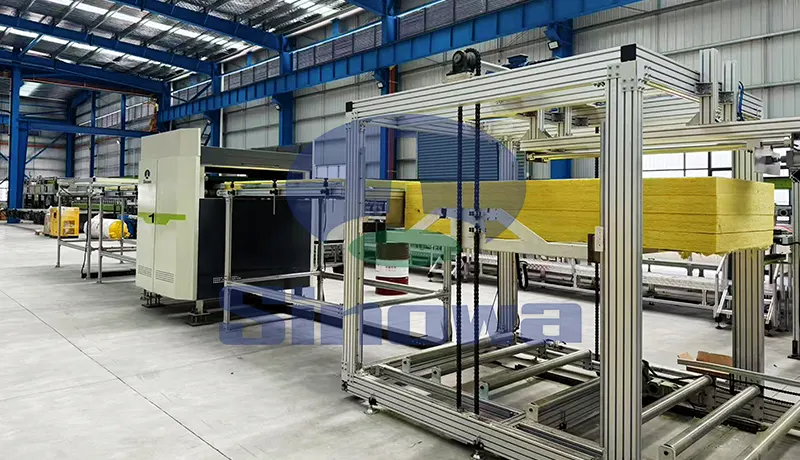
Modern insulation panel manufacturing relies on professional automated equipment to ensure stable product quality and high production efficiency. The rock wool sandwich panel production line features precise material lamination and forming processes to produce rigid, heat-insulating building panels. Meanwhile, the mineral wool sandwich panel production line adopts optimized assembly procedures to fabricate lightweight, soundproof panels widely used in architectural enclosure and thermal preservation projects.