Phenolic Sandwich Panel Production Line
Publication Date: Oct 5, 2026
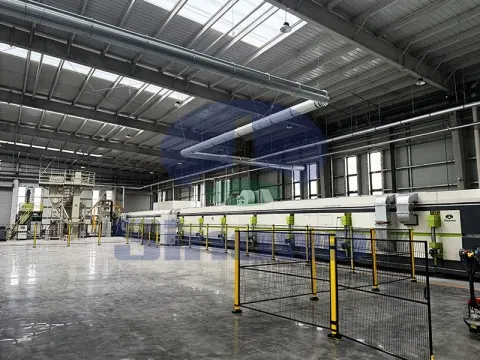
The phenolic sandwich panel production line is a fully integrated automated manufacturing system designed for continuous production of high-performance composite panels. It integrates raw material processing, foaming, laminating, curing and finishing processes to deliver stable, durable insulation panels for diverse industrial and construction applications.
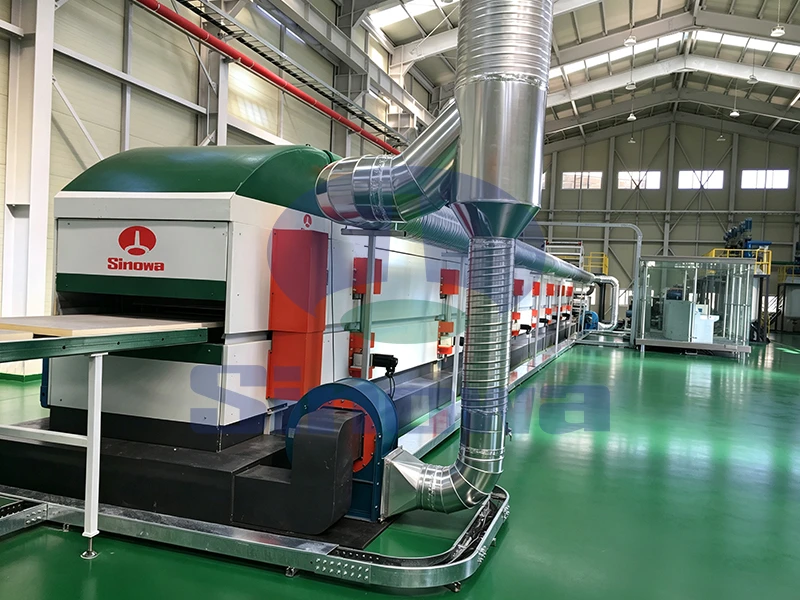
Raw material preparation and intelligent batching serve as the foundational procedure of the entire phenolic sandwich panel manufacturing process, directly determining the uniformity and basic performance of finished products. The core production materials mainly include phenolic resin substrates, specialized curing agents, foaming agents and various functional additives, alongside flexible surface substrate materials for panel protection. This production line adopts a sealed and quantitative feeding structure to avoid manual measurement errors and material waste. All raw materials are transported through closed pipelines to prevent external dust and impurities from contaminating the production system. Meanwhile, the equipment maintains a stable material mixing ratio in real time, ensuring that the chemical properties of mixed materials remain consistent in each production cycle, which lays a solid foundation for subsequent foaming and composite molding processes.
Precision raw material mixing and slurry homogenization is a critical intermediate process that bridges material preparation and formal molding. After quantitative feeding, all raw materials are sent to a professional high-speed mixing unit for full fusion and chemical pre-reaction. The mixing equipment features adjustable stirring speed and constant-temperature mixing chambers, which prevent local overheating or uneven viscosity of phenolic slurry caused by excessive stirring friction. During the mixing process, micro-adjustments are made to the mixing state according to material fluidity, ensuring that foaming components and curing ingredients are evenly distributed in the phenolic resin matrix. Uniform slurry quality effectively avoids inconsistent foaming density and structural defects in the core layer of finished panels, greatly improving the overall structural uniformity of phenolic sandwich panels.
Automatic surface material unwinding and pretreatment ensures the surface quality and composite adhesion effect of phenolic sandwich panels. The insulation board production line is equipped with synchronous unwinding devices for upper and lower surface materials, which can adapt to different types of flexible and rigid surface substrates. Before composite molding, the surface materials will go through automatic flattening, dust removal and micro-roughening treatment. The flattening mechanism eliminates wrinkles and tensile deformation of surface materials, while the dust removal system removes surface attachments to ensure tight bonding with the phenolic core layer. The micro-roughening process increases the surface friction of substrates, enhancing the adhesive force between surface materials and the foam core. The whole pretreatment process operates synchronously with the production rhythm, realizing uninterrupted feeding and effectively improving production efficiency and composite firmness.
Continuous phenolic foaming and core layer forming is the core technological process that shapes the insulation and structural characteristics of panels. The uniformly mixed phenolic slurry is evenly injected between the upper and lower pretreated surface materials through an automatic spraying system. Under set temperature and pressure conditions, the slurry undergoes controllable foaming and initial solidification reactions. Different from ordinary foam materials, phenolic foam requires mild and stable reaction conditions to form a fine and closed-cell structure. The production line precisely controls the foaming speed and expansion range of the slurry, avoiding excessive foaming, hollow cavities or insufficient expansion. The initially formed phenolic foam core presents uniform density and stable pore structure, endowing the sandwich panel with excellent thermal insulation and flame-retardant properties in the early production stage.
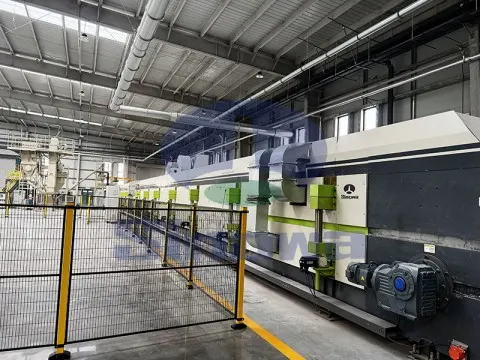
Gradient pressure laminating and composite molding realizes the integrated bonding of surface materials and phenolic foam core. After preliminary foaming, the semi-finished panels enter the long-span laminating unit of the production line, which provides a closed and stable molding space. The equipment adopts a segmented gradient pressure control mode, applying gentle pressure in the early stage to avoid extruding the unconsolidated foam core, and gradually increasing pressure in the middle and later stages to discharge internal air bubbles and achieve tight composite bonding. The double-track synchronous pressing structure ensures consistent stress on the whole panel surface, effectively preventing surface warping, local bulging or delamination. This process integrates the surface protective layer and functional core layer into a unified whole, greatly improving the overall mechanical strength and structural integrity of the panel.
Multi-zone intelligent temperature curing is key to stabilizing the molecular structure and comprehensive performance of phenolic sandwich panels. The insulation panel production line is equipped with an independent gradient curing chamber divided into multiple temperature control zones to implement staged curing treatment. The preheating zone eliminates internal structural stress generated during lamination and prevents surface cracking caused by sudden temperature changes. The constant-temperature curing zone promotes thorough cross-linking and thermosetting reactions of phenolic resin, solidifying the internal molecular structure of the foam core. The final shaping zone fine-tunes the panel flatness and dimensional stability. The whole curing process realizes automatic temperature adjustment according to production speed, ensuring full curing of each panel without quality differences.
Automatic traction and fixed-length cutting achieve standardized sizing of finished phenolic sandwich panels. After completing curing and shaping, the panels are stably transported forward by the synchronous traction device, which maintains a constant conveying speed to avoid stretching or squeezing the shaped panels. The production line is matched with an intelligent tracking cutting system, which can automatically identify and set cutting lengths according to production requirements. The high-precision cutting tool ensures smooth and neat panel sections without burrs, cracks or core layer peeling. The cutting process operates in real time with continuous production, realizing seamless connection between finished product sizing and subsequent processing. It effectively unifies the dimensional specifications of products and meets the standardized use requirements of subsequent construction and installation.
Surface finishing and defect inspection optimize the appearance quality and yield rate of phenolic sandwich panels. After cutting and sizing, panels enter the finishing station for edge trimming, surface cleaning and minor flaw repair. The edge trimming mechanism polishes uneven panel edges to ensure regular overall shapes, while the surface cleaning system removes residual dust and adhesive residues on the panel surface. Meanwhile, the built-in visual inspection system conducts real-time detection of panel surface flatness, composite integrity and core layer uniformity. It can automatically identify tiny defects such as local delamination, surface scratches and uneven thickness, and screen out unqualified products in time. This refined processing and inspection process effectively guarantees the consistent quality of finished products.
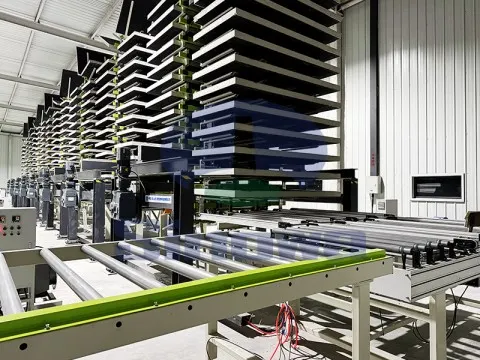
Automatic stacking and finished product output realize efficient packaging and warehouse docking of phenolic sandwich panels. Qualified panels are automatically transported to the stacking station through the conveying system, and the intelligent stacking device neatly arranges panels according to fixed layers and specifications. The sandwich panel equipment adopts flexible stacking operation to avoid extrusion damage to the panel surface and edges. After stacking is completed, the system can cooperate with subsequent packaging equipment to complete automatic film wrapping and binding, realizing integrated production and packaging. The whole output process is fully automated without manual intervention, which greatly reduces labor costs, improves production efficiency, and ensures neat and standardized finished product storage and transportation conditions.
System intelligent control and daily maintenance management ensure the long-term stable operation of the phenolic sandwich panel production line. The entire production process is centrally controlled by an intelligent operating system, which monitors key parameters such as material ratio, production speed, temperature and pressure in real time. The system can automatically adjust operating parameters according to production conditions to maintain stable production status and reduce manual operation errors. In addition, the production line is designed with convenient maintenance structures for key wearing parts and core components, supporting regular cleaning, lubrication and component replacement. Real-time fault self-diagnosis function can quickly locate abnormal problems, reduce equipment downtime, and ensure continuous, efficient and low-consumption operation of the whole production line.
Gallery of Phenolic Sandwich Panel Production Line
Tags: phenolic sandwich panel production line, phenolic sandwich panel production line manufacturer, phenolic sandwich panel production line supplier, china phenolic sandwich panel production line, phenolic sandwich panel production line for sale
https://www.sandwichpanelmanufacturingline.com/blog/phenolic-sandwich-panel-production-line.html
-
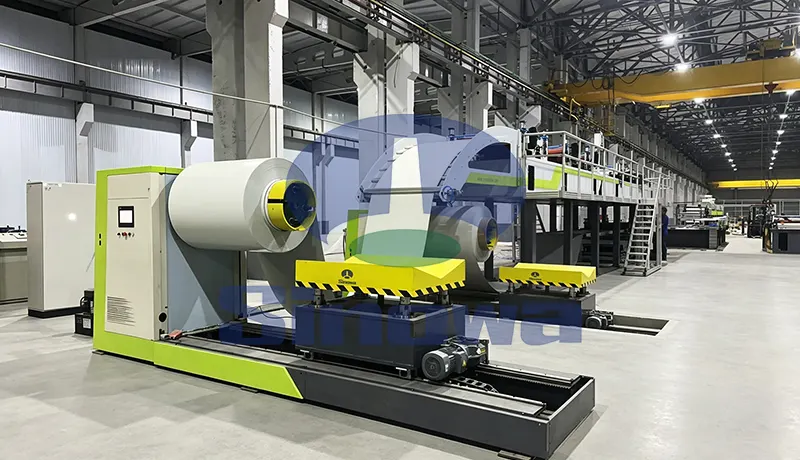
A reliable PU sandwich panel production line serves as the core equipment for manufacturing high-performance building insulation panels. This professional PU sandwich panel line features automated feeding, foaming and molding processes to ensure consistent panel thickness and structural stability. The well-designed polyurethane sandwich panel production line effectively improves production efficiency while reducing material waste in daily operation. Each calibrated polyurethane sandwich panel line can adapt to different panel sizes to meet diverse construction needs. With precise temperature and pressure control, the advanced continuous PU sandwich panel line produces panels with excellent thermal insulation and weather resistance. Meanwhile, the optimized PIR sandwich panel production line upgrades the foaming formula to enhance fire resistance performance. The high-efficiency PIR sandwich panel line maintains stable operation during long-term mass production, delivering durable and high-quality sandwich panels for various architectural and industrial applications.
-
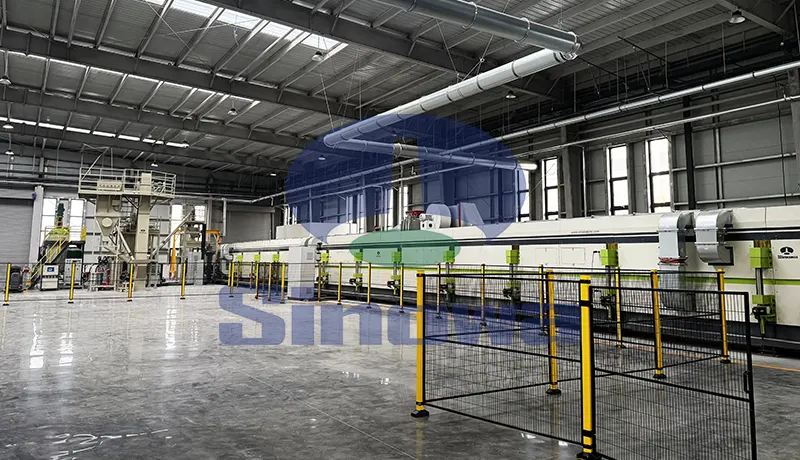
The phenolic panel production line realizes automated and continuous manufacturing of high-performance thermal insulation panels through streamlined and coordinated processing procedures.
-
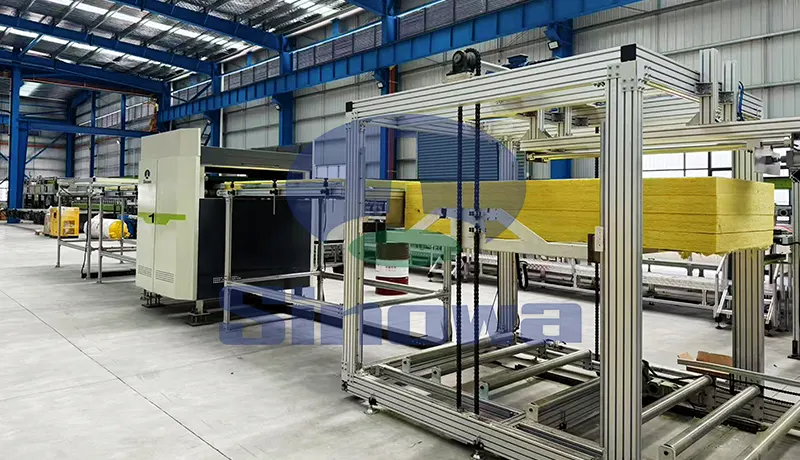
Modern insulation panel manufacturing relies on professional automated equipment to ensure stable product quality and high production efficiency. The rock wool sandwich panel production line features precise material lamination and forming processes to produce rigid, heat-insulating building panels. Meanwhile, the mineral wool sandwich panel production line adopts optimized assembly procedures to fabricate lightweight, soundproof panels widely used in architectural enclosure and thermal preservation projects.