Fire Resistant PU Sandwich Panel Line
Publication Date: Oct 14, 2026
Fire Resistant PU Sandwich Panel Line, continuous automatic machine to produce fireproof PU insulation sandwich panels. Stable operation & flexible configuration for construction projects.
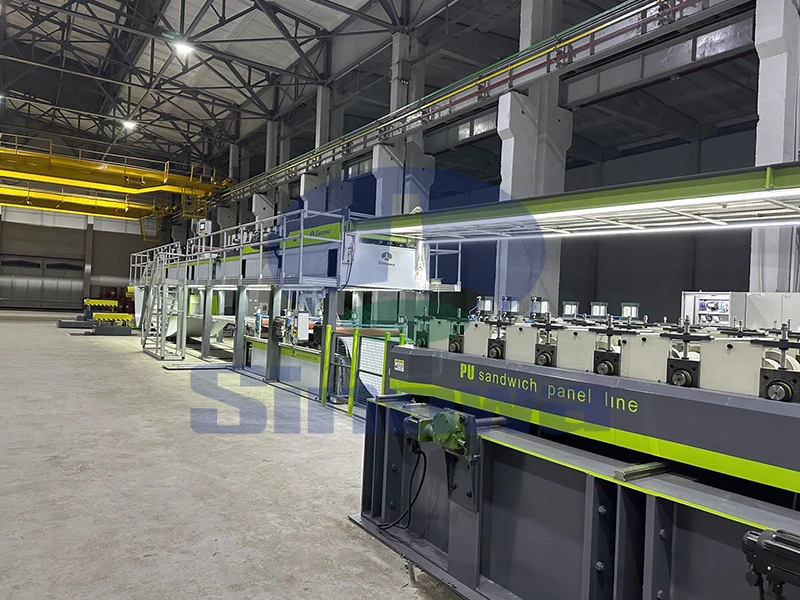
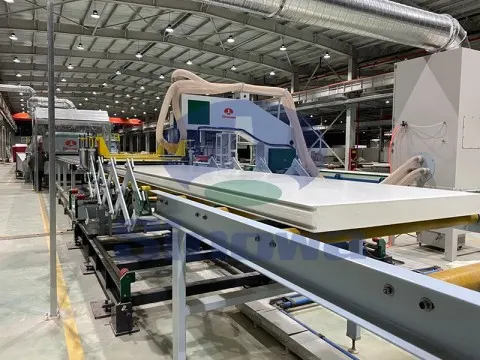
A fire resistant PU sandwich panel line represents a specialized continuous production system engineered to manufacture insulated composite panels that combine thermal performance with enhanced fire-retardant characteristics. Unlike conventional polyurethane (PU) panel lines, which focus primarily on insulation and structural efficiency, a fire resistant variant integrates additional material handling, chemical dosing, and quality control stages designed to ensure that the polyurethane core and its facings meet stringent fire behavior expectations. The line typically comprises a series of interconnected stations: decoilers for the metal facings, a preheating and profiling section, a chemical mixing and dispensing unit for the PU formulation, a double belt laminator where the foam expands and cures between the facings, a cutting station, and an automated stacking and packaging area. Each station must be carefully synchronized because the chemical reaction that transforms liquid polyol and isocyanate into rigid foam occurs within seconds, and any delay or temperature fluctuation can compromise both the insulating value and the fire performance of the finished panel. The overriding challenge in designing such a line is balancing the desire for low thermal conductivity with the need to suppress flame spread, reduce smoke emission, and limit heat release during a fire event.
The raw material preparation stage lies at the heart of fire resistant PU panel manufacturing. The polyol blend is modified by incorporating flame-retardant components that interact chemically with the combustion process, either by promoting char formation on the panel surface, by releasing inert gases that dilute flammable vapors, or by interrupting the radical reactions that sustain flame propagation. On a dedicated production line, these additives are stored in heated and agitated tanks to prevent phase separation and viscosity drift, and they are metered with high-precision piston or gear pumps that feed into a high-pressure impingement mixing head alongside the isocyanate component and blowing agent. The blowing agent itself is increasingly selected for its low global warming potential and its contribution to a fine, closed-cell foam structure, because a dense, uniform cell morphology helps the panel resist both heat transfer and flame penetration. The mixing head traverses across the lower facing at a controlled speed, depositing a continuous ribbon of reactive liquid that must expand evenly before the upper facing contacts it. Any inconsistency in mix ratio, temperature, or deposition weight can create weak zones in the core that act as preferential paths for fire and smoke, which is why modern lines include inline sensors that monitor raw material temperature, pressure, and flow rate in real time and trigger alarms if parameters drift outside preset windows.
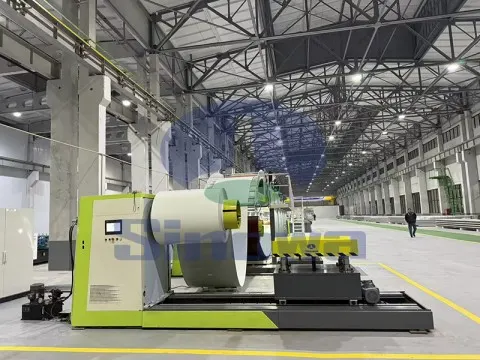
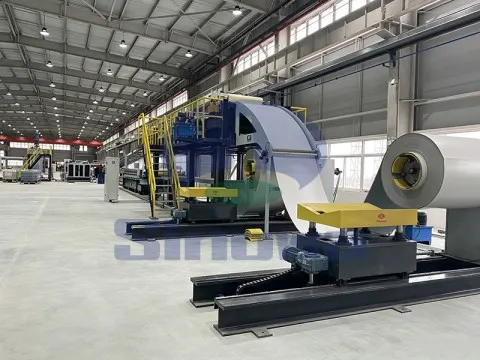
The metal facing handling system on a fire resistant PU panel line must also meet elevated requirements. The facings—typically pre-painted steel, aluminum, or sometimes stainless steel coils—are unwound from large decoilers and passed through a series of rollers that remove protective film, straighten any coil set, and imprint or emboss a texture that improves mechanical adhesion between the metal and the foam. Because fire performance depends in part on the integrity of the bond between facing and core, even a slight delamination can allow hot gases to travel along the interface and accelerate flame spread. The line therefore includes a profile roller section that forms the edges of the panel into the desired tongue-and-groove or secret-fix geometry, and an optional preheating unit that brings the facing to a temperature compatible with the exothermic reaction of the foam. Sensor-guided web alignment systems keep the metal strip centered through every station, preventing skewing that would create uneven edge seals. After lamination and curing, the facing continues to protect the foam core from mechanical damage and UV exposure, but it also acts as a heat shield that delays ignition of the underlying polymer; a smooth, well-bonded facing with no scratches or corrosion spots is therefore essential for consistent fire behavior across every panel produced on the line.
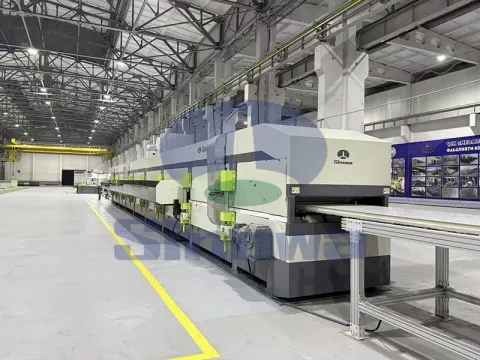
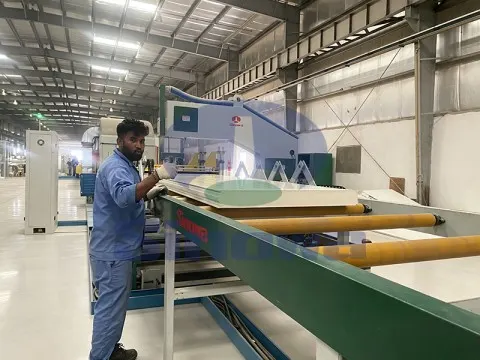
The double belt laminator is the critical section where chemistry, mechanics, and thermal control converge. Two continuous steel belts, usually made of hardened and polished steel plate driven by chains or hydraulic systems, sandwich the deposited foam between the upper and lower facings and carry the assembly through a long, temperature-controlled tunnel. Inside the tunnel, the chemical mixture expands to fill the cavity, adheres to both facings, and cures into a rigid, closed-cell foam with a density tailored to the panel's intended application. On a fire resistant PU line, the tunnel is divided into multiple heating and cooling zones because the addition of flame-retardant additives can alter the reaction profile—sometimes slowing cream time, sometimes accelerating gel time—and the belt temperature profile must be adjusted accordingly. Too much heat in the early zones can cause scorching or uneven skin formation, while too little heat can leave uncured material in the core that later contributes to smoke generation. The belt pressure is also adjustable via support rollers and pressurized chambers, ensuring that the final panel thickness is uniform and that the facings conform tightly to the foam edges. Modern laminators use servo-driven zone adjustments and infrared or contact temperature probes that feed data back to a central PLC, allowing operators to tune the cure profile for specific formulations, panel thicknesses, and ambient conditions.
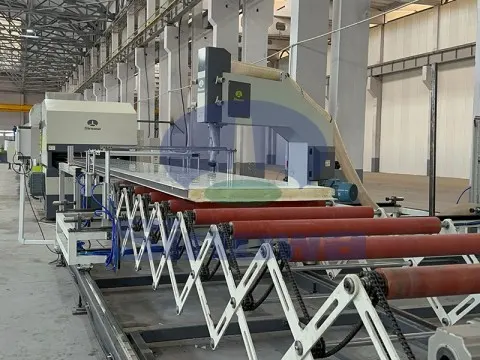
Cutting and sizing on a fire resistant PU panel line demand particular precision because the edge quality of a panel directly influences its fire performance when installed in a wall or roof system. After exiting the laminator, the continuous panel sandwich travels along a roller conveyor toward a transverse cutting saw that slices the board to customer-specified lengths. The saw is typically a traveling cut-off machine that moves synchronously with the panel during the cut, producing a clean, square edge without crushing the foam core. Any ragged edge, exposed loose beads, or internal void at the cut end can later allow flames to penetrate the joint between panels, which is why the cutting station is paired with a vacuum extraction system that removes foam dust and metal shavings before they accumulate on the line. Some lines also include a notching or profiling station that shapes the panel edges to receive gaskets, sealants, or locking mechanisms designed to maintain joint integrity under fire conditions. After cutting, the panels move to an unloading and stacking area where they are separated by protective sheets, strapped into bundles, and labeled with production data. Throughout this handling process, care is taken not to damage the painted facings or compress the edges, because even minor mechanical damage can become a point of weakness during a real fire event.
Quality control on a fire resistant PU sandwich panel line extends far beyond basic dimensional checks. In addition to measuring thickness, width, length, and flatness, sample panels are periodically withdrawn and subjected to a battery of tests that reflect their intended fire-related role. These include assessments of surface and core density uniformity, adhesion strength between facing and foam, dimensional stability under temperature and humidity cycling, and, of course, evaluations of reaction to fire such as ignition resistance, flame spread propagation, smoke production, and heat release characteristics. While the exact test protocols are set by independent laboratories rather than by the line itself, the production system is designed so that every panel's traceability data—coil lot numbers, raw material batch codes, mix ratios, tunnel temperatures, and belt speeds—are recorded against a unique identification code printed or applied to the panel. This traceability allows quality engineers to trace any anomalous result back to the specific shift, tank, or station and to adjust the process before defective material accumulates. Inline vision systems can also inspect the painted facing for scratches, color variation, and contamination, while ultrasonic or laser sensors scan the core for voids that would compromise both insulation and fire performance. The cumulative effect is a manufacturing environment in which fire performance is treated not as an occasional test result but as a continuously monitored process variable.
Energy efficiency and environmental stewardship have become increasingly important design considerations for modern fire resistant PU panel lines. The chemical reaction that cures the foam is exothermic, and capturing and reusing that heat—via heat exchangers in the belt tunnel, exhaust air recovery systems, and pre-heating of incoming raw materials—reduces the external energy demand of the line while also stabilizing process temperatures. The choice of blowing agent is another major environmental lever: modern formulations use low-global-warming-potential agents that not only reduce climate impact but also tend to produce finer cell structures with better insulating and fire-resistance properties. Closed-loop cooling systems for the hydraulic and mixing equipment minimize water consumption, while oil separation units treat any contaminated condensate before it is discharged. Because flame-retardant additives and isocyanate-based chemistries require careful handling, the line is enclosed where appropriate and equipped with local exhaust ventilation that captures vapors at the mixing head and cutting station, protecting operators and preventing release of particulate matter. Energy management software monitors electricity, compressed air, and gas consumption per linear meter of panel, identifying waste patterns and supporting continuous improvement programs. In this way, a well-designed fire resistant PU panel line delivers not only a safe building material but also a production process that is economically and ecologically sustainable over decades of operation.
Operator training, maintenance discipline, and safety culture are inseparable from the performance of a fire resistant PU sandwich panel line. The production environment combines moving steel belts, high-temperature zones, high-pressure chemical mixing, and flying metal coil ends, which means that lockout-tagout procedures, interlocked guarding, and personal protective equipment are non-negotiable. Operators are trained to recognize early warning signs—an unusual smell from the mixing head, a shift in panel color, a change in belt vibration—and to respond through defined escalation procedures rather than ad hoc adjustments. Planned maintenance schedules cover everything from replacing scraper blades on the belts and calibrating metering pumps to inspecting electrical cabinets and testing emergency stops. The high-pressure mixing head, in particular, requires rigorous maintenance because even a small worn seal can cause a ratio error that silently degrades both foam quality and fire performance over hundreds of meters of panel. Many modern lines incorporate predictive maintenance tools that track vibration, temperature, and motor current on critical drives, flagging components for replacement before they fail. Regular mock drills for fire, chemical spill, and equipment entrapment ensure that operators and maintenance staff react instinctively in a real emergency. Ultimately, the quality and safety of the finished panels are a direct reflection of the discipline embedded in the human systems that run the line.
The versatility of a fire resistant PU sandwich panel line allows it to serve a broad spectrum of end markets where both insulation and fire safety are critical. In commercial and industrial buildings, panels are used for walls, roofs, ceilings, and cleanroom partitions, where they contribute to energy efficiency while helping to contain the spread of fire and smoke. Cold storage and refrigerated facilities benefit from the high insulating value of the PU core, and the enhanced fire performance provides additional protection for infrastructure that often operates continuously and contains valuable inventory. Modular construction and prefabricated building systems leverage the speed at which finished panels can be delivered and installed on site, reducing construction time and labor costs. Transportation and marine applications, such as refrigerated truck bodies, shipping containers, and walk-in coolers, also rely on panels produced on similar continuous lines, where lightweight insulation and fire resistance are equally valued. Because the line can switch between different thicknesses, facing profiles, and foam formulations with relatively short changeover times, manufacturers can respond flexibly to project-specific requirements without committing to long, inflexible production runs. This adaptability is increasingly important as building designs evolve, energy codes tighten, and owners seek materials that deliver durable performance over decades of service.
Looking ahead, fire resistant PU sandwich panel lines are expected to evolve in step with advances in materials science, digital manufacturing, and sustainability expectations. Formulations will continue to move toward blowing agents with even lower environmental footprints, while flame-retardant systems will be refined to reduce smoke and toxic gas generation without compromising the green strength and adhesion of the foam. Digital twin models of the line will allow engineers to simulate the effect of new raw materials, panel thicknesses, and belt speeds virtually, reducing trial-and-error waste during product development. Artificial intelligence algorithms will analyze the continuous stream of sensor data—temperatures, pressures, densities, vision inspection results—and recommend proactive adjustments that hold quality tighter than human operators could alone. Greater integration with downstream logistics systems will enable just-in-time delivery of panels cut to exact project lengths, minimizing on-site waste. At the same time, recycling and circular-economy considerations will push manufacturers to design panels and production processes that facilitate recovery of metal facings and reuse or safe treatment of foam cores at end of life. The fire resistant PU sandwich panel line, once a relatively specialized industrial asset, is thus becoming a sophisticated, data-driven platform at the intersection of building physics, chemical engineering, and environmental responsibility—one that will continue to shape how insulated, fire-safe built environments are manufactured for decades to come.
Gallery of Fire Resistant PU Sandwich Panel Line
Tags: fire resistant pu sandwich panel line, fire resistant pu sandwich panel line manufacturer, fire resistant pu sandwich panel line supplier, china fire resistant pu sandwich panel line, fire resistant pu sandwich panel line for sale
https://www.sandwichpanelmanufacturingline.com/blog/fire-resistant-pu-sandwich-panel-line.html
-
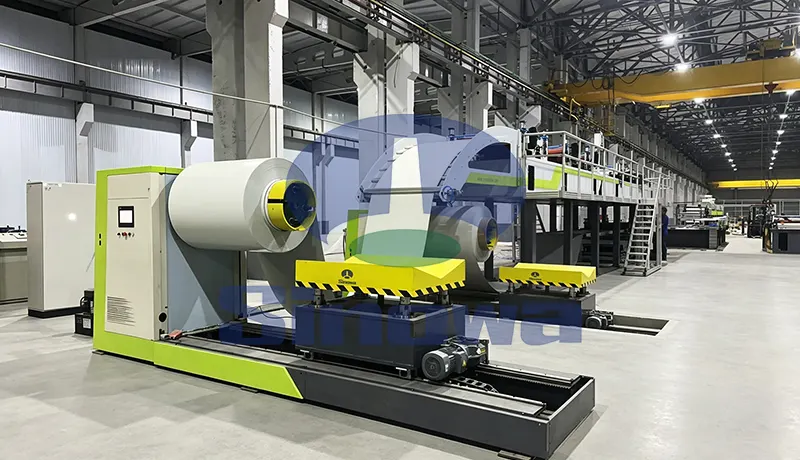
A reliable PU sandwich panel production line serves as the core equipment for manufacturing high-performance building insulation panels. This professional PU sandwich panel line features automated feeding, foaming and molding processes to ensure consistent panel thickness and structural stability. The well-designed polyurethane sandwich panel production line effectively improves production efficiency while reducing material waste in daily operation. Each calibrated polyurethane sandwich panel line can adapt to different panel sizes to meet diverse construction needs. With precise temperature and pressure control, the advanced continuous PU sandwich panel line produces panels with excellent thermal insulation and weather resistance. Meanwhile, the optimized PIR sandwich panel production line upgrades the foaming formula to enhance fire resistance performance. The high-efficiency PIR sandwich panel line maintains stable operation during long-term mass production, delivering durable and high-quality sandwich panels for various architectural and industrial applications.
-
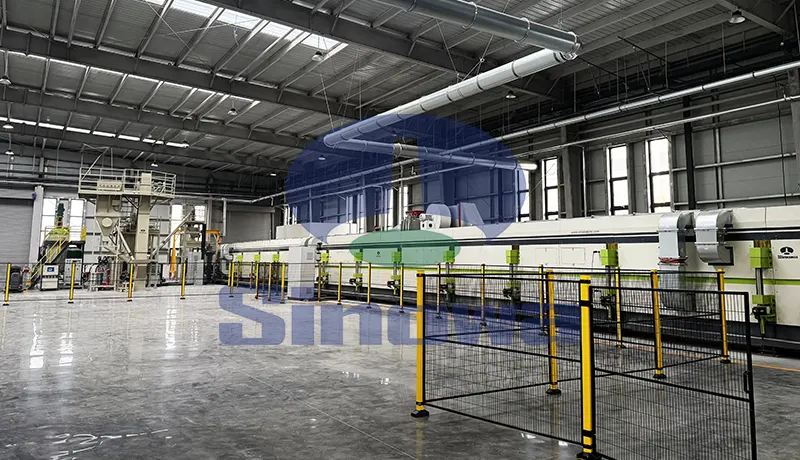
The phenolic panel production line realizes automated and continuous manufacturing of high-performance thermal insulation panels through streamlined and coordinated processing procedures.
-
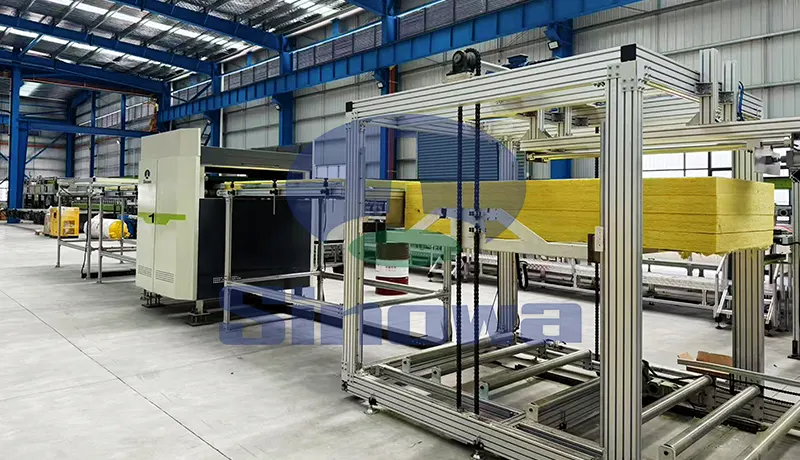
Modern insulation panel manufacturing relies on professional automated equipment to ensure stable product quality and high production efficiency. The rock wool sandwich panel production line features precise material lamination and forming processes to produce rigid, heat-insulating building panels. Meanwhile, the mineral wool sandwich panel production line adopts optimized assembly procedures to fabricate lightweight, soundproof panels widely used in architectural enclosure and thermal preservation projects.