PU Sandwich Panel Production Line Manufacturer
Publication Date: Oct 15, 2026
Professional PU Sandwich Panel Production Line Manufacturer. We supply fully automatic continuous PU/PIR sandwich panel machinery, custom turnkey lines, overseas installation & after-sales. Stable, high-efficiency equipment for insulated building panels.
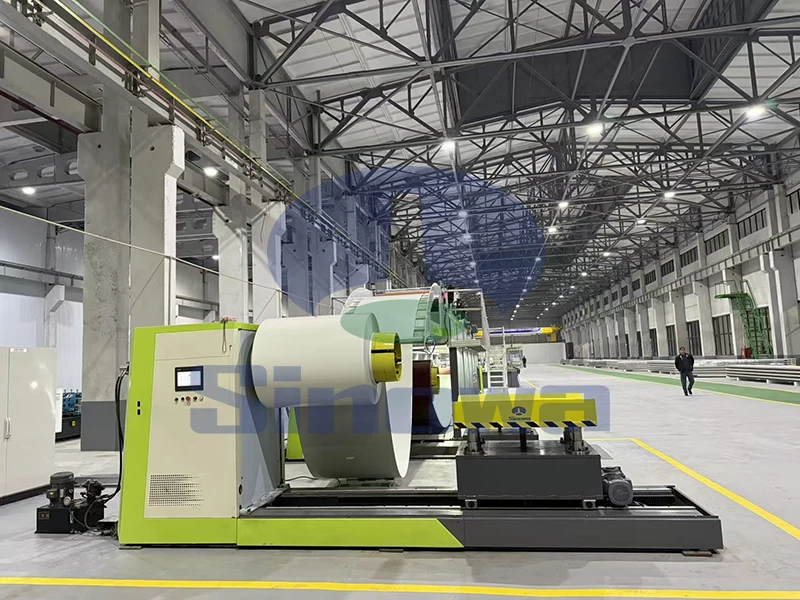
A PU sandwich panel production line manufacturer focuses on designing, assembling and fine-tuning fully integrated continuous manufacturing systems for composite insulated panels, combining mechanical transmission, fluid control, chemical foaming and intelligent automation into one cohesive industrial solution. Unlike general machinery suppliers, manufacturers in this field need deep understanding of both metal sheet processing and polyurethane foaming reactions, because minor deviations in raw material proportion, temperature or pressure can directly affect the uniformity, adhesion and long-term stability of finished panels. The development work starts with communication about production targets, panel dimensions, facing material options and layout limits inside the customer’s workshop. Every line is planned to match available floor space, material handling routes and expected throughput, avoiding unnecessary turns or bottlenecks that could interrupt continuous operation. Engineers evaluate how coil feeding, roll forming, preheating, foaming injection, double-belt pressing, curing and cutting stations connect with each other, ensuring stable synchronization across all segments. This stage also considers future expandability, allowing later upgrades to foaming units or control modules as market demand shifts. The manufacturer does not simply assemble off-the-shelf parts; critical components are selected and tested together to reduce vibration, maintain consistent speed and prevent leakage of reactive PU raw materials. Long before delivery, simulation runs are carried out to test workflow logic, adjust response speeds of sensors and verify the coordination between mechanical motion and chemical reaction timing. This holistic approach separates professional line builders from ordinary equipment traders, as they bear responsibility for system compatibility, on-site commissioning and long-term operational guidance rather than only supplying separate machine units. Customers gain not just a set of machines, but a complete production workflow tailored to their panel portfolio and operational goals, with support to stabilize output and reduce waste during daily manufacturing cycles.
The first functional zone of a continuous PU sandwich panel production system is the unwinding and surface pretreatment section, where facing materials are released from large coils and prepared for composite forming. Most commonly, metal coils are loaded onto unwinding racks, which hold heavy rolls and maintain steady tension as sheets feed forward. Stable tension control is essential, as slack or uneven pulling will create waves, wrinkles or dimensional deviation on the panel surface, which cannot be fully corrected in later forming steps. As the sheet moves forward, it goes through cleaning units that clear dust, oil residues and surface particles, because contaminants weaken the bonding interface between metal facings and PU foam core. Next comes roll forming, where a series of profiling rollers gradually bend and shape the flat sheet into wall or roof panel profiles, creating edge joints, grooves and overlapping structures needed for on-site installation. Each roller set is carefully aligned to avoid scratching coating layers, which protects the exterior finish of panels and preserves their resistance to weather exposure. Preheating modules follow profiling, gently raising the temperature of the metal surface to optimize PU foam adhesion when the reactive mixture is poured. Temperature must be kept within a narrow range; excessive heat accelerates foaming too quickly while insufficient heat leads to poor bonding and delamination risks. Sensors track sheet speed, surface temperature and tension in real time, sending data back to the central controller to make small automatic adjustments. This entire upstream segment operates continuously, feeding prepared upper and lower facings toward the foaming station without manual interruption. Good design in this area lowers scrap rates, reduces surface defects and lays a solid foundation for consistent panel quality in subsequent composite and curing processes.
The PU foaming and mixing station represents the technical heart of the whole production line, determining the cellular structure, density distribution and thermal performance of the finished sandwich panel. Two or more liquid raw materials are stored in insulated tanks, kept at stable temperature and continuously circulated to prevent sedimentation. Precision metering pumps deliver each component to the mixing head at accurately controlled flow rates, and high-pressure impact mixing combines the fluids into a homogeneous reactive blend within a very short time. Immediately after mixing, the liquid PU mixture is evenly distributed onto the lower facing sheet through a moving or fixed pouring device. The pouring pattern is carefully controlled to avoid excessive accumulation or bare gaps; uneven distribution causes voids, low-density areas or hard spots inside the foam core. Right after deposition, the upper facing sheet is brought into position, and the combined assembly enters the double-belt laminator. The upper and lower endless belts apply consistent clamping pressure and maintain a fixed gap to define the finished panel thickness, while the PU mixture expands and cures in the confined space between the two facings. The foaming reaction proceeds while the panel moves forward along the line, and the reaction rate is balanced against line travel speed. If foaming happens too fast, pressure may deform the metal facings; if too slow, foam cannot fully fill the cavity before the panel leaves the pressing zone. The manufacturer optimizes mixing head design, pump response and temperature control to adapt to different raw material formulations and production speeds. Operators can adjust key parameters through the central interface, modifying output density and foaming characteristics to produce panels suited for different application environments. This precise control over the chemical reaction is what enables continuous high-volume manufacturing of reliable insulated composite panels.
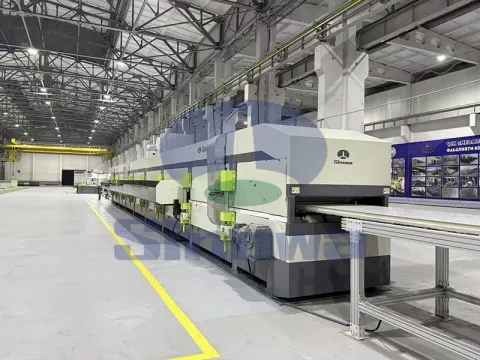
Following the foaming and laminating process, the newly formed PU sandwich panel enters the constant-temperature curing tunnel to complete cross-linking and solidification of the polyurethane core. Even though initial setting happens inside the double-belt press, full curing requires sustained thermal conditions over a set distance to stabilize foam structure and lock bonding strength between core and facings. The curing tunnel maintains a uniform thermal environment along its length, avoiding hot spots that could cause uneven shrinkage or internal stress within the panel. As the composite panel travels through the tunnel, internal chemical reactions continue gradually, and the foam gains mechanical rigidity without distortion. Line speed is matched to curing duration; faster production requires longer tunnel sections or refined thermal management to ensure full reaction before cutting. Sensors placed at multiple positions monitor ambient temperature and panel surface temperature, feeding information to the control system to adjust heating output automatically. During curing, the panel remains supported by conveying structures to prevent sagging or bending before the core gains enough rigidity. Poor curing leads to many hidden quality problems, such as later dimensional warping, reduced bonding strength and decline in thermal insulation performance after installation. Manufacturers spend considerable effort optimizing tunnel insulation and air circulation systems to keep energy consumption reasonable while maintaining stable thermal profiles. This intermediate stage is often underestimated, yet it directly influences long-term panel durability. Once the panel exits the curing section, the foam core has achieved most of its final mechanical properties and can proceed to trimming and cutting operations without deformation risk.
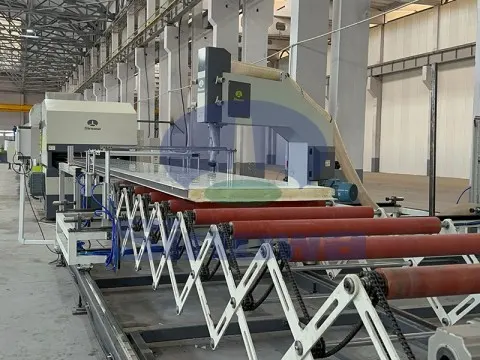
After curing, the continuous long panel moves into the cutting and edge trimming unit, where the endless strip is separated into finished panels of preset lengths and edge profiles. The cutting system uses flying saw technology, meaning the cutting carriage travels synchronously with the moving panel during cutting, eliminating the need to stop the whole line for separation. This synchronous cutting preserves continuous production rhythm and avoids productivity losses caused by intermittent start-stop cycles. Before cutting, length measurement devices track panel travel distance with high resolution, triggering the cutting action exactly when the target dimension is reached. Side trimming tools remove excess material along both edges to ensure uniform panel width and clean, straight edges for tight assembly when panels are installed on site. Trimming also removes areas where foam overflow or edge irregularities formed during lamination, improving the fit between adjacent panels and reducing thermal bridging at joints. All waste trimmings are collected automatically for separate handling, keeping the production area tidy and reducing manual cleanup work. After cutting, each individual panel is transported forward on support rollers while still warm, so a short cooling segment is included to bring surface temperature down before stacking. Operators can quickly change target panel length through the control interface, allowing the line to switch between product specifications without major mechanical adjustments. This flexibility is valuable for manufacturers that supply multiple panel sizes to different projects. Reliable cutting equipment maintains dimensional consistency across thousands of panels, which simplifies later installation and reduces rejection rates during final inspection before shipment.
Cooling and surface inspection form the next stage of the PU sandwich panel production workflow, acting as a quality checkpoint before finished products move to stacking. After cutting, panels retain residual heat from curing, and gradual cooling helps release internal stress built up during foaming and thermal treatment. Rapid uneven cooling can introduce subtle warping that only becomes visible after stacking or delivery, so the cooling conveyor provides enough time for slow, balanced temperature reduction across the whole panel cross-section. While panels pass through this zone, visual inspection stations allow operators or vision systems to check surface appearance, flatness, coating integrity and edge quality. Inspectors look for surface scratches, dents, bubbles, delamination marks or uneven edge cuts that may appear after forming. Minor cosmetic defects can be identified and separated immediately, while panels with structural issues are diverted from the finished product stream. Data about detected defects is logged to trace back to upstream process parameters, helping operators adjust foaming, tension or temperature settings to reduce recurrence. This feedback loop is a key part of stable production management. The manufacturer designs inspection zones with proper lighting and accessible viewing positions, making defect identification easier without slowing line throughput. Automated vision options can be integrated as an upgrade, capturing surface images and comparing them against reference conditions to spot subtle flaws that human eyes may miss during long shifts. Whether inspected manually or by digital systems, this step prevents non-conforming panels from reaching customers and supports continuous process improvement for the whole production plant.
Automatic stacking and handling systems take over after inspection, removing heavy finished PU sandwich panels from the conveyor and arranging them neatly into stacks ready for packaging and transport. Robotic or gantry stacking devices grip panels carefully with suction or mechanical holders to avoid damaging coated surfaces or sharp edges. The stacking sequence is programmed to place panels flat and aligned, maintaining uniform stack height and preventing sliding or tilting during storage. Separator materials can be inserted between panels upon request to protect surface finishes from friction marks. Once a stack reaches the preset quantity, the system transfers the full stack to an output station, and a new stack starts automatically. This automation greatly reduces manual handling work and lowers injury risks associated with lifting large, heavy composite panels. Stacking speed is synchronized with upstream cutting output, so finished panels do not pile up and block the conveyor. The manufacturer designs stacking modules to match the maximum panel dimensions and weight capacity defined in the project layout, and can adjust gripper travel range and stacking pattern according to customer requirements. After stacking, optional wrapping equipment applies protective film or stretch wrapping around the whole stack to shield panel surfaces from dust, moisture and minor abrasion during transportation and storage. Proper packaging preserves panel appearance until delivery to construction sites or fabrication workshops. This downstream automation improves overall plant efficiency, reduces labor demand and ensures orderly finished goods management without disrupting continuous line operation.
The central control and automation architecture serves as the nervous system connecting every module of the PU sandwich panel production line, enabling coordinated operation across unwinding, forming, foaming, curing, cutting and stacking. A human-machine interface allows operators to view real-time parameters including line speed, raw material flow rates, temperature readings, tension values and production counts. All key settings can be adjusted from this central station, and changes propagate to individual drive units, pumps and heating controllers instantly. The system stores production recipes for different panel types; switching between recipes loads preconfigured parameter sets for thickness, density, speed and temperature, cutting down changeover time between product runs. Safety interlocks protect the whole line: if a critical sensor detects abnormal pressure, material shortage or mechanical jam, the system triggers graded responses, reducing speed or stopping specific sections rather than causing sudden full-line shutdown that may damage materials or equipment. Historical operation and alarm data are recorded, supporting troubleshooting and performance analysis. When faults occur, diagnostic information points operators toward the affected area, shortening maintenance time. The manufacturer writes control logic specifically for continuous PU panel production, rather than using generic industrial control programs. Communication between controllers, sensors and drives is optimized to minimize signal delay, which is vital for synchronized actions such as flying saw cutting and oscillating foam pouring. Well-built control systems lower the skill barrier for operators, reduce human error and maintain consistent output quality across long production runs, forming one of the most valuable parts of the complete line solution.
Manufacturers of PU sandwich panel production lines deliver comprehensive technical support beyond machine fabrication and on-site installation, covering commissioning, operator training, maintenance guidance and ongoing technical consultation. After equipment arrives at the customer’s facility, field engineers supervise assembly, mechanical alignment, piping connection and electrical wiring, then carry out sequential single-unit tests before full line trial runs. During commissioning, raw materials are loaded, and trial panels are produced while parameters are fine-tuned step by step until stable qualified output is achieved. Operators receive hands-on training covering normal operation workflows, recipe management, routine inspection, lubrication schedules and safe shutdown procedures. Training also explains how to interpret alarm signals and perform simple troubleshooting, so small issues can be resolved without waiting for remote support. Preventive maintenance guidance outlines regular checks for pumps, seals, belts, sensors and drive systems, helping plant teams replace wearing parts before failure occurs. The manufacturer maintains supply channels for spare components, minimizing downtime when replacement is needed. Support teams can also provide remote assistance, reviewing production data and suggesting parameter adjustments when customers face quality fluctuations. This long-term service mindset differentiates professional line suppliers, as the performance of a PU panel plant depends heavily on correct operation and timely maintenance. The manufacturer’s goal is not only to hand over a working machine, but to help customers build stable, sustainable panel manufacturing capacity and respond flexibly to evolving market demands for insulated building components.
The global market for PU sandwich panels continues to expand, driving ongoing innovation among PU sandwich panel production line manufacturers to enhance equipment capability, operational efficiency and process adaptability. Rising demand for energy-efficient building envelopes, controlled-environment spaces and rapid modular construction pushes panel producers to seek machinery that can run steadily at higher throughput while maintaining consistent quality. Manufacturers respond by refining core systems: improving metering precision of foaming units, optimizing double-belt pressure distribution, upgrading sensor networks and enhancing energy efficiency of curing tunnels. New design options support a wider variety of facing materials and surface finishes, allowing production lines to make panels for diverse application scenarios. At the same time, equipment design focuses on reducing raw material waste, cutting foam overflow and minimizing energy use per square meter of finished panel. Modular construction of the production line becomes more common, so customers can start with a basic configuration and add extra functions gradually as business grows. This modular approach lowers initial investment pressure and improves the scalability of panel manufacturing plants. Manufacturers also keep exploring ways to simplify maintenance, reduce seal wear in high-pressure foaming circuits and extend service life of critical moving components. As end users require more versatile panel performance, line builders keep refining process flexibility, balancing production speed, operational cost and finished panel quality. The continuous evolution of PU sandwich panel production systems will remain closely tied to the development trends of modern construction and cold chain industries, where lightweight, high-performance insulated composite materials continue to replace traditional building solutions in many new projects around the world.
Gallery of PU Sandwich Panel Production Line
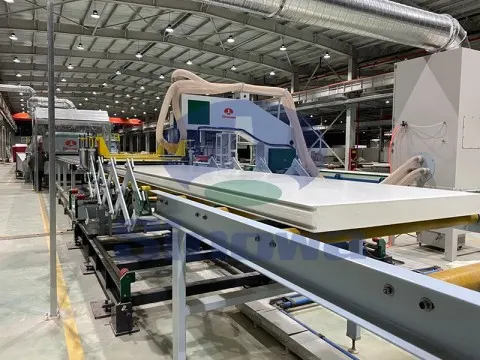
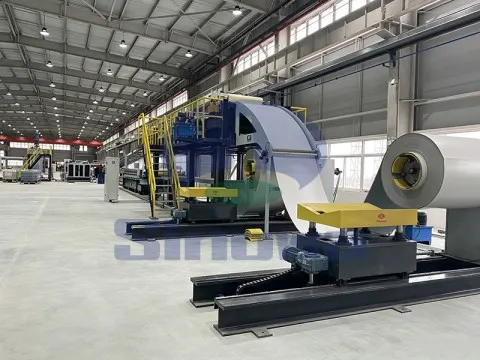
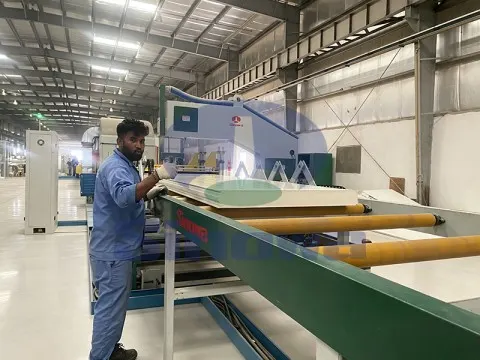
Tags: pu sandwich panel production line, pu sandwich panel production line manufacturer, pu sandwich panel production line supplier, china pu sandwich panel production line, pu sandwich panel production line for sale
-
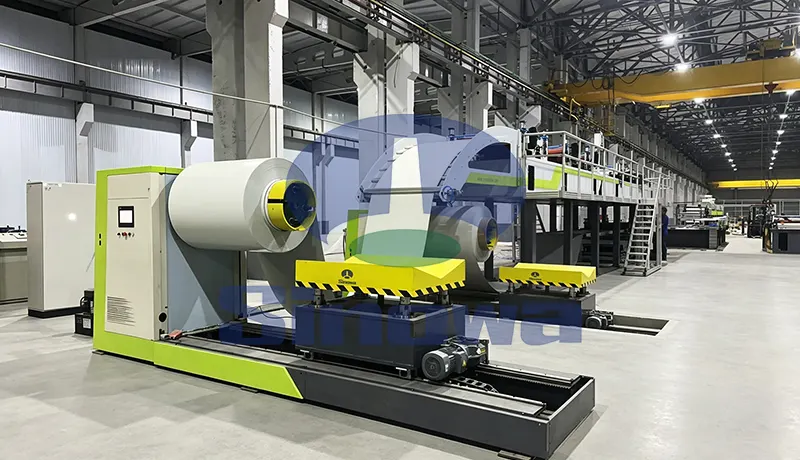
A reliable PU sandwich panel production line serves as the core equipment for manufacturing high-performance building insulation panels. This professional PU sandwich panel line features automated feeding, foaming and molding processes to ensure consistent panel thickness and structural stability. The well-designed polyurethane sandwich panel production line effectively improves production efficiency while reducing material waste in daily operation. Each calibrated polyurethane sandwich panel line can adapt to different panel sizes to meet diverse construction needs. With precise temperature and pressure control, the advanced continuous PU sandwich panel line produces panels with excellent thermal insulation and weather resistance. Meanwhile, the optimized PIR sandwich panel production line upgrades the foaming formula to enhance fire resistance performance. The high-efficiency PIR sandwich panel line maintains stable operation during long-term mass production, delivering durable and high-quality sandwich panels for various architectural and industrial applications.
-
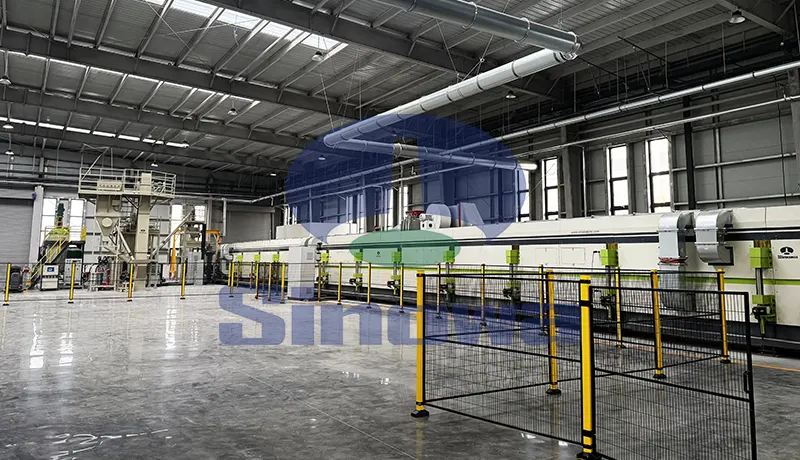
The phenolic panel production line realizes automated and continuous manufacturing of high-performance thermal insulation panels through streamlined and coordinated processing procedures.
-
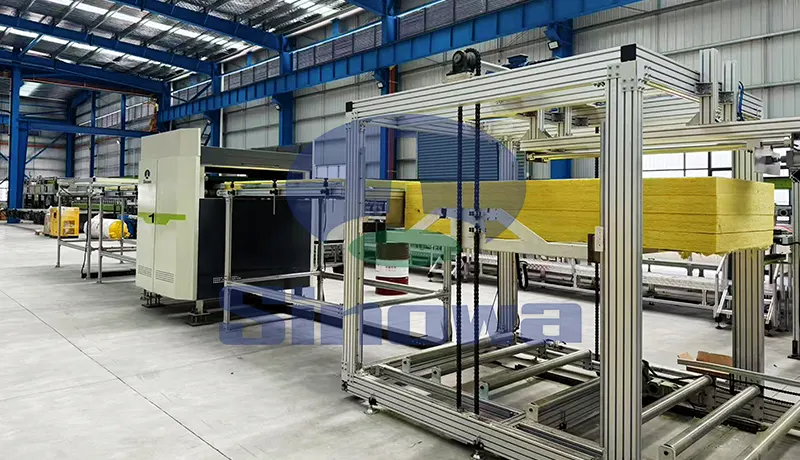
Modern insulation panel manufacturing relies on professional automated equipment to ensure stable product quality and high production efficiency. The rock wool sandwich panel production line features precise material lamination and forming processes to produce rigid, heat-insulating building panels. Meanwhile, the mineral wool sandwich panel production line adopts optimized assembly procedures to fabricate lightweight, soundproof panels widely used in architectural enclosure and thermal preservation projects.