What Leads To Surface Waviness On Panels Made By The Rockwool Panel Production Line?
Publication Date: Oct 9, 2026
Surface waviness on rockwool panels is a common production defect stemming from integrated issues in raw material uniformity, mechanical operation, thermal control, and lamination processes. Minor inconsistencies in each production link can accumulate and form irregular surface undulations on finished panels.
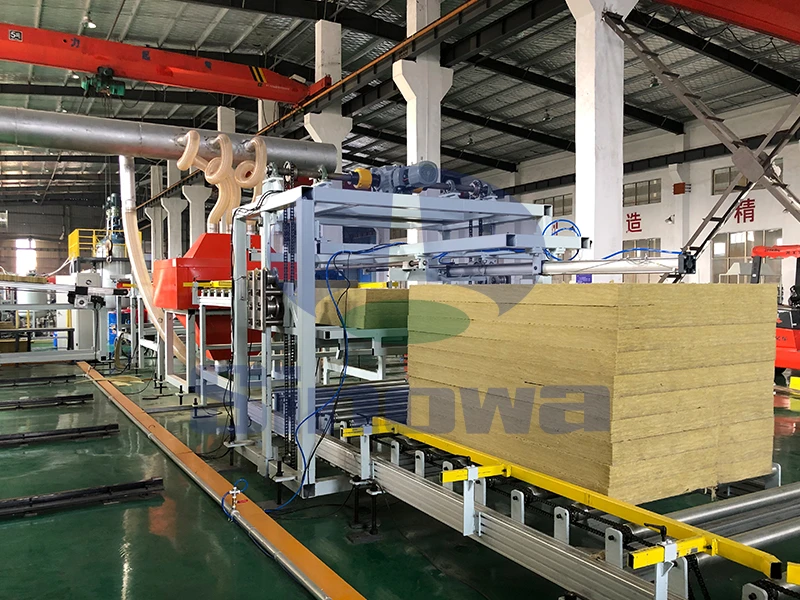
Uneven core density of rockwool materials serves as one of the most fundamental triggers for panel surface waviness during production. In the rockwool fiber forming stage, unstable airflow in the fiber collection chamber disrupts the uniform distribution of molten mineral fibers, leading to dense and sparse areas across the rockwool core. These density discrepancies create inconsistent compression resistance when the core undergoes lamination and pressing procedures. Denser sections withstand pressing force with minimal deformation, while sparser areas compress more easily, forming subtle height differences on the panel surface. Additionally, irregular binder spraying exacerbates this issue. Malfunctioning atomizer nozzles cause uneven binder coverage, resulting in inconsistent fiber bonding strength. Poorly bonded fiber regions shrink slightly during curing, further aggravating surface undulations that develop into visible waviness on finished panels.
Unstable metal skin tension during feeding and roll forming processes directly induces surface waviness on rockwool panels. The decoiler system, which releases metal skins for panel lamination, often causes tension deviations if its brake mechanism is improperly adjusted. An overly tight brake stretches one edge of the metal skin while leaving the other edge relaxed, creating asymmetric internal stress across the skin surface. When the tension-imbalanced metal skin adheres to the flat rockwool core, residual stress gradually releases after lamination, pulling the panel surface into wavy shapes. Moreover, misaligned roll forming stands disrupt the flatness of metal skins. Uneven height or offset positioning of forming rollers generates localized bending stress on the skin, leaving tiny undulations that expand and become prominent after full panel assembly and cooling.
Imbalanced pressure distribution in the laminator machine is a critical mechanical factor behind rockwool panel surface waviness. The lamination process requires uniform pressure across the entire panel area to bond metal skins and rockwool core tightly and evenly. Worn or unevenly adjusted pressing rollers create pressure gaps, where some panel sections receive excessive compression and others receive insufficient force. Over-pressed areas compress the rockwool core excessively and thin the local panel structure, while under-pressed sections retain thicker core layers. This uneven compression forms alternating high and low points on the panel surface. Long-term mechanical wear of laminator components, such as loose roller bearings and deformed pressing plates, further worsens pressure inconsistency, making surface waviness a recurring defect in continuous production batches.
Fluctuating production line operating speed causes inconsistent material forming and bonding, leading to panel surface waviness. Stable conveyor speed is essential for uniform fiber settlement, binder curing, and lamination bonding in rockwool panel production. Sudden speed increases or decreases disrupt the continuous forming rhythm of rockwool fibers, resulting in uneven core thickness along the panel length. When the line runs too fast, the binder does not have enough time to spread and cure evenly, leaving soft, uncured local areas in the core that deform easily under external pressure. Conversely, excessively slow speed causes over-compression of partial fiber layers, creating rigid thickened sections. These alternating soft and rigid core zones produce irregular surface undulations after metal skin lamination and final shaping.
Uneven thermal distribution in the curing oven significantly contributes to surface waviness of finished rockwool panels. The curing process relies on consistent temperature to solidify binders and stabilize the integrated structure of rockwool cores and metal skins. Asymmetric heating between upper and lower oven belts or localized hot and cold spots create uneven thermal expansion and contraction across the panel. Metal skins and rockwool cores have different thermal expansion coefficients, so inconsistent heating rates cause mismatched deformation degrees in different panel parts. After exiting the oven, uneven cooling further amplifies structural deformation. Parts cooled rapidly shrink faster than slowly cooled areas, generating internal structural stress that distorts the flat panel surface into wavy textures.
Conveyor belt operation abnormalities trigger structural unevenness and subsequent surface waviness on rockwool panels. Belt tracking deviation, a common operational fault, makes the conveyor belt shift sideways during continuous running, leading to asymmetric material bearing and extrusion. The offset belt causes uneven thickness formation on the transverse direction of rockwool cores, with one side thicker and the other thinner. Meanwhile, worn or deformed conveyor slats bend slightly under the weight of rockwool materials and high oven temperature, creating concave and convex supporting surfaces. The rockwool core forms corresponding shape deviations under uneven support, and these underlying structural flaws transfer to the panel surface after lamination, forming visible wavy defects that affect surface flatness.
Irregular adhesive application and uneven curing quality lead to localized bonding differences and panel surface waviness. Adhesive plays a vital role in integrating metal skins and rockwool cores into a unified structure. Insufficient or uneven adhesive coverage creates dry bonding spots where the skin and core fail to fit tightly, while excessive adhesive accumulates and forms thick glue layers in partial areas. These inconsistent bonding zones produce different structural rigidity across the panel. During curing, thick adhesive layers cure slowly and expand slightly, while dry spots lack effective bonding support and sink subtly. The mismatched curing deformation and bonding tightness create uneven stress distribution, ultimately distorting the panel surface and forming continuous wavy undulations along the production direction.
Raw material quality inconsistencies indirectly induce surface waviness in rockwool panels. Variations in raw mineral material melting uniformity lead to differences in rockwool fiber diameter and length. Thick and short fibers form dense, rigid core segments, while thin and long fibers create loose, flexible segments. This heterogeneous fiber structure results in uneven compression resilience across the core. When subjected to unified lamination pressure and thermal curing, different fiber areas produce varying deformation responses. In addition, damp raw materials introduce tiny moisture pockets inside the rockwool core. Moisture evaporates during high-temperature curing, forming micro voids that cause local structural shrinkage and surface depression, combining with rigid areas to form irregular wavy surfaces.
Mechanical vibration and equipment precision errors during continuous production aggravate rockwool panel surface waviness. Long-term operation of production line equipment causes loose components and unstable mechanical operation, generating persistent micro-vibrations. These vibrations disrupt the stable forming of rockwool fibers, leading to random thickness and density fluctuations in the core. Vibration also affects the flat feeding of metal skins, causing minor jitters and local wrinkling during roll forming. Moreover, precision errors in cutting and positioning equipment lead to asymmetric stress release at panel edges after cutting. Unbalanced edge stress pulls the panel surface slightly, exacerbating existing undulations and turning minor structural deviations into obvious surface waviness defects.
Insufficient daily maintenance and irregular parameter debugging amplify surface waviness issues in rockwool panel production. Many subtle equipment faults that cause waviness develop gradually due to neglected routine upkeep. Accumulated dirt and residue on rollers and conveyor belts create uneven contact surfaces that deform panel materials during processing. Unregular calibration of lamination pressure, oven temperature, and line speed parameters leads to long-term operational deviations instead of occasional errors. Without timely debugging, these cumulative parameter drifts and equipment abrasions form fixed defective production states, making surface waviness a persistent problem that affects the overall flatness and appearance quality of rockwool panel products.
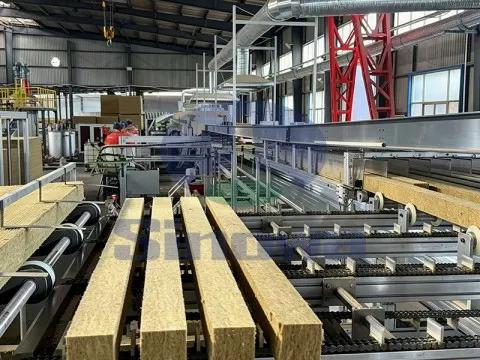
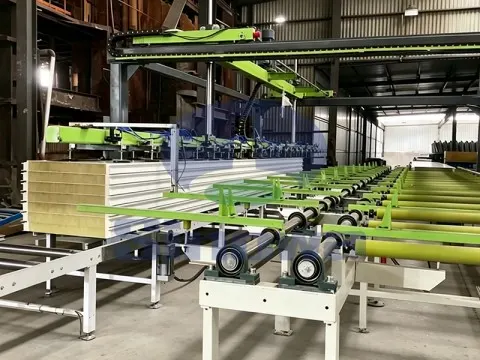
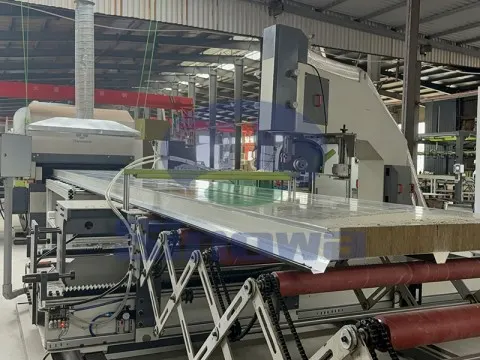
Gallery of Rockwool Panel Production Line
Tags: rockwool panel production line, rockwool panel production line manufacturer, rockwool panel production line supplier, china rockwool panel production line, rockwool panel production line for sale
-

A reliable PU sandwich panel production line serves as the core equipment for manufacturing high-performance building insulation panels. This professional PU sandwich panel line features automated feeding, foaming and molding processes to ensure consistent panel thickness and structural stability. The well-designed polyurethane sandwich panel production line effectively improves production efficiency while reducing material waste in daily operation. Each calibrated polyurethane sandwich panel line can adapt to different panel sizes to meet diverse construction needs. With precise temperature and pressure control, the advanced continuous PU sandwich panel line produces panels with excellent thermal insulation and weather resistance. Meanwhile, the optimized PIR sandwich panel production line upgrades the foaming formula to enhance fire resistance performance. The high-efficiency PIR sandwich panel line maintains stable operation during long-term mass production, delivering durable and high-quality sandwich panels for various architectural and industrial applications.
-

The phenolic panel production line realizes automated and continuous manufacturing of high-performance thermal insulation panels through streamlined and coordinated processing procedures.
-

Modern insulation panel manufacturing relies on professional automated equipment to ensure stable product quality and high production efficiency. The rock wool sandwich panel production line features precise material lamination and forming processes to produce rigid, heat-insulating building panels. Meanwhile, the mineral wool sandwich panel production line adopts optimized assembly procedures to fabricate lightweight, soundproof panels widely used in architectural enclosure and thermal preservation projects.