How To Fix Cutting Length Deviation Of The Fully Automatic Rockwool Board Production Line?
Publication Date: Oct 9, 2026
Cutting length deviation is a common operational flaw in fully automatic rockwool board production lines, undermining product uniformity and production efficiency.
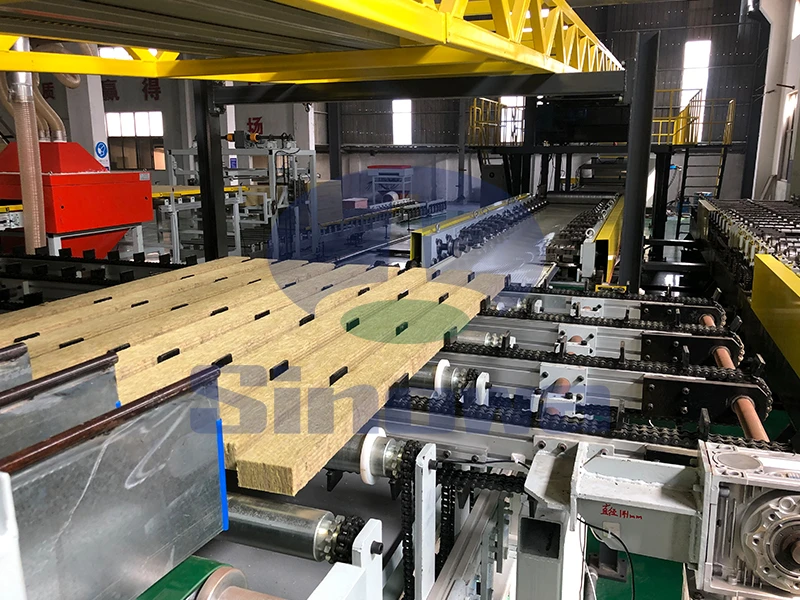
Length deviation in fully automatic rockwool board cutting processes mainly manifests as consistent over-cutting, under-cutting, or irregular length fluctuations in batch production, which directly affects product qualification rates and subsequent packaging and construction applications. Most deviation issues stem from the mismatch between mechanical operation, electrical signal transmission, material characteristics and parameter setting rather than single equipment failure. In actual production environments, long-term continuous operation will gradually wear key components, while unstable production parameters and improper daily maintenance will further amplify length errors. Before implementing targeted repairs, production operators need to conduct comprehensive real-time detection of cutting deviations, record error rules including fixed offset errors and random fluctuating errors, and distinguish accidental temporary deviations from persistent mechanical or electrical faults. This preliminary fault classification lays a solid foundation for accurate subsequent troubleshooting and avoids blind component replacement and parameter adjustment that may cause secondary production problems.
Encoder abnormality is the most prevalent cause of cutting length deviation in rockwool board production lines, as the encoder serves as the core measurement component for calculating material feeding distance. The encoder feeds real-time pulse signals to the PLC system, which converts pulse data into material travel length to trigger cutting actions. Long-term vibration of the production line often leads to loose encoder mounting brackets, causing slight shaft misalignment between the encoder and the feeding drive shaft. This misalignment results in missing or redundant pulse signals, making the PLC calculate inaccurate feeding lengths and generate fixed cutting deviations. In addition, encoder surface dust accumulation and internal component aging can weaken signal stability and cause random length fluctuations. To resolve this issue, operators should regularly inspect encoder mounting tightness, calibrate shaft coaxiality, clean surface dust and impurities, and replace aging encoders with unstable signal output in a timely manner to restore accurate length measurement.
Feeding system instability is another key factor inducing cutting length deviation, involving conveyor belt slippage, roller pressure imbalance and drive chain wear. Rockwool board materials have porous and flexible characteristics, making them prone to micro-deformation and relative sliding during high-speed continuous feeding. When the conveyor belt suffers from insufficient tension or surface wear, it cannot drive the rockwool board to move synchronously with the drive roller, resulting in actual feeding distance inconsistent with system calculated distance. Uneven pressure of upper and lower compression rollers will cause partial material compression deformation, leading to inconsistent feeding speed of different board areas and irregular length errors. Worn drive chains and sprockets will generate intermittent jitter during operation, disrupting uniform feeding rhythm. The effective solution is to adjust conveyor belt tension regularly, replace severely worn belts and chains, and calibrate roller pressure balance to ensure synchronous and stable material feeding throughout the production process.
Cutting execution delay and mechanical misalignment of the flying shear system will directly trigger rockwool board length deviation in automatic production lines. The flying shear device completes dynamic cutting in synchronous operation with the feeding system, and any response delay will change the actual cutting position. Hydraulic or pneumatic driving systems of the shear often produce response delays due to insufficient oil pressure, air pressure leakage or aging valve components, causing the cutting tool to act later than the system set time and form over-length products. Meanwhile, long-term reciprocating operation will cause slight displacement and inclination of the shear frame and tool rest, resulting in inconsistent cutting travel. Tool wear and blade gap abnormality will also cause material jamming during cutting, affecting feeding continuity and generating length errors. Maintenance personnel need to regularly check the driving pressure of the shear system, replace aging hydraulic and pneumatic accessories, calibrate shear frame horizontal alignment and tool stroke, and polish or replace worn blades to eliminate cutting execution errors.
Electrical signal interference and PLC parameter mismatching are important invisible causes of cutting length deviation in intelligent production lines. The automatic rockwool board production line integrates multiple electrical devices, and high-power operation of motors and frequency converters will generate electromagnetic interference, distorting encoder pulse signals and causing data transmission errors. Loose signal wiring terminals and aging transmission lines will also lead to intermittent signal interruption and data deviation during high-speed production. In addition, unreasonable PLC program parameter settings such as inappropriate cutting delay values and mismatched feeding speed calibration coefficients will cause systematic length errors. Operators can shield electromagnetic interference by optimizing wiring layout, fasten signal terminals and replace aging lines to ensure stable signal transmission. Meanwhile, it is necessary to recalibrate PLC feeding and cutting parameters according to actual production speed and material specifications to eliminate systematic offset errors.
Material self-characteristics and environmental factors can not be ignored in inducing rockwool board cutting length deviation. Rockwool boards have certain flexibility and compressibility, and their density and thickness uniformity will affect actual feeding and cutting effects. Loose material structure or uneven density will lead to different compression degrees during roller extrusion feeding, resulting in inconsistent effective feeding length. Changes in production environment temperature and humidity will also cause slight thermal expansion and contraction of rockwool materials and mechanical components, producing small cutting length deviations. Excessively high workshop humidity may also cause material surface dampness and increased friction, leading to feeding jitter. To reduce such deviations, production workshops need to maintain relatively stable temperature and humidity conditions, strictly control raw material quality uniformity, and appropriately adjust feeding pressure and cutting parameters according to real-time material status to adapt to material characteristic changes.
Improper daily operation and irregular equipment maintenance will gradually accumulate cutting length deviation problems in long-term production. Many production line operators adopt fixed parameter modes for long-time batch production without real-time adjustment according to equipment operation status, resulting in gradual accumulation of errors caused by component wear. Irregular equipment lubrication will increase friction resistance of transmission components such as gears and bearings, causing unstable feeding speed and cutting position offset. In addition, incomplete pre-production commissioning and lack of regular length calibration will make small deviations evolve into large-scale unqualified problems in batch production. Standardizing daily operation and maintenance processes is essential; operators need to conduct length calibration before starting each production shift, lubricate transmission components regularly, record equipment operation data, and adjust production parameters dynamically according to component wear status to prevent error accumulation.
Systematic parameter calibration and error offset adjustment are core steps to fix persistent cutting length deviation. After eliminating mechanical and electrical faults, most production lines still have fixed minor length offsets caused by long-term operation deviation accumulation. The production control system supports manual offset parameter adjustment, which can compensate for fixed over-cutting or under-cutting errors by modifying the cutting shift value. For consistent short-length products, positive offset values can be set to increase effective cutting length, while negative values can be used to reduce over-length errors. It is necessary to conduct multiple trial productions and sampling measurements during calibration, gradually adjust offset parameters in small ranges, and verify the stability of corrected length data through continuous batch production to avoid excessive parameter adjustment causing new deviations. This fine calibration can effectively eliminate systematic fixed errors and improve overall cutting accuracy.
Real-time monitoring and intelligent optimization of production operation can effectively avoid recurrent cutting length deviation. Traditional post-production error detection cannot solve real-time deviation problems in the production process, so installing real-time length monitoring modules on the production line is conducive to dynamic tracking of cutting product dimensions. The monitoring system can feed back length error data to the PLC in real time, and the control system can automatically fine-tune feeding speed and cutting delay parameters to realize closed-loop error correction. Meanwhile, establishing equipment operation and error data archives can help summarize deviation rules under different production speeds and material specifications, forming targeted parameter adjustment schemes. Long-term intelligent monitoring and data optimization can reduce manual adjustment errors and maintain long-term stable cutting accuracy of the production line.
Regular equipment overhaul and performance upgrading are fundamental measures to completely solve cutting length deviation of fully automatic rockwool board production lines. With the extension of equipment service life, core components such as encoders, transmission chains and shear systems will have performance attenuation that cannot be eliminated by simple parameter adjustment and daily maintenance. Regular comprehensive overhauls need to be arranged to disassemble, inspect and maintain key transmission and cutting components, replace aging and worn parts in batches, and restore original equipment operation accuracy. For old production lines with backward control systems, targeted upgrading of signal transmission modules and intelligent control units can improve the synchronization accuracy of feeding and cutting actions. Combining daily maintenance, regular calibration and periodic overhaul can form a full-cycle error prevention and control system, fundamentally reducing cutting length deviation and improving the overall operational stability and product qualification rate of the production line.
Tags: fully automatic rockwool board production line, fully automatic rockwool board production line manufacturer, fully automatic rockwool board production line supplier, china fully automatic rockwool board production line, fully automatic rockwool board production line for sale
-
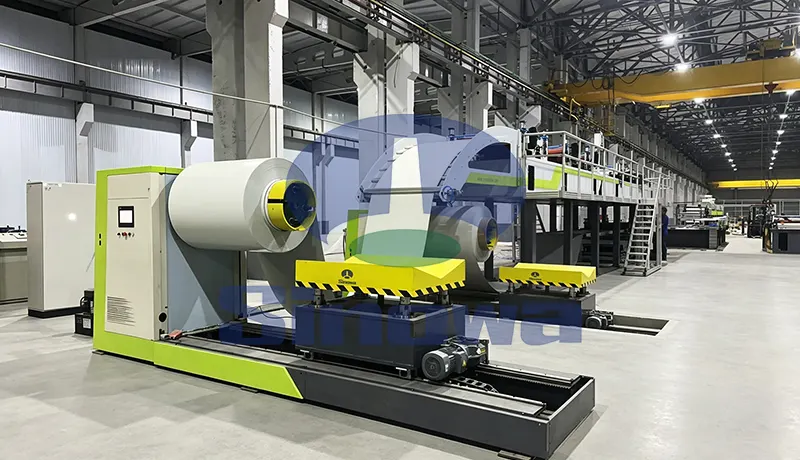
A reliable PU sandwich panel production line serves as the core equipment for manufacturing high-performance building insulation panels. This professional PU sandwich panel line features automated feeding, foaming and molding processes to ensure consistent panel thickness and structural stability. The well-designed polyurethane sandwich panel production line effectively improves production efficiency while reducing material waste in daily operation. Each calibrated polyurethane sandwich panel line can adapt to different panel sizes to meet diverse construction needs. With precise temperature and pressure control, the advanced continuous PU sandwich panel line produces panels with excellent thermal insulation and weather resistance. Meanwhile, the optimized PIR sandwich panel production line upgrades the foaming formula to enhance fire resistance performance. The high-efficiency PIR sandwich panel line maintains stable operation during long-term mass production, delivering durable and high-quality sandwich panels for various architectural and industrial applications.
-
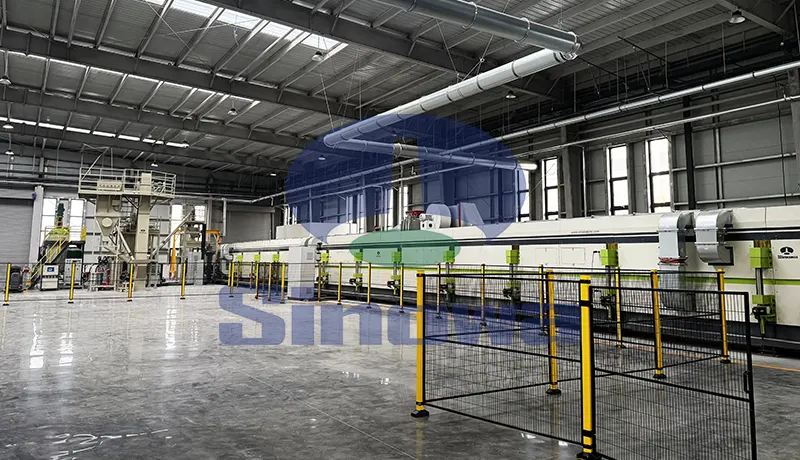
The phenolic panel production line realizes automated and continuous manufacturing of high-performance thermal insulation panels through streamlined and coordinated processing procedures.
-
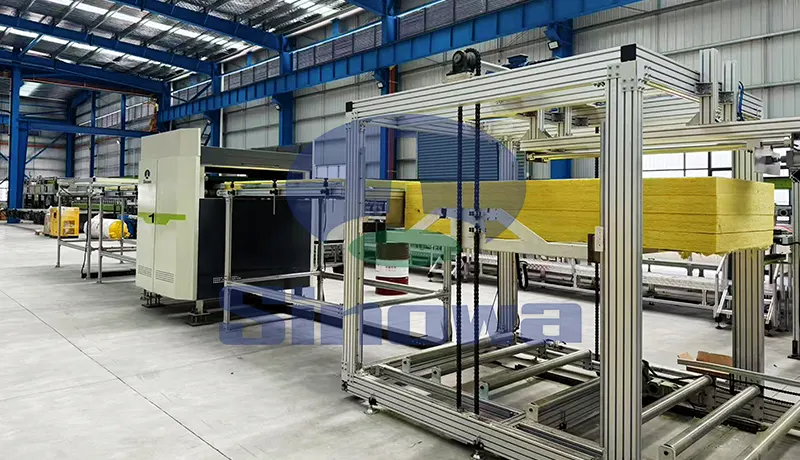
Modern insulation panel manufacturing relies on professional automated equipment to ensure stable product quality and high production efficiency. The rock wool sandwich panel production line features precise material lamination and forming processes to produce rigid, heat-insulating building panels. Meanwhile, the mineral wool sandwich panel production line adopts optimized assembly procedures to fabricate lightweight, soundproof panels widely used in architectural enclosure and thermal preservation projects.