What Are The Key Parameters Of PIR Sandwich Panel Line Operation?
Publication Date: Oct 7, 2026
PIR sandwich panel line operation relies on precise control of multiple core parameters to ensure stable production and qualified panel quality. These key indicators cover material proportioning, temperature, pressure, speed and forming status, jointly determining product performance and production efficiency.
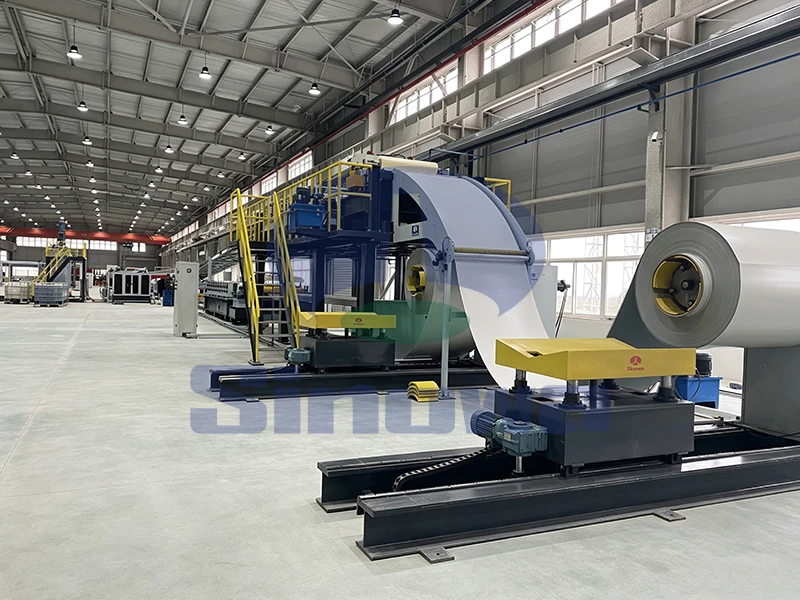
Material proportioning parameters stand as the foundational core of PIR sandwich panel line operation, directly governing the foaming quality and structural stability of PIR foam cores. The matching ratio between polyol and isocyanate is the most critical indicator in this link, as inappropriate proportioning will directly hinder complete polymerization reaction and lead to defective foam structures. Meanwhile, the feeding flow rate of raw materials needs real-time fine adjustment according to production status, keeping consistent material output per unit time to avoid uneven foam density. Stable proportioning ensures the PIR core forms uniform and compact cellular structures, which lays a solid foundation for the panel’s thermal insulation and mechanical properties. Any deviation in ratio or flow rate will cause local hollowing, softening or excessive hardness of the foam core, reducing the overall yield of finished panels.
Reaction temperature parameter control is essential for standardized PIR foam forming in continuous production. The ambient reaction temperature of raw materials needs to be maintained within a stable range to ensure the foaming and curing process proceeds stably. Too low temperature will slow down the molecular reaction speed, resulting in insufficient foam expansion and incomplete curing, making the panel core prone to deformation and poor adhesion. In contrast, excessive temperature will accelerate the reaction excessively, causing rapid foaming and premature surface curing, which easily forms internal voids and uneven cellular distribution. In actual line operation, temperature monitoring covers raw material preheating links and post-injection reaction environments, requiring real-time dynamic adjustment to adapt to different panel thickness specifications and production speeds, ensuring consistent reaction effects in each production cycle.
Injection pressure is a vital dynamic parameter affecting the uniformity and bonding effect of PIR raw material filling. Stable injection pressure ensures that mixed PIR raw materials can be evenly and fully filled between upper and lower metal skins without material overflow or local filling deficiency. Insufficient injection pressure will lead to incomplete material coverage, forming empty areas inside the sandwich panel and causing delamination between the core material and metal skins in subsequent use. Excessively high pressure will squeeze out excessive raw materials, resulting in material waste and irregular panel edge forming, increasing the difficulty of subsequent trimming processing. Operators need to adjust pressure parameters according to panel width and thickness, maintaining stable pressure output during continuous injection to ensure the consistency of filling effect for each batch of panels.
Production line running speed is a core parameter balancing production efficiency and product quality stability. The operating speed of the continuous PIR sandwich panel line needs to match the foaming curing cycle of PIR materials, realizing coordinated operation of rolling, material injection, composite forming and cutting links. Low running speed leads to prolonged material residence time, causing over-curing of foam cores and reduced toughness of finished panels. Excessively fast speed will make the materials fail to complete full foaming and effective bonding before entering the pressing and forming stage, resulting in weak structural adhesion and unstable product quality. Speed parameters need targeted adjustment according to different panel specifications, ensuring each production link completes processing procedures within a reasonable time window to achieve high-efficiency and high-quality continuous production.
Forming pressing pressure parameters determine the flatness, structural compactness and bonding firmness of finished PIR sandwich panels. The double-belt pressing system of the production line needs to maintain uniform and stable pressure in the continuous forming section to tightly fit the metal skins and PIR foam core without gaps. Unstable pressing pressure will cause uneven panel surface flatness, and local pressure deviation will lead to inconsistent core density, affecting the overall thermal insulation and compression resistance of the product. Reasonable pressure settings can eliminate tiny air bubbles generated during foaming, enhance the integration between the core material and metal layers, and avoid delamination and cracking problems in long-term use. In actual operation, pressure parameters need fine calibration according to panel thickness to adapt to different forming thickness requirements.
Forming temperature of the pressing section is a key auxiliary parameter for PIR material curing and composite forming. The constant temperature environment of the pressing belt promotes cross-linking and curing reactions of PIR foam materials, accelerating the integration of core materials and metal skins. Appropriate forming temperature can optimize the cellular structure of PIR foam, make the internal structure more uniform and dense, and improve the mechanical strength and thermal insulation performance of the panel. If the pressing temperature is too low, the curing speed will be slow, the bonding strength between layers will be insufficient, and the finished panel will be easy to peel off. Overly high temperature will cause thermal deformation of metal skins and excessive aging of foam materials, reducing the service life of the product. Stable and accurate temperature control in the pressing section ensures the consistency of panel forming quality in continuous production.
PIR core density control parameters are important indicators for evaluating finished panel quality, which are comprehensively affected by raw material proportioning, injection volume and foaming environment. Reasonable core density enables PIR sandwich panels to maintain excellent thermal insulation performance and lightweight structural characteristics, while ensuring sufficient compression and impact resistance. Too low core density will lead to loose internal foam structure, poor structural stability and reduced thermal insulation effect. Excessively high density will increase the overall weight of the panel, weaken its flexible application performance, and cause unnecessary material consumption. In line operation, density is controlled by linkage adjustment of feeding flow rate, injection pressure and foaming temperature, realizing stable density output for different types of panels.
Panel size precision parameters cover forming width, thickness and cutting length accuracy, reflecting the fine control level of the production line. The continuous rolling and forming system needs to keep stable width and thickness dimensions to avoid dimensional deviation of semi-finished panels in the moving process. The fixed-length cutting system relies on precise measurement and positioning parameters to ensure unified cutting dimensions of finished products. Dimensional parameter deviation will affect the on-site assembly effect of panels, and excessive thickness error will lead to inconsistent overall flatness of the building enclosure structure. In daily operation, it is necessary to regularly calibrate size measurement parameters and adjust forming limit positions to ensure the dimensional uniformity of each batch of finished panels.
Material curing dwell time parameters refer to the time panels stay in the constant temperature and pressure forming section, which is crucial for complete PIR material curing. Dwell time needs to match panel thickness and production speed, ensuring that thick panels obtain sufficient curing time to avoid internal uncured defects, while preventing thin panels from over-curing and performance degradation. Insufficient dwell time will result in incomplete molecular cross-linking of PIR materials, unstable product structure and easy quality changes in later use. Excessively long dwell time will reduce production efficiency and cause energy waste. Scientific dwell time parameter setting realizes the perfect balance between product quality and production efficiency in continuous cyclic production.
Linkage coordination parameters of the whole line ensure the synchronous and stable operation of each functional module including feeding, foaming, pressing, curing and cutting. All single parameters cannot work independently, and the coordinated matching of multiple parameters is the key to stable line operation. For example, the adjustment of production speed must be linked with injection volume, temperature and dwell time to avoid parameter mismatch leading to quality defects. Daily operation requires real-time monitoring of the linkage state of each module parameter, timely correcting parameter deviation caused by equipment operation fatigue and environmental changes. Good parameter linkage control can effectively reduce product defect rate, improve production continuity, and maintain long-term stable and efficient operation of the PIR sandwich panel production line.
Gallery of PIR Sandwich Panel Line






Tags: pir sandwich panel line, pir sandwich panel line manufacturer, pir sandwich panel line supplier, china pir sandwich panel line, pir sandwich panel line for sale
-

A reliable PU sandwich panel production line serves as the core equipment for manufacturing high-performance building insulation panels. This professional PU sandwich panel line features automated feeding, foaming and molding processes to ensure consistent panel thickness and structural stability. The well-designed polyurethane sandwich panel production line effectively improves production efficiency while reducing material waste in daily operation. Each calibrated polyurethane sandwich panel line can adapt to different panel sizes to meet diverse construction needs. With precise temperature and pressure control, the advanced continuous PU sandwich panel line produces panels with excellent thermal insulation and weather resistance. Meanwhile, the optimized PIR sandwich panel production line upgrades the foaming formula to enhance fire resistance performance. The high-efficiency PIR sandwich panel line maintains stable operation during long-term mass production, delivering durable and high-quality sandwich panels for various architectural and industrial applications.
-

The phenolic panel production line realizes automated and continuous manufacturing of high-performance thermal insulation panels through streamlined and coordinated processing procedures.
-

Modern insulation panel manufacturing relies on professional automated equipment to ensure stable product quality and high production efficiency. The rock wool sandwich panel production line features precise material lamination and forming processes to produce rigid, heat-insulating building panels. Meanwhile, the mineral wool sandwich panel production line adopts optimized assembly procedures to fabricate lightweight, soundproof panels widely used in architectural enclosure and thermal preservation projects.