Continuous PU Foam Panel Line
Publication Date: Nov 17, 2026
Continuous PU Foam Panel Line for automated PU/PIR sandwich panel production. High speed, stable foaming, adjustable thickness for cold room, roof & wall insulation panels. Turnkey solution available.
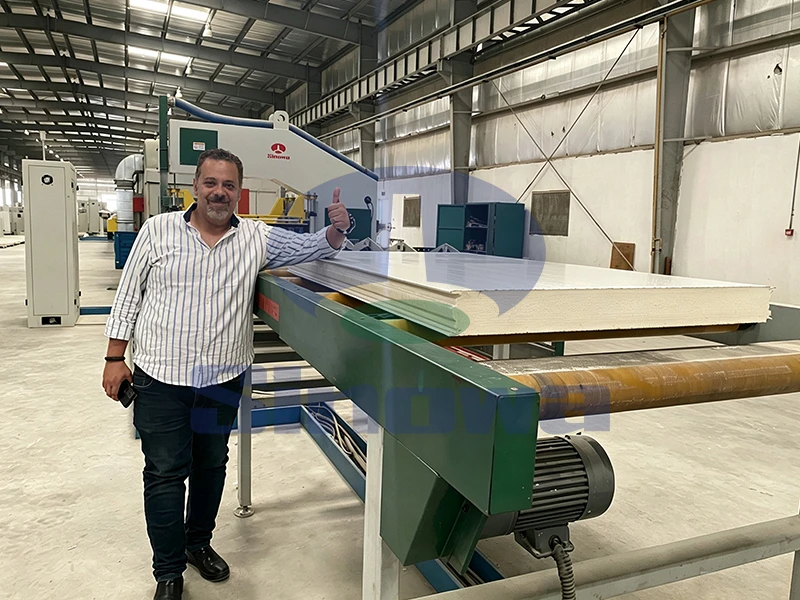
The Basic Definition and Working Logic of Continuous PU Foam Panel Line
A continuous PU foam panel line stands as an integrated, automated production system designed to fabricate rigid polyurethane foam sandwich panels in an uninterrupted running mode. Unlike batch-type production equipment that processes individual panels one by one and requires frequent manual intervention for feeding, foaming, curing and cutting, this continuous line connects all production stages into a closed, flowing workflow. The whole system is built around the chemical reaction characteristic of polyurethane raw materials: when polyol and isocyanate are mixed under controlled temperature, pressure and proportion, they rapidly foam, expand and solidify into a closed-cell foam core with stable thermal insulation performance. Before foaming starts, upper and lower surface facers are unwound and conveyed forward synchronously, which can be flexible rolls such as aluminum foil, color steel sheet, fiberglass mat or other decorative and protective substrates. As the facers move steadily along the conveyor track, mixed PU raw materials are evenly poured or sprayed onto the lower facer. After pouring, the upper facer is closed over the foaming mixture, and the combined materials enter a double-belt pressing and curing section. During this phase, the foam expands freely within the fixed thickness gap set by the pressing belts, bonds tightly with both upper and lower facers, and completes cross-linking curing to form an integrated sandwich structure. Every movement speed, material flow rate and temperature parameter is coordinated by the central control unit to avoid uneven foaming, poor bonding or core layer collapse. This fundamental working logic determines that the line focuses on stable continuous output rather than intermittent small-batch production, and it lays the foundation for consistent panel size, density and surface quality for long-duration production runs. Operators only need to monitor the running status and adjust process parameters instead of repeatedly loading and unloading semi-finished products, greatly reducing unstable factors brought by manual operation.
Raw Material Feeding and Metering System: The Foundation of Stable Foam Quality
The raw material feeding and metering module is the upstream heart of the continuous PU foam panel line, directly deciding the uniformity and physical performance of the PU foam core. The main raw materials stored in sealed storage tanks include polyol composite materials, isocyanate, and auxiliary additives such as catalysts, flame retardants and foam stabilizers. Each material tank is equipped with temperature maintaining and stirring devices, because the viscosity of PU raw materials changes significantly with temperature; too low temperature will increase fluid resistance and lead to inaccurate delivery, while excessive temperature may trigger premature local reaction inside the pipeline. High-precision metering pumps are used to transport each component separately, and the flow data of every pipeline is fed back to the central control system in real time. The system compares actual flow values with preset target values and automatically adjusts pump speed to keep the mixing ratio within a narrow and stable range. Any deviation of the mixing proportion will cause obvious defects: insufficient isocyanate may result in soft foam, slow curing and easy deformation of finished panels; excessive isocyanate can make the foam brittle, prone to cracking and reduce adhesion strength between foam and facers. After precise metering, different raw materials converge inside a high-speed mixing head. The mixing chamber of the mixing head adopts a special structural design to make multiple materials collide and shear fully in an instant, forming a homogeneous mixed liquid without local concentration difference. Once mixing is finished, the material is delivered to the distribution nozzle above the lower facer. The nozzle moves horizontally back and forth at a matched speed, spreading the mixed liquid evenly along the width direction of the facer, so that the thickness distribution of the foamed core after expansion remains consistent across the whole panel width. Regular maintenance of filters, sealing rings and pump detection sensors in this system is essential to prevent pipeline blockage, raw material leakage and metering drift during long continuous production cycles.
Facer Unwinding and Preprocessing Section for Sandwich Panels
Before composite molding, surface facers need to go through unwinding, tension control and simple surface preprocessing, and this section guarantees flatness and bonding reliability of the finished panel surface. Multiple unwinding stands are arranged at the front of the line to carry large roll facer materials. Each unwinding stand is fitted with an independent tension adjusting mechanism. If the tension is too loose, wrinkles, sagging and surface dislocation will appear on the facer during conveying; if the tension is too tight, the facer will stretch and deform, and rebound stress will cause panel warping after the foam core is cured. Tension sensors continuously collect stress data of the facer web, and servo motors automatically adjust the unwinding speed to maintain constant tension throughout the production process. After unwinding, the facer passes through a set of guiding rollers and deviation correction devices. The deviation correction system tracks the edge position of the facer in real time and fine-tunes the angle of guiding rollers to stop lateral deviation. Without effective deviation correction, the upper and lower facers will be misaligned, producing panels with irregular edges that cannot enter the subsequent cutting process. Some production configurations add surface preprocessing units here. For metal facers, a dust removal and degreasing unit removes oil stains, metal dust and floating impurities on the surface; for fiber mat facers, electrostatic elimination equipment reduces static adsorption of dust. These treatments improve the interface affinity between facers and PU foam. After preprocessing, the lower facer enters the horizontal conveyor, waiting to receive the mixed PU raw material from the pouring nozzle, while the upper facer is guided to the top of the pressing section, ready to close and cover the foaming material. The running speed of upper and lower facers must be fully synchronized with the material pouring speed and the speed of the double-belt curing machine, and speed mismatch is one of the common triggers for panel delamination and uneven core thickness.
Foaming, Pressing and Curing Process inside the Double-Belt Conveyor
The double-belt pressing and curing section is where the liquid PU mixture completes foaming expansion, composite bonding and chemical curing, which is the most critical forming stage of the continuous PU foam panel. After the mixed PU material is spread on the lower facer and covered by the upper facer, the whole layered assembly enters the gap between two circulating high-strength steel belts. The upper and lower steel belts are supported by dense rows of pressing rollers, and the gap distance between the two belts is locked according to the target panel thickness. This fixed gap limits the maximum expansion space of the PU foam, so that the finished panel can obtain precise and uniform thickness. The steel belts run at the same linear speed as the front facer conveying system, pulling the composite material forward steadily without relative sliding between belts and facers. Inside the closed curing channel, the temperature environment is precisely regulated. Moderate ambient temperature accelerates the cross-linking reaction of polyurethane, helping the foam complete expansion rapidly and form a fine and uniform closed-cell structure. If the curing temperature is too low, the foaming reaction slows down, the foam cannot reach the designed density, and the bonding strength between foam and facer declines; if the temperature is excessively high, the reaction proceeds too fast, generating a large amount of internal heat, which may cause foam scorching, coarse cell pores and internal voids. During expansion, the foaming material generates internal pressure, pressing the upper and lower facers closely against the steel belt surface. Under the combined action of pressure and chemical adhesion, the foam core and facers form an inseparable integrated structure instead of a simple stacked combination. The length of the double-belt channel determines the minimum curing time the panel can get. The material must stay inside the channel long enough to finish the main cross-linking reaction. When the composite exits the tail end of the double-belt machine, the foam core has gained sufficient structural rigidity and shape stability, and will not collapse or deform under its own weight in the follow-up process.
Online Traction, Continuous Cutting and Edge Trimming Module
After leaving the double-belt curing section, the semi-finished continuous panel strip enters the traction and cutting unit to be divided into finished panels of specified length and neat edge size. The traction machine uses a pair of clamping belts or rollers to grip the surface of the continuous panel and pull it forward at a speed matching the upstream production speed. The traction force needs to be controlled within a reasonable range. Excessive traction force will stretch the incompletely stabilized panel and change the core density and thickness; insufficient traction will cause material accumulation and arching between the curing section and cutting station. An online length measuring encoder tracks the moving distance of the panel strip in real time. When the accumulated length reaches the preset finished panel dimension, the cutting system is triggered automatically. Most continuous lines adopt flying saw cutting structure. The cutting saw moves synchronously with the running panel during cutting, so the panel does not need to stop and pause for cutting, which preserves the continuity of the whole production line. The saw blade runs at high speed to cut through the foam core and two layers of facers at one time, producing smooth cut end faces and reducing foam debris and powder. Next comes the edge trimming process. The two side edges of the continuous panel strip usually have uneven overflowing foam and irregular facer edges generated during foaming and pressing. Side trimming saws cut off redundant materials on both sides, ensuring that the width of each finished panel is consistent. The foam scraps and facer fragments produced by cutting and trimming are collected by a centralized suction system immediately. Timely waste collection prevents debris from falling back onto the panel surface, avoids scratching the facer, and also keeps the working area of the cutting station tidy. After cutting and trimming, individual independent panels are separated from the endless panel strip and transferred to the subsequent cooling and inspection station.
Post-Cooling, Surface Inspection and Defect Identification Workstation
Even after primary curing in the double-belt channel, the PU foam core still retains residual reaction heat inside. Therefore, a forced cooling workstation is arranged after cutting to slowly release internal heat and stabilize the internal stress of the panel. Panels are transported on a roller conveyor through the cooling area, where circulating air flows evenly over both upper and lower surfaces. Gradual cooling avoids rapid temperature difference. Sudden strong cooling will cause inconsistent shrinkage speed between the foam core and facers, inducing panel warping, camber and hidden delamination risks. The cooling duration is adjusted according to panel thickness and foam formula; thicker panels require longer cooling time to dissipate internal heat fully. After cooling, panels enter the manual and auxiliary online inspection station. Inspectors check the appearance quality of panel surfaces, observing for scratches, pits, wrinkles, facer offset, foaming voids, local shrinkage depressions and poor bonding gaps. Some production lines add simple visual detection cameras to assist screening: the camera captures surface images, and the control system compares images with standard samples to mark abnormal areas. Defective panels will be separately marked and diverted out of the normal conveying flow, while qualified panels continue moving forward. Inspection also includes random tactile and simple dimensional spot checks, verifying actual panel thickness, width and flatness. This link cannot eliminate all hidden long-term performance risks, but it can effectively block obvious appearance and forming defects before packaging. Stable inspection rhythm must coordinate with the production speed of the front line, so the conveying speed here will not be set too fast to leave enough observation time for inspectors.
Automatic Stacking, Packaging and Finished Product Output System
Qualified panels after inspection are delivered to the stacking and packaging section, which realizes orderly collection and protection of finished products before leaving the production area. The stacking manipulator or automatic stacking frame receives single panels from the roller conveyor. The stacking mechanism adjusts its posture according to the size of panels, placing each panel flat and aligned on the stacking pallet. A buffer interval is reserved between panels during stacking to prevent hard friction between facer surfaces that may scratch the decorative or protective coating. The stacking quantity is set according to the bearing limit of pallets and convenient handling requirements. Once one stack is completed, the pallet is automatically transferred to the packaging station. Packaging mainly serves for surface protection and dust prevention during storage and transportation. Stretch film winding equipment wraps the whole stack tightly, fixing panels together to avoid sliding and collision in transit. For some facer types that are sensitive to moisture or abrasion, additional protective edge caps are installed at four corners of the panel stack to prevent corner chipping. After packaging, the finished pallet is conveyed out of the production line area by roller or chain conveyor for storage in the finished goods zone. The whole stacking and packaging module reduces heavy repeated manual carrying work. Without automatic stacking, high continuous output of the front foaming line will easily cause panel backlog at the end of the line and block the whole production rhythm. The speed of stacking and packaging needs to match the cutting output rate; if the downstream stacking capacity is insufficient, the upstream line has to reduce running speed, lowering overall production efficiency.
Central Control System and Online Parameter Monitoring Platform
The central control system is the command hub of the entire continuous PU foam panel line, integrating data collection, parameter setting, running interlock and fault alarm functions. All core units of the line, including raw material metering pumps, mixing heads, unwinding tension controllers, double-belt speed motors, temperature modules, flying saw cutting equipment and stacking robots, connect to this control platform. Operators set target production parameters on the human-machine interface, such as panel thickness, production line speed, raw material mixing ratio, curing temperature and finished panel length. After parameter confirmation, the system distributes instructions to each executive component automatically and keeps all equipment running in coordination. Real-time data from every sensor is displayed on the screen continuously: raw material instantaneous flow, tank temperature, facer tension, steel belt speed, curing channel temperature, panel length counting and motor load. If any parameter deviates beyond the preset safe range, the system triggers graded alarms. Minor deviations trigger prompt messages for operators to adjust; serious abnormal conditions such as raw material interruption, belt deviation, motor overload or mixing head blockage activate interlock protection, slowing down or stopping the whole line to prevent large-area defective products or equipment damage. The system also records historical production data automatically, storing running parameters, alarm records and output volume for each production batch
Gallery of Continuous PU Foam Panel Line
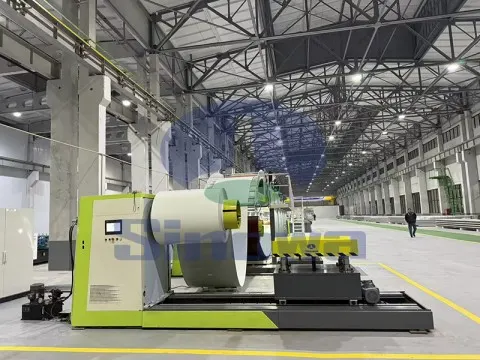
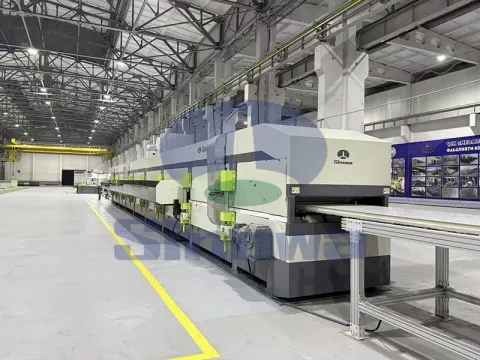
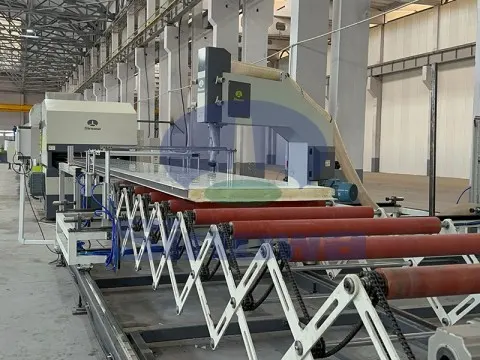
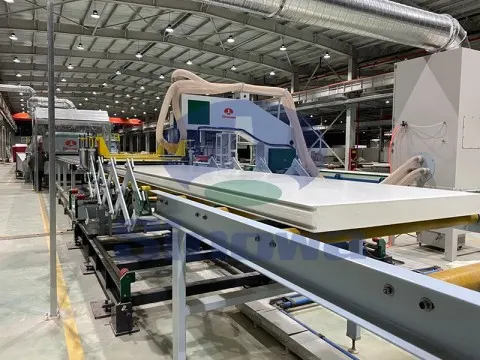
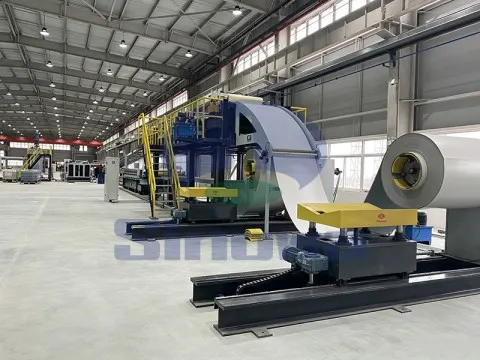
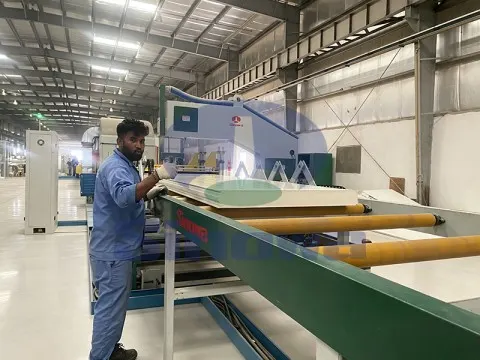
Tags: continuous pu foam panel line, continuous pu foam panel line manufacturer, continuous pu foam panel line supplier, china continuous pu foam panel line, continuous pu foam panel line for sale
-
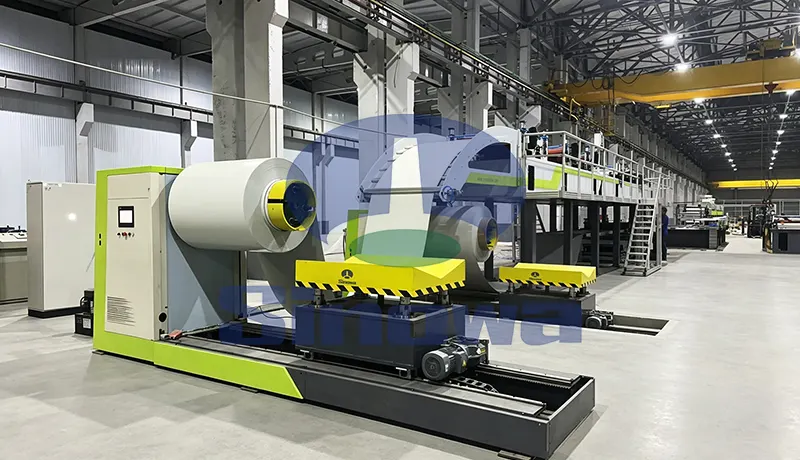
A reliable PU sandwich panel production line serves as the core equipment for manufacturing high-performance building insulation panels. This professional PU sandwich panel line features automated feeding, foaming and molding processes to ensure consistent panel thickness and structural stability. The well-designed polyurethane sandwich panel production line effectively improves production efficiency while reducing material waste in daily operation. Each calibrated polyurethane sandwich panel line can adapt to different panel sizes to meet diverse construction needs. With precise temperature and pressure control, the advanced continuous PU sandwich panel line produces panels with excellent thermal insulation and weather resistance. Meanwhile, the optimized PIR sandwich panel production line upgrades the foaming formula to enhance fire resistance performance. The high-efficiency PIR sandwich panel line maintains stable operation during long-term mass production, delivering durable and high-quality sandwich panels for various architectural and industrial applications.
-
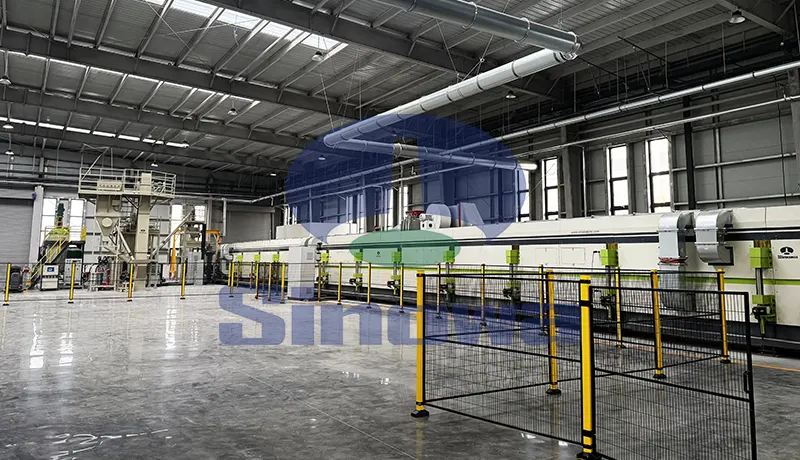
The phenolic panel production line realizes automated and continuous manufacturing of high-performance thermal insulation panels through streamlined and coordinated processing procedures.
-
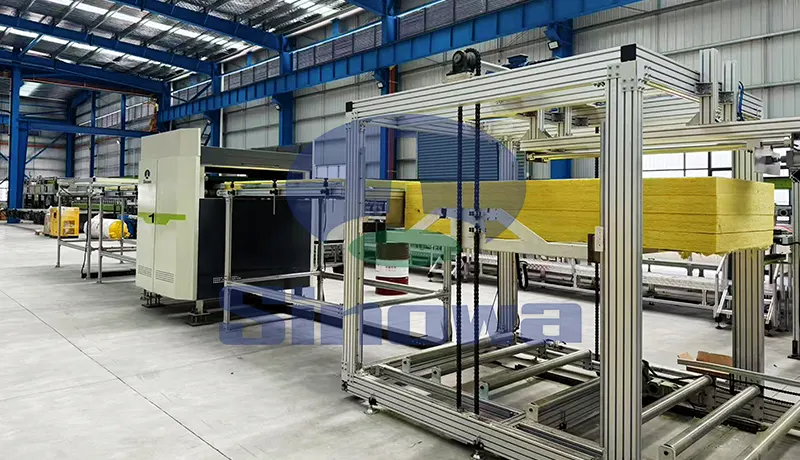
Modern insulation panel manufacturing relies on professional automated equipment to ensure stable product quality and high production efficiency. The rock wool sandwich panel production line features precise material lamination and forming processes to produce rigid, heat-insulating building panels. Meanwhile, the mineral wool sandwich panel production line adopts optimized assembly procedures to fabricate lightweight, soundproof panels widely used in architectural enclosure and thermal preservation projects.