Industrial Workshop Sandwich Panel Line
Publication Date: Oct 12, 2026
The industrial workshop sandwich panel line is an integrated automated production system for manufacturing insulated composite panels. It integrates multiple functional modules to complete continuous forming, bonding, curing and cutting, supporting efficient production of workshop enclosure and thermal insulation panels.
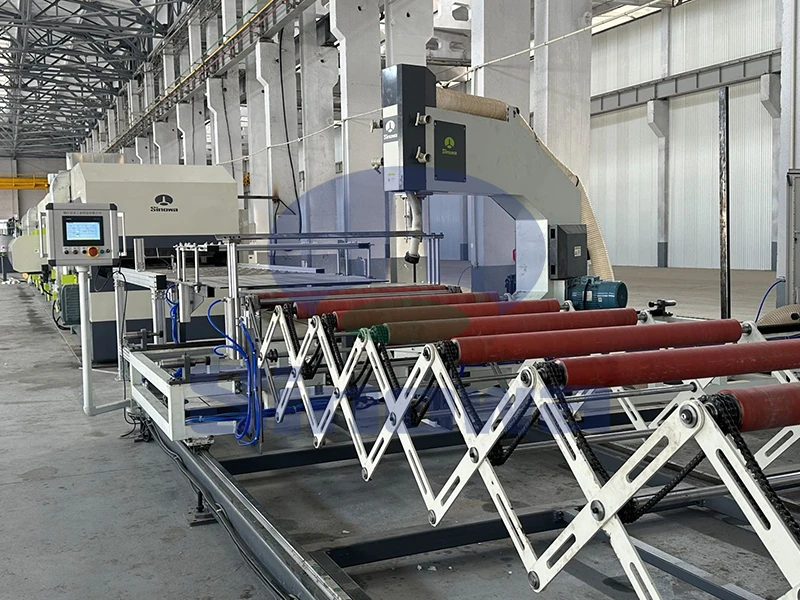
The industrial workshop sandwich panel line serves as a core automated manufacturing system dedicated to producing high-performance composite panels widely used in industrial plant construction, warehouse enclosure, and factory interior partition projects. Unlike discrete processing equipment, this production line adopts a fully connected modular structure, where every functional unit operates in synchronous coordination to realize uninterrupted continuous production. Each component of the line undertakes specialized processing tasks, from raw material input and surface material treatment to core material compounding and final product shaping. The overall operational logic focuses on stabilizing product consistency, optimizing production efficiency, and reducing manual intervention throughout the manufacturing workflow. It adapts to diversified production demands for different panel thicknesses, core materials and surface specifications, making it a foundational equipment solution for modern industrial building material production. Through standardized and streamlined mechanical operation, the line effectively improves the overall structural stability and thermal insulation performance of finished panels, meeting the practical application needs of various industrial workshop scenarios.
Raw material feeding and pretreatment constitute the initial and fundamental stage of the entire sandwich panel production workflow, laying a solid foundation for subsequent composite processing. The line is equipped with automatic unwinding units specially designed for metal surface materials, which can stably release coiled metal raw materials and maintain uniform feeding speed and tension. This tension control function avoids material deformation, wrinkling or offset during the unwinding process, ensuring the flatness of metal surface sheets. Meanwhile, supporting leveling and deviation correction devices continuously adjust the material transmission track to eliminate position errors caused by long-term operation. In addition to surface material processing, the pretreatment module also includes simple surface cleaning and preheating treatment, removing surface attachments and stabilizing the physical state of metal materials. This series of pretreatment operations enhances the adhesion between metal surface layers and intermediate core materials, preventing delamination and bonding failure of finished panels in subsequent use, and greatly improving the overall yield of production.
Roll forming processing is a key link that shapes the geometric structure of sandwich panel surface layers. After completing pretreatment, the flat metal sheets are automatically sent to the roll forming unit composed of multiple groups of precision rolling dies. The rolling dies are arranged in an orderly gradient structure, which gradually bends and shapes the flat metal plates into the required roof or wall panel profiles through continuous mechanical extrusion. The modular die design allows flexible adjustment of forming specifications, enabling the production line to switch between different panel shapes and structural styles without complex part replacement. During the forming process, the mechanical pressure and rolling speed are precisely controlled to ensure uniform stress on all parts of the metal sheet, avoiding local deformation, cracking or uneven radian. The whole forming process is completed automatically with high molding accuracy and good profile consistency, which ensures that the surface size and structure of each batch of panels remain unified, providing qualified surface layer components for later composite bonding processing.
Core material arrangement and distribution directly determine the thermal insulation, fireproof and shock absorption performance of finished sandwich panels. The production line supports the feeding and laying of various common industrial insulation core materials, with automatic cutting, sorting and paving functions integrated in the core material processing module. Bulk or block core materials are precisely cut into uniform specifications according to preset panel thickness parameters, and then evenly laid between the upper and lower metal surface layers through automatic conveying and spreading devices. The system strictly controls the laying density and coverage area of core materials to avoid empty gaps, local accumulation or sparse distribution. Uniform core material arrangement ensures that every part of the panel has consistent thermal insulation and structural buffering performance. Meanwhile, the synchronous operation of core material feeding and surface material transmission realizes seamless docking of front and rear processes, avoiding production stagnation caused by material docking errors and ensuring the continuity of the overall production rhythm.
Gluing and composite lamination are the core processes to realize the integrated structure of sandwich panels. The production line is equipped with an automatic quantitative gluing system, which evenly coats high-performance adhesive on the inner surfaces of upper and lower metal sheets in a fixed proportion. The intelligent gluing control unit adjusts the glue amount and coating range according to different panel specifications and core material types, ensuring moderate glue thickness without overflow or missing coating. After gluing, the surface materials and core materials enter the composite lamination area synchronously, where stable and uniform mechanical pressure is applied through upper and lower pressing structures. This pressure enables the adhesive layer to fully infiltrate the contact surface of core materials and metal sheets, achieving tight fitting between all structural layers. The lamination process maintains stable pressure and transmission speed, ensuring that the composite structure of each panel is compact and uniform, effectively enhancing the overall structural firmness and service durability of the finished product.
Constant temperature curing and shaping processes are essential to stabilize the structural performance of composite panels. After lamination, the semi-finished panels are sent to the closed constant temperature curing channel for continuous heat preservation and curing treatment. The internal temperature of the curing area is kept in a stable range through intelligent temperature control components, creating a constant thermal environment required for adhesive solidification. Under the action of constant temperature, the adhesive undergoes full chemical curing reaction, forming a high-strength bonding structure to permanently integrate the metal surface layers and core material into a whole. The curing channel is matched with a synchronous transmission system to ensure that each panel stays in the constant temperature environment for the same duration, avoiding performance differences caused by inconsistent curing time. After curing, the panels complete preliminary structural shaping, with stable overall hardness and bonding strength, and their basic structural performance can meet the use requirements of industrial workshop environments.
Cooling and fine shaping procedures further optimize the flatness and structural stability of cured panels. High-temperature semi-finished panels after curing will generate tiny internal stress and slight surface deformation due to thermal expansion and contraction. The independent cooling module of the production line adopts natural air cooling and auxiliary uniform heat dissipation mode to slowly reduce the panel temperature to room temperature. This gradual cooling method effectively releases internal structural stress and avoids panel warping, bending or surface unevenness caused by rapid temperature change. In the fine shaping stage, precision flattening and trimming devices perform secondary calibration on the overall flatness and edge structure of the panels. Slight structural deviations generated in the previous processes are corrected in real time, ensuring that the overall flatness and edge regularity of the panels reach a high standard, and laying a good foundation for subsequent fixed-length cutting and finished product finishing.
Fixed-length cutting and edge finishing are the key final processing steps for panel sizing and appearance optimization. According to customized production parameters, the intelligent control system sets the cutting length accurately, and the high-precision cutting device automatically completes fixed-size cutting of continuous long-strip panels. The cutting equipment runs stably with neat and smooth cutting sections, without burrs, collapses or uneven notches. After cutting, the edge finishing unit conducts trimming, deburring and dust removal treatment on the four sides of the panels. Residual core material debris and metal burrs on the cutting edges are thoroughly cleaned to make the panel edges smooth and regular. This series of finishing operations not only improves the appearance quality of finished panels but also eliminates potential installation obstacles, ensuring that the panels can be closely assembled during on-site construction and improving the overall installation effect and sealing performance of industrial workshop enclosure structures.
Automatic stacking and finished product output realize the efficient collection and orderly arrangement of qualified panels. After completing all processing and finishing procedures, qualified sandwich panels are automatically transmitted to the stacking area through the conveying system. The intelligent stacking device adopts mechanical automatic grabbing and stacking modes, which can neatly stack panels according to fixed layers and specifications. The stacking process runs stably without collision, extrusion or surface scratching of panels, effectively protecting the finished product quality. The system can adjust stacking quantity and arrangement mode according to production batches and transportation requirements, realizing standardized collection of finished products. The automated stacking function replaces traditional manual handling and arrangement, greatly improving production efficiency, reducing labor investment and avoiding product damage and quality errors caused by manual operation.
Intelligent control and daily maintenance management ensure the long-term stable and efficient operation of the entire production line. The whole production process is centrally controlled by an integrated intelligent system, which can set, adjust and monitor all process parameters such as feeding speed, forming pressure, curing temperature and cutting size in real time. The system has automatic error detection and abnormal alarm functions, which can identify equipment operation deviations and process abnormalities in time, helping operators quickly troubleshoot problems. In terms of daily maintenance, the modular design of the production line facilitates daily inspection, lubrication and component replacement of key parts. Regular standardized maintenance can effectively reduce equipment failure rate, prolong the service life of mechanical components, and maintain long-term consistent production accuracy and efficiency. Stable system operation and standardized maintenance management guarantee continuous and high-quality output of sandwich panels for industrial workshop construction.
Gallery of Industrial Workshop Sandwich Panel Line






Tags: industrial workshop sandwich panel line, industrial workshop sandwich panel line manufacturer, industrial workshop sandwich panel line supplier, china industrial workshop sandwich panel line, industrial workshop sandwich panel line for sale
https://www.sandwichpanelmanufacturingline.com/blog/industrial-workshop-sandwich-panel-line.html
-

A reliable PU sandwich panel production line serves as the core equipment for manufacturing high-performance building insulation panels. This professional PU sandwich panel line features automated feeding, foaming and molding processes to ensure consistent panel thickness and structural stability. The well-designed polyurethane sandwich panel production line effectively improves production efficiency while reducing material waste in daily operation. Each calibrated polyurethane sandwich panel line can adapt to different panel sizes to meet diverse construction needs. With precise temperature and pressure control, the advanced continuous PU sandwich panel line produces panels with excellent thermal insulation and weather resistance. Meanwhile, the optimized PIR sandwich panel production line upgrades the foaming formula to enhance fire resistance performance. The high-efficiency PIR sandwich panel line maintains stable operation during long-term mass production, delivering durable and high-quality sandwich panels for various architectural and industrial applications.
-

The phenolic panel production line realizes automated and continuous manufacturing of high-performance thermal insulation panels through streamlined and coordinated processing procedures.
-

Modern insulation panel manufacturing relies on professional automated equipment to ensure stable product quality and high production efficiency. The rock wool sandwich panel production line features precise material lamination and forming processes to produce rigid, heat-insulating building panels. Meanwhile, the mineral wool sandwich panel production line adopts optimized assembly procedures to fabricate lightweight, soundproof panels widely used in architectural enclosure and thermal preservation projects.