HVAC Phenolic Duct Board Production Line
Publication Date: Oct 12, 2026
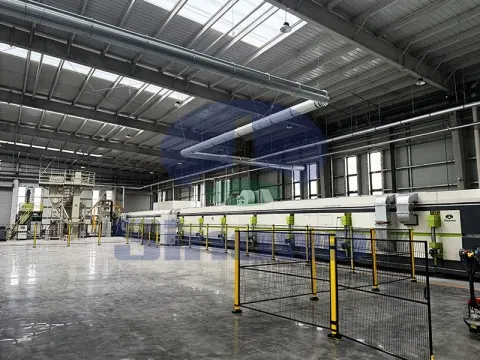
The HVAC phenolic duct board production line is an integrated automated system dedicated to manufacturing high-performance pre-insulated duct panels. It covers full processing procedures from raw material blending to finished product shaping, delivering durable, energy-efficient duct boards for building ventilation systems.
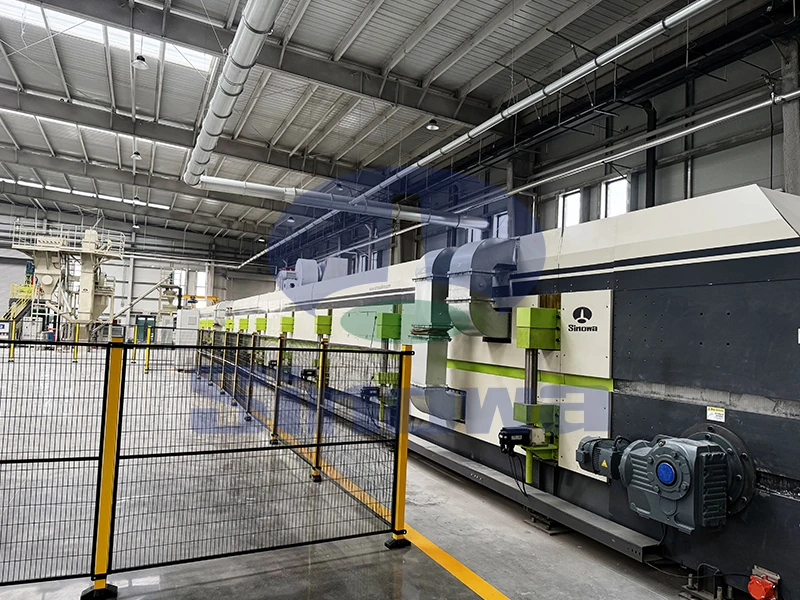
The core foundation of the HVAC phenolic duct board production line lies in precise raw material selection and scientific proportioning, which directly determines the basic performance of finished duct boards. The main raw materials include phenolic resin foam as the core insulating layer and flexible protective facing materials attached to both sides. The foam core is chosen for its excellent thermal insulation and flame-retardant properties, while the surface facings enhance structural stability and anti-corrosion ability. Before formal production, all raw materials undergo strict screening to eliminate impure and unqualified materials that may affect product quality. The production line is equipped with automatic batching modules that accurately adjust the ratio of various raw components according to preset production parameters. This automated proportioning mode effectively avoids manual measurement errors, ensures consistent material composition for each batch of products, and lays a stable foundation for subsequent foaming and composite molding processes.
Raw material mixing and pre-treatment is the first key operational link of the entire production line, undertaking the task of homogenizing all prepared raw materials. The automated mixing system adopts closed stirring equipment to fully blend phenolic resin, curing agents, foaming agents and auxiliary additives. During the mixing process, the system precisely controls stirring speed, mixing duration and internal temperature to ensure uniform fusion of all components without local agglomeration or uneven distribution. After mixing, the raw material mixture enters a temporary constant-temperature storage tank to maintain stable fluidity and activity, which is essential for uniform foaming in the next stage. Meanwhile, the surface facing materials go through pre-treatment processes such as flattening and dust removal to remove surface wrinkles and impurities, ensuring tight adhesion between the facing and foam core in subsequent composite processing.
Continuous foaming and laying molding is the core process that shapes the basic structure of phenolic duct boards. The uniformly mixed phenolic raw material is evenly sprayed and laid on the flattened lower facing material through an automatic quantitative spreading device. The production line adopts a continuous linear operation mode, where the raw material layer forms a uniform foam structure through controlled foaming reaction under constant temperature and pressure environments. As the production proceeds steadily, the upper protective facing material is automatically covered on the surface of the newly formed phenolic foam layer, forming a complete three-layer composite structure with upper and lower protective layers and a middle insulating foam core. This one-step composite molding process realizes synchronous foaming and lamination, effectively improving the structural integrity of the duct board and avoiding delamination problems that often occur in secondary processing.
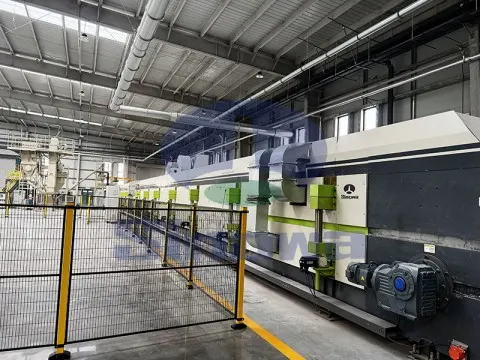
Constant-temperature curing and shaping is a critical process to stabilize the physical structure of composite duct boards. After completing the three-layer composite lamination, the semi-finished board is continuously conveyed into an independent curing channel with adjustable internal temperature. The closed curing environment provides stable thermal conditions to promote thorough curing reaction of the phenolic foam core and enhance the bonding strength between the foam core and surface facings. The curing duration and temperature are dynamically adjusted according to the thickness and density of the duct board to ensure full curing without overheating deformation. During the curing process, the board is kept in a flat conveying state with uniform pressure constraint, which effectively prevents warping, bending and surface unevenness. After full curing, the duct board forms stable hardness, toughness and overall structural rigidity, meeting the basic mechanical requirements for subsequent cutting and processing.
Precision fixed-length cutting and edge trimming processes convert continuous semi-finished board materials into standard specification duct board products. The production line is equipped with high-precision automatic cutting units that support flexible setting of board length and width parameters according to diverse application demands. The high-speed cutting tools adopt sharp wear-resistant blades to achieve smooth and burr-free cutting sections, avoiding foam collapse or surface facing damage. The edge trimming function is integrated in the cutting process to remove irregular edge parts generated during continuous molding, ensuring neat and straight board edges. All cutting and trimming actions are automatically controlled by the system with high dimensional accuracy, which greatly reduces material waste and improves the qualification rate of finished products. The processed boards maintain consistent overall dimensions, facilitating later standardized installation and assembly of HVAC duct systems.
V-groove routing and bending pretreatment is a unique processing step tailored for the installation adaptability of phenolic duct boards. Professional routing equipment on the production line processes precise V-shaped grooves on the board surface according to preset angles and depths. The groove depth is strictly controlled to retain a thin intact facing layer, which serves as a flexible folding hinge for subsequent bending molding. Common groove angles include 45 degrees for rectangular duct corners and 22.5 degrees for special-shaped duct transitions, covering most conventional HVAC duct fabrication needs. The automated routing system ensures consistent groove depth and angle accuracy, enabling the boards to be folded accurately into rectangular, oval or polygonal duct structures on site. This pretreatment greatly simplifies on-site construction procedures and improves the assembly efficiency of ventilation duct systems.
Surface finishing and quality inspection processes ensure the overall appearance and performance qualification of finished duct boards. After cutting and routing, the production line carries out fine surface treatment to remove tiny burrs, residual foam particles and processing marks on the board surface, making the surface smooth and flat. Meanwhile, professional inspection modules conduct online detection on key indicators including board thickness, surface flatness, bonding tightness and groove precision. Unqualified products with dimensional deviation, surface defects or poor bonding will be automatically screened out and sent for reprocessing. The whole inspection process realizes full coverage of batch products without manual omission, ensuring that all delivered products have stable and reliable quality and meet the practical application requirements of HVAC ventilation engineering.
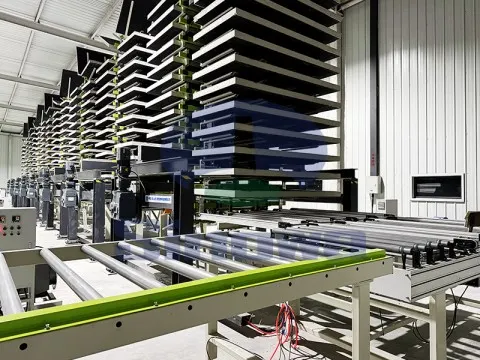
Automatic stacking and orderly sorting is an essential link to realize standardized finished product management. Qualified duct boards are automatically conveyed to the stacking area through the production line’s conveying system. The intelligent stacking equipment adjusts stacking height and arrangement mode according to product specifications, neatly stacking boards in fixed rows and layers. The system maintains uniform spacing and flat placement of each board during stacking to prevent extrusion deformation and surface scratch damage. The sorted and stacked products are classified according to different specifications to facilitate subsequent targeted packaging and storage management. This automated sorting and stacking mode replaces traditional manual operation, greatly improves production efficiency, reduces labor costs, and ensures neat and orderly finished product storage.
Product packaging and dustproof protection processing completes the final finished product output link of the production line. Neatly stacked duct boards enter the automatic packaging station, where professional protective packaging materials are used for overall sealing and wrapping. The packaging process focuses on dust prevention, moisture resistance and scratch resistance, effectively protecting the board surface and structural performance from damage during transportation and storage. The packaging equipment conducts tight wrapping and edge sealing to avoid loose packaging and material leakage. All packaged products maintain complete appearance and intact structure, which is conducive to long-term storage and long-distance transportation. Standardized packaging also facilitates convenient loading, unloading and counting of products in engineering procurement and construction scenarios.
The overall operational advantages and application value of the phenolic duct board production line are prominent in the HVAC industry. The fully automated integrated production mode realizes seamless connection of all processes from raw material processing to finished product output, greatly improving production efficiency and product batch stability. The duct boards produced by this line feature lightweight structure, excellent thermal insulation, good air tightness and convenient construction, which can effectively reduce the energy consumption of building ventilation and air conditioning systems. In addition, the flexible parameter setting of the production line enables it to adapt to diversified product specification requirements, meeting the personalized construction needs of different building ventilation projects. It has become a key intelligent production equipment for supporting high-efficiency and energy-saving HVAC engineering construction.
Gallery of HVAC Phenolic Duct Board Production Line
Tags: hvac phenolic duct board production line, hvac phenolic duct board production line manufacturer, hvac phenolic duct board production line supplier, china hvac phenolic duct board production line, hvac phenolic duct board production line for sale
https://www.sandwichpanelmanufacturingline.com/blog/hvac-phenolic-duct-board-production-line.html
-

A reliable PU sandwich panel production line serves as the core equipment for manufacturing high-performance building insulation panels. This professional PU sandwich panel line features automated feeding, foaming and molding processes to ensure consistent panel thickness and structural stability. The well-designed polyurethane sandwich panel production line effectively improves production efficiency while reducing material waste in daily operation. Each calibrated polyurethane sandwich panel line can adapt to different panel sizes to meet diverse construction needs. With precise temperature and pressure control, the advanced continuous PU sandwich panel line produces panels with excellent thermal insulation and weather resistance. Meanwhile, the optimized PIR sandwich panel production line upgrades the foaming formula to enhance fire resistance performance. The high-efficiency PIR sandwich panel line maintains stable operation during long-term mass production, delivering durable and high-quality sandwich panels for various architectural and industrial applications.
-

The phenolic panel production line realizes automated and continuous manufacturing of high-performance thermal insulation panels through streamlined and coordinated processing procedures.
-

Modern insulation panel manufacturing relies on professional automated equipment to ensure stable product quality and high production efficiency. The rock wool sandwich panel production line features precise material lamination and forming processes to produce rigid, heat-insulating building panels. Meanwhile, the mineral wool sandwich panel production line adopts optimized assembly procedures to fabricate lightweight, soundproof panels widely used in architectural enclosure and thermal preservation projects.