How Long Do PU Panels Need To Stabilize After Exiting The Polyurethane Sandwich Panel Production Line?
Publication Date: Oct 8, 2026
PU sandwich panels require a specific stabilization period after leaving production lines to eliminate residual heat and internal stress.
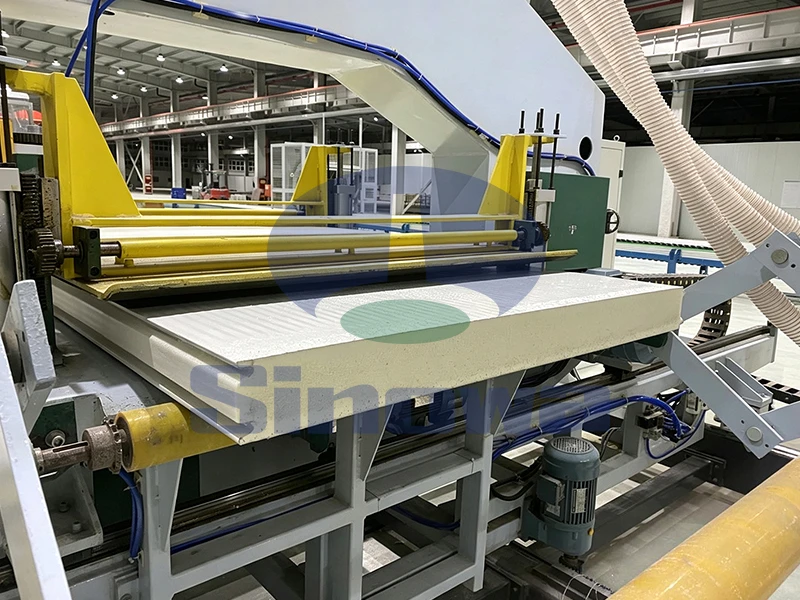
Freshly manufactured PU sandwich panels are structurally unstable immediately after exiting the continuous production line, despite completing primary curing and shaping inside the double-belt press and oven tunnel. During high-temperature forming and foaming, the polyurethane core undergoes rapid chemical expansion and cross-linking, leaving significant residual thermal stress and incomplete molecular bonding within the closed-cell foam structure. The panel surface temperature remains elevated while internal temperature gradients create uneven tension between the metal facing layers and the foam core. Without a dedicated stabilization period, these unrelieved stresses will trigger gradual deformation, surface waviness, or bond separation in subsequent cutting, stacking, and packaging processes. The core purpose of post-line stabilization is to allow uniform heat dissipation, complete secondary curing, and stress balance, laying a stable foundation for long-term structural performance and dimensional accuracy of PU panels.
The basic stabilization cycle for standard-thickness PU panels generally falls within 24 to 48 hours under normal indoor ambient conditions after production line exit. This conventional timeframe covers two critical physical and chemical adjustment stages of the panels. The first stage is rapid cooling and stress relief within the first 12 hours, where most residual surface and internal heat dissipates to balance the temperature difference between the panel interior and exterior. The second stage is slow secondary curing and molecular stabilization in the subsequent 12 to 36 hours, enabling incompletely cross-linked polyurethane molecules to finish chemical reactions and strengthen the bonding interface between foam core and metal facings. Panels processed through this full cycle achieve stable dimensional tolerance and basic structural firmness, avoiding most common post-production quality defects caused by premature processing.
Panel thickness is one of the most direct factors affecting post-production stabilization duration, with thicker PU panels requiring notably longer stabilization cycles. Thin-specification PU panels with a foam core thickness below 50mm feature a smaller internal heat storage capacity and faster heat exchange efficiency with the external environment. Their residual heat dissipates quickly, and internal stress balances in a short time, allowing a shortened stabilization period of around 24 hours. In contrast, thick PU panels with a core thickness exceeding 100mm store massive heat inside the dense closed-cell foam, and internal heat dissipation proceeds extremely slowly. The temperature gradient between the core center and surface persists longer, prolonging stress imbalance. Such thick panels usually need 48 to 72 hours of static stabilization to ensure thorough heat dissipation and complete internal structural adjustment.
Ambient temperature and humidity of the storage environment after production greatly regulate the stabilization speed of PU panels. In a dry, constant-temperature environment with moderate room temperature, the heat dissipation rate of panels is uniform, and the secondary curing reaction of polyurethane proceeds steadily, enabling the panels to complete stabilization within the standard time range. Low ambient temperatures slow down molecular movement and heat convection, delaying both heat dissipation and secondary curing, which requires extending the stabilization period by 12 to 24 hours. High humidity environments also hinder stabilization progress, as excessive moisture in the air slows surface heat loss and may slightly affect the surface curing state of the panel edge glue layer, leading to prolonged stress balance and structural stabilization cycles.
Production line operating parameters during manufacturing also indirectly determine the required post-line stabilization time of PU panels. Lines with higher continuous operating speeds shorten the in-line curing and heating time of panels, resulting in insufficient primary cross-linking of partial polyurethane foam molecules. Such panels retain more uncured active components and residual internal stress after exiting the line, thus needing a longer static stabilization period to complete secondary curing. Conversely, production lines with moderate speeds and sufficient oven curing time produce panels with more thorough primary forming, fewer residual unstable chemical structures, and faster post-line stress relief, which can meet stabilization requirements within the standard cycle. Additionally, inconsistent pressing pressure during production causes uneven internal stress distribution, further requiring extended static placement for uniform structural adjustment.
Improper premature processing without full stabilization will trigger a series of irreversible quality problems for PU panels. If panels are cut, stacked, or packaged immediately after exiting the production line while still retaining residual heat and internal stress, the unbalanced internal tension will slowly release during subsequent storage and transportation. This leads to common defects including uneven panel warping, local surface depression, and subtle gaps between the foam core and metal facings. In severe cases, incomplete curing of the foam core will cause continuous shrinkage after installation, reducing the overall flatness and thermal insulation performance of the panels. These hidden quality issues cannot be repaired later, directly affecting the assembly accuracy and service life of finished building envelope structures.
Reasonable stacking and placement methods during the stabilization period can effectively optimize the stabilization efficiency of PU panels. Panels should be placed horizontally on flat, rigid pallets after exiting the line to avoid uneven stress caused by suspended or tilted placement. The stacking height needs strict control to prevent excessive upper-layer pressure from squeezing the uncured foam core and causing permanent deformation. Sufficient gaps must be reserved between panel stacks and around the storage area to ensure smooth air circulation, accelerate uniform heat dissipation, and avoid local heat accumulation that delays stabilization. Meanwhile, panels should be kept away from strong air convection or direct sunlight, as drastic temperature changes will generate new internal stress and disrupt the natural stabilization process.
The stabilization mechanism of PU panels essentially involves the synergy of physical heat dissipation and chemical secondary curing. Physically, the high-temperature internal structure of freshly produced panels continuously exchanges heat with the external environment, gradually eliminating temperature differences and residual mechanical stress generated by high-pressure pressing and high-temperature foaming. Chemically, the incompletely reacted polyurethane monomers and prepolymers inside the foam continue cross-linking reactions under room temperature conditions, further compacting the closed-cell structure and enhancing the cohesive force of the foam core. At the same time, the adhesive layer between the foam and metal facings completes final curing, maximizing interface bonding strength. Only when both physical stress balance and chemical reaction completion are achieved can the panel structure reach a truly stable state.
Different application scenarios put forward differentiated requirements for PU panel stabilization duration. Panels used for conventional temporary buildings and ordinary enclosure structures can follow the standard 24 to 48-hour stabilization cycle, as their structural tolerance requirements are relatively lenient. In comparison, panels applied in high-precision thermal insulation facilities, clean rooms, and long-term fixed building envelopes require stricter dimensional stability and structural firmness. Such high-demand panels usually need a 48 to 72-hour full stabilization cycle to completely eliminate hidden structural risks. Panels for special low-temperature environments also require extended stabilization to ensure their foam cell structure and bonding performance remain stable in subsequent long-term low-temperature operation.
Sufficient post-production stabilization is a low-cost but critical process to guarantee the comprehensive quality of PU sandwich panels. Strictly following the matched stabilization duration according to panel thickness, storage environment, and production process conditions can effectively eliminate most post-production quality defects, stabilize dimensional accuracy, and optimize structural and thermal insulation performance. This static adjustment process complements in-line manufacturing procedures, ensuring that each batch of panels maintains consistent quality during subsequent transportation, installation, and long-term service. It serves as an indispensable key link to realize the excellent comprehensive performance of finished PU panels.
Gallery of Polyurethane Sandwich Panel Production Line






Tags: polyurethane sandwich panel production line, polyurethane sandwich panel production line manufacturer, polyurethane sandwich panel production line supplier, china polyurethane sandwich panel production line, polyurethane sandwich panel production line for sale
-

A reliable PU sandwich panel production line serves as the core equipment for manufacturing high-performance building insulation panels. This professional PU sandwich panel line features automated feeding, foaming and molding processes to ensure consistent panel thickness and structural stability. The well-designed polyurethane sandwich panel production line effectively improves production efficiency while reducing material waste in daily operation. Each calibrated polyurethane sandwich panel line can adapt to different panel sizes to meet diverse construction needs. With precise temperature and pressure control, the advanced continuous PU sandwich panel line produces panels with excellent thermal insulation and weather resistance. Meanwhile, the optimized PIR sandwich panel production line upgrades the foaming formula to enhance fire resistance performance. The high-efficiency PIR sandwich panel line maintains stable operation during long-term mass production, delivering durable and high-quality sandwich panels for various architectural and industrial applications.
-

The phenolic panel production line realizes automated and continuous manufacturing of high-performance thermal insulation panels through streamlined and coordinated processing procedures.
-

Modern insulation panel manufacturing relies on professional automated equipment to ensure stable product quality and high production efficiency. The rock wool sandwich panel production line features precise material lamination and forming processes to produce rigid, heat-insulating building panels. Meanwhile, the mineral wool sandwich panel production line adopts optimized assembly procedures to fabricate lightweight, soundproof panels widely used in architectural enclosure and thermal preservation projects.