How To Improve The Foaming Uniformity Of The PU Sandwich Panel Production Line?
Publication Date: Sep 28, 2026
Foaming uniformity is a key indicator that determines the quality, stability and service performance of PU sandwich panels. Uneven foaming causes inconsistent density, poor thermal insulation and structural defects. This article explores practical and systematic methods to optimize foaming uniformity in continuous production lines.
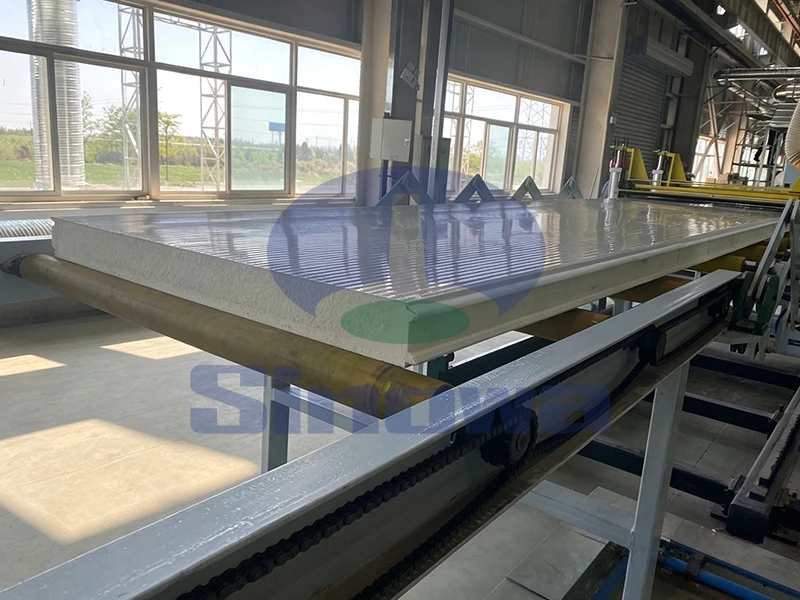
Stable raw material storage and constant temperature management serve as the fundamental premise for consistent PU foaming effects in sandwich panel production. Polyurethane raw materials are highly sensitive to ambient temperature and humidity, and minor fluctuations will directly alter material viscosity, fluidity and chemical reaction activity. Without effective temperature control, raw materials stored in conventional environments will experience inconsistent molecular activity at different time periods, leading to unbalanced reaction speeds during the foaming process and resulting in uneven bubble pore size and irregular core density. Installing professional constant temperature maintenance devices for raw material storage tanks and conveying pipelines can eliminate temperature deviation in material transportation. This stable storage environment ensures all raw materials maintain consistent physical and chemical properties before entering the mixing and foaming stage, laying a solid foundation for uniform foaming across the entire production batch and avoiding batch-to-batch quality differences caused by raw material state changes.
Precise raw material metering and dynamic ratio calibration is the core measure to eliminate local foaming differences in PU sandwich panel production. The foaming quality of polyurethane core materials relies heavily on the accurate proportion of multi-component raw materials, and even tiny flow deviations will trigger partial insufficient reaction or excessive foaming. Traditional manual metering and fixed ratio settings are prone to errors affected by equipment operation wear and environmental changes, leading to inconsistent mixing components. Equipping the production line with high-precision real-time flow monitoring systems can continuously collect material flow data and realize automatic deviation correction through the central control system. Dynamic ratio calibration adapts to subtle changes in raw material viscosity and ambient conditions, maintaining the mixing ratio within a stable and reasonable range at all times. This precise control effectively avoids common defects such as sparse bubble holes, incomplete curing and local density deviation caused by unreasonable component proportions.
Optimizing the high-speed mixing system structure and operating parameters significantly improves the molecular dispersion uniformity of PU raw materials. The mixing head is the key functional unit that determines the fusion degree of polyurethane components, and insufficient mixing always leads to uneven foaming in subsequent processes. Many conventional production lines adopt low-efficiency stirring structures, which cannot eliminate local component concentration differences, resulting in inconsistent reaction degrees in different areas of the foam core. Upgrading to high-shear spiral mixing chambers and adjusting scientific mixing speed and instantaneous mixing time can realize full molecular-level dispersion of all raw material components. High-speed turbulent mixing eliminates component agglomeration and uneven distribution, ensuring every part of the mixed liquid has consistent chemical composition and reaction activity. Uniform mixed materials can produce regular and dense bubble structures during foaming, fundamentally improving the overall uniformity of the panel core layer.
Sheet surface preheating treatment effectively solves uneven foaming defects caused by base material temperature differences. The surface temperature of upper and lower metal sheets directly affects the reaction speed and molding effect of polyurethane foam. Sheets stored in natural environments often have unbalanced surface temperature, and low or inconsistent sheet temperature will slow down the local foaming reaction, causing insufficient foaming, loose bubble pores and weak bonding between the core material and sheets. Professional preheating equipment can uniformly raise and stabilize the sheet surface temperature within the optimal reaction range before foaming. In addition, preheating treatment removes tiny moisture attached to the sheet surface, eliminating the adverse impact of moisture on polyurethane chemical reactions. Consistent sheet surface temperature ensures the foaming reaction proceeds at a synchronous speed on the contact surface, avoiding one-sided insufficient foaming and improving the overall uniformity of the composite structure.
Stabilizing the constant temperature environment of the laminating and foaming section is crucial for synchronous foam molding of PU sandwich panels. The laminating section is where polyurethane completes preliminary foaming and composite molding, and temperature fluctuations in this area will cause obvious differences in local foaming effects. Excessively high local temperature accelerates the foaming reaction rapidly, producing oversized bubbles and residual internal stress, while low temperature leads to slow reaction, incomplete foaming and loose core structure. Adopting a circulating constant temperature heating system can realize full coverage temperature control in the laminating working area, eliminating local hot and cold spots. Maintaining a stable and balanced temperature field enables the polyurethane mixed liquid to complete foaming and preliminary curing at a uniform reaction speed in all positions of the panel. This avoids longitudinal and lateral density differences of the core layer caused by unsynchronized reaction speeds during the molding process.
Optimizing the spraying and distributing uniformity of PU mixed materials further refines the foaming consistency of panel core layers. Even with fully mixed raw materials, uneven spraying distribution will lead to inconsistent material thickness in different areas of the panel, resulting in differentiated foaming volumes and uneven core density. Old spraying devices often have problems such as uneven discharge and local material accumulation, causing partial over-foaming or material shortage and under-foaming. Upgrading to quantitative uniform spraying equipment and adjusting the spraying angle, discharge rate and walking speed can realize full and uniform coverage of mixed materials between upper and lower sheets. Reasonable material distribution ensures each unit area obtains the same amount of raw materials, so the foaming expansion multiple and molding state of all parts of the panel remain consistent, effectively improving the flatness and density uniformity of the finished core layer.
Graded constant-temperature curing process optimization eliminates post-molding foaming inconsistencies and internal structural defects. After preliminary molding in the laminating section, the PU sandwich panel still needs continuous curing to stabilize the foam molecular structure, and unscientific curing temperature changes will damage foaming uniformity. Sudden temperature rise or excessive temperature difference in the curing tunnel easily causes internal bubble cracking, local shrinkage and unbalanced curing degree. Adopting a graded temperature rise and constant temperature maintenance mode enables the foam structure to complete slow and stable cross-linking reaction. The internal circulating hot air system of the curing tunnel ensures uniform temperature distribution in all corners, making each position of the panel complete deep curing at a synchronous speed. This process eliminates residual reaction differences in the preliminary foaming stage and stabilizes the overall uniform foam structure of the panel.
Real-time equipment operation monitoring and parameter dynamic adjustment maintain long-term stable foaming uniformity. Long-term continuous operation of production lines will lead to subtle wear of mixing heads, pipeline blockage and sensor accuracy deviation, which gradually affect mixing and foaming effects and cause fluctuating product quality. Installing a full-process operation monitoring system can track key parameters such as mixing speed, material flow, working temperature and spraying status in real time. The system feeds back abnormal data in time and supports manual or automatic dynamic adjustment of operating parameters according to production status. Regular targeted maintenance of mixing components, conveying pipelines and temperature sensing equipment avoids performance attenuation of key units. This real-time monitoring and adjustment mechanism ensures the production line maintains optimal working conditions for a long time and keeps foaming uniformity stable in mass production.
Optimizing production line operating speed and process matching improves overall foaming synchronization efficiency. Unmatched operating speed often causes asynchronous cooperation between material mixing, spraying, foaming and curing processes, resulting in local foaming unevenness. Excessively fast line speed leads to insufficient mixing time and incomplete raw material reaction, while overly slow speed causes partial material pre-reaction and inconsistent activity. Formulating scientific and unified operating speed standards according to raw material characteristics and process requirements ensures all production links cooperate synchronously. Matching the running speed with mixing efficiency, spraying cycle and curing time makes the foaming reaction maintain a stable and continuous state. Synchronized process operation eliminates quality differences caused by process disconnection and further standardizes the foaming molding state of each panel.
Regular process data analysis and standardized production management consolidate the long-term optimization effect of foaming uniformity. Mass production will generate a large amount of process and quality data, which can reflect potential hidden dangers of uneven foaming. Sorting and analyzing production data regularly can summarize the correlation between process parameters and foaming quality, and form targeted parameter optimization schemes. Establishing standardized operating procedures unifies the operation standards of all production links, avoiding quality fluctuations caused by human operation differences. Regular quality sampling and core density detection feed back product status in real time, which is convenient for timely fine-tuning of process parameters. Perfect data management and standardized operation can continuously optimize the production process and maintain stable and excellent foaming uniformity of PU sandwich panels.
Gallery of PU Sandwich Panel Production Line
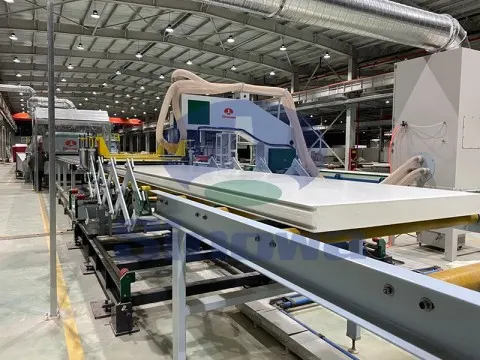
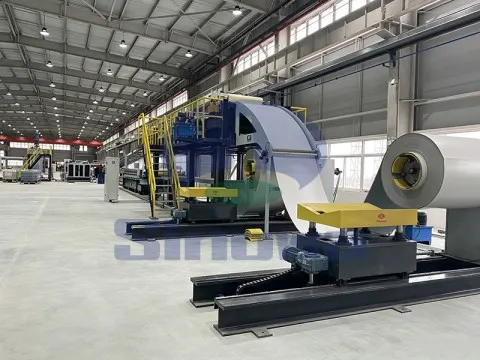
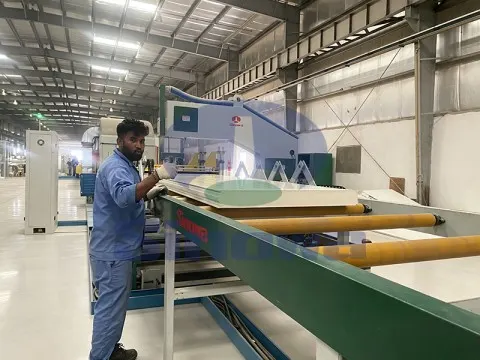
Tags: pu sandwich panel production line, pu sandwich panel production line manufacturer, pu sandwich panel production line supplier, china pu sandwich panel production line, pu sandwich panel production line for sale
-
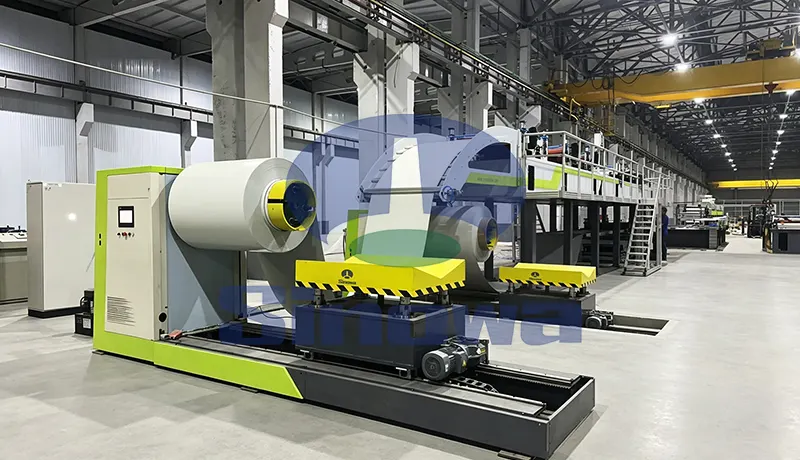
A reliable PU sandwich panel production line serves as the core equipment for manufacturing high-performance building insulation panels. This professional PU sandwich panel line features automated feeding, foaming and molding processes to ensure consistent panel thickness and structural stability. The well-designed polyurethane sandwich panel production line effectively improves production efficiency while reducing material waste in daily operation. Each calibrated polyurethane sandwich panel line can adapt to different panel sizes to meet diverse construction needs. With precise temperature and pressure control, the advanced continuous PU sandwich panel line produces panels with excellent thermal insulation and weather resistance. Meanwhile, the optimized PIR sandwich panel production line upgrades the foaming formula to enhance fire resistance performance. The high-efficiency PIR sandwich panel line maintains stable operation during long-term mass production, delivering durable and high-quality sandwich panels for various architectural and industrial applications.
-
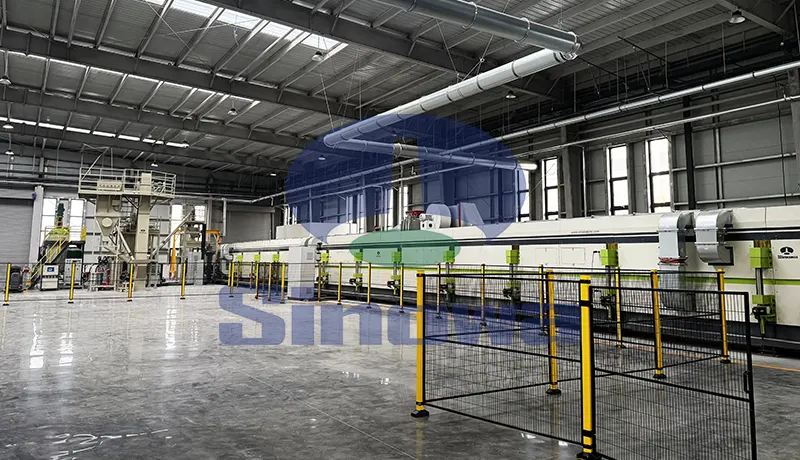
The phenolic panel production line realizes automated and continuous manufacturing of high-performance thermal insulation panels through streamlined and coordinated processing procedures.
-
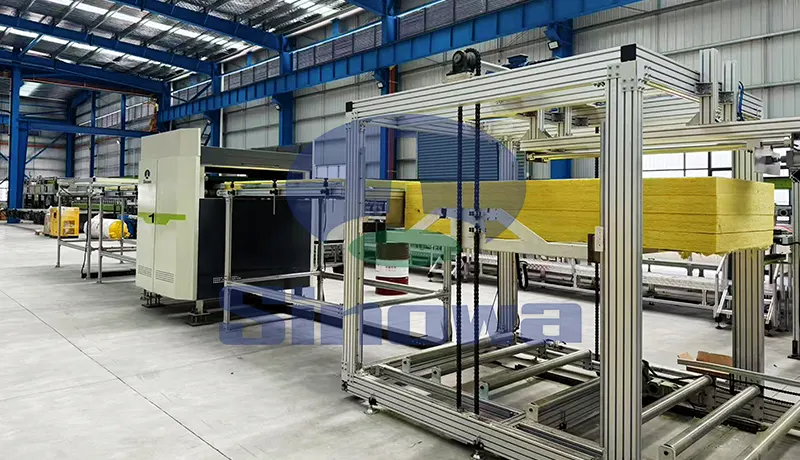
Modern insulation panel manufacturing relies on professional automated equipment to ensure stable product quality and high production efficiency. The rock wool sandwich panel production line features precise material lamination and forming processes to produce rigid, heat-insulating building panels. Meanwhile, the mineral wool sandwich panel production line adopts optimized assembly procedures to fabricate lightweight, soundproof panels widely used in architectural enclosure and thermal preservation projects.