What Is The Working Principle Of A PUR Sandwich Panel Production Line?
Publication Date: Sep 28, 2026
A PUR sandwich panel production line operates on integrated chemical foaming and mechanical composite principles. It processes raw materials through precise mixing, continuous foaming, pressing, curing and cutting, forming durable insulated panels with stable structural and thermal performance.
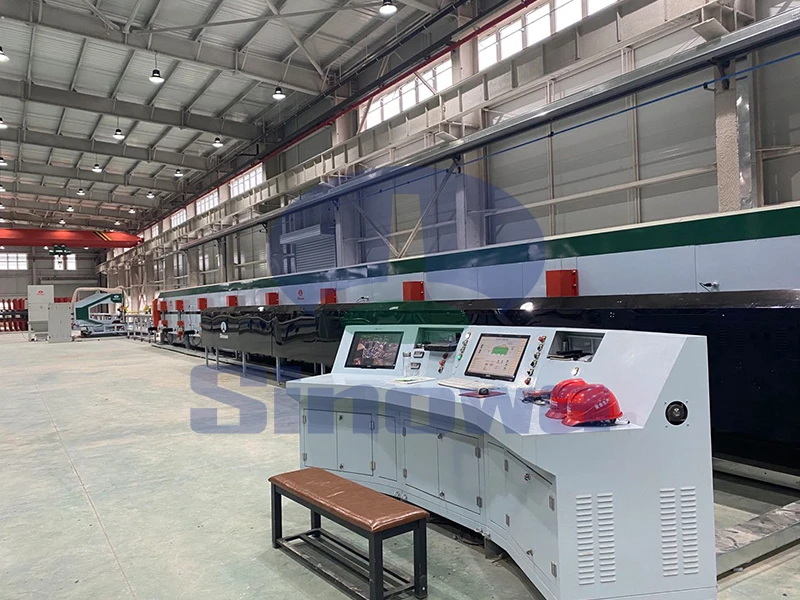
The overall operation of a PUR sandwich panel line relies on fully automated continuous processing, which combines chemical reaction technology and mechanical forming technology to complete panel manufacturing in a streamlined manner. The entire production process follows a fixed sequential logic, starting from raw material preparation and ending with finished product shaping and sorting. Each processing unit is closely linked by intelligent conveying systems, eliminating intermittent operation gaps and ensuring consistent production efficiency. Unlike traditional discontinuous panel manufacturing methods, this continuous production mode maintains stable processing parameters throughout the whole procedure, which lays a solid foundation for the uniform quality of finished panels. The core of the working principle lies in the controllable chemical foaming of polyurethane materials and the tight composite bonding between foamed core layers and surface substrates.
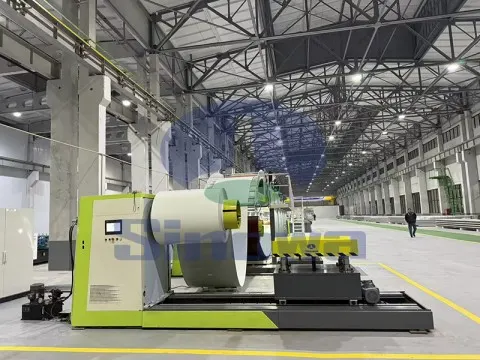
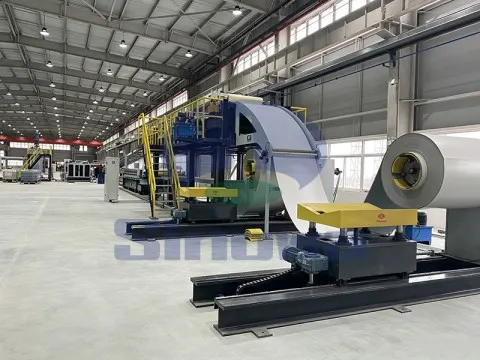
Raw material pretreatment and feeding serve as the foundational link of the entire production workflow, determining the basic conditions for subsequent processing. The PUR sandwich panel manufacturing line mainly requires two types of raw materials: metal or non-metal surface substrates and two-component PUR chemical raw materials. For surface substrates, the automated feeding system unfolds coiled substrates continuously, while completing surface cleaning and flatness correction to remove dust, oil stains and surface wrinkles that may affect bonding effect. For PUR chemical materials, the sealed storage system maintains stable material activity by controlling internal temperature and isolation from external air. Professional metering pumps accurately deliver different components to the subsequent mixing unit, ensuring the basic proportion stability required for chemical reactions.
Precision metering and high-speed mixing of PUR raw materials are the core processes that decide the foam core quality. The two main chemical components of PUR materials, together with trace functional additives, are transported to the high-pressure mixing head through independent metering pipelines. The intelligent metering system strictly controls the delivery proportion of each material to avoid performance defects caused by disproportionate mixing. Inside the mixing head, all materials are stirred at an ultra-high speed to achieve molecular-level uniform fusion, forming a homogeneous liquid mixture without particle agglomeration or component stratification. This uniformly mixed liquid is the key to forming fine and dense foam structures, and it also guarantees the consistent reaction activity of subsequent foaming processes.
Uniform pouring and initial foaming take place right after raw material mixing, realizing the primary forming of the panel core layer. The mixed PUR liquid is sprayed evenly between the upper and lower surface substrates through a movable reciprocating nozzle. The nozzle runs at a stable and adjustable speed to ensure the liquid covers the entire substrate surface evenly without accumulation or missing areas. Once the liquid contacts the air and reaches the preset reaction temperature, it triggers a rapid chemical foaming reaction. The liquid expands quickly in a controllable manner, gradually filling the gap between the two substrates and forming a preliminary porous foam structure. In this stage, the foam is in a semi-solid state with certain fluidity, preparing for the subsequent composite pressing and shaping process.
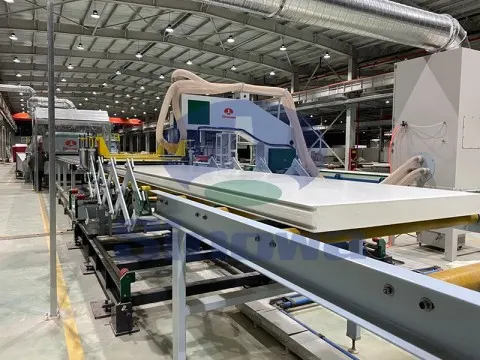
Continuous composite pressing is a key step to integrate substrates and foam core into an integral structure. The semi-finished products with preliminary foamed core layers are stably transported to the circulating pressing unit composed of upper and lower circulating belts. The hydraulic pressure system of the unit provides stable and uniform vertical pressure, which can adjust the pressure range according to the required panel thickness and density. The pressing belts run synchronously with the conveying speed to avoid material displacement and surface deformation during pressing. Under constant pressure, the semi-fluid foam further spreads and fills gaps, and closely fits with the inner surface of the upper and lower substrates. This process eliminates internal voids of the panel and realizes preliminary bonding between the core layer and substrates.
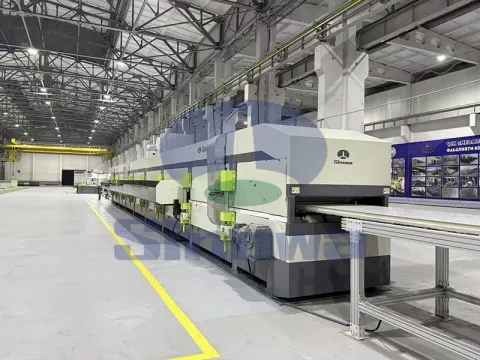
Constant temperature curing and molecular stabilization ensure the structural stability and bonding strength of composite panels. Although the panel forms an integral structure after pressing, the internal chemical reaction of the PUR foam is not completely finished, and the molecular structure is still unstable. The semi-finished panels enter the insulated curing tunnel, where the constant temperature and humidity environment promotes thorough chemical cross-linking reactions of PUR materials. The continuous heat preservation environment accelerates the solidification of the foam core layer and strengthens the irreversible bonding force between the core layer and substrates. Long-term stable curing effectively prevents subsequent panel shrinkage, deformation and degumming problems, and optimizes the overall mechanical and thermal insulation properties of the panels.
Edge trimming and dimensional calibration standardize the overall specifications of semi-finished panels. After curing and shaping, the continuous strip panel has irregular residual edges on both sides due to the spreading of foaming materials. The automatic trimming device on both sides of the production line cuts off the redundant edge materials synchronously according to the preset dimensional standards. The high-precision sensor detects the panel width in real time and fine-tunes the cutting position to ensure consistent dimensions of each panel. This process removes unqualified edge areas with uneven density and insufficient bonding, making the overall structure and size of the panel neat and uniform, and laying a foundation for fixed-length cutting and finished product application.
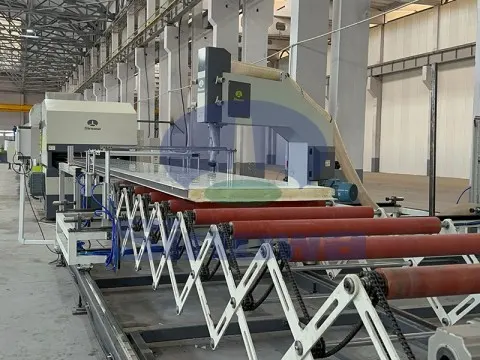
Fixed-length cutting and surface finishing complete the final shaping of single panels. The continuous long strip semi-finished panels are transported to the intelligent cutting unit, which automatically performs fixed-length cutting according to customized specification parameters. The cutting tool runs smoothly and efficiently, ensuring flat and burr-free cutting sections without damaging the surface substrate and internal foam structure. After cutting, the equipment conducts preliminary surface inspection and finishing, removing tiny attachments and processing traces on the panel surface. This step divides the continuous production strip into independent single finished panels with standard specifications, meeting the basic requirements of subsequent transportation and application.
Finished product conveying and stacking realize automated collection and storage of qualified panels. The cut single panels are transmitted to the finished product sorting area through the low-speed stable conveying platform. The automated stacking device accurately grabs and arranges qualified panels in order according to the set stacking rules, realizing neat stacking of finished products. The whole process avoids manual handling damage and ensures the surface integrity of panels. Meanwhile, the production line synchronously eliminates unqualified products with abnormal size, surface defects or insufficient bonding, ensuring that all stacked finished products have stable and qualified overall performance.
The systematic linkage of all units endows the PUR sandwich panel production line with stable and efficient manufacturing capabilities. Every processing link from raw material feeding to finished product stacking is coordinated by the central control system, which monitors and adjusts operating parameters in real time. The matching of speed, temperature, pressure and metering parameters between different units avoids production conflicts and quality fluctuations. The perfect combination of chemical reaction control and mechanical automatic processing enables the production line to stably manufacture PUR sandwich panels with high bonding strength, uniform foam structure and excellent comprehensive performance, realizing efficient and standardized batch production.
Gallery of PUR Sandwich Panel Production Line
Tags: pur sandwich panel production line, pur sandwich panel production line manufacturer, pur sandwich panel production line supplier, china pur sandwich panel production line, pur sandwich panel production line for sale
-

A reliable PU sandwich panel production line serves as the core equipment for manufacturing high-performance building insulation panels. This professional PU sandwich panel line features automated feeding, foaming and molding processes to ensure consistent panel thickness and structural stability. The well-designed polyurethane sandwich panel production line effectively improves production efficiency while reducing material waste in daily operation. Each calibrated polyurethane sandwich panel line can adapt to different panel sizes to meet diverse construction needs. With precise temperature and pressure control, the advanced continuous PU sandwich panel line produces panels with excellent thermal insulation and weather resistance. Meanwhile, the optimized PIR sandwich panel production line upgrades the foaming formula to enhance fire resistance performance. The high-efficiency PIR sandwich panel line maintains stable operation during long-term mass production, delivering durable and high-quality sandwich panels for various architectural and industrial applications.
-

The phenolic panel production line realizes automated and continuous manufacturing of high-performance thermal insulation panels through streamlined and coordinated processing procedures.
-

Modern insulation panel manufacturing relies on professional automated equipment to ensure stable product quality and high production efficiency. The rock wool sandwich panel production line features precise material lamination and forming processes to produce rigid, heat-insulating building panels. Meanwhile, the mineral wool sandwich panel production line adopts optimized assembly procedures to fabricate lightweight, soundproof panels widely used in architectural enclosure and thermal preservation projects.