Thick PU Sandwich Panel Production Line
Publication Date: Oct 12, 2026
The thick PU sandwich panel production line is a fully automated integrated system for manufacturing high-performance insulated composite panels. It completes material forming, PU foaming, laminating, curing and cutting processes, delivering thick panels with stable structure and excellent thermal insulation for diverse construction applications.
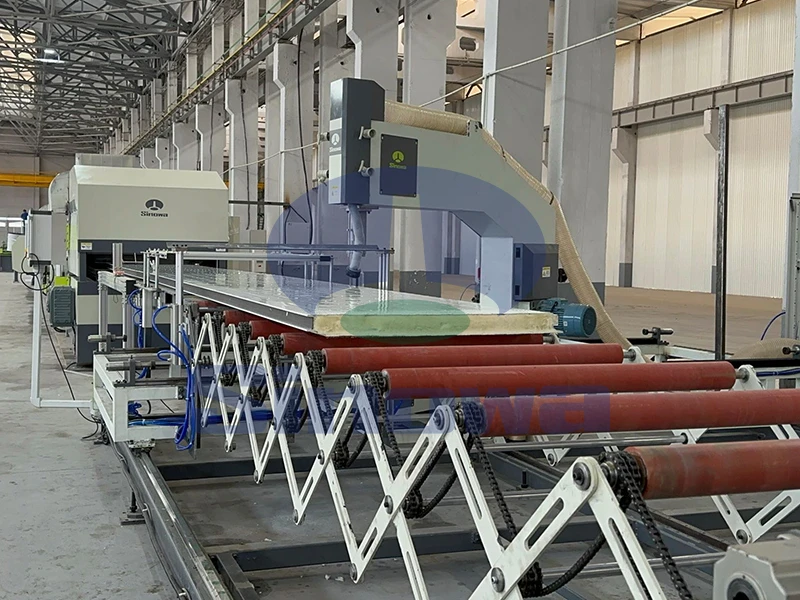
The operation of a thick PU sandwich panel line starts with the stable feeding and pretreatment of surface raw materials, which lays a solid foundation for subsequent composite processing. The line is equipped with professional uncoiling and leveling units that handle coiled metal sheets or other decorative surface materials smoothly. These units eliminate surface wrinkles, uneven tension and deformation caused by long-term coil storage, ensuring the flatness and dimensional consistency of each sheet entering the next process. The feeding speed is intelligently adjusted according to the overall production rhythm, realizing synchronous material supply with follow-up procedures. Meanwhile, a basic surface cleaning mechanism removes dust, oil stains and fine impurities on the material surface, effectively improving the bonding tightness between the surface layer and PU foam core. This preliminary pretreatment process avoids common product defects such as delamination and weak adhesion, greatly enhancing the overall durability of finished thick panels.
After surface material pretreatment, the roll forming system carries out precise contour shaping for thick panel outer layers, a key step to ensure panel structural regularity. Different from ordinary thin panel production, the forming unit for thick PU panels adopts enhanced roller sets with high rigidity and wear resistance, which can withstand continuous extrusion pressure during long-term operation. The rollers are arranged in multi-stage progressive forming structures, gradually bending and flattening the raw sheets into preset edge profiles and overall shapes without damaging the material surface structure. The system supports flexible adjustment of forming parameters to adapt to different surface material thicknesses and panel contour requirements. High-precision sensor devices monitor the forming dimension in real time during operation, automatically fine-tuning roller gaps and pressure to keep consistent forming accuracy for every batch of materials, ensuring uniform appearance and structural specifications of thick panels.
The high-pressure PU foaming and mixing system serves as the core functional module of the entire production line, directly determining the thermal insulation performance and internal quality of thick sandwich panels. This system accurately proportionates two main chemical raw materials and auxiliary additives through precision metering devices, maintaining a stable mixing ratio throughout production. The mixed liquid materials are fully blended in a high-pressure sealed mixing chamber to form a uniform reactive solution without granular agglomeration or component stratification. Equipped with a traversing pouring mechanism, the system evenly sprays the PU solution on the surface of the lower moving sheet. The pouring speed and coverage range are dynamically matched with the sheet conveying speed, ensuring full and uniform distribution of the foam raw materials in the thick panel core layer, preventing hollow cavities and density unevenness that easily occur in thick core processing.
The double-belt pressing and synchronous conveying system is critical for shaping thick PU sandwich panels and realizing integral composite bonding. After PU solution pouring, the upper and lower surface layers with intermediate foam materials enter the closed double-belt pressing area. The upper and lower belts maintain a fixed and adjustable spacing, accurately controlling the final thickness specification of thick panels. The system provides stable and uniform mechanical pressure across the entire panel width and length, enabling the PU foam to expand evenly in a limited space and fully fill the intermediate layer. The synchronous conveying structure ensures zero relative displacement between the upper and lower sheets during pressing, avoiding panel deviation and edge misalignment. The continuous pressing and conveying mode realizes uninterrupted production, effectively improving production efficiency while ensuring consistent compactness and flatness of thick panel products.
Constant temperature curing treatment is an indispensable process to stabilize the internal structure and comprehensive performance of thick PU sandwich panels. Different from thin panels that cure quickly at room temperature, thick foam cores require gradual and sufficient curing to complete chemical cross-linking reactions. The production line is fitted with an insulated constant-temperature curing channel that maintains a stable internal temperature environment. The slow and uniform heat conduction promotes thorough foaming and solidification of the deep core layer of thick panels, eliminating incomplete curing problems in the middle part. The curing time can be flexibly adjusted according to different panel thicknesses and formula requirements to ensure full reaction of PU materials. This process optimizes the internal cell structure of the foam core, significantly improving the thermal insulation, pressure resistance and structural stability of finished thick panels.
The automatic trimming and edge finishing process optimizes the appearance quality and assembly adaptability of thick PU sandwich panels. After preliminary curing and forming, continuous long-strip panels have irregular residual edges and burrs on both sides due to feeding and forming errors. The production line’s edge trimming unit adopts high-speed precision cutting tools to trim the panel edges synchronously with conveying speed, removing redundant materials evenly. Meanwhile, the edge flattening and shaping mechanism calibrates the deformed edges of thick panels to ensure straight and smooth side profiles. This process eliminates edge cracks, uneven thickness and burr defects, making panel sizes more standardized. Neat edge structures also facilitate seamless splicing and assembly of panels in actual construction scenarios, improving the overall installation efficiency and sealing effect of engineering projects.
The fixed-length intelligent cutting system realizes precise sizing and segmentation of continuous thick PU sandwich panels. Equipped with real-time length tracking and laser positioning devices, the system automatically identifies the running speed and cumulative length of continuous panels, and triggers cutting actions accurately according to preset sizing parameters. Different from manual cutting, the automatic flying saw cutting structure maintains stable cutting pressure and speed during dynamic operation, avoiding incision tilting, section deformation and dimensional deviation common in thick plate cutting. The cutting tool has high hardness and wear resistance, adapting to long-term cutting of composite materials with metal surface layers and PU foam cores. Each cut panel features flat and smooth sections with consistent length specifications, meeting the standardized use requirements of various application scenarios.
The post-cut cooling and shaping process further stabilizes the physical properties of thick PU sandwich panels. Panels just cut from the curing channel still retain residual internal temperature, and the internal foam structure is not completely stable, which may cause slight deformation during stacking. The production line is equipped with an extended cooling conveying platform that utilizes natural air circulation and auxiliary uniform heat dissipation to gradually reduce panel temperature. The slow cooling mode avoids rapid temperature drop that leads to internal stress concentration and structural cracking of thick foam cores. During the cooling process, the panels are kept flat and fixed to correct tiny bending and warping generated in previous processes, ensuring that the finished panels maintain excellent flatness and stable structural size for a long time.
The automatic stacking and discharging system improves the intelligent and automated level of the entire production line, realizing efficient collection of finished thick panels. After cooling and shaping, qualified panels are automatically transported to the stacking station through the conveying line. The mechanical stacking structure stably grabs and arranges panels in order according to preset stacking rules, realizing neat and standardized stacking. The system is equipped with anti-collision and pressure protection functions to prevent surface scratches, indentations and structural damage to thick panels during stacking. It can automatically count finished products and alarm for abnormal stacking states, reducing manual intervention. This automated link effectively saves labor costs, improves finished product collection efficiency, and provides convenient conditions for subsequent handling and storage of panels.
The overall intelligent control and quality monitoring system ensures stable operation and consistent product quality of the thick PU sandwich panel production line. The entire production process is centrally controlled by an intelligent operating platform, which uniformly adjusts parameters such as feeding speed, foaming ratio, pressing pressure, curing temperature and cutting size. Real-time data monitoring devices are installed at each key process node to track production status and product quality indicators dynamically. Once abnormal parameters or product defects are detected, the system will automatically prompt and adjust relevant operating parameters in time. The integrated control mode realizes linkage operation of all functional units, avoids production disorder caused by manual parameter mismatch, ensures long-term stable and efficient operation of the production line, and maintains uniform and reliable quality of batch-produced thick PU sandwich panels.
Gallery of Thick PU Sandwich Panel Production Line






Tags: thick pu sandwich panel production line, thick pu sandwich panel production line manufacturer, thick pu sandwich panel production line supplier, china thick pu sandwich panel production line, thick pu sandwich panel production line for sale
https://www.sandwichpanelmanufacturingline.com/blog/thick-pu-sandwich-panel-production-line.html
-

A reliable PU sandwich panel production line serves as the core equipment for manufacturing high-performance building insulation panels. This professional PU sandwich panel line features automated feeding, foaming and molding processes to ensure consistent panel thickness and structural stability. The well-designed polyurethane sandwich panel production line effectively improves production efficiency while reducing material waste in daily operation. Each calibrated polyurethane sandwich panel line can adapt to different panel sizes to meet diverse construction needs. With precise temperature and pressure control, the advanced continuous PU sandwich panel line produces panels with excellent thermal insulation and weather resistance. Meanwhile, the optimized PIR sandwich panel production line upgrades the foaming formula to enhance fire resistance performance. The high-efficiency PIR sandwich panel line maintains stable operation during long-term mass production, delivering durable and high-quality sandwich panels for various architectural and industrial applications.
-

The phenolic panel production line realizes automated and continuous manufacturing of high-performance thermal insulation panels through streamlined and coordinated processing procedures.
-

Modern insulation panel manufacturing relies on professional automated equipment to ensure stable product quality and high production efficiency. The rock wool sandwich panel production line features precise material lamination and forming processes to produce rigid, heat-insulating building panels. Meanwhile, the mineral wool sandwich panel production line adopts optimized assembly procedures to fabricate lightweight, soundproof panels widely used in architectural enclosure and thermal preservation projects.