Phenolic Foam Board Production Line
Publication Date: Oct 5, 2026
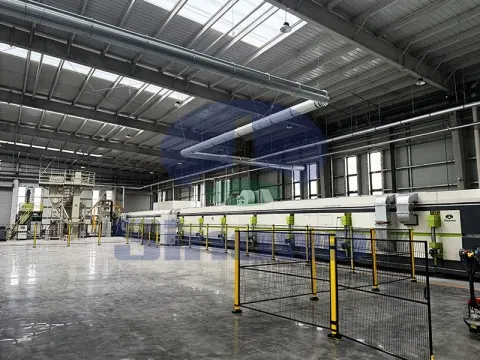
A phenolic foam board production line is an integrated industrial system for manufacturing high-performance thermal insulation boards. It covers full-process automated production from raw material treatment to finished product shaping, featuring stable operation and customizable product performance for diverse industrial and construction needs.
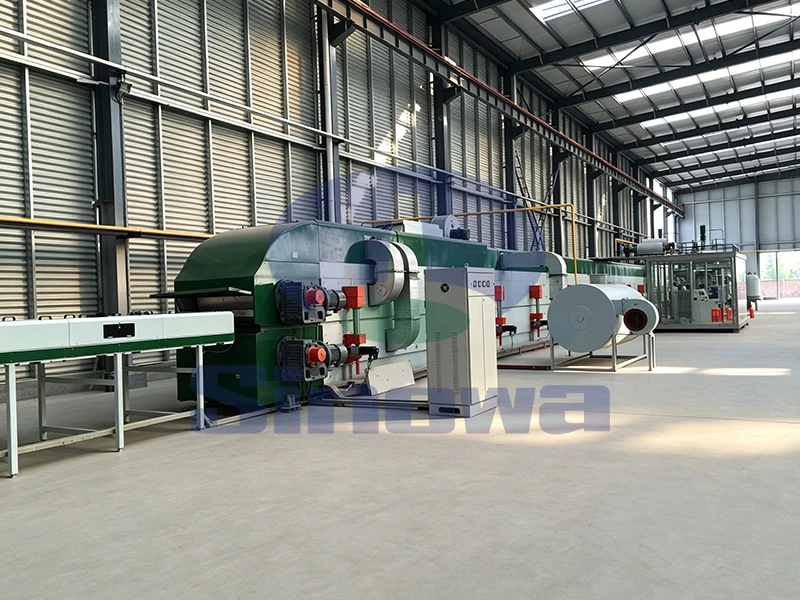
Basic Composition and Overall Operational Logic
A complete phenolic foam board production line is assembled with multiple interlocking functional modules that work in synchronized coordination to realize continuous and automated manufacturing. Each functional unit undertakes a specialized production task while adjusting operating parameters in real time to match the overall production rhythm, eliminating disconnection between working procedures and improving production consistency. The core equipment combinations mainly include raw material supply and pretreatment systems, precise proportioning units, high-efficiency mixing devices, continuous foaming and molding systems, multi-stage curing equipment, fixed-size cutting and trimming mechanisms, and post-processing and conveying modules. All modules are connected by automated transmission structures to form a closed-loop production system. Unlike intermittent production equipment, this streamlined production mode reduces manual intervention throughout the process, effectively avoiding product quality fluctuations caused by human operation errors. The overall operational logic follows the sequence of raw material preparation, chemical reaction molding, structural curing, precision processing and finished product output, ensuring that each batch of phenolic foam boards maintains uniform pore structure, stable density and consistent mechanical properties. The modular design also endows the production line with strong flexibility, allowing partial parameter adjustment and functional matching according to different product design requirements.
Raw Material Pretreatment and Supply System
Raw material pretreatment is the primary foundation for ensuring the stable quality of phenolic foam boards, and the supporting supply system guarantees continuous and orderly material feeding for the entire production line. The main raw materials for phenolic foam board production include phenolic resin, foaming agents, curing agents and functional additives, each of which requires targeted pretreatment before entering the production link. The raw material storage area is equipped with sealed constant-temperature storage devices to prevent resin deterioration, additive volatilization and impurity contamination caused by temperature and humidity changes. Before feeding, raw materials will undergo filtration and homogenization treatment to remove tiny impurities and precipitate that may exist in the raw materials, avoiding pore blockage and surface defects of finished products. The automated supply system adopts quantitative conveying equipment, which can stably transport various raw materials to the subsequent proportioning link at a constant flow rate. The system is designed with anti-blocking and backflow prevention structures to ensure the accuracy and stability of material transportation. In addition, the pretreatment link also includes raw material temperature adjustment, keeping all raw materials within the optimal reaction temperature range, which lays a solid foundation for uniform chemical reaction in the subsequent mixing and foaming process and effectively improves the qualification rate of finished products.
Precise Proportioning and High-Speed Mixing Process
Precise proportioning and homogeneous mixing are the core links that determine the internal structural performance of phenolic foam boards, directly affecting the foaming uniformity and structural stability of finished products. The phenolic insulation board production line adopts an automated intelligent proportioning system, which can independently match the dosage of phenolic resin, foaming agent, curing agent and additives according to preset production parameters. The system realizes micro-adjustment of raw material dosage through high-precision sensing components, effectively avoiding performance differences caused by unreasonable material ratio. After proportioning, all raw materials are sent to a closed high-speed mixing unit for instantaneous homogeneous mixing. The mixing equipment adopts high-speed rotating rotor structure, which can fully blend viscous resin materials and various auxiliary materials in a short time, forming a uniform and stable colloidal mixture. The entire mixing process is carried out in a sealed environment, which isolates external air and dust interference, prevents premature chemical reaction of raw materials, and avoids air bubbles mixed in the colloid. Reasonable mixing speed and time parameters ensure that the foaming agent and curing agent are evenly dispersed in the resin matrix, which enables the subsequent foaming reaction to proceed synchronously and forms a fine and uniform closed-cell structure inside the foam board.
Continuous Foaming and Primary Molding Technology
Foaming and primary molding is the key stage for the formation of phenolic foam board's porous structure, which shapes the basic outline and core physical characteristics of the product. The uniformly mixed colloidal materials are continuously injected into the closed constant-temperature foaming cavity through sealed conveying pipelines. Different from traditional open foaming technology, the closed foaming environment of the production line can accurately control the reaction temperature, internal pressure and foaming time, ensuring stable and ordered foaming reaction. With the gradual rise of cavity temperature, the foaming agent in the colloid undergoes physical gasification and micro chemical reaction to generate uniform gas bubbles, which push the colloid to expand steadily. At the same time, the curing agent starts to trigger preliminary cross-linking reaction of phenolic resin, making the expanded foam structure initially shaped and preventing bubble collapse and uneven expansion. In the continuous production state, the molding equipment runs at a constant speed, driving the preliminary molded foam blank to move forward synchronously. This continuous foaming and molding mode avoids the batch difference of intermittent production, ensures consistent thickness and pore uniformity of the foam blank along the length direction, and lays a good foundation for subsequent curing and finishing processing.
Multi-Stage Constant-Temperature Curing System
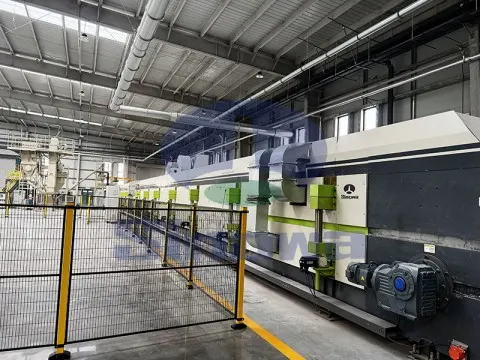
The multi-stage constant-temperature curing system is crucial for optimizing the structural stability and comprehensive performance of phenolic foam boards, realizing the complete solidification and performance shaping of foam blanks. The curing process is divided into preheating, constant-temperature curing and slow cooling shaping stages, and each stage is equipped with independent temperature control and wind speed adjustment modules. In the preheating stage, low-gradient temperature rise is adopted to eliminate the internal stress generated during the foaming and molding process, effectively preventing surface cracking and internal structural damage caused by rapid temperature change. In the high-temperature constant-temperature curing stage, the phenolic resin completes sufficient cross-linking and polymerization reaction, making the loose foam structure compact and stable, and significantly improving the mechanical strength and structural toughness of the product. The slow cooling stage avoids structural deformation caused by sudden temperature drop, ensuring the overall flatness of the foam board. The intelligent control system can adjust the temperature, operating speed and curing time of each area in real time according to the thickness and production speed of the foam board. The circulating air supply structure inside the curing equipment ensures uniform temperature distribution in the curing cavity, so that each part of the foam board can achieve consistent curing effect and stable performance.
Surface Facing and Composite Processing
Surface facing and composite processing is an important link to enhance the practical performance and application diversity of phenolic foam boards. According to different usage scenarios, the phenolic insulation panel production line can complete the composite processing of various surface materials on the surface of cured foam blanks. Common facing materials include flexible and rigid decorative and protective materials, which can improve the surface wear resistance, weather resistance and structural integrity of foam boards. The composite process adopts continuous laminating technology, with automatic unwinding and tension control devices to ensure flat and tight laying of surface materials without wrinkles and deviations. Before lamination, the foam board surface will undergo micro-treatment to remove surface floating powder and increase surface adhesion, so that the facing materials and the foam core layer can be closely combined without delamination. In the composite process, appropriate pressure and auxiliary temperature are matched to realize stable bonding between the surface material and the core layer. The automated composite module can synchronously complete single-sided and double-sided composite processing according to production settings, with high processing efficiency and good product consistency. This processing link greatly expands the application scope of phenolic foam boards, enabling the products to adapt to complex installation and usage environments.
Precision Cutting and Trimming Processing
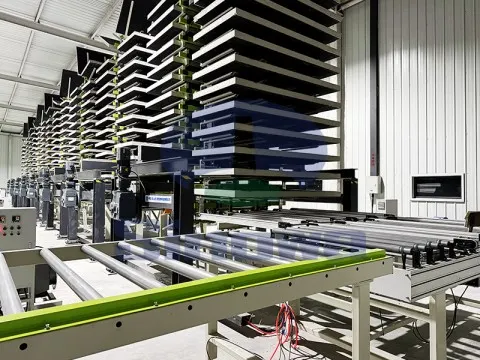
Precision cutting and trimming processing realizes the fixed-size shaping of semi-finished foam boards, ensuring that the dimensional accuracy and appearance quality of finished products meet usage requirements. After curing and composite processing, the continuous foam board blanks are sent to the cutting and trimming unit through the conveying system. The phenolic board production line is equipped with intelligent tracking cutting equipment, which can automatically identify the length and width of the board and complete fixed-length cutting according to preset dimensional parameters. The cutting tool adopts high-precision blade structure with stable cutting speed, which can realize smooth cutting section without burrs, cracks and uneven edges. The trimming module is responsible for cutting off the irregular edges on both sides of the foam board to ensure consistent width of the board. In addition, the equipment is equipped with an error correction system, which can automatically adjust the cutting position according to the running deviation of the board to avoid dimensional errors caused by transmission deviation. The entire cutting and trimming process is fully automated, with high processing accuracy and fast speed, which not only improves production efficiency, but also ensures the uniformity of product size and appearance, reducing subsequent manual finishing workload.
Surface Finishing and Quality Inspection
Surface finishing and online quality inspection are key links to control the finished product quality of phenolic foam boards, eliminating unqualified products and optimizing product appearance and performance. The finishing process includes surface cleaning, flatness correction and defect repair, removing floating dust, adhesive residues and tiny flaws on the board surface to make the product surface smooth and flat. The automated finishing equipment can adapt to foam boards of different thicknesses and sizes, with flexible and efficient processing. The online quality inspection system adopts multi-dimensional detection technology to conduct real-time detection of key indicators such as board thickness, flatness, surface integrity and internal structural uniformity. The system can automatically identify defective products such as uneven thickness, surface damage and poor lamination, and mark and screen them in time. Different from manual inspection, the intelligent inspection mode has higher detection accuracy and efficiency, effectively avoiding missed inspection and misjudgment. Qualified products after inspection will be transmitted to the finished product sorting link, while unqualified products will be sent to the reprocessing or waste treatment link to ensure that all products entering the finished product stage have stable and reliable quality.
Waste Recycling and Environmental Protection Treatment
Modern phenolic foam board production lines are equipped with complete waste recycling and environmental protection treatment systems to realize green and low-carbon production. In the cutting, trimming and finishing links, a certain amount of foam leftover materials and scraps will be generated. The professional waste recycling device can collect these solid wastes in a centralized manner, and after crushing and screening treatment, the qualified foam particles can be reused in the subsequent production process after proportional matching, which effectively improves the utilization rate of raw materials and reduces production waste. For the waste gas and micro-powder generated in the production process, the closed dust removal and gas purification system conducts centralized filtration and purification treatment to avoid environmental pollution caused by production emissions. All waste treatment processes are carried out in a closed system, which not only meets the requirements of clean production, but also improves the safety of the production workshop. The cyclic utilization mode of the production line reduces raw material consumption, lowers production costs, and makes the entire production process more environmentally friendly and sustainable, conforming to the development trend of green building material production.
Operational Advantages and Production Value
The integrated phenolic foam board production line has significant operational advantages and industrial value compared with traditional discrete production equipment. First of all, the fully automated streamlined production mode greatly reduces manual operation links, realizes continuous and uninterrupted production, and effectively improves production efficiency and output stability. The intelligent parameter adjustment function enables the production line to quickly adapt to different product specifications, realizing flexible production of diversified phenolic foam boards and meeting the personalized market demand. In terms of product quality, precise material proportioning, uniform mixing and stable curing technology ensure that the finished products have fine and uniform pore structure, excellent thermal insulation performance and stable mechanical properties, with low product defect rate. In addition, the modular equipment structure is convenient for daily maintenance and later functional upgrading, reducing equipment failure rate and maintenance cost. The efficient and green production mode of the phenolic panel production line not only improves the economic benefits of production and processing, but also provides high-quality and reliable thermal insulation materials for construction, industrial equipment and other fields, with broad industrial application prospects and long-term production value.
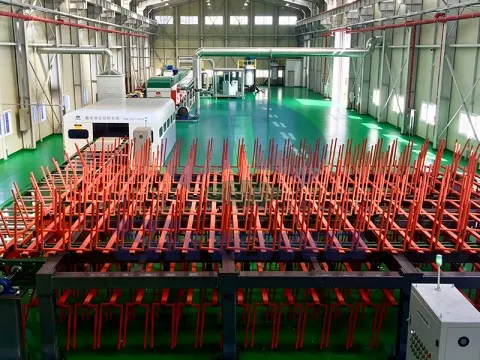
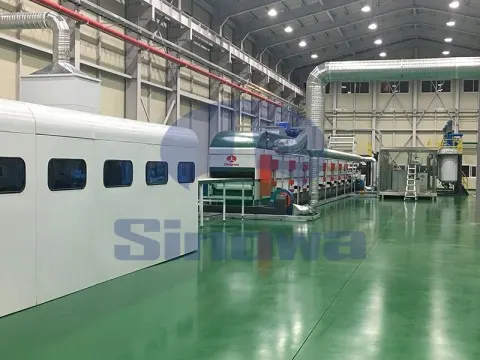
Gallery of Phenolic Foam Board Production Line
Tags: phenolic foam board production line, phenolic foam board production line manufacturer, phenolic foam board production line supplier, china phenolic foam board production line, phenolic foam board production line for sale
https://www.sandwichpanelmanufacturingline.com/blog/phenolic-foam-board-production-line.html
-

A reliable PU sandwich panel production line serves as the core equipment for manufacturing high-performance building insulation panels. This professional PU sandwich panel line features automated feeding, foaming and molding processes to ensure consistent panel thickness and structural stability. The well-designed polyurethane sandwich panel production line effectively improves production efficiency while reducing material waste in daily operation. Each calibrated polyurethane sandwich panel line can adapt to different panel sizes to meet diverse construction needs. With precise temperature and pressure control, the advanced continuous PU sandwich panel line produces panels with excellent thermal insulation and weather resistance. Meanwhile, the optimized PIR sandwich panel production line upgrades the foaming formula to enhance fire resistance performance. The high-efficiency PIR sandwich panel line maintains stable operation during long-term mass production, delivering durable and high-quality sandwich panels for various architectural and industrial applications.
-

The phenolic panel production line realizes automated and continuous manufacturing of high-performance thermal insulation panels through streamlined and coordinated processing procedures.
-

Modern insulation panel manufacturing relies on professional automated equipment to ensure stable product quality and high production efficiency. The rock wool sandwich panel production line features precise material lamination and forming processes to produce rigid, heat-insulating building panels. Meanwhile, the mineral wool sandwich panel production line adopts optimized assembly procedures to fabricate lightweight, soundproof panels widely used in architectural enclosure and thermal preservation projects.